

Six years with the 4.9 kernel
The development cycle that led up to the 4.9 release saw the addition of 16,214 non-merge changesets contributed by 1,719 developers (a record at the time) working for (at least) 228 companies. In the six years between 4.9 and 4.9.337, instead, it gained 23,391 non-merge changesets from 4,037 developers working for at least 503 companies. The 4.9.337 release contains 114,000 more lines of code than 4.9 did. Rather than being the end of a kernel's development life, the final release from Torvalds is really just the beginning of a new and longer phase — at least, for long-term-support kernels.
Contributors
The top contributors of fixes to 4.9.x were:
Top bug-fix contributors to 4.9.x Developer Changesets Pct Greg Kroah-Hartman 470 2.0% Eric Dumazet 395 1.7% Johan Hovold 356 1.5% Dan Carpenter 326 1.4% Takashi Iwai 295 1.3% Arnd Bergmann 286 1.2% Thomas Gleixner 196 0.8% Jason A. Donenfeld 171 0.7% Eric Biggers 159 0.7% Colin Ian King 138 0.6% Christophe JAILLET 134 0.6% Nathan Chancellor 125 0.5% Hans de Goede 120 0.5% Geert Uytterhoeven 117 0.5% Xin Long 113 0.5% Yang Yingliang 108 0.5% Jan Kara 102 0.4% Randy Dunlap 101 0.4% Linus Torvalds 92 0.4% Johannes Berg 92 0.4% Peter Zijlstra 91 0.4% Al Viro 90 0.4% Florian Fainelli 89 0.4% Theodore Ts'o 88 0.4%
While Greg Kroah-Hartman shows as the top contributor of changesets, it is worth remembering that 337 of them are simply setting the version number for each stable release. His appearance there is thus an artifact of how the stable kernels are produced — not that he doesn't play a major role in this process, of course, as will be seen below.
The most active employers of contributors to 4.9.x were:
Employers supporting 4.9.x fixes Company Changesets Pct (Unknown) 2177 9.3% (None) 2149 9.2% 1940 8.3% Red Hat 1911 8.2% Intel 1553 6.6% SUSE 1181 5.0% Huawei Technologies 1050 4.5% IBM 834 3.6% (Consultant) 767 3.3% Linux Foundation 697 3.0% Linaro 625 2.7% Arm 434 1.9% Oracle 387 1.7% Mellanox 314 1.3% Samsung 286 1.2% Broadcom 260 1.1% Linutronix 234 1.0% 226 1.0% Renesas Electronics 201 0.9% NXP Semiconductors 196 0.8%
It can be interesting to compare these numbers to the statistics for the 4.9 release. There are many of the same names there, but the ordering is different. The biggest contributors of work for a mainline release may not be the biggest contributors of fixes after that release is made.
Backports
The stable rules require that changes appear in the mainline before being added to a stable update, so most (or all) of the patches counted above were written for the mainline. Backporting them to 4.9 is a different level of work on top of that. This task can be as simple as applying a patch unmodified to a different tree, or as complex as rewriting it altogether. Either way, there is clearly a lot of work involved in backporting over 23,000 patches to a different kernel.
One way to try to separate out that work was suggested by Srivatsa S. Bhat. A developer who backports a patch to an older kernel is essentially resubmitting it, and so must add a Signed-off-by tag to the patch changelog. Each patch in the stable kernel also contains the commit ID of the original in the mainline. Using that information, one can look at each stable patch and identify any Signed-off-by tags that were added since that patch was merged into the mainline. Those additional signoffs should indicate who backported each one.
In the 4.9.x series, 21,495 of the commits have added Signed-off-by tags. The remaining ones will include the above-mentioned version-number changes, patches that should have gotten an additional tag but didn't, and (most probably) patches that were backported by their original author. The result is thus a picture that is not perfect, but which is clear enough:
Top 4.9.x backporters Developer Changesets Pct Greg Kroah-Hartman 15135 70.41% Sasha Levin 9208 42.84% Ben Hutchings 310 1.44% David Woodhouse 142 0.66% Amit Pundir 90 0.42% Sudip Mukherjee 83 0.39% Jason A. Donenfeld 73 0.34% Mark Rutland 71 0.33% Lee Jones 52 0.24% Nathan Chancellor 44 0.20% Florian Fainelli 42 0.20% David A. Long 40 0.19% Nick Desaulniers 36 0.17% Alex Shi 27 0.13% Thomas Gleixner 24 0.11% James Morse 24 0.11% Giuliano Procida 24 0.11% Nobuhiro Iwamatsu 23 0.11% Thadeu Lima de Souza Cascardo 22 0.10% Arnd Bergmann 15 0.07%
The bulk of the backporting work is clearly being done by the two stable-kernel maintainers: Kroah-Hartman and Sasha Levin. In some cases, they have both added signoffs to the same patch, causing the percentages to add up to more than 100%. The work done by everybody else pales by comparison — especially if one only looks at the patch counts. Often, though, the reason for a developer other than the stable-kernel maintainers to backport a patch is that the backport is not trivial. So, while the other developers backported far fewer patches, many of those patches almost certainly required a lot more work.
Bug reports
In theory, almost every patch in the stable series is a bug fix, implying that somebody must have found and reported a bug. As it happens, only 4,236 of the commits in the 4.9.x series include a Reported-by tag — only 18% of the total. So most of the problems being fixed are either coming to light in some other way, or the report tags are not being included. For the patches that did include such tags, the results look like:
Top bug reporters in 4.9.x Reporter Reports Pct Syzbot 901 18.8% Hulk Robot 181 3.8% kernel test robot 156 3.2% Dmitry Vyukov 100 2.1% Andrey Konovalov 80 1.7% Dan Carpenter 79 1.6% Jann Horn 34 0.7% Guenter Roeck 29 0.6% Jianlin Shi 27 0.6% Ben Hutchings 26 0.5% Fengguang Wu 26 0.5% Al Viro 21 0.4% Arnd Bergmann 19 0.4% Lars-Peter Clausen 19 0.4% Xu, Wen 19 0.4% Eric Biggers 18 0.4% Igor Zhbanov 18 0.4% TOTE Robot 18 0.4% Tetsuo Handa 17 0.4% Linus Torvalds 16 0.3%
Bug reporting is clearly widely distributed, with the top three reporters (all robots) accounting for just over 25% of the total. Even so, it is clear that the bug-hunting robots are finding a lot of problems, hopefully before our users do.
Bug introduction
Another thing one can look at is the source of the bugs that were fixed in 4.9.x. Some work mapping Fixes tags in 4.9.x commits to the original commits can shine a light on when bugs were introduced; the result is a plot that looks like this:
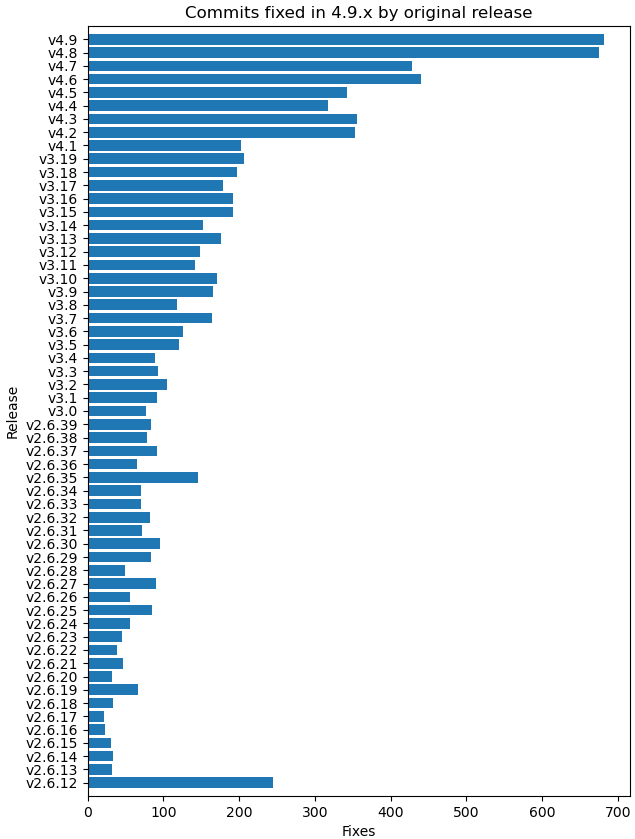
The 4.9 and 4.8 releases are, unsurprisingly, the source of many of the bugs fixed in the stable updates, with nearly 700 coming from each. After that comes the usual long tail, including every release ever made since the Git era began at 2.6.12. Every pre-4.10 release in the Git history is represented here; the least-fixed release is 2.6.17, which was released in 2006, with "only" 22 fixes.
That plot is not the whole story, though. Each of the 4.9.28, 4.9.34, 4.9.51, 4.9.75, 4.9.77, 4.9.78, 4.9.79, 4.9.94, 4.9.102, 4.9.187, 4.9.194, 4.9.195, 4.9.198, 4.9.207, 4.9.214, 4.9.219, 4.9.228, 4.9.253, 4.9.258, 4.9.259, 4.9.261, 4.9.265, 4.9.298, and 4.9.299 releases included a commit that was identified by a later Fixes tag; 4.9.81 and 4.9.218 had two, and 4.9.310 had three. Each of those, clearly, indicates a regression that was introduced into the stable kernel and later fixed. But even that is not the full picture; consider this:
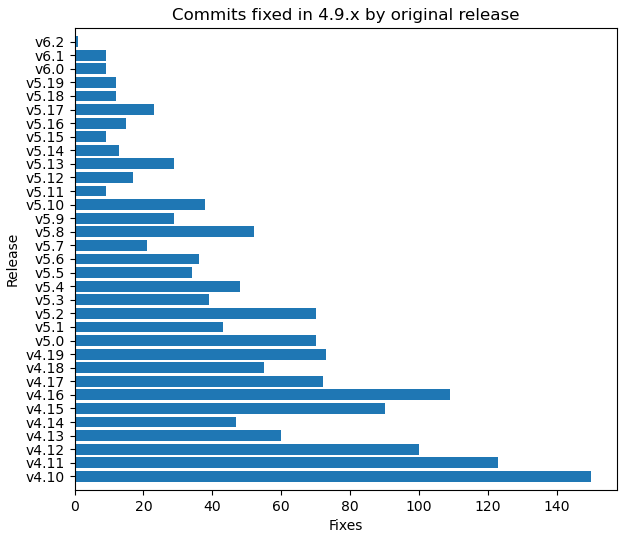
Every release made after 4.9 also introduced bugs that had to be fixed in the stable updates — over 1,500 fixes in all. That is a lot of buggy commits to have introduced into a "stable" kernel. One should also not take the wrong message from the lower counts for more recent kernel releases. It might be possible that our releases are getting less buggy, but a more plausible explanation is that the empty space in the upper-right half of that plot just represents bugs that have not yet been found and fixed.
The 4.9 stable series was, thus, not perfect — not that anybody ever
claimed that it was. It was, however, good enough to be the core of many
deployed systems, including an unimaginable number of Android devices.
The 4.9 kernel series is a testament to what the development community can
accomplish when it sets its mind to it. It was a base that many users
could rely on, and has well earned its retirement.
| Index entries for this article | |
|---|---|
| Kernel | Releases/4.9 |
The LWN site is currently under high scraper load, so comment display has been suppressed for anonymous users. If you are a human, you may read the comments by clicking the button below:
Note: you can avoid this step in the future by logging into your LWN account.