

Distributions
Modularizing Fedora
Those who hang around on the Fedora mailing lists may have seen occasional passing references to "modularization" and the initiatives around it. That makes some of us curious about just what "modularization" means in this context. A bit of digging makes the picture more clear, though it seems that even the developers in the middle of this effort have not entirely figured out what they are doing yet. In short, "modularization" is another attempt to address the strains that are increasingly clear in the Linux distribution model.In that model, distributors are the gatekeepers; they gather together a bunch of software, make it all work well together, and ship it on a regular schedule. After that, they support what they have shipped for some period of time while working on the next big release. This mode of operation seemed logical in the early days of Linux, but it is an awkward fit in a world of ever more complex software stacks, faster release schedules, and a desire within projects to deal more directly with their users.
One particular pain point is the disconnect between any given distribution's release cycle and the release cycles of any projects of interest. Waiting for the next major release from a distribution, which could happen either months or years in the future, can be a problem for impatient users. This is especially true for developers building stacks of software; waiting for a distributor to update the lower-level dependencies in such a stack is often just not an option. So, for a while now, distributors have been looking for ways to stay more relevant for their users, whether it be moving to a rolling model, adding "app stores," jumping on the container bandwagon, or something else.
Back in 2013, Fedora launched an initiative called "rings," which was an attempt to partition the
distribution into layers, some of which could move more quickly than
others. Splitting the distribution into three editions was one outcome of
this effort, one which seems to have worked out reasonably well. But much
of the hoped-for benefit of rings has not really materialized. As the
Fedora modularization wiki
page points out, "it seems that the simple metaphor of concentric
rings doesn't actually work very well for our increasingly messy open
source software world.
" Modularization is an attempt to address
that messiness more directly.
A "module," in short, is a collection of software that serves a specific purpose, carries its own dependencies, is developed and tested as a unit, and is shipped together. Modules can have their own lifecycles that do not match up with that of the distribution as a whole. Beyond that, the definition gets a bit fuzzy; the modularization page adds text like:
A module has an API. In essence, the API is what "makes" the module. For example, if we had a "Web server" module, its "api" might be HTTP/2, we could provide that using httpd or nginx, and, next week, swap it, because the api is king, not the binaries inside.
The hope is that, with software chunked into modules in this way, it can be more easily supported and updated independently of the rest of the distribution. There is some clear enthusiasm behind the idea, as is evidenced by the Fedora Council's March 14 decision to approve the modularization effort as an official Fedora project.
The current plan, as described in this
page, is to have a prototype implementation available at the time of
the Fedora 25 release, so that it can be demonstrated in early 2017.
 That means that much of the initial work must be done by Fedora 24,
due in June of this year. Needless to say, that is an ambitious schedule.
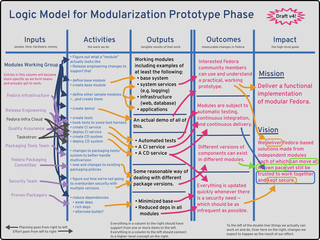
So what will be done for this prototype? The developers provide the
diagram to the right as a way of describing what they are aiming for, but
readers may not find it all that enlightening. Once those developers
manage to put away their
diagram editors, they plan to make a working prototype, "
One interesting issue has to do with the plan to have each module
contain its own dependencies. Having modules move at different speeds
means that they will certainly, at times, need different versions of shared
dependencies, so each module is likely to have its own. This starts to
sound a lot like the bundling of
dependencies, a practice that Fedora (like most Linux distributors) has
fiercely resisted. This
blog post by Langdon White (who is taking the lead on much of this
work) states that "
That is just one of the
many tooling issues that the modularization developers will have to solve,
but it looks to be one of the more difficult ones.
Other problems include things like security updates; patching a dependency
will require creating new modules that use that dependency and testing them
all. Some modules may not work properly with the patch applied, leading to
further version skew.
All told, it looks like a significant technical challenge to make all of
this work. But the benefits, in the form of a more amorphous, flexible,
and useful Fedora, may well be worth it. Langdon has indicated
that Red Hat is putting a number of developers on the job, so the necessary
resources might just be available. One way or another, the community as a
whole is likely to learn more about the problem of running a distribution
in the year of the 25th anniversary of Linux.
functional
enough that people can use it, understand it, hammer on it, and improve
it
", in the next year. The number of actual modules is likely to be
small, consisting of a "core" module and a handful of applications. There
should also be the various mechanisms in place to make modularization work:
a way to automatically test modules, a delivery setup, and more.
we need to be able to define an
'application' (or module) without resorting to bundling
", but the
RPM package-management system does not currently respond well to attempts
to install multiple versions of the same package. So it will be hard to
install dependencies in a way that they can be shared between any modules
that can use the same versions.
Brief items
Distribution quotes of the week
The first CyanogenMod 13.0 release
The CyanogenMod Android distribution has finally moved into the "Marshmallow" era with CM13.0 Release 1. "We left the M release builds in the oven longer than we thought, but nothing a little graham cracker and chocolate can’t make that much better. CM13.0 brings Android 6.0.1 (r17) goodies such as the battery saving ‘doze’ functionality and new permissions model, alongside the CM features you’d expect." Other changes include the removal of WhisperPush, the removal of the "quick unlock" feature, a switch to the standard Android messaging app, a new "Snap" camera app, and more.
Announcing the Debian Astro Pure Blend
The Debian Astro Pure Blend has been announced. Debian Astro is a spin-off from the Debian Science Pure Blend with the goal of supporting both professional and amateur astronomers. "Currently, we have ~80 source packages in team maintenance. The total number of packages in the Blends Tasks lists is currently >200. Packages include state-of-the-art analysis frameworks like Astropy, but also important legacy packages. Our goal is to deliver the first version of the Blend together with the release of Debian Stretch."
Distribution News
Debian GNU/Linux
Debian Project Leader elections
Mehdi Dogguy is the only candidate for this year's DPL election. See Mehdi's platform and the Debian vote page for more information.Debian SunCamp 2016
Debian SunCamp 2016, a 4 day hacking and socialising event, will be held May 26-29 in Catalonia, Spain. "Debian SunCamp (DSC for short) is not a conference, or a MiniConf, it is more like a DIY DebCamp. We want it to be relaxed, fun, and creative: we provide the space, anything else is up to you! There will be no talks programme, but if you want to prepare a talk you can do that too, it's DIY!"
Red Hat Enterprise Linux
Red Hat Enterprise Linux 6.8 Beta
Red Hat has announced the release of Red Hat Enterprise Linux 6.8 beta. "The beta release of Red Hat Enterprise Linux 6.8 includes a number of new and updated features to help organizations preserve investments in existing infrastructure, bolster platform security, enhance application stability, and systems management/monitoring capabilities, and embrace some of the latest Linux innovations." The release notes and technical notes have more information.
Newsletters and articles of interest
Distribution newsletters
- DistroWatch Weekly, Issue 652 (March 14)
- 5 things in Fedora this week (March 12)
- openSUSE Tumbleweed – Review of the Week (March 11)
- Ubuntu Kernel Team - Weekly Newsletter (March 11)
- Ubuntu Kernel Team - Weekly Newsletter (March 15)
- Ubuntu Weekly Newsletter, Issue 458 (March 13)
Best Linux Distro: Linux Experts Rate Distros (Datamation)
Matt Hartley and Bruce Byfield each pick their top 10 favorites, on Datamation. Matt Hartley's number 5 choice: "When it comes to turning ancient PCs into something usable again, there is nothing better than a fresh installation of Puppy Linux. I've personally had Puppy Linux running on a Pentium II before. On something with a bit more in terms of resources (for the browser), Puppy Linux is screaming fast. If you have a computer with 1 GB of RAM, you'll never look back. Puppy Linux is based on Slackware, but you can also install a version that relies on an Ubuntu base if you prefer. Both versions come with the JVM window manager, though OpenBox also runs great on Puppy if you prefer."
Bruce Byfield's number 5 choice:
"Tails is a privacy-conscious distribution that can be run off a flash drive. Used with Tor, it provides a quick method of anonymity, although less security than Qubes OS (see below). Project members take privacy seriously, with many using a pseudonym for their contributions.
Despite all the talk about privacy and security these days, both are poorly understood by average users. One reason why I appreciate Tails is that the project has gone to some effort to assemble and write documentation. Even if you decide not to run Tails, its documentation is well worth reading as a primer in security.
"
KaOS Linux releases updated ISO image: A clean, simple, and solid Linux (ZDNet)
ZDNet has a review of KaOS. "KaOS Linux is an unusual case in the world of Linux distributions. First, because it is not derived from any other distribution; second, because it is so tightly focused on the KDE desktop; and third, because it is a rolling distribution. When you put those three things together, it makes it interesting enough for me to keep KaOS Linux loaded on one or two of my laptops."
Page editor: Rebecca Sobol
Next page:
Development>>