

LWN.net Weekly Edition for March 17, 2016
The 2016 Debian Project Leader election
The Debian Project Leader (DPL) is the project's democratically elected leader; each year, the Debian Developers vote, and whichever of the candidates comes out on top is deemed the winner. At least, that is the way it usually works; this year, the process is a bit different, due to the fact that there is only one candidate. Unless something peculiar happens, then, candidate Mehdi Dogguy will take over as DPL on April 17. It may sound a tad unusual from the outside but, apart from the actual vote, the election process has proceeded as normal, with Dogguy publishing a candidate platform and taking questions from project members on the election mailing list. Some are beginning to worry that the paucity of candidates indicates that the burden of serving as DPL has become too burdensome, however, which is a problem that Debian will need to address in the long term.
Debian project secretary Kurt Roeckx sent out the call for nominations on March 5, six weeks before current DPL Neil McGovern's term ends. As usual, the election was open to all Debian developers, who must nominate themselves as candidates. McGovern declined to run for a second term, and Dogguy was the only candidate who stepped forward prior to the March 12 deadline. The DPL election method can be complicated when there are many candidates, but unless the majority of the voters select "none of the above" (which is a ballot option), Dogguy will almost certainly become the new DPL.
Platforming
According to the election rules, March 13 through April 2 is reserved for the "campaign," during which project members can examine each candidate's platform and ask questions on the debian-vote mailing list.
Dogguy's platform centers on his vision for the project. He began by noting that the project has grown to the point where it complicates collaboration:
He proposed a review of processes and tools to identify bottlenecks
and points of friction between teams, and said he will "work on
collecting and compiling a repository of Debian use cases that can be
used by contributors to find their way more easily into the
project.
" In a related point, Dogguy highlighted the
recruitment of new contributors as a task he will work on. Debian has
successfully participated in third-party internship programs like
Outreachy and Google Summer of Code, he said, "but we should
also think about sponsoring such programs or make our own.
"
Unlike outside efforts, such a program could emphasize Debian-specific goals:
Dogguy also proposed two initiatives that would alter how Debian operates with respect to the outside world. The first is writing and publishing a project roadmap (which Debian does not currently do). Publishing a roadmap would help the various teams within Debian publicize their work, and enable the project as a whole to shine more light on its original work, beyond simply packaging and delivering upstream code. As DPL, he would describe each roadmap item in S.M.A.R.T. criteria, (that is, "Specific, Measurable, Assignable, Realistic, and Time-related") and make sure that progress is made.
The second initiative is pushing Debian to innovate and embrace new challenges. As an example, he cited installation media:
We got used to what we have. We should work on innovating and making sure the way we do Debian is still relevant to the world. We have to make sure that the way we install and deploy Debian is relevant to our users, because they are our priority. We should make sure that our users’ concerns are fulfilled!
Among the other new challenges, he listed improving security,
making upgrades " So far, there have been no questions about Dogguy's platform on the
debian-vote list. This is not too surprising; the platform does not
advocate for what one would call radical change, so it might not have
generated debate in a year with multiple candidates, either.
But the scarcity of DPL candidates was raised in a question to Dogguy from Paul Wise. Wise
noted that the only prior occasion when a candidate ran unopposed was
in 2011, when then DPL Stefano Zacchiroli ran for a second term, and
asked whether " In his reply, Dogguy countered that
while single-candidate elections are rare (he himself was surprised no
one else volunteered, he said), most DPL elections have a small
slate. He also said that he would " Wise also asked Dogguy if he thought voters should collectively
choose the "none of the above" option, in hopes of triggering a new election that would
attract more candidates. Dogguy replied that such a tactic would make
the situation worse.
If people didn't want to nominate themselves for DPL, then we should
not force them to do so. Having "fake" candidates is not doing the
project any favor. No one wants an inactive DPL. No one wants a DPL
that is unprepared for the job.
Dogguy also noted that he had run for
DPL in 2015 (coming close to
winning) and said that " The question of whether or not this year's slim ballot indicates a
problem within the Debian project drew replies from several others on
the mailing list. Daniel Pocock responded that perhaps the public
self-nomination process is to blame, and that nominations should be
secret.
But Pocock and others also expressed concern that the role of DPL
is simply too time-consuming, and that the level of commitment it
demands is scaring off potential candidates. Ian Jackson raised the idea of replacing the lone DPL
position with a board, although he worried that " Martin Krafft was skeptical, asking
what sorts of powers such a board would have. Jackson listed budgetary issues and working with
Debian's legal advisors, but pointed out that:
The board idea did not gain much traction, but everyone seemed to
agree that DPLs would do well to delegate tasks to other project
members—which can be difficult to do in practice. Debian, like
many free-software projects, is driven by volunteers, and volunteers
are notoriously short on time. Dogguy noted in his platform that his
employer will permit him to spend a small portion of each week working
on DPL-related jobs. Such leeway with employers is not unusual (even
just among prior
DPLs), but at best these arrangements increase pressure on the DPL to take on tasks
that the volunteer community may be slow at completing.
In the long term, Debian's growth as a project may mean that the
DPL role becomes more and more of a time commitment. Whether that
will mean redefining it or supplementing it with other leadership
roles remains to be seen. At present, however, the lack of DPL
candidates has only brought the issue to the forefront as a topic of
potential concern. As Dogguy pointed out on the mailing list, there
has rarely been a long line of volunteers willing to take on the
task.
In spite of the larger concerns raised about the process itself,
however, Dogguy seems to be regarded as a good candidate. There are
no signs that there is a movement to reset the election process. This
means that Debian, barring some unforeseen turn of events, already
knows who its next project leader will be—and that new DPL has a
solid understanding of the task ahead.
ManageIQ is an open-source project that allows administrators to control and
manage today's diverse, heterogeneous environments that have many different
cloud
and container instances spread out all over the world. It can automatically
discover these environments wherever they are running and bring them all under
one management roof. Beyond that, it can simplify life for users by allowing
them to choose new virtual machines (VMs) and containers and have them
immediately "spun up" and available for use. The first step in managing a
complex environment is to discover what is actually there. ManageIQ does this
by accessing the APIs of the virtualization systems, public clouds, and other
management systems that make up the environment. Using the APIs it will
download the lists of VMs, hypervisors, containers, networks, and whatever else
is relevant to the system in question. All these "things" it discovers are
called "managed elements" and are stored and tracked in the Virtual Management
Database (VMDB). Currently the VMDB
schema consists
of over 200 entities and relationships. It defines elements such as "Virtual
Machine" and "Hypervisor", ensures that a "Virtual Machine" has a "name"
attribute, and
that a "Virtual Machine" is related to a "Hypervisor" by a "runs on"
relationship. The individual management systems are called "element managers"
in ManageIQ parlance, and the pieces of code that connect to the APIs are
called "Providers". After initial discovery, ManageIQ uses the APIs to listen for events that might
indicate a managed element has changed, and uses those to refresh the
VMDB. The result is that the ManageIQ VMDB is almost always up to date with
respect to what is actually present in the environment, even if changes are
made outside of ManageIQ. Most of today's APIs (but unfortunately not all)
support these change notifications. In addition to the on-demand refresh, a
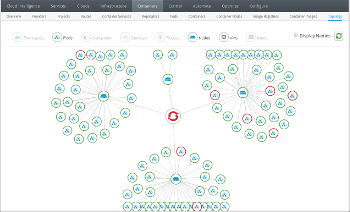
full refresh is also scheduled every 24 hours. The discovered inventory is visualized through the ManageIQ web interface,
which shows all of the discovered elements and their relationships. For
example, when used
together with VMware, it will show a list of virtual machines, their
attributes, the hypervisor they run on, the connected networks, etc. The
inventory can also be visualized in reports, which can be scheduled and
emailed, or displayed as dashboards. One interesting thing about the VMDB is that it allows an abstract
approach
to management.
The advantage of that was seen recently
when support for containers
was added. It involved extending the VMDB schema with elements including
"Container" and "Pod", and creating a provider that connects to the container
management system (Kubernetes in this case).
After
discovery, ManageIQ provides for ongoing operational management. This covers
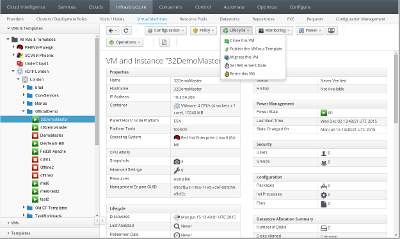
quite a few disciplines, and we'll look at the most important ones here below. ManageIQ provides control actions for the things it manages. For example, VMs
and Instances have "power on" and "power off" actions. Not every possible
action is covered, but the goal is to expose the most common actions so
that the usual
day-to-day management can be completely done within ManageIQ. Change management is another operational management discipline. ManageIQ can
show reports of what attributes (e.g. memory, disks, network devices of a
VM, or even installed software versions when using SmartState Analysis, which is
described below) of an entity have changed,
and
when. Attributes can
be compared across different objects of the same type, for example, to compare
the state of a VM against a golden image. It can also compare the configuration
of the same object against itself from an earlier time. This is called drift
tracking. A third discipline is capacity management. ManageIQ providers track various
utilization metrics such as CPU, memory, and disk. These metrics can be
visualized in charts, and aggregated to understand when capacity will run out.
Modeling "what if" scenarios is possible as well. Financial management is another area where ManageIQ can help operations staff. It can be
used to create a cost model for elements that it discovers. For example,
a certain cost can be allocated to VM memory and disk. Reports can then be
generated to show the total cost of the various groups in the system.
Self-service allows an
administrator to maintain a catalog of requests that can be ordered by regular
users, for example, to provision a single VM or an application stack.
Self-service is good for both the administrator and the end user: it saves
a lot of time for the administrator while end users get their service going
much faster.
Self-service is one of the more powerful use cases of ManageIQ. It starts with
an administrator creating a "service bundle," which is a collection of
"service items". Each service item is a "thing" that ManageIQ knows how to
create, for example, a VM or a container. There is also a generic service item
that can call into the ManageIQ workflow engine (more on that below), and can
be used to provision arbitrary things by invoking arbitrary actions. The
order in
which items in a bundle are provisioned is specified by the administrator. Services typically require some amount of input. For example, if the
request is
to provision a VM, then a typical question would be the size of the memory and
the disk. This information can be requested from the user through a dialog,
which can be
created using a built-in dialog editor. Once the service bundle and the dialog are created, they need to be
associated
with an
"entry point" in the ManageIQ workflow engine (called "Automate"). The entry
point defines the process to provision the bundle. There is a default
entry point to provision bundles, but this entry point can be changed so that
custom logic can be invoked. Workflows are Ruby-based and can be edited through
a built-in integrated development environment. (Many actions in ManageIQ are
actually workflows in Automate; they can be inspected and also modified by the
administrator.) Aside from provisioning, the workflow engine is also used
to run an
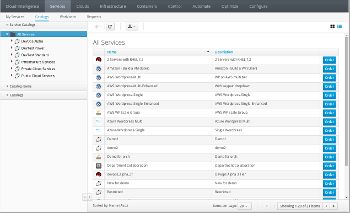
approval process before the provisioning takes place. With the bundle definition, dialog, and entry point, the request can be
published in a service catalog, which then enables users to order the service. Once a service is deployed, the user will see it under the "Services" tab in
the web interface. While a service is operational, a user can interact with it.
For example, if configured to do so, ManageIQ will allow a user to start and
stop VMs comprising the service, or to get a console for them. Custom
actions can
also be created by adding menu items that can be connected to entry
points in Automate. An example of a custom action would be to backup a
service, or to run it on more nodes (i.e. scale it out). The self-service model in ManageIQ also includes a process for termination.
The administrator can specify a lifetime for the service. Once the lifetime has
expired, the service can (optionally) be decommissioned automatically. Users
can be given the privilege to extend the lifetime and to get warnings about
upcoming expirations via email.
ManageIQ allows
administrators to define compliance policies and apply those against elements
that are discovered. This is especially useful when users are deploying their
own systems through self-service as it gives a certain amount of control back
to the administrator. Compliance policies consist of a number of rules, and are enforced by
the ManageIQ
policy engine, which is called "Control". The policy engine is modeled on the
Event-Condition-Action model. If a certain event happens, a condition is
evaluated, which, if true, results in an action. For compliance purposes, the
event is usually "element discovered" or "element updated", the conditions
are the sets of rules to enforce, and the action is "update compliance status",
optionally combined with an automated remediation workflow in
Automate. Control can also be used to invoke automation based on any type of
event. For example, a high load can trigger a scale-out action. A nice thing about compliance in ManageIQ is that it works on more than just
the metadata of the items discovered through the various APIs. It is
also possible to define rules for the contents of VMs, hypervisors, and
containers. Extracting these contents is done by a process called SmartState
Analysis (SSA). SSA can discover configuration files, event logs, and package databases;
it stores that information in the
VMDB. Interestingly, SmartState is a fully agent-less technology. It works by
accessing the disks remotely over platform-specific APIs, usually snapshot
and/or backup APIs. As the disks are untrusted and potentially concurrently
updated, they cannot be safely mounted by a Linux kernel. To get around this,
ManageIQ contains Ruby-based read-only filesystem and
volume manager
implementations that access the disks from user space. The benefits of the agent-less approach is that it doesn't require
cooperative
guests, which means that it also works with VMs that are deployed through
self-service, vendor provided "black box" appliances, or VMs that predate the
implementation of the cloud management platform. Another benefit of being
agent-less is that it also
works for VMs that are shut down. SmartState can give a lot of insight into the environment.
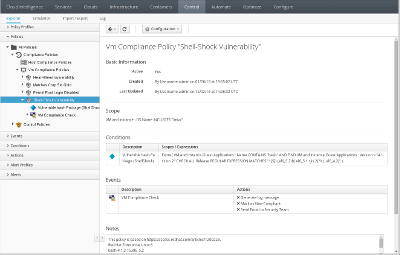
A nice example of a compliance policy based on data from SmartState is this
policy that checks if a
Red Hat operating system is vulnerable to the recently discovered DROWN
attack. ManageIQ ships with a number of providers that are listed below.
If there is a commercial variant of an open-source project it is given in
parentheses. Other providers are in progress in the master branch, such as providers for the
Google Cloud Platform, Ansible Tower, and software-defined networking. ManageIQ is developed by the ManageIQ community. Development happens on
GitHub using a pull-request-based
development model. Discussions of development topics happens on
Gitter, and users interact with each
other on the talk.manageiq.org
forum. ManageIQ
is available under the Apache 2 license. Despite its young age as an open-source project, ManageIQ has a large and
mature code base. The code for ManageIQ was originally developed by ManageIQ
Inc., starting in 2006. This company was acquired by Red Hat in December 2012,
which released the ManageIQ code in June 2014. The code base weighs in at over
200,000 lines of code excluding tests and gem-ified components, and is written
in the Ruby on Rails framework. Since being released as open source, almost 6,000 requests have been
merged, by over 100
contributors. While the majority of contributions are from Red Hat staff, the
project is actively growing and seeking outside contributions. Recently,
companies like Booz Allen Hamilton, Produban/Banco Santander, and Google have
been making contributions to the project. Releases happen approximately every 6 months and are named after chess
grandmasters. Most recently the project made its
third release
named "Capablanca." ManageIQ is also the upstream project for the Red Hat
CloudForms product. The project also holds an annual design summit where users and developers from
all over the world come together to exchange ideas and establish the
development roadmap. The second ever design summit will be held
June 6-7 in Mahwah, NJ. ManageIQ is distributed as a Linux-based virtual appliance that is
a little over 1GB in size.
After downloading it and importing it into a supported
solution (e.g. QEMU/KVM on Linux), the web interface will start up. The first task is to configure
a provider by connecting to an element manager such as oVirt, OpenStack, or
Amazon Web Services, then waiting a couple of
minutes for discovery to complete. The steps are documented in the ManageIQ
documentation, with video walkthroughs of
the Top
Tasks. After the basic
inventory has been discovered, it is possible to create custom dashboards,
define offerings for self-service, or create compliance policies. ManageIQ is a big project with a lot of features. It is quite powerful,
and is even fun to use. It is best to start simply by focusing on a single
objective, for example
self-service or reporting. If you get stuck, or even just want to say hello,
please contact the community at the talk.manageiq.org forum.
[Geert Jansen is the manager of the CloudForms product at Red Hat.]
No Starch Press recently released a book about working with
automotive software systems: The Car Hacker's Handbook: A Guide
for the Penetration Tester, written by Craig Smith. The book
is an expansion of Smith's popular and widely circulated e-book of the same
title. The old version remains available online at no cost, but there
is considerably more content in the new revision—enough to make
it a tempting purchase not just for automotive-software fans in
general, but for those interested in embedded-device security and in
reverse engineering other classes of consumer product.
As the subtitle suggests, the book is written as an overview of reverse
engineering and security testing car computers—meaning all of
the embedded and user-facing computer systems running in a modern
vehicle. It covers interacting with embedded sensors and controllers,
in-vehicle infotainment (IVI) dash units, the powertrain control
modules (PCMs) that control engine operation, and various wireless
systems distributed throughout a vehicle. The book is a comfortable
length (278 pages), and retails for $49.95. The approach Smith takes is to consider the vehicle a security
target like any other computer system that one might analyze for
vulnerabilities. He constructs a threat model, itemizing and rating
every attack surface; he then explores the threats in a systematic fashion.
For instance, the controller area network (CAN) bus is one of the
easiest entry points to the system, since it connects all of the
networked modules in the car. Thus, he first examines the on-wire
format of CAN bus traffic, moves on to sniffing and understanding the
higher-level message formats transported over CAN, and eventually
considers which CAN messages are interesting and how to generate them.
That said, it is clear from the outset that The Car Hacker's
Handbook is not intended as a guide to exploiting the vehicles of other people.
Smith is a co-founder of the automotive hacker community Open Garages, and the book is
peppered with examples of how hacking on one's own car is a valuable
skill to possess. Apart from tweaking engine characteristics to
improve performance or fuel efficiency (which are the two most common
goals), being able to break into a car's computer network is
increasingly necessary to swap in aftermarket parts, replace broken or missing
components, or simply to understand why something is not behaving as
expected.
On this front, the book is quite successful. The text goes out of
its way to de-mystify a number of car-computing topics, from
reading and decoding the Diagnostic Trouble Codes (DTCs) emitted by
electronic control units (ECUs), to capturing messages in various undocumented and
proprietary formats, and even to reverse engineering the
read-only memory (ROM) found in the PCM. All of these are topics that
various industry players (from car makers to the manufacturers of
overpriced diagnostic gadgets) takes pains trying to keep from the
public eye. In addition, many of the automotive standards and
specifications involved are not freely available and must be
purchased—usually at high cost. The information in the book on these topics, especially when
coupled with the pointers to additional online resources, levels the
playing field quite a bit.
Naturally, the same could be said of most of the software
discussed; Open Garages is a project driven by open-source software
ideals, and Linux is the easiest platform for interfacing with
automotive computer systems. Nevertheless, Smith does highlight
several cross-platform and web-based tools that will be of interest to
Windows users. Smith also discusses several Linux-based and open-source
automotive projects, but the focus of the book is on getting into
real-world systems, regardless of whether they run Linux, QNX,
Windows, or some peculiar, one-off operating system from an automotive
subcontractor.
To briefly outline the topics covered in the book, Smith starts
out with a discussion of the networking protocols used in car
computing. The aforementioned CAN bus is a low-level transport
protocol; he also describes the packet formats of ISO-TP, CANopen, and
GMLAN (all of which
are protocols that run on top of raw CAN). He also explains SAE J1850,
Keyword
Protocol 2000, Local Interconnect Network (LIN), Media
Oriented Systems Transport (MOST), and FlexRay; each of
these protocols is found in a
limited subset of cars, but recognizing them in the field is
important. Similarly, there are a variety of DTC messaging protocols;
Smith describes the major formats and conventions (many of which do
not have formal names or specifications).
The book then discusses how to work with the kernel's SocketCAN interface,
providing some valuable tips on the CAN utilities available and on how
capturing CAN traffic differs from sniffing Ethernet or WiFi packets.
For example, Wireshark performs poorly as a CAN sniffer because of how
many times noisy CAN modules repeat their messages; the specialized
can-utils package is better at filtering the flood of messages and catching
only important changes. The book also discusses some tools for
capturing, analyzing, and replaying CAN traffic, like Kayak and caringcaribou, plus Smith's own
CAN-traffic generator, ICSim.
This section of the book is focused on how one might discover and
isolate the CAN message that performs a specific function in the car
(say, unlocking the doors). One of the later chapters then picks up
the topic again, explaining how to develop a compact program to use
this message of interest, writing the unlock signal out to the bus
(drowning out other, contradictory messages if necessary). It also describes how to
adapt the necessary code for use with the Metasploit penetration-testing
tool. Perhaps the most interesting aspect of that discussion is that
it detours into how to fingerprint the make and model of a car by
passively observing its CAN traffic; Open Garages is in the process of
developing a fingerprinting tool called CAN of Fingers (c0f) for
this purpose.
The other major section of the book deals with reverse engineering
ECUs. While a complete description of reverse engineering an embedded
system would be a topic vast enough to fill multiple books, Smith does
an admirable job of outlining the basic process and pointing readers
in the right direction. He discusses side-channel attacks,
brute-force attacks, and the comparatively straightforward process of
dumping an EPROM and analyzing the contents. He looks at some
specific tools, mostly of the hardware variety, but with an emphasis
on open-hardware options like ChipWhisperer. If all one wants to do
is adjust the engine timing or fuel mixture, he notes, little or no
code decompilation may be needed: simply finding the right data tables
and altering them can be simple.
From a practical standpoint, car hackers have
it easier than some reverse engineers, since so many cars (especially
older ones) use small CPUs with modest amounts of memory. But this is
changing fast as car makers catch up to other electronics companies.
It is particularly interesting to note that this section of the
car-hacking space is the one with the most missing pieces from a
free-software standpoint: most of the ECU reverse-engineering tools,
it seems, are still of the proprietary flavor.
In addition to these big topics, there are several self-contained
chapters that cover smaller subjects, including vehicle-to-vehicle
networking, sourcing test components, attacking wireless systems (like
key-fob remotes and tire-pressure monitors), and attacking vehicles
via the IVI unit. Some of these discussions are surprisingly brief,
but that is in line with the feel of the book, which emphasizes
getting into the car's network in order to do something interesting. The IVI
unit and wireless interfaces are enormous attack surfaces, but they
are primarily of interest to the car hacker precisely because one can
go through them to get to the vehicle's other systems. Fiddling
around with the IVI system itself to alter or side-load apps may be
fun, but is somewhat tangential. A lot has been
written elsewhere about vulnerabilities in IVI units and wireless
interfaces; Smith points readers to other resources rather than repeat
their information.
The book closes with an encouragement for readers to start up their
own Open Garages local group (or form a similar car-hacking meet-up), whether
attached to a hackerspace or as a stand-alone entity. At the moment,
there are only a handful of such groups anywhere in the world, but
interest in car hacking as a topic is certainly on the rise. It may
take time to catch up with "maker" subcultures like wearable
electronics and 3D printing, but Open Garages is a good reminder of
how much value a community can add. Its members have developed a lot
of code, including projects of vital importance like c0f.
As a reviewer, I may be personally biased in favor of any book that
addresses car hacking, because it is a hobby I find personally
interesting (although most of my involvement has been in the
Linux-based IVI development camp) and a topic on which there are
precious few long-form resources to be found. Setting that aside,
however, I remain convinced that The Car Hacker's
Handbook is well worth reading in its own right.
For starters, the practical information on automotive networks and
protocols is invaluable. Not only are many of the protocols poorly
documented (if at all) elsewhere, but many of them are in the "legacy
code" bin: companies have moved on and have no interest in continuing
to discuss them, but car owners still own a lot of the systems and
will for many years to come.
At a little more fundamental level, though, the book also works as
an introduction to car computer systems for those who are already
experienced hacking other types of devices. And it addresses the
various security issues and approaches without assuming too
much prior engineering experience, which should make the book useful for
shade-tree mechanics with little hacking experience, too. A reader
cannot learn how to reverse-engineer ECU firmware in a single chapter,
but Smith puts that task in context, explains when it is necessary,
and puts the reader on the right path forward. All things considered,
that is what one wants from a hacker's handbook.
[The author would like to thank No Starch Press for sending a
review copy of the book.]
unbreakable
", and improving usability.
Debate
this situation reflects on the health of the
Debian project
".
not generalize this as a
symptom of an unhealthy situation
" for Debian as a whole,
seeing it instead as a sign that the role of DPL is difficult.
I don't think my candidacy would be more
serious if [there] were two candidates.
" Nevertheless, he
concluded, if project members do not want him as DPL, they are free to
choose "none of the above."
Non-candidates
decision making
would be too slow if everything had to be done by committee.
"
Managing heterogeneous environments with ManageIQ
Discovery
Operational management
Self-service
Compliance
Supported providers
Community
Getting started
The Car Hacker's Handbook
Roadmap

Along for the ride
In the rear-view mirror
Security
Apple, iPhones, and encryption
Much of the world appears to be watching—and commenting on—the battle between Apple and the US government over the code running on a particular iPhone. That phone was used by one of the shooters in the San Bernardino terrorist attack in December and its contents are protected by the encryption used by the iOS operating system. There are many facets to the case; its outcome could pose threats to individual privacy as well as the computer industry as a whole. Closer to home, perhaps, is the danger that government overreach could imperil the use and deployment of free software.
The phone in question is an iPhone 5C that was owned by the San Bernardino County Health Department but used by its employee, Syed Rizwan Farook, who was one of the two people who perpetrated the attack. Farook was subsequently killed during a shootout with police, but the phone was recovered. Early on, a mistake was made in the investigation, when the iCloud password for the phone was reset by the Health Department. That prevented the phone from backing up its recent data to the Apple-controlled iCloud site, which would have allowed the company to provide that information to investigators.
That means that there may be useful information stored on the phone itself that did not make it to the iCloud backup. But access to the phone is protected by a four-digit PIN that will unlock the encryption on the device. Because there are only 10,000 possible PINs, brute forcing the phone would seem like a plausible option, but there is a catch. The iOS version that is used on the phone will erase its filesystem key if ten incorrect PINs are entered, which means the flash storage can no longer be decrypted. That auto-erase feature is optional, but it is unknown if it is enabled on the target phone. That set the stage for the US government to ask Apple to create an "update" to iOS that would circumvent the feature.
Updates to iPhones can only be created by Apple because it holds the key needed to sign the code such that the phone will install it. The FBI (or other agencies) could undoubtedly create the code needed, but cannot install it on the phone without the proper signature. So the government first asked Apple to provide such an update and, after the company declined, then has tried to use the courts to compel the company to do so.
There has been a lot of back-and-forth between Apple and the government over the last few weeks as the conflict has largely played out in public. The judge in the case has ordered Apple to assist by providing code that eliminates or bypasses the auto-erase feature of the phone, allows the FBI to submit PINs electronically (rather than enter them via the touchscreen), and gets rid of the delays introduced between PIN entries. Apple is fighting the court order, with a hearing scheduled for March 22.
The government is arguing that the All Writs Act from 1789 applies and that it can use that act to force Apple to comply with the order. Apple strongly disagrees, as its final filing [PDF] that it made before the hearing noted:
The US government has clearly been using the heinous nature of the attack to try to stir up public opinion—and potentially legislative action—against Apple. That has led to calls for Apple boycotts and various types of intemperate posturing by US presidential candidates, state legislators, and the like. Apple has also been trying to sway public opinion, but seems to be fighting an uphill battle at least partly because of the technical nature of the issue. In addition, in today's landscape, terrorism seems to trump privacy at nearly every turn.
While there is a question about how much useful information may reside on the phone, the government seems to be thinking there may be evidence of additional participants in the plot—or perhaps some kind of "dormant cyber pathogen". While that information, if present, might be useful, there are other ways to access at least some of that data. Call records and SMS metadata, for example. Or it may be possible to remove the flash chip to back up its contents and restore it after any failed attempts as Daniel Kahn Gillmor has suggested.
There are a number of concerns that Apple has expressed regarding creating the ordered iOS update. For one thing, if that update falls into the wrong hands, it could lead to widespread decryption of its customers' phones, which is something that the encryption feature is meant to avoid. Beyond that, though, is the likelihood that lots of other law-enforcement agencies will want to use the precedent to force Apple to effectively break the encryption on other phones. A New York prosecutor has already said that there are 175 encrypted phones that he would like access to. The further this code spreads, the more likely it is to fall into the wrong hands.
Apple's resistance has led to renewed calls for mandated backdoors into encryption, of course. There is a persistent and pernicious myth that somehow encryption systems can be made strong enough to resist criminals and others who would like break into them, but still leave a way for legitimate authorities to access the data. It is a kind of magical thinking that is regularly shot down by cryptography and security experts, but still rears its head periodically. When lawmakers can point to the investigation of a horrible crime that is being thwarted by encryption, those calls for a backdoor only increase.
But the truth of that matter is that any kind of backdoor enforced on Apple (and Google, Microsoft, et al.) is only going to lead to those products not being used by terrorists and other criminals. The cryptography cat is out of the bag and no amount of legislation will put it back. Those who want to communicate in ways that cannot be intercepted will find ways to do so.
And that leads us back to free software, which is instrumental in providing freely available strong encryption. Eventually, lawmakers will realize (as agencies like the NSA already have) that free software is a threat to their dream of backdoors. If someone can buy an Android phone, say, and put their own custom firmware on it, they can ensure (within some limits, obviously) that the encryption in that system does not implement the backdoor. When faced with situations like that, lawmakers typically take that next step and ban the "circumvention" mechanism being used.
If events follow this path—and there is certainly a strong possibility that they won't—it could well be a nightmare for the privacy-conscious as well as for free-software developers and advocates. We have already seen signs that device makers may disallow third-party firmware on their devices due to government regulations. That could certainly expand, such that finding "jail breaks" will be needed to put the code of our choice on "our" devices.
The end game in this dystopian scenario would extend that kind of "protection" to more general-purpose computers: laptops, desktops, and servers, for example. That has been a persistent worry over the years with technologies like DRM, UEFI Secure Boot, and remote attestation of running software being seen as having the potential to enforce this kind of control. Even under those conditions, though, one suspects that criminals, at least, would find ways around this kind of draconian, authoritarian regime.
Encryption is simply a tool. It can be used for an enormous number of important and entirely legitimate tasks, but it can also be used by the "bad guys". As many have noted, that is true of many, if not all, tools. Forcing companies to circumvent the features they have added to protect their customers' data will ultimately not be effective, but it also will have many unintended (hopefully) side-effects that make it a dangerous step down a slippery slope. Apple is on the right side of this fight.
Brief items
Security quotes of the week
We're doomed.
Catanzaro: Do you trust this application?
Michael Catanzaro laments the poor level of security provided by free-software applications, focusing on TLS verification issues in particular. "In the case of Shotwell, the issue has been fixed in git, but it might never be released because nobody works on Shotwell anymore. I informed distributors of the Shotwell vulnerability three months ago via the GNOME distributor list, our official mechanism for communicating with distributions, and advised them to update to a git snapshot. Most distributions ignored it. This is completely typical; to my knowledge, the stable releases of all Linux distributions except Fedora are still vulnerable."
New vulnerabilities
bind: multiple vulnerabilities
| Package(s): | bind | CVE #(s): | CVE-2016-1285 CVE-2016-1286 | ||||||||||||||||||||||||||||||||||||||||||||||||||||||||||||||||||||||||||||||||||||||||||||||||||||||||||||||||||||||||||||||||||||||||
| Created: | March 10, 2016 | Updated: | June 10, 2016 | ||||||||||||||||||||||||||||||||||||||||||||||||||||||||||||||||||||||||||||||||||||||||||||||||||||||||||||||||||||||||||||||||||||||||
| Description: | From the Arch Linux advisory: CVE-2016-1285: Testing by ISC has uncovered a defect in control channel input handling which can cause named to exit due to an assertion failure in sexpr.c or alist.c when a malformed packet is sent to named's control channel (the interface which allows named to be controlled using the 'rndc" server control utility). This assertion occurs before authentication but after network-address-based access controls have been applied. Or in other words: an attacker does not need to have a key or other authentication, but does need to be within the address list specified in the "controls" statement in named.conf which enables the control channel. If no "controls" statement is present in named.conf, named still defaults to listening for control channel information on loopback addresses (127.0.0.1 and ::1) if the file rndc.key is present in the configuration directory and contains a valid key. A search for similar problems revealed an associated defect in the rndc server control utility whereby a malformed response from the server could cause the rndc program to crash. For completeness, it is being fixed at the same time even though this defect in the rndc utility is not in itself exploitable. CVE-2016-1286: An error when parsing signature records for DNAME records having specific properties can lead to named exiting due to an assertion failure in resolver.c or db.c. | ||||||||||||||||||||||||||||||||||||||||||||||||||||||||||||||||||||||||||||||||||||||||||||||||||||||||||||||||||||||||||||||||||||||||||
| Alerts: |
| ||||||||||||||||||||||||||||||||||||||||||||||||||||||||||||||||||||||||||||||||||||||||||||||||||||||||||||||||||||||||||||||||||||||||||
bind: denial of service
| Package(s): | bind | CVE #(s): | CVE-2016-2088 | ||||||||||||||||||||
| Created: | March 11, 2016 | Updated: | March 16, 2016 | ||||||||||||||||||||
| Description: | From the Mageia advisory: In ISC BIND before 9.10.3-P4, A response containing multiple DNS cookies causes servers with cookie support enabled to exit with an assertion failure in resolver.c. | ||||||||||||||||||||||
| Alerts: |
| ||||||||||||||||||||||
chromium: multiple vulnerabilities
| Package(s): | chromium | CVE #(s): | CVE-2016-1643 CVE-2016-1644 CVE-2016-1645 | ||||||||||||||||||||||||||||
| Created: | March 10, 2016 | Updated: | March 21, 2016 | ||||||||||||||||||||||||||||
| Description: | From the Arch Linux advisory: CVE-2016-1643 (type confusion) Type confusion in Blink. CVE-2016-1644 (use-after-free) Use-after-free in Blink. CVE-2016-1645 (out-of-bounds write) Out-of-bounds write in PDFium. | ||||||||||||||||||||||||||||||
| Alerts: |
| ||||||||||||||||||||||||||||||
chromium: two vulnerabilities
| Package(s): | chromium | CVE #(s): | CVE-2015-6783 CVE-2016-1621 | ||||||||
| Created: | March 14, 2016 | Updated: | March 21, 2016 | ||||||||
| Description: | From the CVE entries:
The FindStartOffsetOfFileInZipFile function in crazy_linker_zip.cpp in crazy_linker (aka Crazy Linker) in Android 5.x and 6.x, as used in Google Chrome before 47.0.2526.73, improperly searches for an EOCD record, which allows attackers to bypass a signature-validation requirement via a crafted ZIP archive. (CVE-2015-6783) libvpx in mediaserver in Android 4.x before 4.4.4, 5.x before 5.1.1 LMY49H, and 6.0 before 2016-03-01 allows remote attackers to execute arbitrary code or cause a denial of service (memory corruption) via a crafted media file, related to libwebm/mkvparser.cpp and other files, aka internal bug 23452792. (CVE-2016-1621) | ||||||||||
| Alerts: |
| ||||||||||
community-mysql: multiple vulnerabilities
| Package(s): | community-mysql | CVE #(s): | CVE-2015-4791 CVE-2015-4905 | ||||||||
| Created: | March 10, 2016 | Updated: | March 16, 2016 | ||||||||
| Description: | From the CVE entries: CVE-2015-4791 - Unspecified vulnerability in Oracle MySQL Server 5.6.26 and earlier allows remote authenticated users to affect availability via unknown vectors related to Server : Security : Privileges. CVE-2015-4905 - Unspecified vulnerability in Oracle MySQL Server 5.6.23 and earlier allows remote authenticated users to affect availability via vectors related to Server : DML. | ||||||||||
| Alerts: |
| ||||||||||
dropbear: information disclosure
| Package(s): | dropbear | CVE #(s): | CVE-2016-3116 | ||||||||||||||||||||||||
| Created: | March 15, 2016 | Updated: | July 20, 2016 | ||||||||||||||||||||||||
| Description: | From the Arch Linux advisory:
A vulnerability was found in a way dropbear processed X11 forwarding input. By using a specially crafted request, an attacker could bypass the authorized_keys command restrictions. xauth is run under the user's privilege, so this vulnerability offers no additional access to unrestricted accounts, but could circumvent key or account restrictions such as sshd_config ForceCommand, authorized_keys command="..." or restricted shells. A remote authenticated user who is able to request X11 forwarding can inject commands leading to information disclosure, directory traversal and possibly other impact. | ||||||||||||||||||||||||||
| Alerts: |
| ||||||||||||||||||||||||||
exim: privilege escalation
| Package(s): | exim | CVE #(s): | CVE-2016-1531 | ||||||||||||||||||||||||
| Created: | March 10, 2016 | Updated: | March 16, 2016 | ||||||||||||||||||||||||
| Description: | From the Arch Linux advisory: All installations having Exim set-uid root and using 'perl_startup' are vulnerable to a local privilege escalation. Any user who can start an instance of Exim (and this is normally *any* user) can gain root privileges. | ||||||||||||||||||||||||||
| Alerts: |
| ||||||||||||||||||||||||||
ffmpeg: multiple vulnerabilities
| Package(s): | ffmpeg | CVE #(s): | CVE-2013-0861 CVE-2013-0862 CVE-2013-0863 CVE-2013-0864 CVE-2013-0867 CVE-2013-0872 CVE-2013-0873 CVE-2013-0874 CVE-2013-0875 CVE-2013-0876 CVE-2013-0877 CVE-2013-0878 CVE-2013-4263 CVE-2013-4264 CVE-2013-4265 CVE-2013-7008 CVE-2013-7009 CVE-2013-7011 CVE-2013-7012 CVE-2013-7013 CVE-2013-7016 CVE-2013-7017 CVE-2013-7018 CVE-2013-7019 CVE-2013-7021 CVE-2013-7022 CVE-2013-7023 CVE-2013-7024 CVE-2014-8549 CVE-2014-9319 CVE-2014-9602 | ||||
| Created: | March 14, 2016 | Updated: | March 16, 2016 | ||||
| Description: | From the CVE entries:
The avcodec_decode_audio4 function in libavcodec/utils.c in FFmpeg before 1.0.4 and 1.1.x before 1.1.1 allows remote attackers to trigger memory corruption via vectors related to the channel layout. (CVE-2013-0861) Multiple integer overflows in the process_frame_obj function in libavcodec/sanm.c in FFmpeg before 1.1.2 allow remote attackers to have an unspecified impact via crafted image dimensions in LucasArts Smush video data, which triggers an out-of-bounds array access. (CVE-2013-0862) Buffer overflow in the rle_decode function in libavcodec/sanm.c in FFmpeg before 1.0.4 and 1.1.x before 1.1.2 allows remote attackers to have an unspecified impact via crafted LucasArts Smush video data. (CVE-2013-0863) The gif_copy_img_rect function in libavcodec/gifdec.c in FFmpeg before 1.1.2 performs an incorrect calculation for an "end pointer," which allows remote attackers to have an unspecified impact via crafted GIF data that triggers an out-of-bounds array access. (CVE-2013-0864) The decode_slice_header function in libavcodec/h264.c in FFmpeg before 1.1.2 does not properly check when the pixel format changes, which allows remote attackers to have unspecified impact via crafted H.264 video data, related to an out-of-bounds array access. (CVE-2013-0867) The swr_init function in libswresample/swresample.c in FFmpeg before 1.1.3 allows remote attackers to have an unspecified impact via an invalid or unsupported (1) input or (2) output channel layout, related to an out-of-bounds array access. (CVE-2013-0872) The read_header function in libavcodec/shorten.c in FFmpeg before 1.1.3 allows remote attackers to have an unspecified impact via an invalid channel count, related to "freeing invalid addresses." (CVE-2013-0873) The (1) doubles2str and (2) shorts2str functions in libavcodec/tiff.c in FFmpeg before 1.1.3 allow remote attackers to have an unspecified impact via a crafted TIFF image, related to an out-of-bounds array access. (CVE-2013-0874) The ff_add_png_paeth_prediction function in libavcodec/pngdec.c in FFmpeg before 1.1.3 allows remote attackers to have an unspecified impact via a crafted PNG image, related to an out-of-bounds array access. (CVE-2013-0875) Multiple integer overflows in the (1) old_codec37 and (2) old_codec47 functions in libavcodec/sanm.c in FFmpeg before 1.1.3 allow remote attackers to have an unspecified impact via crafted LucasArts Smush data, which triggers an out-of-bounds array access. (CVE-2013-0876) The old_codec37 function in libavcodec/sanm.c in FFmpeg before 1.1.3 allows remote attackers to have an unspecified impact via crafted LucasArts Smush data that has a large size when decoded, related to an out-of-bounds array access. (CVE-2013-0877) The advance_line function in libavcodec/targa.c in FFmpeg before 1.1.3 allows remote attackers to have an unspecified impact via crafted Targa image data, related to an out-of-bounds array access. (CVE-2013-0878) libavfilter in FFmpeg before 2.0.1 has unspecified impact and remote vectors related to a crafted "plane," which triggers an out-of-bounds heap write. (CVE-2013-4263) The kempf_decode_tile function in libavcodec/g2meet.c in FFmpeg before 2.0.1 allows remote attackers to cause a denial of service (out-of-bounds heap write) via a G2M4 encoded file. (CVE-2013-4264) The av_reallocp_array function in libavutil/mem.c in FFmpeg before 2.0.1 has an unspecified impact and remote vectors related to a "wrong return code" and a resultant NULL pointer dereference. (CVE-2013-4265) The decode_slice_header function in libavcodec/h264.c in FFmpeg before 2.1 incorrectly relies on a certain droppable field, which allows remote attackers to cause a denial of service (deadlock) or possibly have unspecified other impact via crafted H.264 data. (CVE-2013-7008) The rpza_decode_stream function in libavcodec/rpza.c in FFmpeg before 2.1 does not properly maintain a pointer to pixel data, which allows remote attackers to cause a denial of service (out-of-bounds array access) or possibly have unspecified other impact via crafted Apple RPZA data. (CVE-2013-7009) The read_header function in libavcodec/ffv1dec.c in FFmpeg before 2.1 does not prevent changes to global parameters, which allows remote attackers to cause a denial of service (out-of-bounds array access) or possibly have unspecified other impact via crafted FFV1 data. (CVE-2013-7011) The get_siz function in libavcodec/jpeg2000dec.c in FFmpeg before 2.1 does not prevent attempts to use non-zero image offsets, which allows remote attackers to cause a denial of service (out-of-bounds array access) or possibly have unspecified other impact via crafted JPEG2000 data. (CVE-2013-7012) The g2m_init_buffers function in libavcodec/g2meet.c in FFmpeg before 2.1 uses an incorrect ordering of arithmetic operations, which allows remote attackers to cause a denial of service (out-of-bounds array access) or possibly have unspecified other impact via crafted Go2Webinar data. (CVE-2013-7013) The get_siz function in libavcodec/jpeg2000dec.c in FFmpeg before 2.1 does not ensure the expected sample separation, which allows remote attackers to cause a denial of service (out-of-bounds array access) or possibly have unspecified other impact via crafted JPEG2000 data. (CVE-2013-7016) libavcodec/jpeg2000.c in FFmpeg before 2.1 allows remote attackers to cause a denial of service (invalid pointer dereference) or possibly have unspecified other impact via crafted JPEG2000 data. (CVE-2013-7017) libavcodec/jpeg2000dec.c in FFmpeg before 2.1 does not ensure the use of valid code-block dimension values, which allows remote attackers to cause a denial of service (out-of-bounds array access) or possibly have unspecified other impact via crafted JPEG2000 data. (CVE-2013-7018) The get_cox function in libavcodec/jpeg2000dec.c in FFmpeg before 2.1 does not properly validate the reduction factor, which allows remote attackers to cause a denial of service (out-of-bounds array access) or possibly have unspecified other impact via crafted JPEG2000 data. (CVE-2013-7019) The filter_frame function in libavfilter/vf_fps.c in FFmpeg before 2.1 does not properly ensure the availability of FIFO content, which allows remote attackers to cause a denial of service (double free) or possibly have unspecified other impact via crafted data. (CVE-2013-7021) The g2m_init_buffers function in libavcodec/g2meet.c in FFmpeg before 2.1 does not properly allocate memory for tiles, which allows remote attackers to cause a denial of service (out-of-bounds array access) or possibly have unspecified other impact via crafted Go2Webinar data. (CVE-2013-7022) The ff_combine_frame function in libavcodec/parser.c in FFmpeg before 2.1 does not properly handle certain memory-allocation errors, which allows remote attackers to cause a denial of service (out-of-bounds array access) or possibly have unspecified other impact via crafted data. (CVE-2013-7023) The jpeg2000_decode_tile function in libavcodec/jpeg2000dec.c in FFmpeg before 2.1 does not consider the component number in certain calculations, which allows remote attackers to cause a denial of service (out-of-bounds array access) or possibly have unspecified other impact via crafted JPEG2000 data. (CVE-2013-7024) libavcodec/on2avc.c in FFmpeg before 2.4.2 does not constrain the number of channels to at most 2, which allows remote attackers to cause a denial of service (out-of-bounds access) or possibly have unspecified other impact via crafted On2 data. (CVE-2014-8549) The ff_hevc_decode_nal_sps function in libavcodec/hevc_ps.c in FFMpeg before 2.1.6, 2.2.x through 2.3.x, and 2.4.x before 2.4.4 allows remote attackers to cause a denial of service (out-of-bounds access) via a crafted .bit file. (CVE-2014-9319) libavcodec/xface.h in FFmpeg before 2.5.2 establishes certain digits and words array dimensions that do not satisfy a required mathematical relationship, which allows remote attackers to cause a denial of service (out-of-bounds array access) or possibly have unspecified other impact via crafted X-Face image data. (CVE-2014-9602) | ||||||
| Alerts: |
| ||||||
firefox: multiple vulnerabilities
| Package(s): | firefox | CVE #(s): | CVE-2016-1970 CVE-2016-1971 CVE-2016-1972 CVE-2016-1975 CVE-2016-1976 | ||||||||||||||||||||
| Created: | March 10, 2016 | Updated: | March 21, 2016 | ||||||||||||||||||||
| Description: | From the Arch Linux advisory: CVE-2016-1970 CVE-2016-1971 CVE-2016-1972 CVE-2016-1975 CVE-2016-1976: Security researcher Ronald Crane reported five "moderate" rated vulnerabilities affecting released code that were found through code inspection. These included the following issues in WebRTC: an integer underflow, a missing status check, race condition, and a use of deleted pointers to create new object. A race condition in LibVPX was also identified. These do not all have clear mechanisms to be exploited through web content but are vulnerable if a mechanism can be found to trigger them. | ||||||||||||||||||||||
| Alerts: |
| ||||||||||||||||||||||
firefox: use-after-free
| Package(s): | firefox | CVE #(s): | CVE-2016-1979 | ||||||||||||||||||||||||||||||||||||||||||||||||||||||||||||||||||||||||||||||||||||||||||||||||||||||||||||||||||||||||||||||||
| Created: | March 10, 2016 | Updated: | May 19, 2016 | ||||||||||||||||||||||||||||||||||||||||||||||||||||||||||||||||||||||||||||||||||||||||||||||||||||||||||||||||||||||||||||||||
| Description: | From the Mageia advisory: Mozilla developer Tim Taubert used the Address Sanitizer tool and software fuzzing to discover a use-after-free vulnerability while processing DER encoded keys in the Network Security Services (NSS) libraries. The vulnerability overwrites the freed memory with zeroes. | ||||||||||||||||||||||||||||||||||||||||||||||||||||||||||||||||||||||||||||||||||||||||||||||||||||||||||||||||||||||||||||||||||
| Alerts: |
| ||||||||||||||||||||||||||||||||||||||||||||||||||||||||||||||||||||||||||||||||||||||||||||||||||||||||||||||||||||||||||||||||||
git: code execution
| Package(s): | git | CVE #(s): | CVE-2016-2315 CVE-2016-2324 | ||||||||||||||||||||||||||||||||||||||||||||||||||||||||||||||||||||||||||||||||||||||||||||||||
| Created: | March 16, 2016 | Updated: | March 24, 2016 | ||||||||||||||||||||||||||||||||||||||||||||||||||||||||||||||||||||||||||||||||||||||||||||||||
| Description: | From the oss-sec posting:
Server and client side remote code execution through a buffer overflow in all git versions before 2.7.1 | ||||||||||||||||||||||||||||||||||||||||||||||||||||||||||||||||||||||||||||||||||||||||||||||||||
| Alerts: |
| ||||||||||||||||||||||||||||||||||||||||||||||||||||||||||||||||||||||||||||||||||||||||||||||||||
kernel: denial of service
| Package(s): | kernel | CVE #(s): | CVE-2016-2847 | ||||||||||||||||||||||||||||||||||||||||||||||||||||||||||||||||||||||||||||||||||||||||||||||||||||||||||||||||||||||||||||
| Created: | March 11, 2016 | Updated: | March 16, 2016 | ||||||||||||||||||||||||||||||||||||||||||||||||||||||||||||||||||||||||||||||||||||||||||||||||||||||||||||||||||||||||||||
| Description: | From the Red Hat bug report: On no-so-small systems, it is possible for a single process to cause an OOM condition by filling large pipes with data that are never read. A typical process filling 4096 pipes with 1 MB of data will use 4 GB of memory. On small systems it may be tricky to set the pipe max size to prevent this from happening. The result is an OOM condition and oom-killer is not able to help much, as the memory for the pipe data is a kernel memory and a memory footprint of offensive processes is small. | ||||||||||||||||||||||||||||||||||||||||||||||||||||||||||||||||||||||||||||||||||||||||||||||||||||||||||||||||||||||||||||||
| Alerts: |
| ||||||||||||||||||||||||||||||||||||||||||||||||||||||||||||||||||||||||||||||||||||||||||||||||||||||||||||||||||||||||||||||
kernel: multiple vulnerabilities
| Package(s): | kernel | CVE #(s): | CVE-2016-3134 CVE-2016-3135 CVE-2016-2782 | ||||||||||||||||||||||||||||||||||||||||||||||||||||||||||||||||||||||||||||||||||||||||||||||||||||||||||||||||||||||||||||||||||||||||||||||||||||||||||||||||||||||||||||||||||||||||||||||||||||
| Created: | March 15, 2016 | Updated: | March 24, 2016 | ||||||||||||||||||||||||||||||||||||||||||||||||||||||||||||||||||||||||||||||||||||||||||||||||||||||||||||||||||||||||||||||||||||||||||||||||||||||||||||||||||||||||||||||||||||||||||||||||||||
| Description: | From the Ubuntu advisory:
Ben Hawkes discovered that the Linux netfilter implementation did not correctly perform validation when handling IPT_SO_SET_REPLACE events. A local unprivileged attacker could use this to cause a denial of service (system crash) or possibly execute arbitrary code with administrative privileges. (CVE-2016-3134) Ben Hawkes discovered an integer overflow in the Linux netfilter implementation. On systems running 32 bit kernels, a local unprivileged attacker could use this to cause a denial of service (system crash) or possibly execute arbitrary code with administrative privileges. (CVE-2016-3135) Ralf Spenneberg discovered that the USB driver for Treo devices in the Linux kernel did not properly sanity check the endpoints reported by the device. An attacker with physical access could cause a denial of service (system crash). (CVE-2016-2782) | ||||||||||||||||||||||||||||||||||||||||||||||||||||||||||||||||||||||||||||||||||||||||||||||||||||||||||||||||||||||||||||||||||||||||||||||||||||||||||||||||||||||||||||||||||||||||||||||||||||||
| Alerts: |
| ||||||||||||||||||||||||||||||||||||||||||||||||||||||||||||||||||||||||||||||||||||||||||||||||||||||||||||||||||||||||||||||||||||||||||||||||||||||||||||||||||||||||||||||||||||||||||||||||||||||
libmodbus: buffer overflow
| Package(s): | libmodbus | CVE #(s): | |||||||||
| Created: | March 10, 2016 | Updated: | March 16, 2016 | ||||||||
| Description: | From the Fedora advisory: Remote buffer overflow vulnerability on write requests. | ||||||||||
| Alerts: |
| ||||||||||
libotr: code execution
| Package(s): | libotr | CVE #(s): | CVE-2016-2851 | ||||||||||||||||||||||||||||||||||||
| Created: | March 10, 2016 | Updated: | March 21, 2016 | ||||||||||||||||||||||||||||||||||||
| Description: | From the Arch Linux advisory: Versions 4.1.0 and earlier of libotr in 64-bit builds contain an integer overflow security flaw. This flaw could potentially be exploited by a remote attacker to cause a heap buffer overflow and subsequently for arbitrary code to be executed on the user's machine. | ||||||||||||||||||||||||||||||||||||||
| Alerts: |
| ||||||||||||||||||||||||||||||||||||||
nss: denial of service
| Package(s): | firefox nss | CVE #(s): | CVE-2016-1978 | ||||||||||||||||||||||||||||||||||||||||||||||||||||||||||||||||||||||||||||||||||||||||||||||||||||
| Created: | March 14, 2016 | Updated: | March 16, 2016 | ||||||||||||||||||||||||||||||||||||||||||||||||||||||||||||||||||||||||||||||||||||||||||||||||||||
| Description: | From the CVE entry:
Use-after-free vulnerability in the ssl3_HandleECDHServerKeyExchange function in Mozilla Network Security Services (NSS) before 3.21, as used in Mozilla Firefox before 44.0, allows remote attackers to cause a denial of service or possibly have unspecified other impact by making an SSL (1) DHE or (2) ECDHE handshake at a time of high memory consumption. | ||||||||||||||||||||||||||||||||||||||||||||||||||||||||||||||||||||||||||||||||||||||||||||||||||||||
| Alerts: |
| ||||||||||||||||||||||||||||||||||||||||||||||||||||||||||||||||||||||||||||||||||||||||||||||||||||||
openssh: command injection
| Package(s): | openssh | CVE #(s): | CVE-2016-3115 | ||||||||||||||||||||||||||||||||||||||||||||||||||||||||||||||||||||||||||||
| Created: | March 11, 2016 | Updated: | April 26, 2016 | ||||||||||||||||||||||||||||||||||||||||||||||||||||||||||||||||||||||||||||
| Description: | From the Mageia advisory: Missing sanitisation of untrusted input allows an authenticated user who is able to request X11 forwarding to inject commands to xauth(1). | ||||||||||||||||||||||||||||||||||||||||||||||||||||||||||||||||||||||||||||||
| Alerts: |
| ||||||||||||||||||||||||||||||||||||||||||||||||||||||||||||||||||||||||||||||
OpenVPN: multiple vulnerabilities
| Package(s): | OpenVPN | CVE #(s): | |||||
| Created: | March 10, 2016 | Updated: | March 16, 2016 | ||||
| Description: | From the openSUSE advisory: boo#959714: heap overflow on read accessing getaddrinfo result boo#934237: multiple low severity issues | ||||||
| Alerts: |
| ||||||
oracle-jre-bin: code execution
| Package(s): | oracle-jre-bin | CVE #(s): | CVE-2015-7840 | ||||
| Created: | March 14, 2016 | Updated: | March 16, 2016 | ||||
| Description: | From the CVE entry:
The command line management console (CMC) in SolarWinds Log and Event Manager (LEM) before 6.2.0 allows remote attackers to execute arbitrary code via unspecified vectors involving the ping feature. | ||||||
| Alerts: |
| ||||||
php: multiple vulnerabilities
| Package(s): | php | CVE #(s): | |||||||||
| Created: | March 11, 2016 | Updated: | March 16, 2016 | ||||||||
| Description: | From the Mageia advisory: The php package has been updated to version 5.6.19, which fixes several security issues and other bugs. See the upstream ChangeLog for more details. | ||||||||||
| Alerts: |
| ||||||||||
php5: stack overflow
| Package(s): | php5 | CVE #(s): | CVE-2016-2554 | ||||||||||||||||||||||||||||||||||||||||
| Created: | March 10, 2016 | Updated: | March 16, 2016 | ||||||||||||||||||||||||||||||||||||||||
| Description: | From the openSUSE advisory: A stack overflow vulnerability when decompressing tar phar archives was fixed. | ||||||||||||||||||||||||||||||||||||||||||
| Alerts: |
| ||||||||||||||||||||||||||||||||||||||||||
php-htmLawed: unspecified vulnerability
| Package(s): | php-htmLawed | CVE #(s): | |||||||||
| Created: | March 11, 2016 | Updated: | March 16, 2016 | ||||||||
| Description: | From the Fedora advisory: Version 1.1.21 - Improvement and security fix in transforming 'font' element. | ||||||||||
| Alerts: |
| ||||||||||
php-udan11-sql-parser: multiple vulnerabilities
| Package(s): | php-udan11-sql-parser | CVE #(s): | CVE-2016-2562 CVE-2016-2559 | ||||||||||||||||
| Created: | March 10, 2016 | Updated: | March 16, 2016 | ||||||||||||||||
| Description: | From the CVE entries: CVE-2016-2562 - The checkHTTP function in libraries/Config.class.php in phpMyAdmin 4.5.x before 4.5.5.1 does not verify X.509 certificates from api.github.com SSL servers, which allows man-in-the-middle attackers to spoof these servers and obtain sensitive information via a crafted certificate. CVE-2016-2559 - Cross-site scripting (XSS) vulnerability in the format function in libraries/sql-parser/src/Utils/Error.php in the SQL parser in phpMyAdmin 4.5.x before 4.5.5.1 allows remote authenticated users to inject arbitrary web script or HTML via a crafted query. | ||||||||||||||||||
| Alerts: |
| ||||||||||||||||||
pidgin-otr: code execution
| Package(s): | pidgin-otr | CVE #(s): | CVE-2015-8833 | ||||||||||||||||||||||||
| Created: | March 14, 2016 | Updated: | March 24, 2016 | ||||||||||||||||||||||||
| Description: | From the Arch Linux advisory:
The pidgin-otr plugin fixes a heap use after free error. The bug is triggered when a user tries to authenticate a buddy and happens in the function create_smp_dialog. This issue is leading to denial of service or possibly remote code execution. A remote attacker is able to trigger a user-after-free during otr authentication and possibly execute arbitrary code. | ||||||||||||||||||||||||||
| Alerts: |
| ||||||||||||||||||||||||||
rails: multiple vulnerabilities
| Package(s): | rails | CVE #(s): | CVE-2016-2097 CVE-2016-2098 | ||||||||||||||||||||||||||||||||||||||||||||||||||||||||||||
| Created: | March 10, 2016 | Updated: | April 26, 2016 | ||||||||||||||||||||||||||||||||||||||||||||||||||||||||||||
| Description: | From the Debian advisory: CVE-2016-2097 - Crafted requests to Action View, one of the components of Action Pack, might result in rendering files from arbitrary locations, including files beyond the application's view directory. This vulnerability is the result of an incomplete fix of CVE-2016-0752. CVE-2016-2098 - If a web applications does not properly sanitize user inputs, an attacker might control the arguments of the render method in a controller or a view, resulting in the possibility of executing arbitrary ruby code. | ||||||||||||||||||||||||||||||||||||||||||||||||||||||||||||||
| Alerts: |
| ||||||||||||||||||||||||||||||||||||||||||||||||||||||||||||||
spip: two vulnerabilities
| Package(s): | spip | CVE #(s): | CVE-2016-3153 CVE-2016-3154 | ||||
| Created: | March 16, 2016 | Updated: | March 16, 2016 | ||||
| Description: | From the Debian advisory:
CVE-2016-3153: g0uZ et sambecks, from team root-me, discovered that arbitrary PHP code could be injected when adding content. CVE-2016-3154: Gilles Vincent discovered that deserializing untrusted content could result in arbitrary objects injection. | ||||||
| Alerts: |
| ||||||
vlc: multiple vulnerabilities
| Package(s): | vlc | CVE #(s): | CVE-2014-1684 CVE-2014-9597 CVE-2014-9598 CVE-2015-1202 CVE-2015-1203 | ||||
| Created: | March 14, 2016 | Updated: | March 16, 2016 | ||||
| Description: | From the CVE entries:
The ASF_ReadObject_file_properties function in modules/demux/asf/libasf.c in the ASF Demuxer in VideoLAN VLC Media Player before 2.1.3 allows remote attackers to cause a denial of service (divide-by-zero error and crash) via a zero minimum and maximum data packet size in an ASF file. (CVE-2014-1684) The picture_pool_Delete function in misc/picture_pool.c in VideoLAN VLC media player 2.1.5 allows remote attackers to execute arbitrary code or cause a denial of service (DEP violation and application crash) via a crafted FLV file. (CVE-2014-9597) The picture_Release function in misc/picture.c in VideoLAN VLC media player 2.1.5 allows remote attackers to execute arbitrary code or cause a denial of service (write access violation) via a crafted M2V file. (CVE-2014-9598) Unspecified (CVE-2015-1202 and CVE-2015-1203) | ||||||
| Alerts: |
| ||||||
Page editor: Jake Edge
Kernel development
Brief items
Kernel release status
The 4.5 kernel was released on March 13 after a bit of indecision on Linus's part: "So this is later on a Sunday than my usual schedule, because I just couldn't make up my mind whether I should do another rc8 or not, and kept just waffling about it. In the end, I obviously decided not to, but it could have gone either way."
The 4.6 merge window is open; see the separate article below for a summary of what has found its way into the mainline so far.
Stable updates: 4.4.5, 3.14.64, and 3.10.100 were released on March 9; 4.4.6, 3.14.65, and 3.10.101 followed on March 16.
It's also worth noting that 2.6.32.71 was
released on March 12. This kernel has been maintained ever since its
release in December 2009, but Willy Tarreau has indicated that this is the
last release. "In theory there is no reason to deploy this release unless
you're still in the process of validating a new kernel. Kernel 3.2 is
an excellent upgrade which still has more than two extra years to
live
"
Quotes of the week
A (nearly) mainline kernel running on the Nexus 7
As was discussed at the 2015 Kernel Summit, there are essentially no commercial Android devices running mainline kernels. At the recently concluded Linaro Connect event, though, John Stultz demonstrated a Nexus 7 tablet running mainline with just a few patches. It even has accelerated graphics via the freedreno driver. "This is really great, because we now have a very-close to mainline test bed on a actual consumer device. So we can make sure upstream doesn't introduce any regressions (just recently, two ABI breaks that affected android were recently caught) and allows us to make sure when we push Android functionality upstream, that any interface changes required by maintainers can be properly tested to make sure what lands upstream really works."
Kernel development news
The 4.6 merge window opens
As of this writing, the 4.6 merge window has gotten off to a relatively slow start, with a mere 0x3ff (1023) non-merge changesets pulled into the mainline so far. Linus may be proceeding slowly because the changes that have been merged are concentrated on tricky, low-level code, such as the x86 system-call machinery, CPU hotplugging, and the floating-point unit management code. It may well make sense to let any problems in this area make themselves known before further muddying the water.That said, we have already seen some interesting new features merged, including:
- The code implementing shared futexes in anonymous memory has seen some
serious optimization, eliminating a bottleneck that made these
futexes significantly slower than the private variety.
- The perf subsystem has seen the usual set of improvements; see the
pull request for details.
- Address-space layout randomization, which aims to thwart exploits by
making things harder to find in a process's address space, has been
fully extended to 32-bit programs running on 64-bit systems. In
particular, the locations for libraries, the vDSO virtual system call
area, and areas allocated with mmap() are now randomized.
- The post-init read-only memory patches
have been merged, hopefully hardening the kernel against certain
data-overwrite exploits.
- The new irqaffinity= command-line option allows an
administrator to limit the CPUs to which interrupts will be directed;
this feature is expected to be useful for CPU-isolation users who want
to ensure that no interrupts will be delivered to the isolated
processors.
- New hardware support includes:
- Miscellaneous:
Broadcom BCM6345 interrupt controllers,
Alpine MSIX interrupt controllers,
Analog Devices AXI SPI Engine controllers,
Active-Semi ACT8945A voltage regulators,
Hisilicon HI655X PMIC regulators,
Maxim 77620/MAX20024 voltage regulators,
Linear Technology LTC2990 I2C system monitors,
ZyXEL NSA320 fan-speed and temperature sensors, and
ISSI IS31FL32XX I2C LED controllers.
- Pin control:
ST Microelectronics STM32F429 pin controllers,
Microchip PIC32 pin controllers,
Mediatek MT2701 pin controllers,
Qualcomm IPQ4019 pin controllers, and
Mediatek MT7623 pin controllers.
- Realtime clocks: Epson RX-6110 realtime clocks, Alphascale asm9260 realtime clocks, and Microchip PIC32 realtime clocks.
- Miscellaneous:
Broadcom BCM6345 interrupt controllers,
Alpine MSIX interrupt controllers,
Analog Devices AXI SPI Engine controllers,
Active-Semi ACT8945A voltage regulators,
Hisilicon HI655X PMIC regulators,
Maxim 77620/MAX20024 voltage regulators,
Linear Technology LTC2990 I2C system monitors,
ZyXEL NSA320 fan-speed and temperature sensors, and
ISSI IS31FL32XX I2C LED controllers.
Changes visible to kernel developers include:
- The project to rework the CPU hotplug
mechanism stalled for a couple of years, but it is now back,
partly as a result of the Linux Foundation's funding of the realtime
project. This work replaces a tangled set of notifiers with a more
straightforward state machine that, one hopes, is easier to follow and
make work correctly. The initial state machine has been merged for
4.6; see this
pull request text for a description of what has been merged so
far.
- The low-level resource-management code understands a new resource
type: IORESOURCE_SYSRAM, meant to indicate system RAM. This
makes it easier for kernel code to distinguish system memory from
other resource types without having to use strcmp() on the
resource name.
- The new function memcpy_mcsafe() will copy a block of memory;
unlike memcpy(), it will not crash the system if the copy
causes a machine-check error. It is intended for use with persistent
memory, where the possibility of memory errors is higher and the
system should recover when they happen.
- Simple wait queues have been merged,
making life easier for code that just needs to wait without the fancy
features that ordinary wait queues have accumulated over the years.
- The new function get_device_system_crosststamp() allows the simultaneous acquisition of timestamps from the core system clock and a peripheral device. Its purpose is to enable tight synchronization of events across a system; see this commit changelog for more information. In 4.6, the e1000e network driver will use this capability.
This merge window is likely to remain open until March 27, with the most likely date for the 4.6 release being May 15.
Thread-level control with resource groups
The kernel's control-group mechanism allows processes to be divided into groups for the purposes of tracking and resource control. Both the API and underlying implementation of this mechanism have been going through considerable change in recent years. As part of that change, the newer control-group API has lost the ability to separately manage threads within a process, a loss that is not welcome in some quarters. Current work to replace that functionality is not finding an entirely warm reception either, though.
No threads need apply
Within the kernel, the distinction between a "thread" and a "process" is not entirely clear; for the most part, everything that can run is just a thread. At the user level, though, the two are seen as separate, with processes having their own address space while threads share a single address space (to oversimplify things slightly). Within the kernel, the "everything is a thread" notion led to the first version of the control-group interface (the "v1 API") managing everything at the thread level.
When control-group maintainer Tejun Heo designed the new (v2) control-group interface, one of the key changes he made is that the individual threads that make up a process cannot be assigned to different groups; the entire process is assigned (or moved) as a unit. This restriction comes about for a couple of reasons:
- Many of the resources managed by control groups belong to the process
as a whole; think about memory usage in a setting where all threads
share the same address space, for example. Putting different threads
into different control groups makes it impossible to say what the
memory-usage policy actually is. Bringing in multiple controllers
with overlapping responsibilities — memory and I/O bandwidth, for
example — muddies the picture even further. By keeping threads
together (and in a single group hierarchy as well, another change made
by the v2 API) the new mechanism
makes a coherent resource-management policy possible.
- Control groups are seen to be a mechanism by which the system
administrator can manage resources, and the API is designed around
that use case. Resource management for threads, though, is more of a
concern for an application itself rather than the administrator.
Using the same interface for both is seen as conflating two use cases,
creating possible security issues, and leading to possible performance
problems — an API designed for occasional use by administrators may
not perform well if an application uses it to make frequent changes.
Additionally, in the v1 API, giving a process access to a portion of the virtual filesystem tree used to manage control groups requires the intervention of an outside process, possibly leading to a situation where applications have to be written for any management scheme that distributions may adopt. Tejun sees that as a cost imposed by the kernel's failure to provide a proper interface for this type of control.
Limiting control groups to processes steps around all of these problems without, it was thought, creating any new ones. But there are indeed use cases for managing resources at the thread level. Most of those use cases seem to be oriented around scheduling; an application may well want to use control groups to manage the division of its available CPU time among its component threads. In the v2 API, that ability has been lost.
Enter resource groups
Tejun has been pondering the thread-level control problem for a while now. In early January he posted a lengthy writeup of what he intended to do, but got no responses. That is often the case in kernel development; developers would rather see the code than a lot of words about what somebody intends to do. Besides, many were probably still recovering from their new-year hangovers on January 5. So the real discussion had to wait for the posting of Tejun's "resource group" mechanism patch set in March.
A "resource group" can be thought of as a special kind of control group
designed for use within a process to control its own threads. They are
thus distinct from "system groups," which are control groups as implemented
in current kernels. Tejun uses the terms "rgroup" and "sgroup" for those
two types of groups, but that leads to language like "a top-level
rgroup of a process is a rgroup whose parent cgroup is a sgroup,
" so
it might be better to spell things out.
Unlike control groups, resource groups are essentially invisible; they cannot be managed with the regular control-group API. That is done, in part, to separate the management interfaces, but it is also done because there is quite a bit less management to be done with resource groups. A process may be moved from one control group (system group) to another at any time, but resource-group membership for threads is forever. Among other things, that addresses the performance issues that can come from frequent group changes: if such changes cannot be done, the performance problems go away.
Resource-group membership is managed, instead, at process-creation time via a new flag (CLONE_NEWRGRP) to the clone() system call. A thread thus can never change its own resource-group membership, but it can create new threads in a different group. Thus resource groups, unlike system groups, can only cover specific subtrees of the process tree.
Controllers ordinarily operate on system groups only, but they can be made available at the resource-group level as well. Tejun's patch set does that for only one controller: the CPU (scheduling) controller. This controller is enabled on a specific resource group by calling setpriority() with the new PRIO_RGRP flag. For the top-level resource groups within a process, the priority can only be set as high as the priority of the process itself. Lower-level resource groups can have any priority, since they only affect the relative scheduling within the group itself.
Scheduling of resource groups works the same way it does with system groups. If a given system group contains two processes and a resource group with a few processes of its own, the CPU time given to the system group will, by default, be divided in three and split equally among those two processes and that one resource group. All of the threads within the resource group will then contend for that one-third of the available CPU time allotted to the group.
Another area of interest for thread-level control is the "cpuset" mechanism
that allows threads to be restricted to specific CPUs. Tejun has chosen
not to address this problem quite yet; as he said in January:
"cpuset can also benefit from thread granularity; however,
the situation around cpuset is murkier, so let's stay away from it for
now.
" A dive into the murk will eventually become necessary, but
there are enough thorny issues to deal with even without addressing the
cpuset problem.
On the existence of processes
Like many other aspects of the control-group refactoring, the resource-group patches are going to have to overcome some resistance before getting into the mainline kernel. Mike Galbraith led the resistance in this case by complaining that the scheduler has no notion of processes. Everything there is just a sched_entity structure that can represent either a thread or a (system) control group. According to Mike, pushing the "process" concept into the scheduler is not a good idea. He is particularly concerned about the inability to move threads between resource groups, citing the thread-pool use case where threads do work for different users (and thus should run in different groups) over their lifetime. Ingo Molnar took the criticism further, accusing Tejun of ignoring concerns that have been expressed in the past and pushing forward with a problematic design.
Tejun responded that the resource-group patch set is his attempt to address the concerns that have been raised, most of which had to do with the loss of thread-level management. The scheduler may not recognize processes as such, but users do. So, he said, a process is a good place to separate system-level administration from user-level control:
Beyond that, he said, for some resources it makes no sense to go below the process level.
For the thread-group use case, he said, the best solution remains to put
the CPU controller on a separate system-group hierarchy. That remains
possible with the v1 API, and that capability is not going away
anytime soon. But, he noted, doing so sacrifices the ability to manage all
resources in a unified manner. In another
response he described this organization as "completely alien to
how the rest of the system is organized
"; such modes can be useful,
and they will remain supported, but there will be costs to using them.
Part of Mike's disagreement appears to be a
desire to not allow processes to control resource management on his systems
at all. As he put it: "That's what happens when control freak meets
control freak, one of them ends up in pieces. There can be only one, and
that one is me, the administrator.
" That view clearly runs contrary
to what other users would like, though; there are constituencies out there
for process-level resource-management control.
That is where the conversation stands as of this writing, but it seems certain that the discussion is not yet done. There is a fundamental disagreement here over how control groups should work, especially with regard to how they interact with the CPU scheduler. Tejun remains confident, though, that his design meets the requirements of those who are making real use of control groups now, and who need thread-level scheduling. Thus far, there have not been any well-developed alternatives proposed.
Patches and updates
Kernel trees
Architecture-specific
Build system
Core kernel code
Development tools
Device drivers
Device driver infrastructure
Documentation
Filesystems and block I/O
Memory management
Networking
Virtualization and containers
Miscellaneous
Page editor: Jonathan Corbet
Distributions
Modularizing Fedora
Those who hang around on the Fedora mailing lists may have seen occasional passing references to "modularization" and the initiatives around it. That makes some of us curious about just what "modularization" means in this context. A bit of digging makes the picture more clear, though it seems that even the developers in the middle of this effort have not entirely figured out what they are doing yet. In short, "modularization" is another attempt to address the strains that are increasingly clear in the Linux distribution model.In that model, distributors are the gatekeepers; they gather together a bunch of software, make it all work well together, and ship it on a regular schedule. After that, they support what they have shipped for some period of time while working on the next big release. This mode of operation seemed logical in the early days of Linux, but it is an awkward fit in a world of ever more complex software stacks, faster release schedules, and a desire within projects to deal more directly with their users.
One particular pain point is the disconnect between any given distribution's release cycle and the release cycles of any projects of interest. Waiting for the next major release from a distribution, which could happen either months or years in the future, can be a problem for impatient users. This is especially true for developers building stacks of software; waiting for a distributor to update the lower-level dependencies in such a stack is often just not an option. So, for a while now, distributors have been looking for ways to stay more relevant for their users, whether it be moving to a rolling model, adding "app stores," jumping on the container bandwagon, or something else.
Back in 2013, Fedora launched an initiative called "rings," which was an attempt to partition the
distribution into layers, some of which could move more quickly than
others. Splitting the distribution into three editions was one outcome of
this effort, one which seems to have worked out reasonably well. But much
of the hoped-for benefit of rings has not really materialized. As the
Fedora modularization wiki
page points out, "it seems that the simple metaphor of concentric
rings doesn't actually work very well for our increasingly messy open
source software world.
" Modularization is an attempt to address
that messiness more directly.
A "module," in short, is a collection of software that serves a specific purpose, carries its own dependencies, is developed and tested as a unit, and is shipped together. Modules can have their own lifecycles that do not match up with that of the distribution as a whole. Beyond that, the definition gets a bit fuzzy; the modularization page adds text like:
A module has an API. In essence, the API is what "makes" the module. For example, if we had a "Web server" module, its "api" might be HTTP/2, we could provide that using httpd or nginx, and, next week, swap it, because the api is king, not the binaries inside.
The hope is that, with software chunked into modules in this way, it can be more easily supported and updated independently of the rest of the distribution. There is some clear enthusiasm behind the idea, as is evidenced by the Fedora Council's March 14 decision to approve the modularization effort as an official Fedora project.
The current plan, as described in this
page, is to have a prototype implementation available at the time of
the Fedora 25 release, so that it can be demonstrated in early 2017.
 That means that much of the initial work must be done by Fedora 24,
due in June of this year. Needless to say, that is an ambitious schedule.
So what will be done for this prototype? The developers provide the
diagram to the right as a way of describing what they are aiming for, but
readers may not find it all that enlightening. Once those developers
manage to put away their
diagram editors, they plan to make a working prototype, "
One interesting issue has to do with the plan to have each module
contain its own dependencies. Having modules move at different speeds
means that they will certainly, at times, need different versions of shared
dependencies, so each module is likely to have its own. This starts to
sound a lot like the bundling of
dependencies, a practice that Fedora (like most Linux distributors) has
fiercely resisted. This
blog post by Langdon White (who is taking the lead on much of this
work) states that "
That is just one of the
many tooling issues that the modularization developers will have to solve,
but it looks to be one of the more difficult ones.
Other problems include things like security updates; patching a dependency
will require creating new modules that use that dependency and testing them
all. Some modules may not work properly with the patch applied, leading to
further version skew.
All told, it looks like a significant technical challenge to make all of
this work. But the benefits, in the form of a more amorphous, flexible,
and useful Fedora, may well be worth it. Langdon has indicated
that Red Hat is putting a number of developers on the job, so the necessary
resources might just be available. One way or another, the community as a
whole is likely to learn more about the problem of running a distribution
in the year of the 25th anniversary of Linux.
functional
enough that people can use it, understand it, hammer on it, and improve
it
", in the next year. The number of actual modules is likely to be
small, consisting of a "core" module and a handful of applications. There
should also be the various mechanisms in place to make modularization work:
a way to automatically test modules, a delivery setup, and more.
we need to be able to define an
'application' (or module) without resorting to bundling
", but the
RPM package-management system does not currently respond well to attempts
to install multiple versions of the same package. So it will be hard to
install dependencies in a way that they can be shared between any modules
that can use the same versions.
Brief items
Distribution quotes of the week
The first CyanogenMod 13.0 release
The CyanogenMod Android distribution has finally moved into the "Marshmallow" era with CM13.0 Release 1. "We left the M release builds in the oven longer than we thought, but nothing a little graham cracker and chocolate can’t make that much better. CM13.0 brings Android 6.0.1 (r17) goodies such as the battery saving ‘doze’ functionality and new permissions model, alongside the CM features you’d expect." Other changes include the removal of WhisperPush, the removal of the "quick unlock" feature, a switch to the standard Android messaging app, a new "Snap" camera app, and more.
Announcing the Debian Astro Pure Blend
The Debian Astro Pure Blend has been announced. Debian Astro is a spin-off from the Debian Science Pure Blend with the goal of supporting both professional and amateur astronomers. "Currently, we have ~80 source packages in team maintenance. The total number of packages in the Blends Tasks lists is currently >200. Packages include state-of-the-art analysis frameworks like Astropy, but also important legacy packages. Our goal is to deliver the first version of the Blend together with the release of Debian Stretch."
Distribution News
Debian GNU/Linux
Debian Project Leader elections
Mehdi Dogguy is the only candidate for this year's DPL election. See Mehdi's platform and the Debian vote page for more information.Debian SunCamp 2016
Debian SunCamp 2016, a 4 day hacking and socialising event, will be held May 26-29 in Catalonia, Spain. "Debian SunCamp (DSC for short) is not a conference, or a MiniConf, it is more like a DIY DebCamp. We want it to be relaxed, fun, and creative: we provide the space, anything else is up to you! There will be no talks programme, but if you want to prepare a talk you can do that too, it's DIY!"
Red Hat Enterprise Linux
Red Hat Enterprise Linux 6.8 Beta
Red Hat has announced the release of Red Hat Enterprise Linux 6.8 beta. "The beta release of Red Hat Enterprise Linux 6.8 includes a number of new and updated features to help organizations preserve investments in existing infrastructure, bolster platform security, enhance application stability, and systems management/monitoring capabilities, and embrace some of the latest Linux innovations." The release notes and technical notes have more information.
Newsletters and articles of interest
Distribution newsletters
- DistroWatch Weekly, Issue 652 (March 14)
- 5 things in Fedora this week (March 12)
- openSUSE Tumbleweed – Review of the Week (March 11)
- Ubuntu Kernel Team - Weekly Newsletter (March 11)
- Ubuntu Kernel Team - Weekly Newsletter (March 15)
- Ubuntu Weekly Newsletter, Issue 458 (March 13)
Best Linux Distro: Linux Experts Rate Distros (Datamation)
Matt Hartley and Bruce Byfield each pick their top 10 favorites, on Datamation. Matt Hartley's number 5 choice: "When it comes to turning ancient PCs into something usable again, there is nothing better than a fresh installation of Puppy Linux. I've personally had Puppy Linux running on a Pentium II before. On something with a bit more in terms of resources (for the browser), Puppy Linux is screaming fast. If you have a computer with 1 GB of RAM, you'll never look back. Puppy Linux is based on Slackware, but you can also install a version that relies on an Ubuntu base if you prefer. Both versions come with the JVM window manager, though OpenBox also runs great on Puppy if you prefer."
Bruce Byfield's number 5 choice:
"Tails is a privacy-conscious distribution that can be run off a flash drive. Used with Tor, it provides a quick method of anonymity, although less security than Qubes OS (see below). Project members take privacy seriously, with many using a pseudonym for their contributions.
Despite all the talk about privacy and security these days, both are poorly understood by average users. One reason why I appreciate Tails is that the project has gone to some effort to assemble and write documentation. Even if you decide not to run Tails, its documentation is well worth reading as a primer in security.
"
KaOS Linux releases updated ISO image: A clean, simple, and solid Linux (ZDNet)
ZDNet has a review of KaOS. "KaOS Linux is an unusual case in the world of Linux distributions. First, because it is not derived from any other distribution; second, because it is so tightly focused on the KDE desktop; and third, because it is a rolling distribution. When you put those three things together, it makes it interesting enough for me to keep KaOS Linux loaded on one or two of my laptops."
Page editor: Rebecca Sobol
Development
JMAP — reinventing IMAP
The Internet Message Access Protocol version 4 (IMAP4) is a mainstay of remote email access. The vast majority of email clients support the use of IMAP4 to read and manage email. Even web-based email clients that may not really need remote access often use IMAP4, whether to simplify implementation, to improve security through clear separation, or to enhance scalability. IMAP4 recently passed its 21st birthday and, while it is still the king of email access, there is a contender in the wings that appears to be preparing to make a takeover bid: JMAP, the JSON Mail Access Protocol.
JMAP is being developed and promoted by FastMail, a cloud email provider with a history of open-source support, at least of the "open core" variety: it has contributed over half the Git commits to the Cyrus IMAP server in the last five years and is a significant sponsor of the "Roundcube Next" project to build a new webmail client. JMAP, as Bron Gondwana explained in his lightning talk at linux.conf.au 2016, started life as an internal API used by FastMail between its JavaScript in-browser email client and its back-end servers. Positive experiences with open source convinced the company that an open specification would bring more value than keeping the protocol proprietary, so it created a more formal specification and started migrating the internal code base toward it.
Why replace IMAP4?
The first IETF RFC describing IMAP4 was published in December 1994, but it has not been static since then. A quick check of the RFC index shows over 60 RFCs that propose revisions, discuss extensions, or provide clarifications for the specification; the most recent being RFC7377, which was published in October 2014.
This ongoing development and revision could mean that IMAP4 has or will gain all the features that it needs to remain relevant and functional. Or it could mean that it has become a bloated monster with little internal coherence, and multiple implementations each supporting some, but not all, of the extensions. Gondwana was clearly inclined to the latter interpretation, but the specifics he gave were primarily about scope.
A modern email client needs more than just access to messages. It requires the ability to send email (using a protocol like SMTP or LMTP), look up a contacts database (possibly using LDAP or CardDAV), and often to query and update a calendar (perhaps with CalDAV). Managing all of these independently not only increases the configuration burden but is much more likely to run afoul of firewalls or related networking problems. Having a single protocol accessing all this data using a single port is likely to either work smoothly or fail completely, both outcomes seen as preferable to a mix of bits that work and bits that don't.
JMAP basics
JMAP addresses those concerns by defining a single protocol that can
access all of the mentioned services and data types, and possibly more in
the future,
in a fairly uniform way. Configuration is entirely automatic: a
DNS lookup for an "SRV" record for
_jmaps._tcp.example.com will
report a server and port to connect to for someone with an
@example.com email address. An https POST request to a well-known
URI (/.well-known/jmap) allows JavaScript Object Notation (JSON)
messages to be sent and replies received. These messages can create
and authenticate a session, which results in an authentication token.
This token can then authenticate future connections to any of a small
number of URIs that allow different actions to be performed and data
to be extracted.
There are upload and download URIs for sending and receiving attachments, raw RFC2822 mail files, and any binary large objects (BLOBs). There are also an event source URI for receiving asynchronous change notifications and an API URI for general request/response interaction. Each API message can contain multiple requests that are processed in sequence, each of which can generate one or more responses, all of which are combined into a single reply. Allowing multiple requests and replies in a single message reduces the number of round-trips to the server to gather complete information, which is important for getting good responsiveness on a high-latency network link.
The JMAP data model identifies a small number of object types, some
that exist in their own right and others that are synthesized. The
former group includes Mailboxes and Messages, Contact Groups and
Contacts, and Calendars and Calendar Events. Objects of these types are
each a collection of named attributes that can be requested
separately by the client. One particular attribute that is common to all
types is
an ID, which is a string value, assigned by the server, that is unique
within the type and stable
for the object's lifetime. Using this
ID, objects of a given type (e.g. Foo) can be retrieved
(GetFoos), modified if not immutable, and deleted
(SetFoos). Each
type has a "state" value that is effectively incremented
whenever any object
of that type is changed, and it is possible to ask for any updates
since a particular state (GetFooUpdates). This simplifies the task
of keeping a client-side cache up to date with any changes on the
server. JMAP also includes the option of a side-band protocol to
proactively notify the client of changes so that it doesn't need to
poll periodically.
This can use a platform-specific "push" mechanism, if available, or
the client can make a persistent connection to the event source URI.
For each of the base types (Messages, Contacts, Calendar Events)
there is a synthetic List type that is used to represent the results
of a search for that type within a particular account. These search results are
treated like a separate data type, as they are expected to be cached
by the server. The client can request a "window" into a list by
indicating a start position and a limit on the number of entries
to report. In the case of MessageLists, there is also an Updates
function, so getMessageListUpdates will report any changes to the
result of a previous search if those results are still cached by the
server.
JMAP extras
While this pattern of containers, lists, and objects covers much of the data model, it is not quite complete. There are three exceptions: Accounts, Threads, and SearchSnippets.
The "Accounts" abstraction allows a single user to have access to
multiple accounts; there will always be a primary account but there
may also be group accounts or accounts that the user been delegated
responsibility for. Accounts are a bit like the three container
types in that it is possible to get a list of all the accounts in a
single request, though no search filtering is possible. Unlike the
container, it is not possible to get a list of Updates, though a
client can discover if the list of accounts has changed at all.
"Threads" are lists of related messages. Each message is assigned a
threadId by a mechanism determined by the server rather than
by the protocol and a given thread is all of the messages
with that threadId. This could nearly be implemented with the
getMessageList function since it can filter based on threadId, but
threads are such a central concept in email handling that the protocol
can be more efficient if they are a first-class citizen. For example,
the getMessageList function can be asked to fetchMessages in which
case it returns not just the list of message IDs, but also (as a
separate response) the actual messages themselves (or more precisely:
a given set of attributes for each message). In a similar way, it can
be asked to fetchThreads and will report a list of all threads
found
by the search, each represented as a flat list of message IDs without any
parent/child relationships exposed. These
cannot just be a property of the messages since there will likely be a
different number of threads than messages. Having a separate object
type makes this easy.
"SearchSnippets" are a bit like Threads in that they exist to optimize
a particularly valuable part of the user experience. One of the
attributes that can be fetched for any message is a "preview", which is
a line or two of the most relevant text, possibly skipping quoted text or
salutations. For a specific search filter and a specific message, a
SearchSnippet contains an alternate preview text that includes sections
of the message that match search strings in the filter and has those
strings marked for easy highlighting. It also includes an alternate
version of the Subject with similar markup. A getMesssageList
request can include a fetchSnippets directive so that these
snippets are provided to the client.
Messages, mailboxes, and tags
Messages are undoubtedly the richest and most interesting objects
managed by JMAP. Messages are mostly immutable, with the only
permitted changes being to change the list of mailboxes the message is
a member of and to set or clear one of four flags: isUnread,
isFlagged, isAnswered, and isDraft. These roughly correspond to the
\Seen, \Flagged, \Answered, and \Draft flags supported by IMAP4.
The other two IMAP4 flags: \Deleted and \Recent are not supported
by JMAP, presumably because they aren't particularly
useful. \Deleted is only needed for a two-stage delete, which is
adequately handled by moving a message to a "Trash" folder. \Recent
has semantics that are not particularly user-friendly: it is quite
possible for the server to be required to clear \Recent before the
user has had a chance to see any hint of the message at all.
While IMAP4 allows arbitrary user-defined flags to be assigned to a message, JMAP does not. Instead, it allows a message to be attached to an arbitrary number of user-defined mailboxes. This allows the email client to treat mailboxes like folders, tags, or even both. This last suggests a slight weakness in the protocol. It is quite possible that a user would want some mailboxes to behave like tags and others to behave like folders: when dragged to a folder, a message would be removed from the current folder, while dragging to a tag would just add that tag. A client cannot support this distinction without imposing its own interpretation of mailbox names, such as assuming that any child of the "tags" mailbox should be treated as a tag.
A JMAP Mailbox can have a mustBeOnlyMailbox flag set, in which case
messages can only be in that mailbox if they aren't in any other.
This can force a mailbox to behave like a folder, but then none of the
messages in it can belong to any tag-like mailboxes, so it seems rather
restrictive.
Mailbox roles and sending email
Only five years ago, IMAP gained the concept of special-use mailboxes
thanks to RFC6154. This
defined mailbox attributes like \Drafts, \Sent,
\Junk, and \Trash so that an IMAP client could use those flags instead
of depending on hard-coded (English language) names. JMAP has a
matching concept, referred to as mailbox "roles", with some minor variations
such as \Junk being replaced by spam. One role that deserves
special attention is the outbox role.
When a message is placed in an outbox mailbox, it must have the
isDraft flag set; the implication is that it has been queued for
delivery. At some future time, which may be immediately or may be
when the time in the "Date:" header is reached, the JMAP server
should attempt to deliver the message. Once this attempt completes,
the message is deleted from the outbox and re-created in the folder
with sent role. The specification is not explicit on what happens
if the delivery attempt fails. The likely implication is that a
delivery status email would appear in the inbox. Given how easy it can
be to miss or be confused by such messages, protocol support that would
allow the client to highlight and help
resolve failures would be quite valuable.
Spam filtering is important in any modern email application and JMAP
provides some help in this direction. Aside from the spam role
already mentioned, which makes it easy to find spam, there is a dedicated
"reportMessages" request that can be used to report that a message
is, or is not, spam in the eyes of the user. This is typically used
to train the per-user spam filter. Unfortunately, the specification does
not spend
time justifying various decisions, so we do not know why this request
is needed rather then allowing spam status to be set by simply moving
messages into or out of the spam mailbox. All we know is that the
specification is quite explicit that moving messages
like this would be a separate operation from reporting their spam
status.
Managing MIME
JMAP is able to handle messages as uninterpreted blobs of RFC2822
text or as completely parsed messages with various headers and
details of attachments available as attributes in the JSON encoding.
When collecting a message from the server, a client can ask for
specific fields and will get the relevant data in pure UTF-8 with no
escaping or transport encoding. When uploading a message to the
server, it can list the content of various fields and describe
attachments that have previously been uploaded as ordinary files, and
the server will combine all the parts together using the appropriate
encoding. There is even a provision to extract a textBody from a
message that only contains an HTML version, or to get an HTML version
of plain text.
While this MIME (Multipurpose Internet Mail Extensions) transcoding is
useful, it appears to be focused on matching common
usage rather than precisely mirroring the MIME specification. MIME
supports generic recursive multipart structuring of messages, where
any MIME part can itself be multipart, typically multipart/mixed
for attachments, multipart/alternative for different renderings of
the same message (text or HTML), or multipart/related for HTML
combined with some image files. While the standard allows multiple
levels of multiparts and a variety of subtypes of multipart, JMAP
knows little of this. There is only one pair of alternatives, text or
HTML. Together with this, there are attachments, which might be tagged
inline in the multipart/related case. One specific type of
attachment — an email message — can result in a recursive structure
and JMAP handles this correctly, but no other recursion is apparent.
This contrasts with IMAP4, which does support reporting of nested
structure in the BODYSTRUCTURE response.
While this is theoretically limiting, it does cover the vast majority of email. Since a client can deal directly with the undecoded RFC2822 message if it chooses, it may be an acceptable tradeoff. Unfortunately, there is no easy way for such a client to determine if there might be anything extra to decode, so it cannot know if it needs to fetch the raw message.
One place where this might be a real problem is with signed or encrypted email. The JMAP specification makes no mention of S/MIME, the Secure MIME standard. While there may be difficult issues around deciding whether a server should be trusted to sign or decrypt messages, it would be nice to have the option, and it would be nice if the server told the client when the message might need decrypting or if a signature needs checking.
What else is missing from JMAP?
Email involves such a rich and varied experience that it is probably impossible for any protocol to really cover everybody's favorite feature. There are, however, two missing features worthy of note that both relate to the processing of mail as it arrives — an area currently unaddressed by JMAP. One is the ability to register a "vacation" message to be automatically sent in reply to incoming messages. This was raised on the discussion list and a possible protocol enhancement to cover it was discussed. This suggests that there is an openness to enhance the protocol to meet requirements.
The other feature, one close to my heart, is saved searches.
Whether you use procmail, Sieve-based filtering, or a similar mechanism
to direct new
messages to different mailboxes based on content, or use Notmuch or
similar to perform searches at the moment you open a virtual mailbox,
there is a clear need to be able to save rules or searches somewhere;
having this exposed in JMAP would be quite helpful. This is even
mentioned in the JMAP specification, though clearly as an aside. In
the section on negotiating extension support, there are some
hypothetical example extensions including
"com.fastmail.savedSearch:4". Clearly this need has been thought
about, but no clear resolution has been found. It may well be a
challenge to provide support in the protocol that is useful to
clients without being an undue burden on servers. But it would be a
poor email access protocol in this day and age that didn't
provide for saved searches in some form.
Status
JMAP is clearly something that FastMail wants people to play with. It has released a proxy server, written in Perl, that provides a gateway between JMAP on the client side, and IMAP and SMTP on the server side. The various parts can be downloaded from GitHub and built without too much difficulty, or a hosted version can be used — though, obviously, don't give that the password of an important email account. The downloads include a simple JavaScript email client that talks JMAP and can be used to complete the experience.
While JMAP is certainly interesting, and ticks a lot of the right boxes, but it is far from certain that it can gather sufficient momentum that anyone other than FastMail and a few niche players will invest in it. To achieve that, it would need to be a lot better than "good enough"; it would need to be "compelling", and probably also "exciting". The proxy server should help to reduce the typical chicken-and-egg problem that new protocols face by making it possible to use a JMAP client even if your service provider doesn't support JMAP natively. Whether this will be enough to encourage people to join the adventure is hard to know. We'll just have to wait and see.
Brief items
Quotes of the week
Plan 9 : *Everything* is a file!
2016 : Everything is an obsolete Ruby gem in 4GB of staticly compiled trash
KDE Frameworks 5.20.0 released
Version 5.20.0 of the KDE Frameworks library collection has been released. Among the changes, the Breeze Icons library has been updated (with many new icons added), a number of older dependencies have been removed from KActivities, and many new features have been added to Plasma.
Qt 5.6 released
Version 5.6.0 of the Qt framework has been released. Most notably, this is a "Long Term Supported" (LTS) release, which will receive security updates and bug fixes for the next three years. Among the functional changes found in 5.6 are support for high-DPI displays, an updated virtual keyboard with handwriting-recognition support, a new Qt Location module for map and navigation features, and significant updates to Qt WebEngine.
Newsletters and articles
Development newsletters from the past week
- What's cooking in git.git (March 9)
- Git Rev News (March 16)
- LLVM Weekly (March 14)
- OCaml Weekly News (March 15)
- OpenStack Developer Digest (March 11)
- Perl Weekly (March 14)
- PostgreSQL Weekly News (March 13)
- Python Weekly (March 10)
- Ruby Weekly (March 11)
- This Week in Rust (March 14)
- Tor Weekly News (March 14)
- Wikimedia Tech News (March 14)
A policy statement on open-source software from the White House
The White House has announced a draft policy addressing how the U.S. federal government will share and release custom software. "This policy requires that, among other things: (1) new custom code whose development is paid for by the Federal Government be made available for reuse across Federal agencies; and (2) a portion of that new custom code be released to the public as Open Source Software (OSS).
"
The full policy document is available at sourcecode.cio.gov, where it has been made available for public comment. The relevant passage regarding public source releases begins by outlining a pilot program. "Each covered agency shall release at least 20 percent of its newly-developed custom code each year as OSS. Custom code is defined as code for all custom software projects, modules, and add-ons that are self-contained. [...] Although the minimum requirement for OSS release is 20 percent of custom code, covered agencies are strongly encouraged to publish as much custom-developed code as possible to further the Federal Government’s commitment to transparency, participation, and collaboration.
"
FSF: A preliminary analysis of High Priority Projects feedback
The Free Software Foundation (FSF) has posted an initial
analysis of the public feedback submitted in response to its call
for suggestions about what software projects deserve to be on the high-priority
projects list. Several of the existing projects on the list are
likely to be removed, such as a replacement for Google Earth and an
automatic-transcription application. Multiple potential additions to
the list are also described, such as a free-software "Siri"-like
personal assistant and a free-software implementation of advanced PDF
features. Further input is welcome; the page notes that the FSF
"will strive to recommend projects that are actionable. Such
projects document ways for members of the free software community to
get involved and make the project succeed, with any kind of concrete
contributions, from money donation, to code patches, advocacy, etc.
"
Graber: LXD 2.0: Introduction to LXD
Stéphane Graber provides an introduction to LXD. "LXD focuses on system containers, also called infrastructure containers. That is, a LXD container runs a full Linux system, exactly as it would be when run on metal or in a VM. Those containers will typically be long running and based on a clean distribution image. Traditional configuration management tools and deployment tools can be used with LXD containers exactly as you would use them for a VM, cloud instance or physical machine."
Page editor: Nathan Willis
Announcements
Brief items
Libre Graphics magazine ends
Libre Graphics magazine announced that this issue will be the last. "So we’re ending things on a high note. But, being a project inspired by F/LOSS, we’re not disappearing entirely. Though we won’t be continuing active development of the magazine and won’t be publishing new issues, we’ll be continuing to make the work that’s already happened available. Our repositories are still up, and you can still branch them, copy them, and use their contents. We’re leaving our website up, too, so that you can download the PDFs and point other people to them. You can still get and read digital copies of every issue of Libre Graphics magazine, and you can still print them out should you so desire. And, until we run out of the stock we have on hand, you can still order copies of most back issues in print." (Thanks to Paul Wise)
NetDev 1.1 videos now available
Videos from the NetDev 1.1 conference are now available on YouTube. "It took us a while to edit and to upload these ~100 Gbytes of videos, so thanks for your patience." LWN covered several sessions from this event.
Articles of interest
TP-Link blocks open source router firmware to comply with new FCC rule (ars technica)
Ars technica reports that TP-Link will block the loading of third-party firmware on its routers, citing new US Federal Communications Commission rules. "The FCC says it doesn't intend to ban the use of third-party firmware such as DD-WRT and OpenWRT; in theory, router makers can still allow loading of open source firmware as long as they also deploy controls that prevent devices from operating outside their allowed frequencies, types of modulation, power levels, and so on. But open source users feared that hardware makers would lock third-party firmware out entirely, since that would be the easiest way to comply with the FCC requirements."
Calls for Presentations
O’Reilly Security Conference 2016
The O’Reilly Security Conference: Building Better Defenses, will take place October 31–November 2 in New York City. The call for papers is open until May 16. "At the first annual O’Reilly Security Conference, we’ll assemble the brightest minds in the industry, bringing together in-the- trenches security practitioners from organizations of every size, across a wide breadth of industries, not just technology, to share actionable insight in a supportive, hype-free environment. Rather than focusing on the hype aspects of the field, the full scope of a security practitioner’s job, from current tools and practices to the necessary business skills needed to communicate with all levels of the organization and provide a forum for networking to learn from other professionals’ real world experiences."
CFP Deadlines: March 17, 2016 to May 16, 2016
The following listing of CFP deadlines is taken from the LWN.net CFP Calendar.
| Deadline | Event Dates | Event | Location |
|---|---|---|---|
| March 20 | April 28 April 30 |
Linuxwochen Wien 2016 | Vienna, Austria |
| March 25 | July 11 July 17 |
SciPy 2016 | Austin, TX, USA |
| April 1 | May 26 | NLUUG - Spring conference 2016 | Bunnik, The Netherlands |
| April 2 | May 2 May 3 |
PyCon Israel 2016 | Tel Aviv, Israel |
| April 7 | April 8 April 10 |
mini Linux Audio Conference 2016 | Berlin, Germany |
| April 8 | August 2 August 5 |
Flock to Fedora | Krakow, Poland |
| April 15 | June 27 July 1 |
12th Netfilter Workshop | Amsterdam, Netherlands |
| April 15 | June 22 June 26 |
openSUSE Conference 2016 | Nürnberg, Germany |
| April 24 | August 20 August 21 |
Conference for Open Source Coders, Users and Promoters | Taipei, Taiwan |
| April 26 | August 22 August 24 |
LinuxCon NA | Toronto, Canada |
| April 27 | August 12 August 14 |
GNOME Users and Developers European Conference | Karlsruhe, Germany |
| April 30 | June 11 | TÜBIX 2016 | Tübingen, Germany |
| April 30 | October 27 October 28 |
Rust Belt Rust | Pittsburgh, PA, USA |
| April 30 | August 25 August 26 |
The Prometheus conference | Berlin, Germany |
| May 1 | August 24 August 26 |
KVM Forum 2016 | Toronto, Canada |
| May 2 | June 24 June 25 |
devopsdays Silicon Valley 2016 | Mountain View, CA, USA |
| May 6 | October 26 October 27 |
All Things Open | Raleigh, NC, USA |
| May 6 | July 13 July 15 |
LinuxCon Japan | Tokyo, Japan |
| May 8 | August 12 August 16 |
PyCon Australia 2016 | Melbourne, Australia |
| May 15 | July 2 July 9 |
DebConf16 | Cape Town, South Africa |
| May 15 | September 1 September 8 |
QtCon 2016 | Berlin, Germany |
| May 15 | June 11 June 12 |
Linuxwochen Linz | Linz, Austria |
If the CFP deadline for your event does not appear here, please tell us about it.
Upcoming Events
Events: March 17, 2016 to May 16, 2016
The following event listing is taken from the LWN.net Calendar.
| Date(s) | Event | Location |
|---|---|---|
| March 14 March 17 |
Open Networking Summit | Santa Clara, CA, USA |
| March 14 March 18 |
CeBIT 2016 Open Source Forum | Hannover, Germany |
| March 16 March 17 |
Great Wide Open | Atlanta, GA, USA |
| March 18 March 20 |
FOSSASIA 2016 Singapore | Singapore, Singapore |
| March 19 March 20 |
Chemnitzer Linux Tage 2016 | Chemnitz, Germany |
| March 19 March 20 |
LibrePlanet | Boston, MA, USA |
| March 23 | Make Open Source Software 2016 | Bucharest, Romania |
| March 29 March 31 |
Collaboration Summit | Lake Tahoe, CA, USA |
| April 1 | DevOps Italia | Bologna, Italy |
| April 4 April 6 |
Web Audio Conference | Atlanta, GA, USA |
| April 4 April 6 |
Embedded Linux Conference | San Diego, CA, USA |
| April 4 April 6 |
OpenIoT Summit | San Diego, CA, USA |
| April 4 April 8 |
OpenFabrics Alliance Workshop | Monterey, CA, USA |
| April 5 April 7 |
Lustre User Group 2016 | Portland, OR, USA |
| April 6 | PostgreSQL and PostGIS, Session #8 | Lyon, France |
| April 7 April 8 |
SRECon16 | Santa Clara, CA, USA |
| April 8 April 10 |
mini Linux Audio Conference 2016 | Berlin, Germany |
| April 9 April 10 |
OSS Weekend | Bratislava, Slovakia |
| April 11 April 13 |
O’Reilly Software Architecture Conference | New York, NY, USA |
| April 15 April 17 |
Akademy-es 2016 | Madrid, Spain |
| April 15 April 17 |
PyCon Italia Sette | Firenze, Italia |
| April 15 April 18 |
Libre Graphics Meeting | London, UK |
| April 16 | 15. Augsburger Linux Info Tag | Augsburg, Germany |
| April 18 April 19 |
Linux Storage, Filesystem & Memory Management Summit | Raleigh, NC, USA |
| April 18 April 20 |
PostgreSQL Conference US 2016 | New York, NY, USA |
| April 20 April 21 |
Vault 2016 | Raleigh, NC, USA |
| April 21 April 24 |
GNOME.Asia Summit | Delhi, India |
| April 23 | DevCrowd 2016 | Szczecin, Poland |
| April 23 April 24 |
LinuxFest Northwest | Bellingham, WA, USA |
| April 25 April 29 |
OpenStack Summit | Austin, TX, USA |
| April 25 April 27 |
Cuba International Free Software Conference | Havana, Cuba |
| April 26 April 28 |
Open Source Data Center Conference | Berlin, Germany |
| April 26 | Open Source Day 2016 | Warsaw, Poland |
| April 28 April 30 |
Linuxwochen Wien 2016 | Vienna, Austria |
| April 28 May 1 |
Mini-DebCamp & DebConf | Vienna, Austria |
| April 30 | Linux Presentation Day 2016.1 | many cities, Germany |
| May 1 June 29 |
Open Source Innovation Spring | Paris, France |
| May 2 May 5 |
FOSS4G North America | Raleigh, NC, USA |
| May 2 May 3 |
PyCon Israel 2016 | Tel Aviv, Israel |
| May 9 May 13 |
ApacheCon North America | Vancouver, Canada |
| May 10 May 12 |
Samba eXPerience 2016 | Berlin, Germany |
| May 14 May 15 |
Open Source Conference Albania | Tirana, Albania |
| May 14 May 15 |
Community Leadership Summit 2016 | Austin, TX, USA |
If your event does not appear here, please tell us about it.
Page editor: Rebecca Sobol