| From: |
| "Joshua Gay, FSF" <info-AT-fsf.org> |
| To: |
| LWN <lwn-AT-lwn.net> |
| Subject: |
| Free Software Foundation submits comment to Copyright Office with over 1200 co-signers |
| Date: |
| Tue, 08 Mar 2016 10:25:08 -0500 |
| Message-ID: |
| <E1adJVU-000432-LJ@crmserver1p.fsf.org> |
BOSTON, Massachusetts, USA -- Tuesday, March 8th, 2016 -- On March 3rd, 2016,
the Free Software Foundation (FSF) submitted a comment along with over
1200 co-signers to the U.S. Copyright Office in response to its
*Section 1201 Study: Notice and Request for Public Comment* in regards
to the Digital Millennium Copyright Act's (DMCA) anti-circumvention
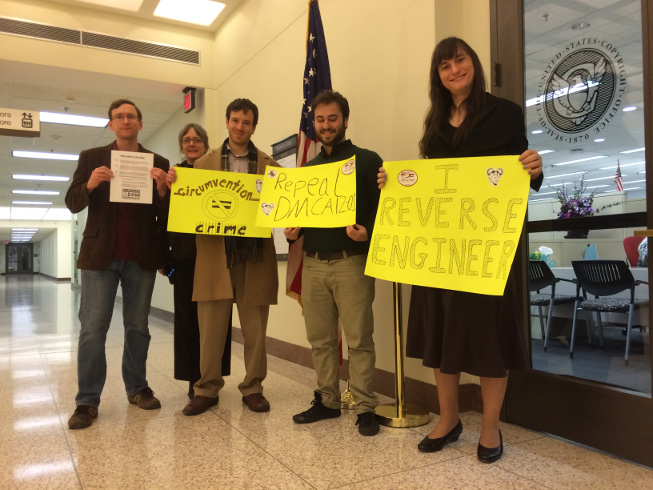
provisions. These comments were submitted in person by FSF campaigns
manager Zak Rogoff, as the Copyright Office refused to offer a means
of electronic submission that did not require the use of proprietary
JavaScript.

![https://static.fsf.org/nosvn/images/dmca-comment-delivery..."]
(This work by Christi Vandermale is licensed under a Creative Commons
Attribution 4.0 International License http://creativecommons.org/licenses/by/4.0/)

The Copyright Office was seeking comments in response to a request
from Congress to study the effects of the DMCA's anti-circumvention
provisions and the triennial exemptions process. The DMCA's
anti-circumvention provisions create legal penalties for the
circumvention of technologies that restrict access to copyrighted
works, known as Digital Restrictions Management (DRM). It further
criminalizes the sharing of tools needed to avoid DRM. The DMCA also
set up a system where activists, academics and researchers may request
that certain uses be exempted from the anti-circumvention
provisions. Every three years they may submit a request to the
Copyright Office that the circumvention of a particular type of work
be free from the DMCA's penalties. Even when an exemption is granted,
it expires three years later when the next round of the exemptions
process begins, requiring repeated effort to maintain narrow
exemptions.

In response, the FSF published [a comment][1] and called on people in
the United States to co-sign that comment through its
[Defective By Design][2] campaign to end the use of DRM. Over 1200
people in the United States heeded the call and co-signed the
comment. In addition, the FSF asked users in the international
community to advocate with their local governments about the dangers
of DRM.

[1]:https://www.fsf.org/licensing/2016-dmca-study-comment
[2]:https://www.defectivebydesign.org

The FSF's comment detailed the damaging effects of DRM on all users,
and called for the repeal of the DMCA's anti-circumvention provisions
and to bring an end to the exemptions process. The comment explained
how DRM is about the restriction of computer-users, not enforcing
rights. DRM does not respect the rights of users, and gives the DRM
implementer a degree of power not envisioned even under copyright
law. It permits companies and governments to spy on users, prevent
them from controlling their own computing, and abrogates users' rights
to even legally permitted copying and modification of copyrighted
materials. It interferes with the work of academics and librarians,
preventing them from studying and archiving works. It prevents
security researchers from discovering vulnerabilities and fraud, as
was the case when Volkswagen used software to
[defeat emission control tests][3].

[3]:https://www.defectivebydesign.org/epa-drm-drone

Given all the damage DRM causes, a law that enforces DRM and creates
legal penalties for trying to avoid its harms is untenable. No system
of exemptions can fix a fundamentally broken law.

"DRM is used to restrict and spy on users. Any use of DRM harms users,
so no system of exemptions, no matter how perfectly run, can ever
solve the problems the DMCA causes," said FSF's executive director,
John Sullivan.

In addition to the comments, the FSF provided the Copyright Office
with [a letter][4] calling for a mechanism to submit comments
electronically without the use of proprietary software. Currently,
comments submitted digitally to federal agencies that participate in
the eRulemaking Program require submission via the Regulations.gov
interface. This interface requires the use of JavaScript that is not
freely licensed, meaning that it is proprietary software.

[4]:https://www.fsf.org/licensing/2016-dmca-study-letter

When software is proprietary, that means that some company or
individual claims ownership of it, and through that ownership claim,
imposes restrictions on users as to how they can or can't use the
software. When the government requires citizens run such software, it
is requiring that they accept the specific and arbitrary terms imposed
by that company. The FSF's letter stresses that citizens should not be
required to engage with any particular private company in order to
participate in public proceedings, or use any governmental Web sites
or network service.

Unlike other government agencies, the Copyright Office refused to
accept comments even via the post. The Copyright Office is effectively
denying all citizens the ability to communicate with their
government. As such, the FSF was forced to hand-deliver the comment
and signatures.

"This situation is completely unjust and the Copyright Office's
behavior is simply reprehensible. No one should be forced to use
proprietary software simply to communicate with their
government. Hand-delivering documents to an office in Washington
D.C. is not possible for the vast majority of people in this
country. The Copyright Office and all government agencies must provide
a way to submit comments that does not require proprietary software,"
said FSF's licensing and compliance manager, Joshua Gay.

*Read and share this online at
<https://www.fsf.org/news/free-software-foundation-submits...>*

### About the Free Software Foundation

The Free Software Foundation, founded in 1985, is dedicated to
promoting computer users' right to use, study, copy, modify, and
redistribute computer programs. The FSF promotes the development and
use of free (as in freedom) software -- particularly the GNU operating
system and its GNU/Linux variants -- and free documentation for free
software. The FSF also helps to spread awareness of the ethical and
political issues of freedom in the use of software, and its Web sites,
located at fsf.org and gnu.org, are an important source of information
about GNU/Linux. Donations to support the FSF's work can be made at
<https://donate.fsf.org>. Its headquarters are in Boston, MA, USA.

More information about the FSF, as well as important information for
journalists and publishers, is at <https://www.fsf.org/press>.

### About Defective By Design

Defective by Design is the Free Software Foundation's campaign against
Digital Restrictions Management (DRM). DRM is the practice of imposing
technological restrictions that control what users can do with digital
media, creating a good that is defective by design. DRM requires the
use of proprietary software and is a major threat to computer user
freedom. It often spies on users as well. The campaign, based at
defectivebydesign.org, organizes anti-DRM activists for in-person and
online actions, and challenges powerful media and technology interests
promoting DRM. Supporters can donate to the campaign at
<https://www.defectivebydesign.org/donate>.

### Media Contacts

Joshua Gay
Licensing and Compliance Manager
Free Software Foundation
+1 (617) 542 5942
<licensing@fsf.org>

--
* Follow us at <https://status.fsf.org/fsf>.
* Subscribe to our RSS feeds at <https://fsf.org/blogs/RSS>.
* Join us as an associate member at <https://www.fsf.org/jf>.

Sent from the Free Software Foundation,

51 Franklin St, Fifth Floor
Boston, Massachusetts 02110-1335
UNITED STATES