

LWN.net Weekly Edition for February 11, 2016
Making use of persistent memory
Persistent memory holds a lot of promise: what's not to like about vast amounts of directly-attached memory that remembers its contents over a power cycle? For some years we have been told that large persistent-memory arrays are coming; now it seems that they are about to arrive. According to Matthew Wilcox, who spoke on the topic at linux.conf.au 2016, Intel wants persistent memory to become a regular platform feature. It will start by shipping server platforms supporting 6TB arrays in 2017. Matthew's question was: how will we make use of that persistent memory?
There are a lot of ideas out there, he said, many of which have been
promoted by academics — most of whom are not greatly concerned about
practicality. Start, for example, with the idea of total system
persistence, where the entire system can be turned off at any time and,
when powered back on, will simply pick up where it left off. The problem
here is that the CPU caches are not persistent, and there is no easy
 way to know when all writes to main memory have completed. Whole-system
persistence is a "delightful" idea, but it is not something that can be
done with today's hardware.
Stepping back a bit, one can try for application persistence — using persistent memory to make cheap application snapshots. Unfortunately, the cache problem exists here as well.
Perhaps what needs to be done is to completely redesign the operating system, creating a new system designed around persistent memory from the beginning. The "new" ideas that proponents of this idea bring up tend to have a familiar ring to them: microkernels, nanokernels, unikernels, etc. Matthew suggested that some people see new technology as an opportunity to push the same ideas they have been promoting for years. He wishes them the best, but is looking for something that will work today.
Some developers at Intel created a new filesystem for persistent memory called pmfs. They are, he said, smart people, but they are not Linux kernel developers. As a result, the work they did is not suitable for production settings.
What can be done today is to package up a persistent-memory array and export it as a fast block device. We have support for that in the kernel now, but, he said, it doesn't feel like a general-purpose solution. To get to that more general solution, he set out to make some small modifications to existing filesystems so that they could make use of persistent memory; he allowed that it was perhaps good that Dave Chinner was unable to attend the conference, since Dave might just quibble with Matthew's notion of "small". In any case, Matthew started with the existing execute-in-place support, rewrote it, and ended up with the subsystem now known as DAX.
Beyond filesystems
There is more to proper persistent-memory support than getting the filesystems to work, though. Down at the CPU level, Intel's designers have created a new set of instructions for use with persistent memory. The intent is to allow developers to initiate the flushing of specific cache lines; it is not possible to know when a write completes, but the operation can at least be started when needed. The CLFLUSH instruction has existed for years; its job is to remove a line of data from the cache. It is not optimal for persistent-memory applications, though, because it serializes the instruction stream, hurting performance.
That shortcoming will be addressed with the CLFLUSHOPT instruction, which does not perform that serialization. In the future, there will also be CLWB, which starts writing out the cache line but does not remove the data from the cache. Finally, the PCOMMIT instruction will ensure that all data written prior to the last store fence is persistent. It may not be written to a specific persistent-memory array, but it will be in persistent storage somewhere.
There is still the question of how application programmers should make use of persistent memory. One option would be to create a special-purpose programming language that natively understands persistence, but that, he said, is not particularly interesting. A bit more practical might be to modify the runtime virtual machines for language like Python to get them to issue the new instructions when needed. That would avoid the need for code changes in general, but is still not entirely interesting to "dinosaurs" like him, who want to program in languages like C.
For such people, there is a whole set of new libraries available. At the lowest level, libpmem simply provides easy access to the new instructions, but adds little otherwise. The libvmmalloc library supplies a replacement for malloc() that can allocate from persistent memory. It can also be used for non-persistent applications; indeed, applications can be linked against this library and be unaware that they are using persistent memory at all. For developers who are willing to code specific persistent-memory awareness into their applications, there is libvmem. It provides better performance on persistent memory, but is still mainly expected to be used with memory used as if it were volatile.
Developers wanting utilities to help with the storage of persistent memory can use libpmemblk, which provides access to atomic blocks of memory. Log-oriented applications, which append data to an existing structure, can use libpmlog to manage logs easily in persistent memory. But the interesting one, he said, is libpmemobj, which provides a transactional object store on top of persistent memory. It provides locking that persists over system boots, type safety, and data structures like doubly linked lists and a key-value store. It can handle replication of data across files. And, for those who are so inclined, C++ support has been added in recent months.
Quite a bit of functionality has been built on these libraries, he said. There is, for example, a MySQL storage engine that uses it. Interested developers can go to pmem.io, which hosts a blog, pointers to the source, and other information. There is also intel.com/nvm, which has mostly marketing material about the upcoming persistent-memory hardware. It appears that, after years of hype, the hardware will soon be available, and the software support will be there for it as well.
The video of this talk is available for those wanting more information.
[Your editor thanks LCA for assisting with his travel expenses.]
A Linux-powered microwave oven
Scratching an itch is a recurring theme in presentations at linux.conf.au. As the open-hardware movement gains strength, more and more of these itches relate to the physical world, not just the digital. David Tulloh used his presentation [WebM] on the “Linux Driven Microwave” to discuss how annoying microwave ovens can be and to describe his project to build something less irritating.
Tulloh's story began when he obtained a microwave oven, admittedly an inexpensive one, with a user interface even worse than the norm. Setting the time required pressing buttons so hard that the microwave tended to get pushed away — a fact that was elegantly balanced by the door handle requiring a sufficiently hard tug to return the oven to its original position. While this is clearly an extreme case, Tulloh lamented that microwave ovens really hadn't improved noticeably in recent decades. They may have gotten a little cheaper and gained a few features that few people could use without poring over the instruction manual — the implied contrast to smartphones, which are widely used with little instruction, was clear.
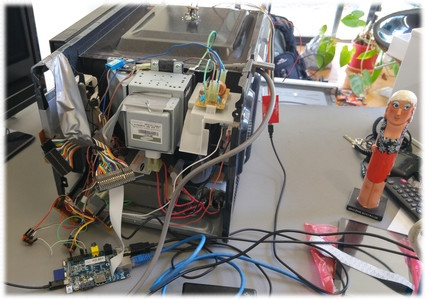
This microwave oven was not a lost cause — it gave its life to the greater good and became the prototype for an idea that Tulloh hopes to turn into a crowd-funded project if he can find the right match between features and demand: a Linux-driven microwave oven.
Adding novelty
Adding a smartphone-like touchscreen and a network connection and encouraging a community to build innovative apps such as recipe sharing are fairly obvious ideas once you think to put “Linux” and “microwave oven” together, but Tulloh's vision and prototype lead well beyond there. Two novel features that have been fitted are a thermal camera and a scale for measuring weight.
The thermal camera provides an eight-by-eight-pixel image of the contents of the oven with a precision of about two degrees. This is enough to detect if a glass of milk is about to boil over, or if the steak being thawed is in danger of getting cooked. In either case, the power can be reduced or removed. If appropriate, an alert can be sounded. This would not be the first microwave to be temperature sensitive — GE sold microwave ovens with temperature probes decades ago — but an always-present sensor is much more useful than a manually inserted probe, especially when there is an accessible API behind it.
The second innovation is a built-in scale to weigh the food (and container) being cooked. Many recipes give cooking-time guidance based on weight and some microwave ovens allow you to enter the weight manually so it can do a calculation for you. With built-in scales, that can become automatic. Placing a scale reliably under the rotating plate typical of many microwave ovens would be a mechanical challenge that Tulloh did not think worth confronting. Instead his design is based on the “flat-plate” or “flat-bed” style of oven — placing a sensor at each of the four corners is mechanically straightforward and gives good results.
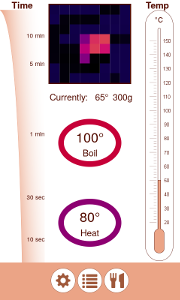
Once you have these extra sensors — weight and temperature — connected to a suitable logic engine, more interesting possibilities can be explored. A cup of cold milk from the fridge will have a particular weight and temperature profile with a modest degree of error. Tulloh suggested that situation could be detected and some relevant options such as “Boil” or “Warm” could be offered for easy selection (a mock up of the interface is at right, a clickable version is here). Simple machine learning could extend this to create a personalized experience. It would be easy to collect a history of starting profiles and cooking choices; when those patterns are detected, the most likely cooking choices could be made the easiest to select.
Overcoming staleness
Beyond just new functionality, Tulloh wants to improve the functionality that already exists. Door handles as stiff as on Tulloh's cheap microwave may not be common, but few microwave oven doors seem designed to make life easy for people with physical handicaps. There are regulatory restrictions, particularly in the US, that require the oven to function only if there is positive confirmation that the door is actually shut. This confirmation must be resilient against simple fraud, so poking a stick in the hole must not trick the oven into working with the door open. In fact, there must be two independent confirmations and, if they disagree, a fuse must be blown so that a service call is required. Tulloh believes that a magnetic latch would provide much greater flexibility (including easy software control) and that magnetic keying similar to that used in a magnetic keyed lock would allow the magnetic latch to pass certification.
Another pain point with microwave ovens is the annoying sounds they make. Tulloh has discarded the beeper and hooked up a speaker to the Banana Pi that is controlling his prototype. This allows for more pleasant and configurable alerts as well as for advice and guidance through a text-to-speech system. Adding a microphone for voice control is an obvious next step.
Many microwave ovens can do more than just set a time and a power level — they provide a range of power profiles for cooking, warming, defrosting, and so on. Adding precise temperature sensing will allow the community to extend this range substantially. A question from Andrew Tridgell in the audience wondered if tempering chocolate — a process that requires very precise temperature control — would be possible. Tulloh had no experience with the process, and couldn't make promises, but thought it was certainly worth looking in to. Even if that doesn't work out, it shows clear potential for value to be gained from community input.
Availability
Tulloh would very much like to get these Linux-enabled microwave ovens out into the world to create a community and see where it goes. Buying existing ovens and replacing the electronics is not seen as a viable option. The result would be ugly and, given that a small-run smart microwave will inevitably cost more, potential buyers are going to want something that doesn't look completely out of place in their kitchen.
Many components are available off-the-shelf (magnetron, processor board, thermal sensor) and others, such as a USB interface for the thermal sensor, are easily built. Prototype software is, of course, already available on GitHub. The case and door are more of a challenge and would need to be made to order. Tulloh wants to turn this adversity into an opportunity by providing the option for left-handed microwave ovens and a variety of colors.
A quick survey of the audience suggested that few people would hastily commit to his target price of $AU1000 for a new, improved, open oven. Whether a bit more time for reflection and a wider audience might tip the balance is hard to know. The idea is intriguing, so it seems worth watching Tulloh's blog for updates.
Security
Protecting systems with the TPM
"TPM," said Matthew Garrett in his linux.conf.au 2016 talk, stands for "trusted platform module"; it is a tool that is meant to allow a system's owner to decide which software to trust. Some years ago, there was a lot of fear that the TPM would be used, instead, to take that decision away, to allow others to decide which software would be trusted to run on our systems; for that reason, some called "trusted computing" by the rather less complimentary name "treacherous computing." That scenario didn't come about, though, for a number of reasons, both technical and social. But we can still use the TPM for its original purpose; Matthew was there to talk about his work to bring about computing that we can trust.
Verifying software integrity at boot time
The TPM is a 28-pin chip found in most desktop and server-class systems; it is offered by a number of manufacturers, and those offerings are all interchangeable. Most deployed TPMs adhere to the 1.2 standard, but 2.0 is out now and is quite different. Some TPMs are minimal in functionality and slow, while others are essentially ARM cores running at several hundred MHz. They feature a small amount of nonvolatile RAM storage; "small amount" meaning hundreds of bytes in this case. They can do some cryptographic operations, such as signing or encrypting data, but they do it quite slowly. Some operations can take multiple seconds; it would be almost as fast to do things by hand, Matthew said. In other words, the TPM is worse than the CPU in every single way, so why do manufacturers bother installing them in so many machines? Answering that question was the focus of much of the rest of the talk.
A core feature of a TPM is the platform configuration registers, or PCRs.
These are used to perform measurement of the bootstrap process, where
"measurement" means verification of the software that is run. The TPM
cannot do this work on its own, though, since it is unable to perform DMA
 or to ask the operating system to perform actions on its behalf. So the
bootstrap code must feed
data to the TPM by way of explicit "extend" operations on the PCRs.
An interesting feature of the PCRs is that their value cannot be set directly (other than initializing them to zero when the system resets). Instead, they support an "extend" operation that calculates a cryptographic hash of a PCR's current state combined with the new data and uses the result as the new value. More precisely, the extend operation appends the new data to the 20-byte value already stored in the PCR, performs a hash of the 40-byte result, and stores the output of the hash back into the PCR. TPM 1.2 uses SHA1; version 2.0 moves on to more secure hashing algorithms.
In a typical trusted boot, things start at power-on time, when the special "management engine" starts running within the CPU. It measures the first-stage firmware by reading and hashing the binary code, using the result to extend the first PCR. Each subsequent stage of the process (second-stage firmware, option-card firmware, the bootloader) measures the stage to follow before executing it; by the time the kernel is measured and booted, the TPM will have a set of PCRs describing the software that has run so far. If those PCRs do not contain the expected values, then somebody has tampered with something somewhere in the process and the system cannot be trusted.
Quotes, sealing, and more
The TPM is not able to block the bootstrap process if the PCRs do not end up with the expected values; somebody must ask it whether all is well or not. The TPM is a device, accessed via a device driver, so any process wanting to query the TPM must do so by way of the kernel. There is an obvious potential problem here: if the kernel has been corrupted, it can lie about the values stored in the PCRs, thus defeating the entire measurement process.
The designers of the TPM specification have thought about this particular problem, though; the result is the remote attestation mechanism. The TPM supports a "quote" operation, which provides a list of current PCR values signed by a private key hidden within the device. This operation also includes a nonce value provided with the request, preventing quotes from being reused by hostile software. A system wanting to verify a quote can verify the signature using a well-known public key and ensure that the nonce matches what it provided; if things check out, then the PCR values can be trusted as having been provided by the TPM.
This quote can be passed back to a remote attestation server, which can check the PCR values and be sure that your machine is running trusted software. This works well for granting (or denying) access to the network or some other resource, but it is rather less helpful for a user trying to decide whether they can trust their own system. That's because answering that question requires asking the remote-attestation server — by sending it packets through the kernel. Once again, a malicious kernel is in a position to lie to the user.
There is some help for this problem as well, based on the TPM's ability to encrypt data. In particular, it can "seal" data, which cannot subsequently be decrypted unless the PCRs contain the expected values. So the solution is to encrypt the disk and seal the key with the TPM. If the system has been tampered with, the PCR values will not match, the disk cannot be decrypted, and the system will fail to boot. If it boots successfully, the software has not been messed with.
This kind of encryption will protect the contents of the disk if somebody removes it from the laptop, but is not helpful if somebody steals the whole box. The obvious answer is to add a passphrase to the bootstrap process, but that just leads to another question: how does the user know that the passphrase prompt is legitimate? An attacker (of the evil maid variety, perhaps) could install malware that would put up a fake password prompt, then fake a crash and reboot. Matthew noted that few of us would be seriously surprised by a crash-and-reboot cycle; we are, he said, not very good at doing computers in general.
One possible anti-evil-maid tactic would be to have the TPM encrypt a secret (a phrase, perhaps) and display it at boot time; if the phrase shows up, the user knows that the software running up to that point has not been modified. But an attacker could simply observe the phrase and replicate it. That problem could be addressed by putting the encrypted phrase onto a USB stick and booting from it anytime the system has been out of the user's control. This tactic requires discipline, though; the user has to remember to use it whenever there might be trouble.
A promising alternative (also described here) is to encrypt a time-based one-time password (TOTP) seed and seal that; the seed would also be put onto a second device (a smartphone, for example). When the system boots, it decrypts the seed, calculates the current one-time password, and displays it on the screen. That value should match what is shown on the second device. If the two numbers match, the system has not been changed. Either that, Matthew said, or both devices have been tampered with; it would be a good idea to not leave them both unattended in the same place.
Other issues
All of this seems like a reasonable solution, but there are still a few potential issues worth pointing out. The point of this whole exercise is that, if somebody has modified the system, it will fail to boot. But there can be legitimate reasons to modify the system, including installing a new bootloader or kernel, firmware upgrades, and more. Supporting upgrades is "awkward." Beyond that, once the TPM has decrypted the disk-encryption key, that key will be sitting in RAM where a hostile device could copy it via a DMA operation. An I/O memory management unit (IOMMU) can address that threat, but it must be enabled to do so; most distributions leave the IOMMU turned off, since it has an unpleasant habit of breaking Intel graphics.
Then there is the issue of the management engine. It runs before the CPU starts and performs the initial firmware verification. If the management engine can be made to run arbitrary code, the whole chain of trust fails before it even starts. This processor runs encrypted code that cannot be audited, so, Matthew said, he has no idea how secure it really is.
What about after the kernel boots? Modified user-space software can be just as bad. That's where the kernel's integrity measurement architecture comes into play. Every binary run by the system can be measured, with the resulting value used to extend a PCR; that PCR can then be used to verify that the binaries have not been modified. The only problem is that getting to a specific PCR value not only requires that a specific set of binaries is run; it also requires that they are run in a specific order. Guaranteeing that order during the bootstrap process is not easy. Working around that problem is a matter of obtaining the "event log" from the TPM; this log contains a record of each individual measurement event. Interested code can examine the log, verifying the trustworthiness of each individual binary that has been run.
Going one step further and measuring containers is really just a matter of measuring their disk images. This, too, can produce an event log, yielding a list of every container that has been launched. If a specific container turns out to be hostile (or to contain a bad vulnerability), it is possible to determine which systems it has run on. The just-announced Rkt 1.0 release has the ability to do this kind of measurement.
For those interested in the code: Rkt is available on this page. Matthew has put up code for shim (for the bootstrap process) and for GRUB. His tpmtotp repository has code to make the one-time password checks work. Much of this code will eventually go upstream to the relevant projects but, for now, it must be obtained separately.
An audience member asked about what pieces are missing still; Matthew replied that there is currently no way to measure the firmware running in the disk drive (or other peripherals). A hostile drive could provide correct code for a critical binary once to pass the IMA test, then provide corrupt code thereafter. We need, he said, a way for users to verify that the rest of the platform is also trustworthy.
When asked about the trustworthiness of the TPM himself, Matthew said that he hasn't really looked into it; he is afraid of what might happen. He knows of nobody who has tried to do any sort of serious fuzz-testing of TPM chips. There is, he said, a push to move TPM functionality into the firmware, running it on the management engine; that would allow manufacturers to remove the separate TPM chip from the board. If that were done, though, any flaws in the TPM implementation might enable code to be executed on the management engine itself — not a pleasing prospect.
The video for this talk is available on the LCA site.
[Your editor thanks LCA for assisting with his travel expenses.]
Brief items
The US government's "Cybersecurity National Action Plan"
The Obama administration has put out a plan for how it would like to make the net a safer place. There are a lot of topics covered here; toward the end it also mentions that "the Government will work with organizations such as the Linux Foundation’s Core Infrastructure Initiative to fund and secure commonly used internet 'utilities' such as open-source software, protocols, and standards. Just as our roads and bridges need regular repair and upkeep, so do the technical linkages that allow the information superhighway to flow."
New vulnerabilities
claws-mail: stack-based buffer overflow
| Package(s): | claws-mail | CVE #(s): | CVE-2015-8708 | ||||||||||||||||
| Created: | February 8, 2016 | Updated: | February 10, 2016 | ||||||||||||||||
| Description: | From the Red Hat bugzilla:
A stack-based buffer overflow has been found in conv_euctojis() after applying incomplete patch for CVE-2015-8614. In conv_euctojis() the comparison is with outlen - 3, but each pass through the loop uses up to 5 bytes and the rest of the function may add another 4 bytes. The comparison should presumably be '<= outlen - 9' or equivalently '< outlen - 8'. | ||||||||||||||||||
| Alerts: |
| ||||||||||||||||||
eglibc: multiple vulnerabilities
| Package(s): | eglibc | CVE #(s): | CVE-2014-9761 CVE-2015-8776 CVE-2015-8778 CVE-2015-8779 | ||||||||||||||||||||||||||||||||||||||||||||||||||||||||||||||||||||||||||||||||||||||||||||||||
| Created: | February 8, 2016 | Updated: | May 11, 2016 | ||||||||||||||||||||||||||||||||||||||||||||||||||||||||||||||||||||||||||||||||||||||||||||||||
| Description: | From the Debian LTS advisory:
CVE-2014-9761: The math's nan* function wrongly handled payload strings, yielding to an unbounded stack allocation based on the length of the arguments. To solve this issue, payload parsing has been refactored out of strtod into a separate functions that nan* can call directly. CVE-2015-8776: The strftime() function made it possible to access invalid memory, allowing to segfault the calling application. CVE-2015-8778: hcreate() was susceptible to an integer overflow, that may results in out-of-bounds heap accesses. CVE-2015-8779: The catopen() function suffered from multiple unbounded stack allocations. | ||||||||||||||||||||||||||||||||||||||||||||||||||||||||||||||||||||||||||||||||||||||||||||||||||
| Alerts: |
| ||||||||||||||||||||||||||||||||||||||||||||||||||||||||||||||||||||||||||||||||||||||||||||||||||
ffmpeg: denial of service
| Package(s): | ffmpeg | CVE #(s): | CVE-2016-2213 | ||||||||
| Created: | February 10, 2016 | Updated: | February 10, 2016 | ||||||||
| Description: | From the CVE entry:
The jpeg2000_decode_tile function in libavcodec/jpeg2000dec.c in FFmpeg before 2.8.6 allows remote attackers to cause a denial of service (out-of-bounds array read access) via crafted JPEG 2000 data. | ||||||||||
| Alerts: |
| ||||||||||
jasper: denial of service
| Package(s): | jasper | CVE #(s): | CVE-2016-2089 | ||||||||||||||||||||||||||||||||||||||||
| Created: | February 10, 2016 | Updated: | February 11, 2016 | ||||||||||||||||||||||||||||||||||||||||
| Description: | From the openSUSE advisory:
Specially crafted JPEG 2000 may cause JasPer to crash. | ||||||||||||||||||||||||||||||||||||||||||
| Alerts: |
| ||||||||||||||||||||||||||||||||||||||||||
kernel: privilege escalation
| Package(s): | kernel linux-2.6 | CVE #(s): | CVE-2016-2069 | ||||||||||||||||||||||||||||||||||||||||||||||||||||||||||||||||||||||||||||||||||||||||||||||||||||||||||||||||||||||||
| Created: | February 8, 2016 | Updated: | February 10, 2016 | ||||||||||||||||||||||||||||||||||||||||||||||||||||||||||||||||||||||||||||||||||||||||||||||||||||||||||||||||||||||||
| Description: | From the Debian LTS advisory:
Andy Lutomirski discovered a race condition in flushing of the TLB when switching tasks. On an SMP system this could possibly lead to a crash, information leak or privilege escalation. | ||||||||||||||||||||||||||||||||||||||||||||||||||||||||||||||||||||||||||||||||||||||||||||||||||||||||||||||||||||||||||
| Alerts: |
| ||||||||||||||||||||||||||||||||||||||||||||||||||||||||||||||||||||||||||||||||||||||||||||||||||||||||||||||||||||||||||
kscreenlocker: restriction bypass
| Package(s): | kscreenlocker | CVE #(s): | CVE-2016-2312 | ||||||||||||
| Created: | February 10, 2016 | Updated: | February 22, 2016 | ||||||||||||
| Description: | From the Arch Linux advisory:
A vulnerability has been discovered in kscreenlocker that is leading to access restriction bypass. Turning all screens off while the lock screen is shown can result in the screen being unlocked when turning a screen on again. A local attacker with physical access to the hardware is able to gain unauthorized access to a locked system. | ||||||||||||||
| Alerts: |
| ||||||||||||||
libbsd: denial of service
| Package(s): | libbsd | CVE #(s): | CVE-2016-2090 | ||||||||||||||||
| Created: | February 5, 2016 | Updated: | January 2, 2017 | ||||||||||||||||
| Description: | From the Arch Linux advisory: libbsd 0.8.1 and earlier contains a buffer overflow in the function fgetwln(). An "if" checks if it is necessary to reallocate memory in the target buffer. However this check is off by one, therefore an out of bounds write happens. | ||||||||||||||||||
| Alerts: |
| ||||||||||||||||||
mariadb: information leak
| Package(s): | mariadb | CVE #(s): | CVE-2015-5969 | ||||||||||||
| Created: | February 8, 2016 | Updated: | February 10, 2016 | ||||||||||||
| Description: | From the SUSE bug report:
In our systemd unit files we use mysql-systemd-helper, which calls my_print_defaults. The output is used to start the service. If the configuration contains sensitive information it might be exposed because they're used as command line arguments. | ||||||||||||||
| Alerts: |
| ||||||||||||||
mysql: multiple vulnerabilities
| Package(s): | mysql | CVE #(s): | CVE-2015-7744 CVE-2016-0502 CVE-2016-0594 CVE-2016-0605 | ||||||||||||||||||||||||||||||||
| Created: | February 8, 2016 | Updated: | February 10, 2016 | ||||||||||||||||||||||||||||||||
| Description: | From the
wolfSSL (formerly CyaSSL) before 3.6.8 does not properly handle faults associated with the Chinese Remainder Theorm (CRT) process when allowing ephemeral key exchange without low memory optimizations on a server, which makes it easier for remote attackers to obtain private RSA keys by capturing TLS handshakes, aka a Lenstra attack. (CVE-2015-7744) Unspecified vulnerability in Oracle MySQL 5.5.31 and earlier and 5.6.11 and earlier allows remote authenticated users to affect availability via unknown vectors related to Optimizer. (CVE-2016-0502) Unspecified vulnerability in Oracle MySQL 5.6.21 and earlier allows remote authenticated users to affect availability via vectors related to DML. (CVE-2016-0594) Unspecified vulnerability in Oracle MySQL 5.6.26 and earlier allows remote authenticated users to affect availability via unknown vectors. (CVE-2016-0605) | ||||||||||||||||||||||||||||||||||
| Alerts: |
| ||||||||||||||||||||||||||||||||||
nodejs-is-my-json-valid: denial of service
| Package(s): | nodejs-is-my-json-valid | CVE #(s): | |||||||||
| Created: | February 4, 2016 | Updated: | February 12, 2016 | ||||||||
| Description: | From the Red Hat bugzilla entry:
A regular expression denial of service vulnerability was found in is-my-json-valid. It is possible to block the event loop when specially crafted user input is allowed into a validator using the utc-millisec format. | ||||||||||
| Alerts: |
| ||||||||||
openstack-swift: denial of service
| Package(s): | openstack-swift | CVE #(s): | CVE-2016-0737 | ||||||||||||||||
| Created: | February 8, 2016 | Updated: | February 10, 2016 | ||||||||||||||||
| Description: | From the CVE entry:
OpenStack Object Storage (Swift) before 2.4.0 does not properly close client connections, which allows remote attackers to cause a denial of service (proxy-server resource consumption) via a series of interrupted requests to a Large Object URL. | ||||||||||||||||||
| Alerts: |
| ||||||||||||||||||
php: multiple vulnerabilities
| Package(s): | php | CVE #(s): | |||||||||||||||||||||||||
| Created: | February 9, 2016 | Updated: | March 8, 2016 | ||||||||||||||||||||||||
| Description: | PHP version 5.6.18 fixes several security issues and other bugs.
See the PHP changelog for details.
More issues fixed in 5.6.19. See the PHP changelog for details. | ||||||||||||||||||||||||||
| Alerts: |
| ||||||||||||||||||||||||||
polarssl: code execution
| Package(s): | polarssl | CVE #(s): | CVE-2015-8036 | ||||||||||||
| Created: | February 8, 2016 | Updated: | August 1, 2016 | ||||||||||||
| Description: | From the CVE entry:
Heap-based buffer overflow in ARM mbed TLS (formerly PolarSSL) 1.3.x before 1.3.14 and 2.x before 2.1.2 allows remote SSL servers to cause a denial of service (client crash) and possibly execute arbitrary code via a long session ticket name to the session ticket extension, which is not properly handled when creating a ClientHello message to resume a session. NOTE: this identifier was SPLIT from CVE-2015-5291 per ADT3 due to different affected version ranges. | ||||||||||||||
| Alerts: |
| ||||||||||||||
python-pillow: denial of service
| Package(s): | python-pillow | CVE #(s): | CVE-2016-0775 CVE-2016-0740 | ||||||||||||||||||||||||||||||||||||||||
| Created: | February 10, 2016 | Updated: | March 15, 2016 | ||||||||||||||||||||||||||||||||||||||||
| Description: | From the Red Hat bugzilla:
CVE-2016-0775: A buffer overflow vulnerability in FliDecode.c was reported, affecting all versions of python-pillow at least from 1.1.7 release. CVE-2016-0740: It was reported that python-pillow 3.1.0 when linked against libtiff >= 4.0.0 may overflow a buffer when reading a specially crafted tiff file. libtiff >=4.0.0 changed the return type of TIFFScanlineSize from int32 to machine dependent int32|64. If the scanline is sized so that it overflows an int32, it may be interpreted as a negative number, which will then pass the size check in TiffDecode.c line 236. To do this, the logical scanline size has to be > 2gb. If the size of allocated buffer is 64k, any image data over 64k is written over the heap, causing a segfault. | ||||||||||||||||||||||||||||||||||||||||||
| Alerts: |
| ||||||||||||||||||||||||||||||||||||||||||
qemu: privilege escalation
| Package(s): | qemu | CVE #(s): | CVE-2015-8556 | ||||
| Created: | February 4, 2016 | Updated: | February 10, 2016 | ||||
| Description: | From the oss-security message describing the problem:
Some distros make qemu's virtfs-proxy-helper binary either SUID or give it filesystem capabilities such as cap_chown. This is completely insane for a wide variety of reasons; there are quite a few ways of abusing this to elevate privileges. | ||||||
| Alerts: |
| ||||||
rubygem-rails-html-sanitizer: multiple vulnerabilities
| Package(s): | rubygem-rails-html-sanitizer | CVE #(s): | CVE-2015-7578 CVE-2015-7579 CVE-2015-7580 | ||||||||||||||||||||
| Created: | February 8, 2016 | Updated: | February 29, 2016 | ||||||||||||||||||||
| Description: | From the SUSE bug reports:
CVE-2015-7578: There is a possible XSS vulnerability in rails-html-sanitizer. Certain attributes are not removed from tags when they are sanitized, and these attributes can lead to an XSS attack on target applications. CVE-2015-7579: Due to the way that `Rails::Html::FullSanitizer` is implemented, if an attacker passes an already escaped HTML entity to the input of Action View's `strip_tags` these entities will be unescaped what may cause a XSS attack if used in combination with `raw` or `html_safe`. CVE-2015-7580: Carefully crafted strings can cause user input to bypass the sanitization in the white list sanitizer which will can lead to an XSS attack. | ||||||||||||||||||||||
| Alerts: |
| ||||||||||||||||||||||
salt: information leak
| Package(s): | salt | CVE #(s): | CVE-2015-8034 | ||||
| Created: | February 5, 2016 | Updated: | February 10, 2016 | ||||
| Description: | From the Red Hat bug report: It was found that state.sls function stores state run cache on the minion onto the disk with incorrect permissions, making it world-readable. This file could potentially contain sensitive data that was inserted via jinja into the state SLS files. | ||||||
| Alerts: |
| ||||||
socat: man-in-the-middle
| Package(s): | socat | CVE #(s): | CVE-2016-2217 | ||||||||
| Created: | February 8, 2016 | Updated: | December 8, 2016 | ||||||||
| Description: | From the Mageia advisory:
In socat before 2.0.0-b9, in the OpenSSL address implementation, the hard coded 1024 bit DH p parameter was not prime. It may be possible for an eavesdropper to recover the shared secret from a key exchange (CVE-2016-2217). In socat before 2.0.0-b9, a stack overflow vulnerability was found that can be triggered when command line arguments are longer than 512 bytes. This vulnerability can only be exploited when an attacker is able to inject data into socat's command line. | ||||||||||
| Alerts: |
| ||||||||||
webkitgtk4: multiple vulnerabilities
| Package(s): | webkitgtk4 | CVE #(s): | CVE-2015-7096 CVE-2015-7098 | ||||||||||||||||||||
| Created: | February 5, 2016 | Updated: | February 10, 2016 | ||||||||||||||||||||
| Description: | From the CVE entries: CVE-2015-7096: WebKit in Apple iOS before 9.2, Safari before 9.0.2, and tvOS before 9.1 allows remote attackers to execute arbitrary code or cause a denial of service (memory corruption and application crash) via a crafted web site, a different vulnerability than CVE-2015-7048, CVE-2015-7095, CVE-2015-7097, CVE-2015-7098, CVE-2015-7099, CVE-2015-7100, CVE-2015-7101, CVE-2015-7102, and CVE-2015-7103. CVE-2015-7098: WebKit in Apple iOS before 9.2, Safari before 9.0.2, and tvOS before 9.1 allows remote attackers to execute arbitrary code or cause a denial of service (memory corruption and application crash) via a crafted web site, a different vulnerability than CVE-2015-7048, CVE-2015-7095, CVE-2015-7096, CVE-2015-7097, CVE-2015-7099, CVE-2015-7100, CVE-2015-7101, CVE-2015-7102, and CVE-2015-7103. | ||||||||||||||||||||||
| Alerts: |
| ||||||||||||||||||||||
wordpress: two vulnerabilities
| Package(s): | wordpress | CVE #(s): | CVE-2016-2221 CVE-2016-2222 | ||||||||||||||||
| Created: | February 9, 2016 | Updated: | February 17, 2016 | ||||||||||||||||
| Description: | From the Debian advisory:
CVE-2016-2221: Shailesh Suthar discovered an open redirection vulnerability. CVE-2016-2222: Ronni Skansing discovered a server-side request forgery (SSRF) vulnerability. | ||||||||||||||||||
| Alerts: |
| ||||||||||||||||||
Page editor: Jake Edge
Kernel development
Brief items
Kernel release status
The current development kernel is 4.5-rc3, released on February 7. Linus said: "It's slightly bigger than I'd like, but not excessively so (and not unusually so). Most of the patches are pretty small, although the diff is utterly dominated by the (big) removal a couple of staging rdma drivers that just weren't going anywhere. Those removal patches are 90% of the bulk of the diff."
Stable updates: none have been released in the last week.
Kernel development news
Netconf discussions, part 1
For two days prior to the Netdev 1.1 conference in Seville, Spain, kernel networking developers gathered for Netconf, an informal summit to discuss recent issues face to face and to hash out approaches to take for upcoming work. What follows is a recap of how those discussions progressed on the first day of the event; an account of the second day is forthcoming.Checksums
The first issue on the table was checksum offloading, in particular with respect to tunneling protocols. Since we first looked at checksum offloading in December, an updated patch set has been posted. Checksums allow the kernel to verify that a packet was unaltered during transit; computing them is a task that it would be nice to offload to hardware. For tunneling there are two checksums to cope with: inner checksums cover a packet encapsulated within another protocol (the tunneled payload) while outer checksums cover the entire packet, including the payload and its wrapper.
In short, Local Checksum Offloading (LCO) allows the kernel to compute the outer checksum of an outgoing packet in software, while offloading the job of calculating the inner checksum to the hardware device. This is a bit of clever sleight-of-hand; it can be done efficiently since the outer checksum is merely the checksum of the outer header—a substantially smaller set of bytes, which the kernel is already processing in memory—added to the inner checksum in one's-complement arithmetic. For incoming packets, most network interfaces are capable of offloading only the outer checksum but, again, the kernel can derive the inner checksum relatively easily by processing only the outer header.
Several factors continue to make checksum offloading a convoluted issue from the kernel's perspective, though. As Alex Duyck explained, some newer networking devices are designed to compute the checksum of the innermost recognized packet type. If the inner packet is VXLAN, the device will compute the inner checksum; if not, the device will compute the outer checksum instead. And additional work is required to get checksum offloading to play nicely with TCP segmentation offload (TSO), where the network hardware splits up packets before sending them out over the outgoing interface. Thus, the device performing the hardware checksum computations must be told the proper offsets at which to begin the checksum calculations.
In addition to the implementation details, which at this point seem to be relatively well-understood, the need to improve the documentation of the checksum-offloading features was raised. As Jesse Brandeburg pointed out based on his experiences at Intel, it can be rather difficult for the authors of new device drivers to make sense out of all of the flags in use. Tom Herbert commented that it is probably incorrect to call many of the calculations involved "checksums" to begin with, since they are, in fact, cyclic redundancy checks (CRCs). It does not look like that terminology change, however, should be expected any time soon.
IPv4 containers on IPv6 hosts
Next, Thomas Graf proposed creating a new socket type that would enable an IPv6-only system to support containerized applications that are, internally, IPv4-aware only. The idea would be that a containerized application explicitly asking for an IPv4 address would be given a socket that was transparently bound to an external IPv6 address. Doing so would do away with the need to set up an IPv4 routing table and other overhead—which is required, currently, whenever an application explicitly asks for an IPv4 address on an IPv6 system.
Not everyone was persuaded that the approach was a worthwhile idea; Shrijeet Mukherjee, for example, asked whether setting up a 6to4 tunnel instead would suffice. The end goal, Graf said, was to make containerized applications as lightweight as possible, thus making life simpler for systems that have to cope with ancient containers that are no longer updated (or whose developers refuse to transition to proper IPv6 support). There was enough interest to convince Graf to pursue the idea further, though, and he agreed to work on a patch and submit it for comment.
SCTP
Eric Dumazet asked the group how important it was to support the Stream Control Transmission Protocol (SCTP)—the implication being that SCTP is rarely used and, therefore, not worth expending excess effort on. Networking subsystem maintainer David Miller agreed that it was difficult to know how many users there were of the SCTP code (as is true of other protocols) and floated the idea of asking Linux distributions to gather anonymized usage statistics—with end-user permission—much as they already collect statistics on package installations. If such information were available, he said, it could lead to further investment in networking features; it is difficult to get traction on work like SCTP support unless that work is funded. Anecdotally, many SCTP users seem to use proprietary, out-of-tree SCTP stacks, so this would seem to be an area where there is a need for more investment.
Virtual routing and forwarding
David Ahern presented an update on Virtual Routing and Forwarding (VRF), a feature used to create a virtual layer-3 (IP) routing domain in the network stack. Basic support for IPv4 VRFs was added in kernel 4.3, and IPv6 support in kernel 4.4. Several usability issues remain, however. Creating the routing-table rules required for the VRF is still a cumbersome process. Miller has already rejected a patch that would have allowed a VRF driver to automatically create "simple" routing rules; Ahern noted that there were other possible solutions, such as defining a vrf subcommand for the ip utility.
A more serious usability problem is that every time a VRF's enslaved network devices (that is, the individual interfaces that are combined into the VRF) are brought down and then back up, they lose their IPv6 addresses. The cycling is required, since it is used to flush the neighbor cache and routes. But, technically, flushing the entire interface is not required—only wiping the cache and route data. Ahern said that a patch was being developed to perform more of a "pause/resume" or "soft down" operation. Miller noted, however, that the problem is not limited to VRF; ultimately one would like to be able to cycle an interface without losing IPv6 addresses. Arriving at a fix for that underlying problem is going to take considerable effort, Miller said, but he encouraged Ahern to proceed with the VRF patch anyway, "and let's see what happens."
Ahern also listed several features missing from VRF, starting with the ability to run tasks in a VRF context. Control groups seem like the right approach for implementing that feature, but Tejun Heo objected to that idea when Ahern sent an RFC in January. Miller noted that Heo has spent quite a bit of time cleaning up control groups and is likely to balk at uses that violate the new model he is moving toward. Miller said he would attempt to smooth the path to acceptance in that regard, but suggested that Ahern look at alternative solutions in case he is unable to persuade Heo.
Ahern also noted that the VRF developers would like more netfilter hooks on transmit and receive paths, and would like to be able to bind a socket to an enslaved device. Finally, he noted that there is a major roadblock to using VRF with switchdev: currently, switchdev disables layer-3 offload on a system if any IP rules are installed in the Forwarding Information Base (FIB). That makes it impossible to use VRF with switchdev's hardware-offloading capabilities. He suggested that the "overly cautious" ban on IP rules be relaxed, perhaps allowing rules for non-hardware (i.e., virtual) ports or allowing the "simple" rules needed for VRF. He conceded, though, that it could be challenging to find a solution.
Header (un)alignment
Herbert then discussed how to approach byte-alignment problems. It is a fundamental issue that the headers on a network packet do not always arrive conveniently aligned on four-byte boundaries as the kernel would prefer, thus decreasing performance. In some cases, the misalignment is entirely predictable—for example, in tunneling, when the outer IP header is stripped off, whatever is inside will be offset by two bytes. While several approaches to alleviating the performance impact have been raised (shifting headers with memmove(), for example), they do not attack the underlying issue head-on.
Miller advocated taking a moderate, fix-the-major-cases approach rather than attempting an attack on the root of the problem that could prove disruptive. On Sparc systems, for instance, unaligned headers trigger scores of kernel warnings. While it might be possible to wrap every access on Sparc in a get_unaligned() macro, he said, that solution would certainly be rejected by Linus. In the end, Duyck posted a short patch that will correct unaligned headers in the Generic Routing Encapsulation (GRE) code, which Herbert signed off on.
Documentation
Jeff Kirsher proposed refreshing the skeleton driver (the "outline" that developers are intended to use when writing a new network device driver), which has not been updated to show new features like offloading. In addition, he suggested that the documentation could be improved in several areas—code comments most obviously, but perhaps more papers as well, like Herbert's 2015 white paper on checksum offloading. He also asked about adding per-queue statistics. Miller did not find the idea appealing, since network interface dumps are "enormous" already. But he noted that perhaps "extended statistics" could be made available with filter bits; there are several other cases where more statistics need to be exposed, such as network interface cards (NICs) that include built-in switches.
TCP performance
Dumazet discussed progress on the new TCP congestion algorithm in use at Google. Though it is working well enough so far, there is concern over the fact that it is not currently possible to tell if a packet was dropped because of a bottleneck or because of the action of a firewall (or some other interfering device) somewhere along the route. He also reported that work was still underway exploring random packet spraying (RPS), which gives up attempting to force all TCP packets in a stream to follow the exact same path. The idea of using RPS was first floated after a paper [PDF] on the subject was published by researchers at Purdue University. The challenge is how to reorder TCP packets that arrive on different paths; using flow labels was discussed briefly, but there may be no simple solution.
Wireless
Johannes Berg gave a brief report on recent work on the wireless side. At present, major effort is being directed at receive side scaling (RSS), he said, splitting up everything serialized in order to make it parallel. Currently, the effort is focused on implementing RSS on a single TCP stream; the developers would like to support aggregating TCP streams, but real world experience seems to indicate that most common wireless devices (e.g., mobile phones) will use only one stream at a time anyway.
Miller asked if anything is "getting in the way," to which Berg replied that the wireless developers would like to have more transmit queues, to better support multi-user MIMO. That feature allows a wireless access point to simultaneously stream to different devices via separate antennas (on the same frequency band), which works if the receiving devices are physically far apart, and provides better overall throughput. Modern access points have as many as eight antennas—all sharing a single network interface. The kernel, therefore, needs to be able to manage multiple transmit queues to keep the antennas filled. Work is underway on supporting the feature, although only on Intel hardware so far.
Statistics
Jamal Hadi Salim closed out the first day by proposing a new message type for netlink that could be used to subscribe to periodic status updates. The use case is recording statistics in high volume (say, once every one to five seconds) but, specifically, statistics that are intended to profile system performance. Collecting data in this fashion is different from subscribing to other netlink updates, where one generally wants to hear about an event immediately. There did not seem to be any serious objection to the idea, so a new "stats" message would appear to be a possibility.
With that, the discussion wound down for day one.
[The author would like to thank the Netconf and Netdev organizers for travel assistance to Seville.]
Measuring packet classifier performance
At Netdev 1.1 in Seville, Spain, Jamal Hadi Salim presented the results of recent tests he has done to assess the performance characteristics of the kernel's various network-packet classifiers. While the raw numbers may be of interest to those seeking the best possible performance, the testing process itself revealed other factors of interest to the kernel networking community.
There are a number of reasons to run such tests, he said. First, there have been two new classifiers added in the past year: flower and the extended Berkeley Packet Filter (eBPF) classifier. Naturally, that makes one curious how they compare to the older mechanisms. Second, he had spent several years working with software-defined networking (SDN) running on big application-specific integrated circuit (ASIC) hardware switches, and was interested in seeing how much could be done within the kernel itself. Third, an examination of kernel performance would also serve to counterbalance all the "noise" one hears about the superiority of the Data Plane Development Kit (DPDK) and similar user-space libraries. And, he added, it just sounded like an easy topic for a paper—although that notion turned out to be delusional.
Constructing a test
In order to not compare apples and oranges, he said, some care has to be taken in designing both the tests and the test system. If the goal is to allow a comparison between the kernel and ASICs, then the actions tested in kernel classifiers needed to be limited to those a typical ASIC would perform—no hashing or using masks to group flows. As to testing the new classifiers, a baseline is required, so he choose to profile the "Swiss-army knife of packet filtering," the u32 classifier.
He then spent a few minutes comparing the design and functionality of the various classifiers. "Classic" BPF, he pointed out, was a register-based virtual machine allowing classification rules that branch but, notably, could not include loops. Classic BPF has now been superseded by eBPF, but the prohibition on loops remains. Still, the virtual-machine byte code suggests a natural mapping to hardware CPU instructions, and the recent work to add just-in-time (JIT) compilation provided substantial performance improvements. In fact, they were substantial enough that he dropped all non-JIT eBPF data from his performance tests, as the JIT version was always significantly superior.
The new eBPF classification engine allows one to compile multiple, independent "proglets," which are then loaded into the tc classifier. More importantly, the proglets can be combined to create policy loops within the tc framework.
The flower classifier was written by Jiří Pírko and, cleverly, makes use of several "commodity" kernel features. As a packet traverses the stack, the flow it uses is cached. Flower then stores the flow in an rhashtable. Subsequent packets matching a classifier rule can quickly be directed into the correct flow by retrieving the cached copy from the rhashtable. Currently, flower supports rules based on just a subset of the possible flow parameters (source and destination address, ingress and egress ports, MAC addresses, etc), but the design supports extending the set of supported tuples, and it will most likely continue to grow.
The "u" in the name of the u32 classifier stands for "ugly," he said, and that is a more or less apt description. Consequently, few users know u32 well, but it can surprise them when it is well-tuned. The design is centered on a set of hash tables. Each filter rule can direct a matching packet to any of a series of buckets, each of which can then optionally point to another hash table. All flows begin at the root bucket; a user that knows the exact flow a packet should take can script the u32 rules to be extremely efficient. The fact that few do so points to usability problems, not to performance limitations.
For his tests, Hadi Salim choose to measure data-path throughput performance. It is the simplest metric and easy to understand: one fires off a bunch of packets and then counts how many make it through in a given time period. He hopes to continue the work and measure latency as well, but did not have time to collect those results to present. All of the classifiers were tested on the same hardware: a quad-core Intel NUC with 16GB of the fastest RAM available (1600MHz). The machine ran kernel net-next 4.4.1-rc1, patched to support flower.
The classifiers were attached at ingress and connected to an egress queue on a dummy network device (to remove any influence of device driver performance). Several "baseline" tests were run to measure the system characteristics at other points (such as dropping all packets at ingress) in order to properly account for the affects of the rest of the system. Then, each classifier was run with a variety of rule sets (from a single rule up to 1000 rules), and across a variety of packet sizes.
Results and observations
After several thousand test runs, he said, the most interesting conclusions he drew were not which classifier had the highest throughput—the throughput winner was u32 in essentially every test permutation—but the unusual performance characteristics observed in the system across the variables. For instance, there was no measurable variance on any of the classifiers: the mean scores were indistinguishable from the maximums and minimums.
More importantly, though, he initially tested classifier rules that forwarded packets, but the performance hit was so substantial that it overshadowed the other factors. The test machine was able to produce a peak throughput of 60Gbps (the maximum throughput being observed with 1020-byte packets) when copying packets to the dummy interface. But when forwarding the packets to a "blackhole" destination IP, the throughput rather mysteriously dropped to 25Gbps.
The lack of variance is probably a good sign from a reliability standpoint, but the forwarding performance suggests that the kernel's forwarding code should get a closer look. The tests also suggested that memory latency is a significant factor in throughput. He said he hopes to find RAM chips with a different latency and re-run the same tests.
As to the actual throughput numbers of the classifiers, which many were interested in seeing plotted together, the "best case" performance test measured the classifiers on a set of rules where the first rule matched every packet. u32 processed around 180Gbps, eBPF 160Gbps, and flower 60Gbps. The "worst case" test measured the classifiers with 1000-rule sets, for which the last rule matched. Under those circumstances, u32 processed 463Mbps, flower 88Mbps, and eBPF 73Mbps. In between, all three classifiers' throughput dropped off at about the same rate as the size of the rule set increased. He noted, though, that the tests always showed flower's worst-case performance scenario, since the test framework forced flower to cache every packet's flow. Its real-world behavior can only be better.
Time ran short on the conference schedule, so he had to skip over the details of several test runs (and never got back to the question of comparing the kernel's performance to ASIC hardware), but Hadi Salim took a few minutes at the end to point out that "throughput" is hardly the only factor worth considering. In particular, the design and execution of the tests provided practical insights along the way. The eBPF classifier is the best option for extensibility, he said, but flower is the clear winner on usability. The flower command-line interface is the most human-friendly option, and it is the easiest classifier to control from an external program. In contrast, time spent scripting the u32 classifier could produce a 4x performance improvement compared to u32's unscripted usage, but there are few network administrators who seem to regard that time spent as time well-used.
[The author would like to thank the Netconf and Netdev organizers for travel assistance to Seville.]
Writing your own security module
Casey Schaufler started off his linux.conf.au 2016 talk by noting that a prospective security-module author may be told that writing a new module is not necessarily a good idea. They'll hear that we already have a good selection of security modules, or it can all be done with SELinux anyway and, besides, kernel programming is hard. But, he said, there are indeed good reasons for wanting to write a new security module; he was there to discuss those reasons and give some guidance for those unfamiliar with this part of the kernel.So why might one want to write a new security module? Our current modules, he said, are showing their age; they follow a design that dates from a time when users actually sat in a computer room to do their work. These modules are a poor fit to the concerns we have now; they were not designed with systems like smartphones in mind. We need to start working on ideas that don't date from the era of paper tape. And, in any case, there are things that cannot be done with SELinux.
It is important to understand what security modules can do. They are a way to add new restrictive controls to operations that a process might try to perform; they cannot replace the existing discretionary access control checks, which will be done anyway. Thus, they offer a new opportunity to say "no" to an operation, but they cannot authorize an action that the user would not have otherwise been able to perform.
There are a few basic rules to bear in mind when contemplating a new security module. The first of those is to avoid duplicating existing modules. If SELinux can do what you need, you're better off joining its community and pushing things in the direction that you need. Another rule is to not rely heavily on user-space helpers. There is a proprietary module out there, he said, that asks user space to make the actual security decisions. This solution is inefficient and provides a hook for proprietary code; either reason would be enough to keep it from ever going upstream. Remember that you're playing in kernel space, so try not to upset the kernel developers; he named Al Viro in particular as one not to inflame.
The most important rule, though, is to plagiarize freely from other security modules; don't reinvent things that already exist and work. When he wrote Smack, he took a lot of things from SELinux. That, he said, is how we do things in the Linux community.
How security modules work
Casey started into the mechanics of security modules by talking about the hooks that they rely on. There are function calls scattered around the kernel that exist to give security modules a chance to make a decision on a specific action; their names all start with "security_". Modules use these hooks to do access checks and perform general data management; it is only necessary to write the hooks that are relevant to the task at hand. Following normal kernel conventions, hooks return zero for success (generally allowing the requested operation); EACCES should be used to indicate a policy denial, while EPERM means that a necessary privilege is missing.
Many (or most) hooks are object-based, in that they relate to a specific object in kernel space. Hooks often deal with inode structures, for example, since those structures represent files within the kernel. Some hooks, though, work with pathnames instead. Paths are more human-friendly, since that's how people deal with files, but they may not uniquely identify the underlying object (files can have more than one name, for example).
"Security blobs" are data structures attached to objects by a security
module. One will often see the terms secctx, which refers to a
text string associated with a blob, and secid, a 32-bit ID number
for a blob. There are two types of modules, called "major" and "minor,"
with the difference being that major modules use blobs. There can only be
 one major module active in the kernel, and it runs after any other
module. There is no mechanism, yet, for sharing the security-blob pointers
between modules; Casey allowed as to how fixing that is an ongoing crusade of his. Minor modules, thus,
have no blobs and don't maintain any per-object state. They run after the
discretionary checks, but before the major module, if one exists.
There are some questions that should be answered before attempting to design a new security module, starting with: what resource is to be protected by the module? If you can't answer that, Casey said, you're not thinking about security. Answers might be files created by a particular user, or specific paths within the filesystem, or one might want to protect specific processes from each other.
That leads to the second question: what is that resource to be protected from? Traditionally, security has been based around users, but now we think about things like malicious apps. So, rather than protecting users from each other, we're now concerned with protecting Facebook's data from Netflix.
Finally, a security-module developer needs to know how that protection will be done. The traditional answer is to simply deny access to unauthorized users, but other approaches are possible. Logging of such attempts is often done, of course. One could consider more wide-ranging changes, such as changing the ownership of a file to match the last user who wrote to it via group access.
Various details
Security modules can make information available under /proc. One should, however, resist the temptation to reuse the attribute names already used by SELinux; a new security module should make its own names.
Objects contain numerous attributes that can be used by a security module; these include ownership, access mode, object types and sizes, etc. Modules can use them any way they like, but they should not change their fundamental meaning. The user ID should not identify the application, as "a certain system" has done. Security modules can make decisions based on pathnames if that works best, though the interface to pathnames inside the kernel is not the most convenient.
With regard to networking, Casey said, there may not be much for a security-module developer to do. Linux has the netfilter subsystem that can make all kinds of access-control decisions; that approach should always be tried first. If a module must be written, there are hooks for various socket operations, and for packet delivery as well. The SO_PEERSEC socket operation can be used to pass security attributes to another process. Working with Unix-domain sockets is easy, he said, because the security module has access to both ends of the connection. Internet sockets are harder, since only one end is available. The CIPSO mechanism can be used to send attributes across a link; support for CALIPSO, which will make similar functionality available under IPv6, is coming.
Casey suggested that modules probably want to log access denials, to help with policy debugging if nothing else. Helpful stuff can be found in <linux/lsm_audit.h>. The actual data to be logged is up to the module author; various utilities are available for formatting that data in user space.
Non-trivial modules probably need control interfaces; administrators will want to be able to change access rules, look at statistics, and more. Casey advised against adding new ioctl() calls or system calls; instead, a virtual filesystem should be created. A call to sysfs_create_mount_point() makes that easy; he recommended borrowing the relevant code from an existing module.
Finally, what about stacking of security modules? At this point, stacking of minor modules is easy and supported, but there can only be one major module at a time, since there is only one security-blob pointer. There is, he said, a way to cheat on systems where the kernel is built from source: simply add the new security blob to the SELinux blob. Work is in progress to allow multiple major modules, but they cannot be supported now.
In the end, Casey said, anybody looking to write a security module should have a good reason for doing it. Some stuff, after all, really does belong in user space. If you write a module, do it properly: provide documentation and support the code. Don't reinvent the wheel; generic security has long since been done, show us something new instead. Nobody has done a good application resource-management security policy, for example. There is interesting potential around policies tied to the sensors found on current devices. Security, he said, does not have to be dull.
The video of this talk is available on the LCA site.
[Your editor thanks LCA for assisting with his travel expenses.]
Patches and updates
Kernel trees
Architecture-specific
Build system
Core kernel code
Development tools
Device drivers
Device driver infrastructure
Filesystems and block I/O
Memory management
Networking
Security-related
Page editor: Jonathan Corbet
Distributions
Bricking systems using rm
Deleting all files starting at the root (i.e. rm -rf /) is generally ill-advised; it is almost always a mistake of some sort. But, even if it is done intentionally, a permanently unbootable system—a brick—is not expected to be the result. The rm command can cause all of the Extensible Firmware Interface (EFI) variables to be cleared; due to some poorly implemented firmware in some systems, that can render the device permanently unable to even run the start-up firmware.
The problem was first reported to the Arch Linux forums in a thread that has been moved so that it is only available to registered users. Essentially, the user "9233" reported running:
rm -rf --no-preserve-root /
The reason given was to "get rid of the pretty bloated Arch installation" on an MSI notebook. As noted in the post, there are plenty of other ways to accomplish that (e.g. reformat the partition), but that was the one chosen. After doing so, the system would no longer even start up the firmware after a power cycle, thus it couldn't boot or even allow the firmware settings to be changed.
Participants in the thread rapidly narrowed it down to the EFI variables that are accessible via the /sys/firmware/efi/efivars/ directory. These variables are stored in non-volatile RAM (NVRAM) on the motherboard of the system. Even though the Universal EFI (UEFI) specification clearly states that wiping all of the boot variables should still result in a bootable system, the UEFI implementation on the laptop did not conform. When those variables were deleted by the rm command, the laptop would no longer even reach the power-on self-test (POST) that is the first step in booting.
Some in the thread (and in discussions at Hacker News and reddit) tried to blame systemd for the problem, but the systemd bug filed was quickly closed by Lennart Poettering. Systemd needs the ability to write to EFI variables to reboot the system in some scenarios, so it mounts the efivarfs as a read-write filesystem on /sys/firmware/efi/efivars as he noted in a later message. He also pointed out that the filesystem can be remounted read-only with a change in /etc/fstab.
None of that completely ended the systemd squawking, but it was clear to most that the real problem lies in the UEFI implementation. That broken firmware may not be fixed soon—if ever—so the conversation turned to how to work around the problem. There were some who advocated mounting efivarfs as read-only until something needed to write to it. Poettering seemed adamant that systemd would not do so, but distributions could certainly remount efivarfs as read-only, though it might require changes to systemd for the reboot scenario.
But the kernel is traditionally the place where broken hardware is "fixed",
as
others
in the thread argued.
To that end, Matthew Garrett offered up a quick fix
that simply disallowed deleting most UEFI variables. "For a short-term
fix, let's just block deletion of most variables while we figure out a
better approach.
" A longer-term solution has also been proposed by Peter Jones (with an Acked-by
from Garrett).
Jones's approach is to make most of the UEFI variable "files" in efivarfs immutable, except for a whitelist of those variables that are known to be safe (at least so far). Making the files immutable means they cannot be changed, but root (or processes with the CAP_LINUX_IMMUTABLE capability) can use the chattr -i command to make them mutable again. The idea is to protect these variable files from programs like rm, but to allow programs that do need to change them the ability to do that. That way, accidental (or even intentional) deletions will be prevented unless an administrator makes a conscious effort to circumvent the restrictions.
While the real problem lies in the firmware implementation, it is not uncommon for the kernel developers to try to find ways to avoid giving users unpleasant surprises. Bricked laptops certainly qualify. One can wonder about whether it is sensible to delete all files from the root, but there is no question that it shouldn't lead to unusable hardware—or even warranty service.
It should be noted that any attackers who get root access to a system that has this flaw can exploit it. They can, of course, do lots of other destructive things, but permanently disabling the hardware is not exactly expected. Those who have affected systems should be clamoring for a firmware update from their manufacturers. Unfortunately, the only way to figure out if a system is impacted may be to try to brick it, which is likely to make folks just a little shy about doing so.
Brief items
Distribution quote of the week
Fifty thousand packages, give or take a few, is such an awesome thing for the project to achieve. It's about six new packages per day throughout the existence of Debian.
(*) In the interest of truth: I don't miss those days at all.
Distribution News
Ubuntu family
Ubuntu 15.04 End of Life
Ubuntu 15.04 (Vivid Vervet) reached its end of life on February 4. The supported upgrade path from Ubuntu 15.04 is via Ubuntu 15.10.
Newsletters and articles of interest
Distribution newsletters
- DistroWatch Weekly, Issue 647 (February 8)
- openSUSE Tumbleweed review (February 5)
- Tails report (August 2015 — published February 4)
- Ubuntu Kernel Team newsletter (February 9)
- Ubuntu Weekly Newsletter, Issue 453 (February 7)
FreeBSD quarterly report
FreeBSD presents its quarterly report for the fourth quarter of 2015. "Efforts to bring our BSD high standards to new architectures continue, with impressive work on arm64 leading to its promotion to Tier-2 status and a flurry of work bringing up the new RISC-V hardware architecture. Software architecture is also under active development, including system startup and service management. A handful of potential init system replacements are mentioned in this report: launchd, relaunchd, and nosh. Architectural changes originating both from academic research (multipath TCP) and from the realities of industry (sendfile(2) improvements) are also under way. It is heartening to see how FreeBSD provides a welcoming platform for contributions from both research and industry."
First Ubuntu Touch Tablet Brings Convergence at Last (Linux.com)
Over at Linux.com, Eric Brown looks at the newly announced Ubuntu Touch tablet. The hardware: "The Aquaris M10 is equipped with a 64-bit, quad-core, Cortex-A53 MediaTek MT8163A system-on-chip clocked to 1.5GHz, along with a high-powered ARM Mali-T720 MP2 GPU. The tablet ships with 2GB of RAM, 16GB flash, and a microSD slot." It is said to have 1920x1200 resolution and an 8 megapixel camera capable of HD recording. The interface will change to take advantage of larger displays and additional input devices (e.g. keyboard, mouse). "
It appears that the upcoming Ubuntu 16.04 “Xenial Xerus” LTS release due in April will be the first true convergence release. According to PC World, it will still be optional, however, with a traditional Unity 7 build with X.org available alongside the newly converged Unity 8 with the new Mir display server. The new tablet, and Unity 8, will feature Ubuntu Touch’s Scopes interface, which presents frequently used content and services as an alternative to traditional apps. In addition to automatically changing the interface in response to new screens and input devices, Ubuntu is also providing convergence on the application development level. Developers are already developing single apps that can automatically morph into desktop, phone, and tablet formats."
Rosa Is a Real Powerhouse (LinuxInsider)
LinuxInsider reviews Rosa Desktop Fresh R7, which was released last month. "The Rosa distro's custom software is a big differentiator that sets Rosa apart from other purveyors of Linux, especially those using the KDE flavor. Some of the Rosa-specific features are turned on by default. Others are widgets you can add to the desktop controls. A nice touch associated with these Rosa-branded items is a modification to the panel bar across the bottom of the screen. The panel is redesigned to allow bigger icons. This function previously was unavailable for the KDE panel."
Page editor: Rebecca Sobol
Development
CloudABI
As he described in his presentation [WebM] at the 2016 linux.conf.au, Ed Schouten has a vision to create a new niche in the open-software world: one for software that cannot be trusted but can be run safely. This approach is based on a new application binary interface (ABI) for which he is building support. The ABI is called "CloudABI", though the range of planned use cases has rather outgrown the "Cloud" focus.
CloudABI came out of a dissatisfaction with common approaches to security, but also with the usual approaches to reusability and testability in Unix applications.
Disappointed with security focus
Schouten observed that untrusted code can be run natively, which isn't particularly safe, or in a virtual machine, which can be costly in terms of performance and complexity. In between these two extremes are various mechanisms to impose access controls on the code while it is running.
The particular example he highlighted was AppArmor, which can impose fine-grained controls. The problem with this approach is that the access control is "stapled on later", so the burden of creating a secure policy rests on distributors, system administrators, or users — not on the developers. Consequently, AppArmor policies break over time and it is not uncommon to just turn the access controls off because they are too hard to get right.
This attitude echoed an opinion expressed by Casey Schaufler earlier in the week where, during the Kernel Miniconf, he explained his reason for disliking SELinux. The complexity of SELinux encourages policies to be auto-written from audit traces, rather than developed from an understanding of the important issues.
The access-control approach seems to lead to a "tweak it until it works" mentality rather than deliberate, meaningful, justifiable access restrictions. Unlike these systems, Schouten's approach doesn't offer any hope for existing software, but instead aims to create a context that stimulates developers to create code where the security implications are more obvious. That way, those implications can be managed intentionally.
Disappointed with reusability and testability
Given the fact that Schouten was talking about Unix more than Linux (he is a self-proclaimed fan of FreeBSD) and that reusable components are often touted as part of the "Unix Philosophy", it seemed strange for him to suggest that Unix doesn't encourage building reusable and testable tools. He does, however, have a point.
While reflecting on the particular example Schouten gave (a web server) and how it contrasted with with the more reusable parts of Unix, it became clear that reusability in Unix is largely limited to "filters", that take a single input (typically lines of text) and produce an output (probably text again), and that can be combined into pipelines. This limit is really imposed by the shell, which cannot pass anything more interesting than these two file descriptors and a few textual arguments.
Applications that need more than a single input and a single output (or maybe two with stderr) need to actively find them rather than passively receive them. This can require hard-coded pathnames (like /etc/mimetypes or /etc/resolv.conf) and, even when pathnames are passed via the command line or a configuration file, the application will normally be restricted to files in the filesystem so the end of a pipe or a network connection are hard to use. Some of these limitations can be overcome by paths in /dev/fd and extensive use of environment variables to override built-in paths, but Unix does not seem to encourage this.
All of this means, as Schouten lamented, that you often cannot use an application beyond the way the developer envisioned (as you often can with filters and pipes), and it is difficult to control the complete environment for testing.
Restricting Capabilities
These ideas of security, reusability, and testability are brought
together by focusing on capabilities. Not the per-process capability
bits such as CAP_SYS_ADMIN that Linux supports, but the
capabilities
that Unix has had since the beginning: file descriptors. If a process
holds a file descriptor, then it is capable of doing various things to
the file (or other object) attached.
While we may not always think of a file descriptor as a capability, it has always been able to serve that function, though not always to the extent that is possible today. Passing a file to a setuid program that is not setuid to "root" is best done by passing the file descriptor as a capability. The setuid program will then be able to read a file which it could not open itself. With CLONE_FD we are a step closer to using file descriptors as capabilities over processes too.
If a process is restricted from creating new file descriptors unless
it already has an authorizing file descriptor, then many possible
security concerns immediately disappear: much of the filesystem is
inaccessible and new connections to the network cannot be established.
Here, an authorizing file descriptor is something like a descriptor for
a directory where a simple name (no / or ..) can be
opened using openat(), or a listening socket on which
accept() is
permitted, but little else.
Further, if processes are so restricted, then all the resources they
need will have to be provided at startup. This would be unworkable
if we hoped to run these processes from a regular Unix shell, but
Schouten presented the idea of a wrapper program (currently named
cloudabi-run). It is given a untrusted CloudABI program and a
configuration file (written in YAML). cloudabi-run identifies all
the resources from the configuration file, modifies the file to
contain file descriptor numbers in place of file names or Internet
addresses, and makes both the file descriptors and the updated
configuration available to the program. With the certainty that all
resources can be controlled at startup, it becomes much easier to test
the application in a variety of controlled contexts, and there is
greater possibility of creating interesting reuse cases.
Capsicum and CloudABI
Restricting capabilities like this is already possible. In FreeBSD there is "Capsicum". In Linux there is seccomp/BPF in the mainline or Capsicum available as out-of-tree patches. Unfortunately, just using Capsicum isn't always easy.
Capsicum and seccomp perform their task by making certain system calls fail. This ensures that security is preserved, but it also can lead to error paths being followed in code where those paths have not been tested. Running untested code is not the best way toward security and reliability.
A particular example Schouten cited was of a cryptography library
that would try to open /dev/random; on failure it would fall back
to generating random numbers from a simple arithmetic combination of
process ID and time of day. Consequently, an attempt to tighten
security by enabling Capsicum could silently and seriously reduce the
quality of the random numbers used.
This is where CloudABI comes in. It is an alternate ABI to compile code against, an ABI that matches POSIX for all of the functionality that Capsicum would permit, but excludes all functionality that Capsicum would reject. So there is openat() but no open(), and there is accept() for networking connections but no socket(), bind(), or connect(). When you successfully compile code against CloudABI using the provided toolchain, you can be reasonably sure that the code will run under Capsicum and not get the ENOTCAPABLE that it returns for disallowed requests.
Capsicum restrictions are not normally enforced until the cap_enter() call. Schouten wants to go beyond just making it easy for programs to choose to use Capsicum; he wants to provide for programs that are forced to use Capsicum. Programs built against the CloudABI are annotated in the ELF file in such a way that the kernel will enforce the expected restrictions. This goes beyond automatically calling cap_enter() by also limiting the process to a specific set of 58 system calls that make up the ABI. The hope is that this ABI can be identical across multiple kernels (Linux, FreeBSD, NetBSD) so that these untrusted binaries can be run equally well on all supported operating systems.
This means that if you want to use some library in your application and aren't sure what resources it needs, you just need to compile it against CloudABI and fix all the errors. This may well be a non-trivial amount of work, but once it is done you can know the library will never use unexpected resources. And maybe someone else will have done it already. Schouten listed Boost, cURL, GLib, LibreSSL, and Lua as already being available in CloudABI versions. These versions naturally have a restricted set of interfaces — only those that are consistent with the CloudABI model. He has been working on Python too, but it is a big job.
A key part of CloudABI is the compiler and toolchain support. CloudABI does not provide any new sort of security — Capsicum and seccomp are already available and provide the same kind of restrictions. Rather, CloudABI is intended to encourage the writing of secure, testable, reusable code. If you don't, the compiler will complain and tell you to try again.
Use cases
CloudABI is not for every application. The fact that you cannot initiate network connections or write to arbitrary files means that there are lots of places where it would not be the correct choice. But there are plenty of situations that do fit this niche — where the risk of attack is high, and the trust that can be placed in the code is low. These are situations where the disciplines enforced by CloudABI can make it a sensible choice.
Some examples suggested by Schouten were a spam filter, a web server, and a high-level cluster manager. The first two are appropriate choices as they are exposed to external attack. The last deserves a little explanation as it highlights another benefit produced by following the discipline of CloudABI and specifically the cloudabi-run approach to providing resources.
A cluster manager can benefit from knowing exactly what resources each application needs so that it can make sure they are available before starting the application and can make sure they stay available. With cloudabi-run, the configuration file is guaranteed to list all the resources that will be needed (the application cannot possibly access any others). This ensures that nothing slips through the cracks.
Another compelling use case is an "app engine" where customers can upload code to be run. Some memory and resource limits would need to be imposed, but otherwise the CloudABI program could be run on "bare metal" without virtualization or containerization. The ABI that is enforced by the kernel is all that is needed. If Schouten's goal of providing an identical ABI on multiple kernels is realized, app engine providers could provide this same service using whichever operating system they find most suitable. This may almost mean a "write once, run anywhere" experience.
Status
As always, there is much to do. This ABI is already available in the
FreeBSD development code. Code for NetBSD and Linux is available, but
not so well advanced; it can be found here.
Schouten (ed@nuxi.nl) would like to be motivated to continue
work by
having interest shown.
Brief items
Quotes of the week
Docker 1.10 released
The 1.10 release of the Docker container management system is now available. "As usual, we’ve got a load of security updates in this release. All the big features you’ve been asking for are now available to use: user namespacing for isolating system users, seccomp profiles for filtering syscalls, and an authorization plugin system for restricting access to Engine features."
LibreOffice 5.1 released
The LibreOffice 5.1 release is available. "LibreOffice 5.1's user interface has been completely reorganized, to provide faster and more convenient access to its most used features. A new menu has been added to each of the applications: Style (Writer), Sheet (Calc) and Slide (Impress and Draw). In addition, several icons and menu commands have been repositioned based on user preferences." See this page for (a little) more information and some videos.
Mercurial 3.7 released
Version 3.7 of the Mercurial source-code management system has been released. It includes a much more space-efficient compression format, "clonebundles" as a way to speed up the initial cloning of a repository, and more.The rkt container manager reaches 1.0
The CoreOS project has announced version
1.0 of its rkt container manager.
As part of the release, rkt's command-line interface and on-disk
format have been declared stable. The announcement also highlights a
number of new security features, including "KVM-based container
isolation, SELinux support, TPM integration, image signature
validation, and privilege separation
" and notes that rkt will
run Docker images.
Texinfo 6.1 released
Version 6.1 of Texinfo, the GNU documentation-formatting system, has been released. It contains a number of enhancements and performance improvements throughout the system.
Newsletters and articles
Development newsletters from the last week
- What's cooking in git.git (February 5)
- What's cooking in git.git (February 9)
- Git Rev News (February 10)
- LLVM Weekly (February 8)
- OCaml Weekly News (February 9)
- Perl Weekly (February 8)
- Python Weekly (February 4)
- Ruby Weekly (February 4)
- This Week in Rust (February 8)
- Tahoe-LAFS Weekly News (February 4)
- Wikimedia Tech News (February 8)
Foreman: WOW, Wayland Over Wire!
Derek Foreman describes his work providing (rudimentary) network transparency for Wayland. "So, I’ve prepared a really simplistic implementation of Wayland network transparency, or Wayland Over Wire, which essentially spits the Wayland protocol over a TCP/IP socket. Since Wayland only carries handles to image data in its messages, I’ve added some new messages to take care of this. I’ve also taught libwayland-client about buffers, which is probably a controversial move. I’ve done this by adding client side “hooks” to certain requests."
Page editor: Nathan Willis
Announcements
Brief items
SourceForge dumps DevShare
The SourceForge hosting site has announced that it has a new owner (BIZX, LLC, along with Slashdot) and that it will be getting rid of the controversial DevShare program, which was covered here in 2013. "As of last week, the DevShare program was completely eliminated. The DevShare program delivered installer bundles as part of the download for participating projects. We want to restore our reputation as a trusted home for open source software, and this was a clear first step towards that. We’re more interested in doing the right thing than making extra short-term profit."
FSFE: I love Free Software Day 2016
The Free Software Foundation Europe asks all free software users to think of the hardworking people contributing to the Free Software we all depend on. "In the Free Software society we exchange a lot of criticism. We write bug reports, tell others how they can improve the software, ask them for new features, and generally are not shy about criticising others. There is nothing wrong about that. It helps us to constantly improve. But sometimes we forget to show the hardworking people behind the software our appreciation. We should not underestimate the power of a simple "thank you" to motivate Free Software contributors in their important work for society. The 14th of February (a Sunday this year) is the ideal day to do that."
Linux.conf.au 2016 videos
Videos from linux.conf.au (February 1-5, 2016, Geelong, Australia) have been posted to the conference web site; they are also mirrored on YouTube.
Articles of interest
License compatibility and relicensing by Richard Stallman
Richard Stallman has published a new guide titled License compatibility and relicensing. "Gnu.org is home to a whole host of resources on free software licensing, including frequently asked questions about GNU licenses and our list of free software licenses. Our license list contains information on which licenses are compatible with the GNU General Public License as well as a brief description of what it means to be compatible. This latest article by Stallman provides a more in-depth explanation of what compatibility means and the different ways in which it is achieved."
It’s Been 20 Years Since This Man Declared Cyberspace Independence (Wired)
Wired talks with John Perry Barlow on the 20th anniversary of his Declaration of Independence of Cyberspace. "In the modern era of global NSA surveillance, China’s Great Firewall, and FBI agents trawling the dark Web, it’s easy to write off Barlow’s declaration as early dotcom-era hubris. But on his document’s 20th anniversary, Barlow himself wants to be clear: He stands by his words just as much today as he did when he clicked “send” in 1996."
Calls for Presentations
Faust Awards 2016 : call for participation
The Faust Open-Source Software Competition is intended to promote innovative high-quality free audio software developed with the Faust programming language, as well as development tools build around the Faust compiler itself. "To participate, the software must be provided with source code and licensed with a Free/Open Source license. A substantial part of the software must be written in Faust and the Faust source code must be provided. As part of the review process, the software will be built from the sources. All source code, license, video demonstration, installation instructions, and any other documentation must be available on a public web page. License compatibility with other open source software is encouraged. Dependencies on non-open source third-party software are discouraged, with the exception of operating systems and freely available commercial packages." The submission deadline is June 1.
Flock 2016
Flock, the Fedora contributor conference, will take place August 2-5 in Krakow, Poland. Registration and talk submission are open. "The Flock 2016 conference will feature four full days of talks, workshops, hackfests, and sprints. Your submission is encouraged, since we want to fill the schedule with good content. And of course there will be opportunities to interact with other contributors throughout the conference."
CFP Deadlines: February 11, 2016 to April 11, 2016
The following listing of CFP deadlines is taken from the LWN.net CFP Calendar.
| Deadline | Event Dates | Event | Location |
|---|---|---|---|
| February 12 | May 9 May 13 |
ApacheCon North America | Vancouver, Canada |
| February 15 | March 11 March 13 |
Zimowisko Linuksowe TLUG | Puck, Poland |
| February 23 | April 9 April 10 |
OSS Weekend | Bratislava, Slovakia |
| February 28 | April 6 | PostgreSQL and PostGIS, Session #8 | Lyon, France |
| February 28 | May 10 May 12 |
Samba eXPerience 2016 | Berlin, Germany |
| February 28 | April 18 April 19 |
Linux Storage, Filesystem & Memory Management Summit | Raleigh, NC, USA |
| February 28 | June 21 June 22 |
Deutsche OpenStack Tage | Köln, Deutschland |
| February 28 | June 24 June 25 |
Hong Kong Open Source Conference 2016 | Hong Kong, Hong Kong |
| March 1 | April 23 | DevCrowd 2016 | Szczecin, Poland |
| March 6 | July 17 July 24 |
EuroPython 2016 | Bilbao, Spain |
| March 9 | June 1 June 2 |
Apache MesosCon | Denver, CO, USA |
| March 10 | May 14 May 15 |
Open Source Conference Albania | Tirana, Albania |
| March 12 | April 26 | Open Source Day 2016 | Warsaw, Poland |
| March 15 | April 28 May 1 |
Mini-DebCamp & DebConf | Vienna, Austria |
| March 20 | April 28 April 30 |
Linuxwochen Wien 2016 | Vienna, Austria |
| March 25 | July 11 July 17 |
SciPy 2016 | Austin, TX, USA |
| April 1 | May 26 | NLUUG - Spring conference 2016 | Bunnik, The Netherlands |
| April 2 | May 2 May 3 |
PyCon Israel 2016 | Tel Aviv, Israel |
| April 7 | April 8 April 10 |
mini Linux Audio Conference 2016 | Berlin, Germany |
| April 8 | August 2 August 5 |
Flock to Fedora | Krakow, Poland |
If the CFP deadline for your event does not appear here, please tell us about it.
Upcoming Events
Events: February 11, 2016 to April 11, 2016
The following event listing is taken from the LWN.net Calendar.
| Date(s) | Event | Location |
|---|---|---|
| February 10 February 12 |
netdev 1.1 | Seville, Spain |
| February 12 February 14 |
Linux Vacation / Eastern Europe Winter Edition 2016 | Minsk, Belarus |
| February 24 February 25 |
AGL Member's Meeting | Tokyo, Japan |
| February 27 | Open Source Days | Copenhagen, Denmark |
| March 1 | Icinga Camp Berlin | Berlin, Germany |
| March 1 March 6 |
Internet Freedom Festival | Valencia, Spain |
| March 8 March 10 |
Fluent 2016 | San Francisco, CA, USA |
| March 9 March 11 |
18th German Perl Workshop | Nürnberg, Germany |
| March 10 March 12 |
Studencki Festiwal Informatyczny (Students' Computer Science Festival) | Cracow, Poland |
| March 11 March 13 |
PyCon SK 2016 | Bratislava, Slovakia |
| March 11 March 13 |
Zimowisko Linuksowe TLUG | Puck, Poland |
| March 14 March 18 |
CeBIT 2016 Open Source Forum | Hannover, Germany |
| March 14 March 17 |
Open Networking Summit | Santa Clara, CA, USA |
| March 16 March 17 |
Great Wide Open | Atlanta, GA, USA |
| March 18 March 20 |
FOSSASIA 2016 Singapore | Singapore, Singapore |
| March 19 March 20 |
Chemnitzer Linux Tage 2016 | Chemnitz, Germany |
| March 19 March 20 |
LibrePlanet | Boston, MA, USA |
| March 23 | Make Open Source Software 2016 | Bucharest, Romania |
| March 29 March 31 |
Collaboration Summit | Lake Tahoe, CA, USA |
| April 1 | DevOps Italia | Bologna, Italy |
| April 4 April 6 |
OpenIoT Summit | San Diego, CA, USA |
| April 4 April 6 |
Web Audio Conference | Atlanta, GA, USA |
| April 4 April 6 |
Embedded Linux Conference | San Diego, CA, USA |
| April 4 April 8 |
OpenFabrics Alliance Workshop | Monterey, CA, USA |
| April 5 April 7 |
Lustre User Group 2016 | Portland, OR, USA |
| April 6 | PostgreSQL and PostGIS, Session #8 | Lyon, France |
| April 7 April 8 |
SRECon16 | Santa Clara, CA, USA |
| April 8 April 10 |
mini Linux Audio Conference 2016 | Berlin, Germany |
| April 9 April 10 |
OSS Weekend | Bratislava, Slovakia |
If your event does not appear here, please tell us about it.
Page editor: Rebecca Sobol