

LWN.net Weekly Edition for June 18, 2015
What's new in Scribus 1.5
The Scribus project released version 1.5.0 in late May. The 1.5 release is unusual in that it is designated as an unstable version. However, it has been so long since the last new stable release of the desktop publishing (DTP) application that the Scribus team decided to highlight it anyway, asking users to test and review the numerous changes in what will eventually become the 1.6 release.
The announcement notes that Scribus 1.5 should not be considered production-ready, but it suggests that users test out the new release to get a feel for the features added and the changes made since the 2012 release of version 1.4.0. We looked at 1.4.0 around that time, as well as at the 1.4.3 release in 2013. The source code for 1.5.0 is available for download through the project's Subversion repository. At the moment, the only binary builds for Linux systems appear to be those in the project's Ubuntu personal package archive (PPA), although if history is any guide, builds for other distributions should arrive in due course.
As the 1.5.0 release notes explain, there are both technical and user-interface changes to be found in the new release. The biggest difference found in the technical column is the port to Qt 5 as the application toolkit; as is often the case, the new major version of the toolkit makes extensive testing a wise move. A slightly less obvious change, however, is that Scribus 1.5.0 is pushing more and more functionality out into external libraries, which makes for a larger set of package dependencies.
For example, in 1.5.0, several new file types are supported through the UniConvertor library, rather than through internal import code. Similarly, several new features make use of GraphicsMagick and OpenSceneGraph. For regular Scribus users, it is also vital to note that the 1.5.0 release makes several changes to the native file format—and the project is not offering guarantees that the new format will not change again between now and the eventual 1.6.0 release.
These changes are not arbitrary, however, and it is important to point out that they are tied to new, user-visible features. Using UniConverter allows Scribus 1.5 to open the native files produced by other DTP applications (such as Adobe InDesign and PageMaker, Microsoft Publisher, and Apple Pages). This is a feature that has been requested for years, so many users will be happy to see it available at last.
Along the lines of "oft-requested" features, the new file format adds support for several key DTP constructs of interest to Scribus users, such as footnotes, endnotes, and sidenotes. Since Scribus allows users to create text frames and place them anywhere on the page, it has always been possible to approximate footnotes and the like, but having real, first-order support is another matter entirely. The user does not have to manually keep track of which note belongs on which page, nor re-number the notes when a subsequent one is added, removed, or rearranged.
Another major addition is support for "real" tables. Here, too, the earlier versions of Scribus allowed for a workaround that would suffice for simple documents, but it was a hack. Earlier Scribus tables were nothing more than a grid of generic text frames grouped together. The new implementation is a rewrite that makes the table behave more like the "table" objects users are accustomed to in word processors: rows, columns, and entire tables can be selected, styled, and acted upon as units. Rows and columns can be inserted or removed, and their dimensions adjusted on the fly.
The new release also allows control over typographic orphans and widows: isolated lines from the beginning or end of longer paragraphs that end up on a page by themselves due to inconvenient placement of page breaks. It is also now possible to link objects (such as images or text frames) together but retain the ability to edit them individually. Previously, using Scribus's "group" feature would lock all of the selected objects as-is. This is similar to how grouping works in Inkscape and many other applications, but it can be inconvenient. Version 1.5 adds a "weld" feature that links selected objects in this new, still-editable fashion.
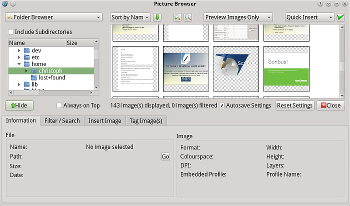
Several features have been added in this release that offer new functionality even though they have not been the subject of repeated feature requests from users. One is the "Picture browser," an asset-management aid that lets users create libraries of tagged images. Later, someone designing a document can open the picture browser, pull up images matching a particular tag, and drag them into the document. This feature has many applications for teams of designers, as well as for those users with a habit of forgetting where they store their images.
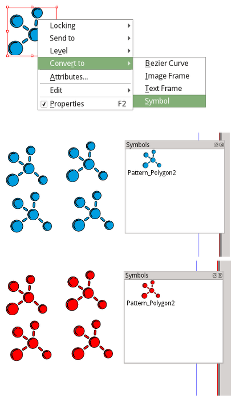
Version 1.5 also adds a "Symbol" feature akin to the "Clone" feature found in Inkscape. Essentially, the user can select an object as the master copy and create linked clones of it; subsequently, whenever the user alters the master, all of the clones get updated as well. Calling this feature "Symbol" is a bit of an odd choice, but it will no doubt come in handy for many.
Many smaller additions make their debut in this release as well: there are now "arc" and "spiral" tools for creating additional vector shapes, there is a drop shadow effect tool (complete with full control over color, opacity, blur, and other parameters), and there is support for gradient fills and color palettes created in other applications (like GIMP and Adobe Photoshop). Several new options for rendering objects are supported, such as transparency and cross-hatch fills.
Finally, the UI itself has been reconfigured in a number of places. The most obvious change is that all tool and option palettes can be docked to the active window, rather than floating (where it often needs to be dragged out of the way). The document preferences dialog has been redesigned, as has the right-click context menu. The release notes say both of these redesigns were undertaken with an eye toward simplification.
It will, however, be up to Scribus users to provide feedback to the project regarding how useful the simplifications are. The project is soliciting such feedback from those willing to test 1.5.0. Most users may be able to get along fine with the stable 1.4.x series, but those who make heavy use of footnotes, tables, and large image collections might just be tempted to make the jump to 1.5 now, stable or otherwise.
Testing the ColorHug 2
Richard Hughes's ColorHug device made a splash in free-software circles when it was released in 2012 (at which point we took a look). Although there were other colorimeters supported by software projects like Argyll CMS, the ColorHug was open hardware designed with first-class Linux support in mind. Users could create color profiles for their displays using free software and free firmware. But the ColorHug had its share of weaknesses, too, and Hughes soon turned his attention to designing a more ambitious spectrometer device. That spectrometer has yet to arrive, so it was a bit of a surprise when, in mid-April, Hughes announced the first test batch of ColorHug 2 devices: a serious refresh of the original ColorHug colorimeter that looks poised to close most of that generation's lingering bugs and feature requests—but without the strikingly higher price tag of a true spectrometer.
To recap, the first ColorHug is a tristimulus colorimeter, which profiles the output of a display device by measuring the color of a bank of on-screen color patches precisely selected to sample the entire color space. The heart of the device is a set of light sensors behind filters that limit them to sensing specific frequency ranges. That works well enough as long as the red, green, and blue sub-pixels of the display device match up with the filters. But the method starts to break down for devices with significantly different sub-pixel components.
That was one of the two major complaints heard about the original ColorHug. It worked great for CRT displays (which are increasingly hard to find) and for many LCD displays with cold-cathode backlights. But it did not produce good results for the distinctly different illumination characteristics of newer LED-backlit LCD monitors. The other issue cited with the original ColorHug device was that it was—by necessity—calibrated against an ideal sRGB color space. For many individual monitors, generating an optimal color profile would require loading a color-correction matrix (CCMX) file to replace the generic sRGB matrix. Unfortunately, creating the CCMX file was not possible using the ColorHug, since that would be akin to trying to measure a ruler with itself—one needs an impartial reference.
Initially, Hughes concluded that the right fix for both problems was to design and build a different class of hardware device altogether, a spectrophotometer (or spectrometer for short). The key difference is the sensor used; a spectrometer measures the entire visible wavelength by breaking the light sample up into a spectrum—like a prism—and then measuring along the whole spectrum. That makes it immune to the differences between the RGB primitives used, whereas if the colorimeter's filters do not line up conveniently with the primitives, the measurements could be garbage. That also makes spectrometers a lot more expensive; at Libre Graphics Meeting 2014, Hughes speculated that such a device could run £300.
That price point did not seem to engender much interest in the community, but Hughes kept looking into it, periodically noting ways to reduce the up-front manufacturing costs. He generally referred to this device as the ColorHug+, but in social media and general conversation others variously called it the ColorHug2 or ColorHug v2, which led to some confusion when Hughes announced something called the ColorHug 2 in April. The announcement may have eluded many readers, because it was posted to the colorhug-users discussion list, rather than on Hughes's blog.
The new device is a prototype; just 24 were built in the initial batch. But it indicates that, regardless of whether or not a spectrometer product is ever released, Hughes has found ways to cope with the original ColorHug's limitations, at least for the majority of users. The ColorHug 2 includes a substantially upgraded color sensor, an on-board temperature sensor, and RAM that allow the firmware to take more complex readings.
The sensor module used in the original ColorHug was the TCS3200. The ColorHug 2 uses a JENCOLOR sensor with spectral sensitivity characteristics that match the CIE 1931 XYZ color space. This color space is specifically tailored to correspond to human vision; while the sensor is still not reading the entire visible spectrum like a spectrometer would, it does produce output that works without a CCMX file and is accurate for any reasonably normal display type. The new sensor also adds nearly $30 (£19) to the price of the device, he said. The prototypes were sold for £75.
The inclusion of a temperature sensor will allow the ColorHug 2 firmware to compensate for readings taken outside of the JENCOLOR sensor's calibrated range. Hughes cites the range at 20 to 40 degrees Celsius, either end of which could be experienced in real-world conditions (although more likely with a laptop being toted from place to place than with a desktop machine kept indoors). Firmware support for the feature is still in development.
Last but not least, the new device should be capable of performing some additional measurements thanks to some on-board RAM. While the first-generation ColorHug could output only instantaneous sensor readings, the new device can measure a display's latency by measuring the time it takes for the pixels to change color. For color purists, the measurement of interest would likely be the rise and fall response times of the display hardware (which could even be different), although interesting data could also be collected about the overall performance of the entire graphics stack in use.
As of today, using the ColorHug 2 is no different from using the original model. The devices are identical in size and function the same way when used with GNOME Color Manager. When the device is attached via USB, the "Calibrate" button in GNOME Color Manager becomes clickable. Creating a color profile involves securing the ColorHug device to the center of the display (a long elastic band is included to help with this, although holding it in place is certainly possible for quick profiles) while the calibration routine cycles through a series of color patches.
The result of the process is a .icc color profile file, which GNOME Color Manager automatically adds to the list of profiles available for the display. It also lists the age of each available profile; re-calibrating periodically is regarded as a good idea since display characteristics degrade over time.
I first attempted to test the ColorHug 2 using the live USB stick included in the package (which was running a beta release of Fedora 22). Unfortunately, this live image did not boot on my machine (which is a problem others have reported as well). Compiling the latest release of colord did not help either, which seems to be related to problems reported with the nouveau video driver: on newer GPUs, nouveau may fail to initiate 3D mode at startup, which prevents GNOME Color Manager from correctly detecting the display.
Ultimately, though, the proprietary NVIDIA driver did work, and allowed me to create a new profile. For the laptop that I tested the device with, the ColorHug 2 profile did not differ significantly from that created with the original ColorHug. For a recently purchased external display, however, the difference was stark, removing a strong teal cast most likely due to the peculiarities of the display's characteristics.
Many users may not be convinced that color calibration is worth the effort, of course—and there is probably little that can be said to change those minds. But for anyone who is interested in display accuracy or in matching the output of multiple monitors, keeping an eye out for the full production run of the ColorHug 2 is a good idea. We may yet see a true spectrometer, which will be a boon for printer calibration and other tasks, but in the meantime, this update of the original ColorHug corrects most of problems users encountered with the original. And, naturally, it will be interesting to see what new firmware features Hughes—and others—manage to come up with to leverage the expanded hardware capabilities.
Micro Python on the pyboard
A 2013 Kickstarter project brought us Micro Python, which is a version of Python 3 for microcontrollers, along with the pyboard to run it on. Micro Python is a complete rewrite of the interpreter that avoids some of the CPython (the canonical Python interpreter written in C) implementation details that don't work well on microcontrollers. I recently got my hands on a pyboard and decided to give it—and Micro Python—a try.
All of the core Python language has been implemented in Micro Python, as well as a number of the standard libraries. Some C-language Python standard modules have not been ported—at least yet. Beyond that, Micro Python developer Damien George has added a library that simplifies access to the pyboard and its peripherals (e.g. LEDs, buttons, accelerometer).
The key to running Python on a microcontroller (such as the STM32F405 used on the pyboard) is to keep memory usage low while still providing good performance. The footprint for Micro Python is 260KB (as detailed in the "official end" message for the Kickstarter back in April), though removing floating point support brings it down to 240KB. A stripped-down version of the interpreter can be as small as 75KB (and run in 8KB of RAM), but leaves out support for SD cards, FAT filesystems, USB serial ports, USB mass storage, and so on.
While Micro Python will run any Python 3.4 code, it is not byte-code compatible with CPython. In particular, it avoids heap allocations for integer operations and for calling methods. Heap allocations inevitably lead to garbage collection, which can cause problems for time-critical processing and for code running from interrupts (since garbage collection is not reentrant).
So Micro Python encodes "small" integers in the top 31 bits of "pointers" on the stack (with the low bit set to one to distinguish them from real pointers). It also adds a new byte code (CALL_METHOD) that retrieves the information it needs from the stack, rather than creating a new object (which requires a heap allocation) as CPython does. The latter is a technique adopted from PyPy. Information about all of this is, unfortunately, buried in the first FAQ entry on the Kickstarter page and is not separately linkable.
Micro Python has four different "emitters" that generate different kinds of code from the compiler. The default byte-code emitter does what its name implies: generates byte codes to run on the Micro Python virtual machine. The other emitters are accessed using Python decorators. The native emitter (@micropython.native) translates each byte code to ARM Thumb (the native code for the pyboard CPU) machine code. The viper emitter (@micropython.viper) also generates ARM Thumb code, but it further optimizes integer operations to bypass the normal Python binary operation runtime code, which speeds things up considerably. Viper does not support all of the Python language, however. The final emitter (@micropython.asm_thumb) allows for inline assembly code using a Python-like syntax. The emitters are detailed in some of the Kickstarter update entries: "The 3 different code emitters", "The 3 different code emitters, part 2", and "Inline assembler".
The emitters are targeted at situations where better performance might be needed for a time-critical section. Both the native and viper emitters generate faster code, but they also generate larger code. Viper actually generates somewhat smaller and faster (sometimes much faster) code than native, but the viper emitter does not support all of the language types and constructs (though it is still under development), so it may not be the best choice for all cases. Using the emitters is as simple as decorating a function:
    @micropython.native
    def foo(bar):
        ...
The asm_thumb emitter allows Micro Python to easily interface with assembly code; it handles putting function arguments into registers according to the ARM embedded-application binary interface (EABI), having the function return the contents of register r0, and so on. Python's syntax is used so that there are no changes needed to the parser to support asm_thumb. Here is a snippet from the example in the Kickstarter update posting:
    @micropython.asm_thumb
    def delay(r0):
        b(loop_entry)      # branch to 'loop_entry'
	label(loop1)       # 'loop1' label
	movw(r1, 55999)    # move 55999 to register 1
	...
Instead of the usual syntax, things like branches, labels, and opcodes are
encoded as functions for the emitter.
The documentation for Micro Python is fairly extensive, covering the standard libraries that come with it, as well as certain libraries that have "micro-fied" in keeping with Micro Python's focus on small size. Beyond that, there are some additional libraries that are not part of the standard Micro Python distribution, but that can be downloaded and added as needed. The documentation also covers the pyboard hardware and the pyb library written to access various features of the device.
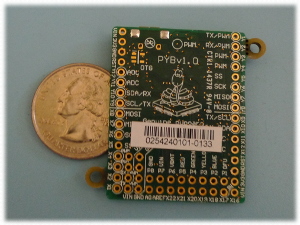
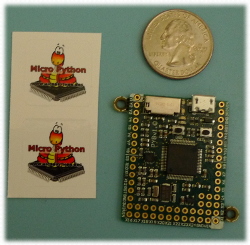
The board itself is perhaps two large postage stamps (or two large coins) in size. It is powered by USB, which also acts as its means of communication (as a serial port and a mass storage device). The device effectively has Python as its operating system; connecting to it with a terminal program leads to a Micro Python prompt. The board can also boot into a Python program by putting a suitable main.py in the boot filesystem.
There are two choices for the boot filesystem, either the small internal partition in the microcontroller's 1MB flash or a micro SD card that has been inserted into a slot on the board. If there is a micro SD card present, it takes precedence. There are also two safe modes that are accessible by holding down buttons at boot time: one that can bypass the startup scripts (both a boot.py and the main.py that get run by default) and another that resets the filesystem in the flash partition to its factory default state.
A third way to run code on the device is to use pyboard.py to transfer a file over the serial connection and run it on the board. So if you get tired of typing a program at the prompt, or uploading it to the flash or SD card and rebooting, you can edit it locally, then send and run it all at once.
The pyboard has two buttons (one reset, RST, and one user definable, USR), four LEDs, an accelerometer, a realtime clock, and 30 general-purpose I/O (GPIO) pins. The pyb library has made it easy to access this functionality. For example:
    Micro Python v1.3.10 on 2015-02-13; PYBv1.0 with STM32F405RG

    >>> leds = [pyb.LED(n) for n in range(1,5)]  # LEDs are numbered 1-4
    >>> for i in range(10):
    ...     for l in leds:
    ...         l.on()
    ...         pyb.delay(1000)
    ...         l.off()
    ...
That program will blink each LED in turn for one second (pyb.delay() is in milliseconds) ten times. A somewhat more complex example reads the USR button to stop the loop:
    >>> sw = pyb.Switch()
    >>> flag = True
    >>> while flag:
    ...     for l in leds:
    ...         l.on()
    ...         pyb.delay(200)
    ...         l.off()
    ...         if sw():
    ...             flag = False
    ...
Hitting the RST button instead of USR (as I did, twice, sadly) will only lead to having to type the code in again (or to using one of the other means for running the code). One final example:
    >>> acc = pyb.Accel()
    >>> while True:
    ...     print(acc.x(), acc.y(), acc.z())
    ...     pyb.delay(200)
    ...
    2 0 22
    -8 5 17
    -11 4 18
    -16 4 12
    ...
The accelerometer returns signed values -30 to 30 for each of the three axes. The accelerometer tutorial page has some additional examples. In fact, the Micro Python tutorial has much of interest (e.g. turning the pyboard into a USB mouse).
Overall, the pyboard is an interesting device to play with. One can imagine various kinds of gadgets that could be built (or prototyped) using it. The recently completed WiPy Kickstarter envisions Micro Python as an entrant into the Internet of Things (IoT) sweepstakes. The Micro Python store also has devices of various sorts that can be hooked up to the pyboard.
Micro Python and the pyboard are in some ways reminiscent of the Python in the GRUB bootloader project (known as the BIOS Implementation Test Suite or BITS) that was presented at PyCon. One big difference is that Micro Python only implements Python 3; another is the size of the systems targeted. But getting a Python prompt when booting a system is a reminder of days gone by—when a BASIC (or DOS) prompt would greet computer users.
There are plenty of other things to investigate with the pyboard: updating the firmware to something more recent than February, for example, or messing around with interrupts from the switch rather than polling. For those looking for an easily programmed microcontroller to use in a project, the pyboard may fit the bill well. As mentioned, the tutorial has some interesting ideas, but others are also starting to use the board (e.g. to control a hexapod robot). The Raspberry Pi and other single-board computers also support Python, of course, but they are a far more heavyweight solution. For smaller tasks, especially those that need to be battery operated, the pyboard is definitely an attractive option.
Security
Chromium suddenly starts downloading a binary blob
A Debian bug that was filed at the end of May serves as a reminder that even open-source software is not immune to some of the problems of proprietary software. In this case, Chromium 43 was silently downloading a browser extension to enable the "OK Google" voice activation "feature" of the browser, which is somewhat reminiscent of the various sideloading schemes that plague downloads of "free" software, particularly on Windows. The download was a binary blob, of course, so its contents cannot be vetted in any real sense. As might be guessed, Debian developers were not amused, but it should also serve as a bit of a wakeup call to all of the free-software world.
The extension in question is called "Chrome Hotword" and the download is a native client (NaCl) shared module that includes executable content. Starting with version 43, Chromium could only be built with the extension, which would download the shared module at its first opportunity—all without user intervention or notification. Perhaps even weirder still, the extension did not show up in the usual chrome://extensions/ page. Its controls were available at chrome://voicesearch/, but users have to know it was installed and where to find that page.
To summarize, a popular open-source web browser does a surreptitious download of a program and hides the download and the existence of the program from the user. Even if the binary only does what it is purported to do, it can turn on the microphone and upload what it hears to a remote site to search for a key phrase. That description sounds a lot like one for the latest malware outbreak—or National Security Agency (NSA) eavesdropping program.
It is not (yet) clear how this came about—prosaic explanations seem most likely, in truth—but it did make its way into Debian unstable without being noticed. It was reported to the Chromium team on May 22 and fixed by adding a build option to disable the Hotword extension on June 9. The extension is still enabled by default, though, so builders who don't want that functionality need to turn it off before starting the build. By June 15, Debian had done just that and updated its version of Chromium.
There is plenty to be disturbed about here, but it seems pretty unlikely this was some deliberate scheme by Google (or the Chromium team). It would be hard to hide something like that in an open-source program like Chromium. But it is clear that the amount of independent review of the changes going into Chromium is less than what we might hope for. The value of open source is lessened if "many eyes" really turns out to be "zero eyes".
The contents of the executable should also be scrutinized, but there is no real way to do that. Even if Google is completely trustworthy with respect to what the program does (and there is no reason to believe it isn't) it is still a bit worrisome that your browser can simply execute whatever code its corporate master orders it to. Though, in some ways, that isn't terribly different from Flash or JavaScript. We are increasingly required to trust the various sites, companies, and organizations that we deal with on a daily basis on today's internet.
Given the way Chromium uses certificate pinning, a man in the middle would not have been able to deliver some other version of NaCl executable. It should be noted that locally stored root certificates for proxies and the like are not subject to pinning, though. It's a pretty far-fetched attack mechanism, since having access to install certificates locally would allow anything else to be installed at the same time. Being able to sign certificates for any site and have them accepted by all of the affected browsers would also seem to provide endless avenues of exploitation.
This incident is a little disheartening, overall. The web is a big, scary place these days; we depend on browsers that are working to protect their users. Undoubtedly Google doesn't see this executable download as a violation of that—rather it is probably seen as a nifty feature—but many outside the Googleplex quite reasonably disagree. As long as we have the source, and are vigilant about reviewing it, we can be reasonably assured of having browsers (and other programs) that do protect their users. That may, at some point, require a fork-and-rebrand effort for a browser or other open-source project if the organization developing it won't back down from some kind of anti-feature. Thankfully, that seems to be a problem for down the road—if ever.
Brief items
Security quotes of the week
It's bad enough when the ever more censorship and surveillance loving Western leaders have this kind of power. But how about Vladimir Putin, or China's rulers, or Iran's Supreme Leader as GLOBAL censors?
It wouldn't be long before it would seem that every search on any controversial topic might as well be replaced with a "404 Not found" page -- a rush to lowest common denominator mediocrity, purged of any and all information that government leaders, politicians, or bureaucrats would prefer people not be able to find and see.
The hidden costs of embargoes (Red Hat Security Blog)
Over at the Red Hat Security Blog, Kurt Seifried looks at the costs of security embargoes. Keeping the information about security vulnerabilities quiet until distributions can coordinate their releases of a fix for it seems like it makes a lot of sense, but there are hidden costs to that. "Patch creation with an embargoed issue means only the researcher and upstream participating. The end result of this is often patches that are incomplete and do not fully address the issue. This happened with the Bash Shellshock issue (CVE-2014-6271) where the initial patch, and even subsequent patches, were incomplete resulting in several more CVEs (CVE-2014-6277, CVE-2014-6278, CVE-2014-7169). For a somewhat complete listing of such examples simply search the CVE database for 'because of an incomplete fix for'."
New vulnerabilities
aptdaemon: information leak
| Package(s): | aptdaemon | CVE #(s): | CVE-2015-1323 | ||||||||||||
| Created: | June 17, 2015 | Updated: | July 6, 2015 | ||||||||||||
| Description: | From the Ubuntu advisory:
Tavis Ormandy discovered that Aptdeamon incorrectly handled the simulate dbus method. A local attacker could use this issue to possibly expose sensitive information, or perform other file access as the root user. | ||||||||||||||
| Alerts: |
| ||||||||||||||
armacycles-ad: multiple vulnerabilities
| Package(s): | armacycles-ad | CVE #(s): | |||||||||||||
| Created: | June 15, 2015 | Updated: | June 17, 2015 | ||||||||||||
| Description: | From the Fedora advisory:
Changes since 0.2.8.3.2:
| ||||||||||||||
| Alerts: |
| ||||||||||||||
cabal-install: force digest authentication
| Package(s): | cabal-install | CVE #(s): | |||||||||
| Created: | June 11, 2015 | Updated: | June 17, 2015 | ||||||||
| Description: | From the Fedora advisory:
Force cabal upload to always use digest auth and never basic auth | ||||||||||
| Alerts: |
| ||||||||||
coreutils: memory handling error
| Package(s): | coreutils,coreutils-testsuite | CVE #(s): | CVE-2015-4041 CVE-2015-4042 | ||||||||
| Created: | June 15, 2015 | Updated: | July 6, 2015 | ||||||||
| Description: | From the openSUSE bug report:
On 64-bit (not on 32-bit) OpenSUSE 13.2 when running command LANG=en_US.UTF-8 sort -f sort_bug_caseinsensitive.txt I get the following error (remark: changing a single character in the file to sort won't show the error anymore; the same is true for not case-insensitive search, no UTF-8 or not running on 64-bit) | ||||||||||
| Alerts: |
| ||||||||||
filezilla: multiple vulnerabilities
| Package(s): | filezilla | CVE #(s): | |||||
| Created: | June 15, 2015 | Updated: | June 17, 2015 | ||||
| Description: | From FileZilla:
2015-06-12 - FileZilla Server 0.9.53 released Bugfixes and minor changes: Updated OpenSSL to 1.0.2b due to several security vulnerabilities in OpenSSL | ||||||
| Alerts: |
| ||||||
freecad: code execution
| Package(s): | freecad | CVE #(s): | |||||
| Created: | June 11, 2015 | Updated: | June 17, 2015 | ||||
| Description: | From the Red Hat bugzilla entry:
It was reported that FreeCAD downloads and executes code (e.g. ArchCommands.py) from the network, from https. This uses urllib2, which does not check https certificates. The files that are downloaded occur when attempting to activate non-present module features, such as via opening a DXF file. This can allow Man-in-the-Middle attack, leading to code execution. | ||||||
| Alerts: |
| ||||||
kernel: privilege escalation
| Package(s): | kernel | CVE #(s): | CVE-2015-1328 | ||||||||||||||||||||||||||||||||||||||||||||||||||||||||
| Created: | June 16, 2015 | Updated: | June 23, 2015 | ||||||||||||||||||||||||||||||||||||||||||||||||||||||||
| Description: | From the Ubuntu advisory:
Philip Pettersson discovered a privilege escalation when using overlayfs mounts inside of user namespaces. A local user could exploit this flaw to gain administrative privileges on the system. | ||||||||||||||||||||||||||||||||||||||||||||||||||||||||||
| Alerts: |
| ||||||||||||||||||||||||||||||||||||||||||||||||||||||||||
kernel: multiple vulnerabilities
| Package(s): | linux-2.6 kernel | CVE #(s): | CVE-2011-5321 CVE-2012-6689 CVE-2014-9728 CVE-2014-9729 CVE-2014-9730 CVE-2014-9731 CVE-2015-4167 | ||||||||||||||||||||||||||||||||||||||||||||||||||||||||||||||||||||
| Created: | June 17, 2015 | Updated: | June 17, 2015 | ||||||||||||||||||||||||||||||||||||||||||||||||||||||||||||||||||||
| Description: | From the Debian LTS advisory:
CVE-2011-5321: Jiri Slaby discovered that tty_driver_lookup_tty() may leak a reference to the tty driver. A local user could use this flaw to crash the system. CVE-2012-6689: Pablo Neira Ayuso discovered that non-root user-space processes can send forged Netlink notifications to other processes. A local user could use this flaw for denial of service or privilege escalation. CVE-2014-9728 / CVE-2014-9729 / CVE-2014-9730 / CVE-2014-9731 / CVE-2015-4167: Carl Henrik Lunde discovered that the UDF implementation is missing several necessary length checks. A local user that can mount devices could use these various flaws to crash the system, to leak information from the kernel, or possibly for privilege escalation. | ||||||||||||||||||||||||||||||||||||||||||||||||||||||||||||||||||||||
| Alerts: |
| ||||||||||||||||||||||||||||||||||||||||||||||||||||||||||||||||||||||
libav: unspecified vulnerability
| Package(s): | libav | CVE #(s): | CVE-2015-3395 | ||||||||||||||||
| Created: | June 15, 2015 | Updated: | June 17, 2015 | ||||||||||||||||
| Description: | From the libav changelog:
msrle: Use FFABS to determine the frame size in msrle_decode_pal4 | ||||||||||||||||||
| Alerts: |
| ||||||||||||||||||
libreswan: denial of service
| Package(s): | libreswan | CVE #(s): | CVE-2015-3204 | ||||||||||||||||||||||||||||||||
| Created: | June 11, 2015 | Updated: | June 25, 2015 | ||||||||||||||||||||||||||||||||
| Description: | From the Red Hat bugzilla entry:
A denial of service flaw was found when assembling a log message regarding invalid bit names (caused by a fuzzer setting all of them, and our bitnames buffer being too small). On libreswan, this hits a passert() and causes the daemon to restart. | ||||||||||||||||||||||||||||||||||
| Alerts: |
| ||||||||||||||||||||||||||||||||||
openssl: multiple vulnerabilities
| Package(s): | openssl | CVE #(s): | CVE-2015-1788 CVE-2015-1789 CVE-2015-1790 CVE-2015-1791 CVE-2015-1792 | ||||||||||||||||||||||||||||||||||||||||||||||||||||||||||||||||||||||||||||||||||||||||||||||||||||||||||||||||||||||||||||||||||||||||||||
| Created: | June 12, 2015 | Updated: | June 24, 2015 | ||||||||||||||||||||||||||||||||||||||||||||||||||||||||||||||||||||||||||||||||||||||||||||||||||||||||||||||||||||||||||||||||||||||||||||
| Description: | From the Arch Linux advisory: CVE-2015-1788 (denial of service) - When processing an ECParameters structure OpenSSL enters an infinite loop if the curve specified is over a specially malformed binary polynomial field. This can be used to perform denial of service against any system which processes public keys, certificate requests or certificates. This includes TLS clients and TLS servers with client authentication enabled. CVE-2015-1789 (out-of-bounds read) - X509_cmp_time does not properly check the length of the ASN1_TIME string and can read a few bytes out of bounds. In addition, X509_cmp_time accepts an arbitrary number of fractional seconds in the time string. An attacker can use this to craft malformed certificates and CRLs of various sizes and potentially cause a segmentation fault, resulting in a DoS on applications that verify certificates or CRLs. TLS clients that verify CRLs are affected. TLS clients and servers with client authentication enabled may be affected if they use custom verification callbacks. CVE-2015-1790 (denial of service) - The PKCS#7 parsing code does not handle missing inner EncryptedContent correctly. An attacker can craft malformed ASN.1-encoded PKCS#7 blobs with missing content and trigger a NULL pointer dereference on parsing. Applications that decrypt PKCS#7 data or otherwise parse PKCS#7 structures from untrusted sources are affected. OpenSSL clients and servers are not affected. CVE-2015-1791 (double free) - If a NewSessionTicket is received by a multi-threaded client when attempting to reuse a previous ticket then a race condition can occur potentially leading to a double free of the ticket data. CVE-2015-1792 (denial of service) - When verifying a signedData message the CMS code can enter an infinite loop if presented with an unknown hash function OID. This can be used to perform denial of service against any system which verifies signedData messages using the CMS code. | ||||||||||||||||||||||||||||||||||||||||||||||||||||||||||||||||||||||||||||||||||||||||||||||||||||||||||||||||||||||||||||||||||||||||||||||
| Alerts: |
| ||||||||||||||||||||||||||||||||||||||||||||||||||||||||||||||||||||||||||||||||||||||||||||||||||||||||||||||||||||||||||||||||||||||||||||||
openssl: code execution
| Package(s): | openssl | CVE #(s): | CVE-2014-8176 | ||||||||||||||||||||||||||||||||||||||||||||||||||||
| Created: | June 12, 2015 | Updated: | June 17, 2015 | ||||||||||||||||||||||||||||||||||||||||||||||||||||
| Description: | From the Ubuntu advisory: Praveen Kariyanahalli, Ivan Fratric and Felix Groebert discovered that OpenSSL incorrectly handled memory when buffering DTLS data. A remote attacker could use this issue to cause OpenSSL to crash, resulting in a denial of service, or possibly execute arbitrary code. | ||||||||||||||||||||||||||||||||||||||||||||||||||||||
| Alerts: |
| ||||||||||||||||||||||||||||||||||||||||||||||||||||||
openssl: denial of service
| Package(s): | openssl | CVE #(s): | CVE-2015-3216 | ||||||||||||||||||||||||||||||||||||||||||||||||||||||||
| Created: | June 16, 2015 | Updated: | June 17, 2015 | ||||||||||||||||||||||||||||||||||||||||||||||||||||||||
| Description: | From the Red Hat advisory:
A flaw was found in the way the OpenSSL packages shipped with Red Hat Enterprise Linux 6 and 7 performed locking in the ssleay_rand_bytes() function. This issue could possibly cause a multi-threaded application using OpenSSL to perform an out-of-bounds read and crash. | ||||||||||||||||||||||||||||||||||||||||||||||||||||||||||
| Alerts: |
| ||||||||||||||||||||||||||||||||||||||||||||||||||||||||||
p7zip: directory traversal
| Package(s): | p7zip | CVE #(s): | CVE-2015-1038 | ||||||||||||||||||||||||
| Created: | June 15, 2015 | Updated: | December 21, 2015 | ||||||||||||||||||||||||
| Description: | From the Debian LTS advisory:
Alexander Cherepanov discovered that p7zip is susceptible to a directory traversal vulnerability. While extracting an archive, it will extract symlinks and then follow them if they are referenced in further entries. This can be exploited by a rogue archive to write files outside the current directory. | ||||||||||||||||||||||||||
| Alerts: |
| ||||||||||||||||||||||||||
php5: information disclosure
| Package(s): | php5 | CVE #(s): | CVE-2015-4148 | ||||||||||||||||||||||||||||||||||||||||||||||||||||
| Created: | June 15, 2015 | Updated: | June 17, 2015 | ||||||||||||||||||||||||||||||||||||||||||||||||||||
| Description: | From the CVE entry:
The do_soap_call function in ext/soap/soap.c in PHP before 5.4.39, 5.5.x before 5.5.23, and 5.6.x before 5.6.7 does not verify that the uri property is a string, which allows remote attackers to obtain sensitive information by providing crafted serialized data with an int data type, related to a "type confusion" issue. | ||||||||||||||||||||||||||||||||||||||||||||||||||||||
| Alerts: |
| ||||||||||||||||||||||||||||||||||||||||||||||||||||||
tidy: buffer overflow
| Package(s): | tidy | CVE #(s): | |
| Created: | June 12, 2015 | Updated: | July 6, 2015 |
| Description: | From the Tidy CVE request: Tidy is affected by a write out of bounds when processing malformed html files. This issue could be abused on server side applications that use php-tidy extension with user input. | ||
| Alerts: | (No alerts in the database for this vulnerability) | ||
wpa: denial of service
| Package(s): | wpa wpasupplicant hostapd | CVE #(s): | CVE-2015-4144 CVE-2015-4145 CVE-2015-4146 | ||||||||||||||||
| Created: | June 17, 2015 | Updated: | June 17, 2015 | ||||||||||||||||
| Description: | From the Ubuntu advisory:
Kostya Kortchinsky discovered multiple flaws in wpa_supplicant and hostapd. A remote attacker could use these issues to cause wpa_supplicant or hostapd to crash, resulting in a denial of service. | ||||||||||||||||||
| Alerts: |
| ||||||||||||||||||
wpa_supplicant: two vulnerabilities
| Package(s): | wpa_supplicant | CVE #(s): | CVE-2015-4141 CVE-2015-4143 | ||||||||||||||||||||||||
| Created: | June 11, 2015 | Updated: | June 17, 2015 | ||||||||||||||||||||||||
| Description: | From the openSUSE advisory:
CVE-2015-4141: WPS UPnP vulnerability with HTTP chunked transfer encoding (boo#930077) CVE-2015-4143: EAP-pwd missing payload length validation (boo#930079) | ||||||||||||||||||||||||||
| Alerts: |
| ||||||||||||||||||||||||||
xen: multiple vulnerabilities
| Package(s): | Xen | CVE #(s): | CVE-2015-4163 CVE-2015-4164 | ||||||||||||||||||||||||||||||||||||||||||||||||||||||||||||
| Created: | June 12, 2015 | Updated: | June 24, 2015 | ||||||||||||||||||||||||||||||||||||||||||||||||||||||||||||
| Description: | From the Xen advisories: CVE-2015-4163 - With the introduction of version 2 grant table operations, a version check became necessary for most grant table related hypercalls. The GNTTABOP_swap_grant_ref call was lacking such a check. As a result, the subsequent code behaved as if version 2 was in use, when a guest issued this hypercall without a prior GNTTABOP_setup_table or GNTTABOP_set_version. The effect is a possible NULL pointer dereferences. However, this cannot be exploited to elevate privileges of the attacking domain, as the maximum memory address that can be wrongly accessed this way is bounded to far below the start of hypervisor memory. CVE-2015-4164 - A buggy loop in Xen's compat_iret() function iterates the wrong way around a 32-bit index. Any 32-bit PV guest kernel can trigger this vulnerability by attempting a hypercall_iret with EFLAGS.VM set. Given the use of __get/put_user(), and that the virtual addresses in question are contained within the lower canonical half, the guest cannot clobber any hypervisor data. Instead, Xen will take up to 2^33 pagefaults, in sequence, effectively hanging the host. | ||||||||||||||||||||||||||||||||||||||||||||||||||||||||||||||
| Alerts: |
| ||||||||||||||||||||||||||||||||||||||||||||||||||||||||||||||
Page editor: Jake Edge
Kernel development
Brief items
Kernel release status
The current development kernel is 4.1-rc8, released on June 14. "So I'm on vacation, but time doesn't stop for that, and it's Sunday, so time for a hopefully final rc."
Stable updates: none have been released in the last week.
Quotes of the week
    +		/*
    +		 * That should not fail at boot due to OOM, and it'll
    +		 * already warn if we somehow get two identical names,
    +		 * but this one line should quiet both gcc and lkml.
    +		 */
Kernel development news
Greybus
A little while back, Greg Kroah-Hartman was given an opportunity to work on an interesting problem. Project Ara is developing a phone handset that can be assembled (and customized) from a range of components; these components include speakers, displays, cameras, interesting sensors, and more. Making this work requires an internal bus that can handle devices that may come and go at any time — something that cellphones have not needed up to this point. Greg's job was to help to bring that bus into being; the result was "Greybus," which was the subject of Greg's LinuxCon Japan talk.Project Ara imposes some interesting requirements on its internal bus. Beyond being dynamic, the bus must be routable and secure; in other words, any two components on the bus must be able to communicate directly with each other, without any other component being able to listen in. As a result, standard buses like USB and PCIe are not suitable. After some searching, Greg and company came across the UniPro bus, which seems to fit the bill.
UniPro has its origins in Nokia, which wanted a way to be able to easily
integrate cameras from any vendor. Google then picked it up and made it
routable. At this point, Greg said, it is fast and mature. It promises
low latency, has low-power modes and quality-of-service features, and
 promises in-order message delivery. The standards
have been out there for a while; they are driven by the MIPI Alliance.
Everything on UniPro happens by way of bidirectional connections that pass directly from one component to another; data does not pass through the processor. A connection is represented by a "CPort," which looks a lot like a network socket. There is a switch on the bus that sets up the actual routes. Messages can pass at a rate of around 10Gb/s; the bus also has message prioritization, error handling, and notification of delivery problems. What UniPro does not do is streams or multicast delivery; Greg suggested the latter was a good non-feature, since it prevents modules from sniffing unrelated traffic.
UniPro adheres to the OSI network model, except that it has no application layer defined. So the Project Ara developers made their own, which they called Greybus. (The name evidently comes from the gray color of the original prototype device; nobody has since come up with a better one). Greybus adds device discovery; all modules on the bus are self-describing. There are, it seems, advantages when the people who have to make the software side work get a say in how the hardware is designed.
Greybus also adds a network routing layer internally and a set of class protocols for specific device types. This is something that USB and PCI got right, Greg said. When they adhere to the class protocols, devices like keyboards or WiFi adapters just work with no additional software development needed. This is important for Project Ara; it would like to see a lively market in third-party modules, and that is much more likely to happen if new modules simply work in existing systems.
Each device on the bus offers a description to the rest of the system; it includes vendor and product IDs, a serial number, the protocols used, etc. Each module (a physical thing plugged into the phone) offers one or more "interfaces," each of which is a physical connection. CPort 0 on each interface controls the interface as a whole; other CPorts offer the actual functionality and will be what the kernel normally talks to. Those CPorts support "operations," which are a way of getting a module to do something using an interface that resembles a remote procedure call API.
Currently a number of protocol classes have been implemented; these include the battery, vibrator, and near-field communications classes. Others, including audio, input, sensors, and cameras, are in progress. There are a few that have been left for later, including WiFi, Bluetooth, cellular modems, GPS receivers, lights, and the display — which, Greg suggested, will be a fair amount of work.
Also built into Greybus is the ability to bridge other protocols. So, for example, devices speaking protocols like USB, I2C, I2S, or SPI can be driven directly over the bus. There is also support for tunneling protocols like CSI (for cameras) or DSI (for displays).
Greg concluded by noting that the code is all available in the Greybus GitHub repository. It represents a piece of the Project Ara puzzle, but not the whole solution. In particular, making this device successful will require turning Android into a much more dynamic system; it is the same challenge that Linux distributors dealt with ten or fifteen years ago. It's a big job, but developers at Google are working on it. Once they are done (and the hardware is available), we will have stepped into a world where phone handsets are far more dynamic and configurable than they have been in the past.
Greg let people look at his prototype handset after the talk. It consisted of a chassis into which a number of postage-stamp-sized modules could be plugged. It was a nice-looking device, though the chassis seems like it will always force the device to be a bit fatter and heavier than less configurable devices. Suffice to say your editor wants one.
[Your editor would like to thank the Linux Foundation for supporting his travel to LinuxCon Japan.]
Writeback and control groups
"Writeback" is the process of writing dirty pages in memory back to permanent storage. It is a tricky job; the kernel must arbitrate the use of limited I/O bandwidth while ensuring that the system is not overwhelmed by dirty pages. Some years ago, writeback was a perennial discussion topic at gatherings of memory-management developers; the kernel did not do as good a job as anybody would have liked. Those problems have, for the most part, been solved in recent years — until one adds control groups into the mix. A solution to that problem is in the works, though, and should be hitting the mainline in the near future.
Tejun Heo took some time to discuss the current situation during his
LinuxCon Japan talk. The memory-management subsystem will, by default, try
to limit dirty pages to a maximum of 15% of the memory on the system.
There is a "magical function" called balance_dirty_pages() that
will, if need be, throttle processes dirtying a lot of pages in order to
match the rate at which pages are being dirtied and the rate at which they
 can be cleaned. It works reasonably well in current kernels, but it only
operates globally; it is not equipped to deal with control groups.
On the control group side, the memory controller can regulate the amount of memory that is available to any given group, while the block controller is in charge of regulating I/O bandwidth use. Writeback is clearly related to both memory use and I/O bandwidth, but the control-group mechanism offers no way to enable controllers to work together — so these two controllers don't. The result, Tejun said, is a "really sad situation."
The memory controller currently tags pages in memory with owner information so that it knows which control group to charge for each page. The block controller is unable to use that information, though, so it has no way of knowing which control group to charge for writeback I/O traffic. So control groups do not use the system's global throttling mechanism at all; instead, there is a "hacky" mechanism built into the memory controller itself that, according to Tejun, "does not throttle anything effectively." It ignores the global dirty-page watermarks that control throttling and is, he said, "completely broken." There has been talk of fixing the situation for at least five years but nothing has been done, leading to a certain amount of frustration.
Fixing writeback in control groups
So Tejun set out to deal with the problem. His approach is driven by the idea that control-group features should not need completely new mechanisms for their implementation — writeback control in control groups should use the same mechanism that the system as a whole uses. The global mechanism should just be a degenerate form of the single-group case.
There are two structures involved in writeback control in the kernel. struct backing_dev_info contains information about a specific device to which dirty pages are being written; it tracks the observed I/O bandwidth of the device and how it is being used. The bdi_writeback structure, instead, regulates writeback activity in particular. There is currently a single bdi_writeback structure for each backing_dev_info structure, and the separation of their roles is somewhat fuzzy. (Both of these structures are defined in include/linux/backing-dev.h)
One of the first things Tejun's control-group writeback support patch set does is to move more writeback-specific information from struct backing_dev_info into the bdi_writeback structure. That structure then goes from a single instance per device to one instance for each control group, allowing for each group to be regulated separately. balance_dirty_pages() is changed to use the per-group bdi_writeback structure, as are other pieces of the writeback-control mechanism. Tejun described it as being mostly "a giant plumbing job."
Details
The completion of that plumbing job allows the block bandwidth controller to regulate writeback I/O, but it is missing an important piece: the throttling of processes that are dirtying more memory than can be cleaned within their group's I/O bandwidth limits. Or, more precisely, while the system can throttle processes when the global dirty-page limit is reached, it cannot throttle those that have dirtied too much of the memory that is available to their specific control group. Solving that problem is the subject of a separate patch set adding per-group throttling.
This patch set adds a new structure (struct wb_domain) for the control of dirty-page throttling. There is one global domain that implements the "15% of total memory" limit that exists in current kernels. Each control group gets its own wb_domain structure as well, to enforce limits specific to that group. When the memory-management code computes the number of pages that a process within a specific group is allowed to dirty, it looks at both the global and per-group wb_domain structures and uses the more restrictive of the two. A process will never be allowed to exceed the number of dirty pages allowed to its control group, but that limit may be lowered if the system as a whole has a lot of dirty pages.
That is still not a complete solution to the problem, though. The writeback mechanism uses the inode (open file) as its fundamental unit of control, while the memory controller applies limits on a per-page basis. Tejun explained that each makes sense within its own context, but there is a mismatch between the two that makes it harder to make those mechanisms work well together.
The writeback mechanism is designed to focus on a single inode at a time; among other things, writing out all of a single file's dirty pages together tends to improve disk I/O locality. When the I/O bandwidth controller first sees writeback activity for an inode, it assigns "ownership" of the inode to the control group responsible for that activity. Thereafter, all writeback activity for that inode is charged to that control group, regardless of who actually dirtied the pages. Tejun looked into making the accounting more fine-grained but, he said, the result was far too complex and wasn't worth it. In the end, one control group is usually responsible for the majority of writeback traffic to any given file.
There is still a problem, though, that the initial assignment of responsibility for any given file might be incorrect. Or the file could move from one control group to another over time. In either case, the result could be that one group finds itself charged for large amounts of writeback created by another group entirely.
To resolve that issue, Tejun has posted yet another patch set adding "foreign cgroup inode bdi_writeback switching." This mechanism watches the ownership of the pages (as tracked by the memory controller) being written back to each inode. Using the Boyer-Moore majority vote algorithm, it decides which control group is responsible for the most I/O traffic. If most traffic originates in a group other than the owner of that inode, and that pattern holds for a period of time (two seconds, in the current patch), the ownership of the inode will be switched to the new "winner". Over time, that mechanism should ensure that writeback I/O traffic is charged correctly without adding the need to track things on a sub-inode level.
As for the status of all this work: Tejun said that it works and is currently slated for the 4.2 merge window. That said, it is still experimental and there are probably some issues to be shaken out. At the time of the talk, only the ext2 filesystem was supported; since then, ext4 support has been posted as well. Each filesystem will require changes to support the new writeback mechanism, but the changes tend to be quite small. Getting those pieces into place should not take too long; then, once this work stabilizes, another longstanding Linux memory-management shortcoming should be no more.
[Your editor would like to thank the Linux Foundation for supporting his travel to LinuxCon Japan.]
Leap-second issues, 2015 edition
The leap second is an occasional ritual wherein Coordinated Universal Time (UTC) is held back for one second to account for the slowing of the Earth's rotation. The last leap second happened on June 30, 2012; the next is scheduled for June 30 of this year. Leap seconds are thus infrequent events. One might easily imagine that infrequent events involving time discontinuities would be likely to expose software problems, and, sure enough, the 2012 leap second had its share of issues. The 2015 leap second looks to be a calmer affair, but it appears that it will not be entirely problem-free.Prarit Bhargava reported a problem at the end of May: it seems that, when the leap second hits, some timers can fire one second earlier than they should. This is not a good outcome; timers can be delayed, but they should never fire before their appointed time. It did not take long to understand the problem, but finding a proper solution was a rather slower task.
Linux handles leap seconds in the kernel. An application (typically the network time protocol (NTP) daemon) informs the kernel of an upcoming leap second via the adjtimex() system call; when the appointed time arrives, the system clock will be set back by one second. There is an important detail in all of this, though: this adjustment happens during the normal timer tick. The tick is not precisely lined up with the second boundaries as determined by UTC, so there is a window of time between the beginning of the leap second and when the kernel figures out that it needs to hold the clock back. The window is brief (a maximum of about 10ms, usually shorter), but that's enough time for timers set for just after midnight to fire.
One might argue that one second every few years is not a big problem, and that applications that really care should be using the International Atomic Time (TAI) clock anyway. There are applications with precise timekeeping requirements; some of them are certainly using the UTC clock rather than TAI, but they should work anyway if possible. So this seems like a problem worth fixing.
John Stultz's first attempt at providing
that fix did not go entirely well, though. In particular, the patch that moved the leap-second adjustments
into the timer fast-path code ran into opposition. The patch added some
significant complexity to code that is already far from simple, and it
threatened to slow down some of the most frequently exercised code in the
kernel. The loudest opposition came from
Ingo Molnar, who asked: "why do we add over 100 lines of
code for something that occurs (literally) once in a blue moon?
"
Ingo's suggestion was to implement leap-second smearing instead. The smearing approach does away with the time discontinuity by tweaking the speed of the clock instead; it would handle a leap second insertion by running the clock just a little slower for a number of hours prior to the event. There are no abrupt time transitions, and no weird times (like 23:59:60) that applications may not be prepared to deal with. It could, Ingo said, also be handled almost entirely from user space via adjtimex(), allowing administrators to control policy and getting the kernel out of the leap-second business entirely.
In truth, life is not so simple. Clocks that do not have leap seconds (the TAI clock in particular) should not smear, so the kernel would have to stay involved and it would have to maintain time bases running at different speeds while the smearing was happening. As John noted, that does not look like a path leading to lower levels of complexity. He argued that, while smearing looks like a worthwhile thing to add to the kernel, it does not address the immediate problem.
Ingo also argued that the leap-second code
should not support leap-second deletion, where the clock is set
ahead by one second. Deletion has never happened, and, when one
looks at the physical processes involved in the slowing of the Earth's
rotation, it seems like it probably never will ("discounting massive
asteroid strikes, at which point leap seconds will be the least of our
problems
"). Other operating systems are unlikely to handle deletion
gracefully; if they support it at all, it is with code that has never been
exercised in the real world. The adjtimex() interface allows for
it, though, so John argues that it should be supported; the code is already
there and seems unlikely to be removed.
After the discussion calmed down, John came back with a reduced patch set limited to the essential fix. In this version of the patch, the timer code does the leap-second adjustment early enough to avoid premature timer expirations; one might suggest that the new timer code looks before it leaps. The rest of the code remains untouched, though, so the performance impact of the change is minimal. This version found a friendlier reception; it has been added to the "tip" tree for merging into the 4.2 kernel.
As of this writing, the leap-second insertion is less than two weeks away, so John's fix is clearly not destined to be deployed worldwide before that happens. But getting it into the mainline now will ensure that it's running on at least some development systems when the leap second hits, giving it a certain amount of real-world testing. That should increase confidence in the correctness of the patch and help to ensure that, when the next leap second is declared, the kernel will handle it properly.
Patches and updates
Kernel trees
Architecture-specific
Core kernel code
Device drivers
Device driver infrastructure
Filesystems and block I/O
Memory management
Networking
Security-related
Virtualization and containers
Miscellaneous
Page editor: Jonathan Corbet
Distributions
The costs of forks
The perils of code forks are well-known within free software communities: as the code diverges, fixes and new features are only applied to one branch or the other, which leads to further divergence—and bugs that persist far too long. The Fuel project, which is a graphical user interface (GUI) to help deploy, test, and manage OpenStack installations, has seemingly learned that lesson anew.
A request from Emilien Macchi for more collaboration between Fuel and the Puppet OpenStack project kicked off the discussion. Puppet is a configuration management utility that is used by Fuel to assist in deploying OpenStack. But Fuel has forked some of the Puppet modules it uses from the Puppet OpenStack project—which creates Puppet modules for OpenStack components—into its Fuel Library repository. Macchi noted a number of problems with how that has been handled over the last two years.
He listed three areas of concern. Bugs are reported against Fuel and fixed there, but the fixes fail to propagate back to the Puppet OpenStack modules. Sometimes fixes are submitted to Puppet OpenStack, but without tests and without any push to get them committed because they have already been fixed in Fuel. Finally, code is moving from the modules into Fuel but not using mechanisms that would maintain the history and author attribution of the patches (e.g. using Git merges). Macchi suggested that working together would be beneficial:
Matthew Mosesohn explained that
Fuel was acting similar to other OpenStack projects with regard to forking
and bundling other components into its repositories. It may not be "the
most community-oriented approach
", but it is part of what allowed
Fuel to stabilize and mature, he said.
The directory structure in the Fuel Library makes it difficult to directly
merge from the upstream modules, he said.
Fixes not flowing from Fuel to Puppet OpenStack is a problem, Mosesohn
continued.
The Fuel team has a policy adopted
back in October that patches to the Puppet OpenStack modules will not be
merged unless they have been
submitted upstream or an upstream bug has been filed. Lastly, he suggested
that bugs
found in the modules that had already been reported or fixed in Fuel should
result in a ping on the Fuel IRC channel "and we can try to
figure out how to get this applied upstream correctly
".
But Thomas Goirand (and others) found that to be a bit backward. Fuel is the downstream project and should pursue an "upstream first" strategy:
For his part, Macchi welcomed the discussion, but also felt that Mosesohn and the Fuel project were approaching the problems from the wrong direction.
Macchi and Dmitry Borodaenko (who picked up the discussion on the Fuel project's side) seem to have a fundamental disagreement about two things. Macchi is unhappy that the commit history is getting lost when Fuel does large copy-and-paste patches from the Puppet modules; he mentions possible license issues, but that is really a red herring, as Borodaenko pointed out. However, as James Bottomley described, forks of that nature build up a huge technical debt that can be enormously expensive to unwind:
The other area of contention is about what level of responsibility the Fuel project and its developers should have to not simply submit their patches upstream, but to respond to the comments, respin the patches, and shepherd them through the process of getting them into Puppet OpenStack. Borodaenko suggested that the Puppet OpenStack team take over that role as needed. He asked about finding a middle ground, perhaps:
But Macchi would rather see Fuel developers working in the upstream project. The Puppet OpenStack team would be happy to help Fuel developers get involved with its community, as that was Macchi's goal in starting the thread. But the team does not just want to pick up whatever Fuel submits:
This is definitely not how OpenStack works.
As it turns out, the divide is not as big as it might seem. Borodaenko is on-board with the overall goal of having Fuel use the upstream Puppet OpenStack modules directly; the difference is mostly about how to get there. In fact, he advocated working more closely with the Puppet OpenStack upstream back in March 2014. His concern is that overcommitting the Fuel project developers too quickly will not succeed:
Other Fuel project members (including Andrew Woodward and Bogdan Dobrelya) were largely in agreement with Macchi, Goirand, and others that "upstream first" is really the only workable approach. Dobrelya has also taken some concrete steps to combat the problem, including changing the documentation to strongly discourage any additional forks of Puppet modules. It is not the kind of change that can happen overnight but, by the sounds, it is one that has lingered for too long—to the point where some momentum for a change has built up.
It is sometimes easy for development projects to get so wrapped up in solving their own problems that they forget to occasionally look up and evaluate their relationship with the rest of the ecosystem. That appears to be what happened here at some level. The problem has been known and discussed at various summits over the years, but little has changed. With luck, that should not be the case anymore.
For the most part, the "evils" of one-way forks were already known to the Fuel developers from the experiences of other projects over the years. But it can be easy to fall into the trap; thanks to Macchi's note, the process of extricating the project from it has begun in earnest.
Brief items
Distribution quotes of the week
Distribution News
Fedora
FESCo, Council and Env and Stacks elections
The campaigning period for Fedora elections is underway. There are six nominees for four seats on FESCo: Stephen Gallagher, Haïkel Guémar, David King, Josh Boyer, Dennis Gilmore, and Germano Massullo. There is one seat open on the Fedora Council and one nominee, Langdon White. Environment and Stacks will be filling 5 seats from among six nominees: Honza Horak, Jens Petersen, Stuart Campbell, Václav Pavlín, Jan Kaluza, and Nick Coghlan. Voting begins June 22.
Newsletters and articles of interest
Distribution newsletters
- Debian Misc Developer News (#39) (June 14)
- Debian Project News (June 15)
- DistroWatch Weekly, Issue 614 (June 15)
- 5 things in Fedora this week (June 12)
- Linux Mint Monthly News (June)
- Tails report (May)
- Ubuntu Weekly Newsletter, Issue 421 (June 14)
antiX Linux Doesn't Fool Around (LinuxInsider)
LinuxInsider takes a look at antiX. "I discovered a variant of antiX that was only several months old and is updated monthly. MX-14 Symbiosis is a special Xfce edition of antiX made in collaboration with the Mepis community. Version 14.4 was released on March 24 of this year. Symbiosis breaks from tradition in the way the developers handle ISO releases of the current version. They pump out monthly updates/upgrades in both PAE and Non-PAE (physical address extension) ISOs created from the original release using MX Snapshot."
Page editor: Rebecca Sobol
Development
Parallel page rendering with Mozilla Servo
The free-software community may not have excessively many browsers to choose from these days, but there are even fewer choices for developers in search of a web rendering engine—WebKit and Blink dominate the category. Thus, Mozilla's Servo project is interesting for providing another option to consider and, as Lars Bergstrom and Mike Blumenkrantz explained in their LinuxCon Japan talk [PDF], Servo also takes on some new challenges. It is a new engine written with the needs of modern web usage in mind—namely, security and extensive parallelism.
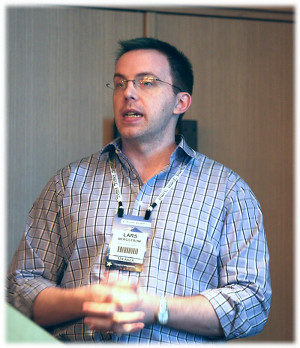
Bergstrom works at Mozilla Research, while Blumenkrantz is from Samsung; Servo is a joint venture of the two organizations. Bergstrom started the session by addressing the fundamental "why" question: why create a new web-rendering engine from scratch then there are several robust engines already (namely WebKit, Blink, and Gecko)? The answer, he said, is that all of the existing engines were designed prior to 2000. The state of the web has changed significantly since then.
One of the biggest such shifts can be seen in the fact that existing browser engines provide parallelism only at an extremely coarse level: separate processes for each tab. In recent years, the main trend in CPU development has been adding more cores, so there are important gains to be made by parallelizing more stages in each page-rendering task. These gains are particularly noticeable on mobile devices, he said, which often run at lower clock speeds and have multiple CPU cores sitting idle. The existing browser engines also tend to be rather monolithic in design, with tightly coupled components that cannot be improved or replaced easily.
The second justification for the project is that the team believes it can improve security by working in the Rust language, taking advantage of Rust's inherent memory safety. Memory handling is the source of most browser security issues, they said, stemming largely from C++'s memory model. Finally, he said, while Gecko used to be maintained as an embeddable component, Mozilla long ago dropped that feature and focused on making Gecko a highly tuned engine for Firefox. Mozilla's commitment, he said, is to making the web better, and that means exploring a rendering engine designed for embedding in other projects.
Bergstrom then spent a few minutes discussing Rust and, in particular, its memory-safety features. Rust is designed to provide memory safety without overhead, he said: no reference counting is required, no garbage collection is needed, and none of the "smart" pointer classes "that litter most C++ codebases" are necessary. Rust's memory safety comes through its type system: every value has an owner, and if ownership changes hands, the previous owner can no longer access the object through references. Thus, there are no race conditions and no need to guard against them with locks.
The Rust toolchain provides static checks that will catch attempts at violating ownership. While Rust's model means there are some types of code you can't write, he said, it uses essentially the same syntax as C++, except that it is safe for concurrency.
Rendering in parallel
Utilizing Rust's concurrency, of course, is the goal of using it in Servo. Bergstrom showed a block diagram of the page-rendering process: a page's HTML, CSS, and JavaScript are first parsed, then a document object model (DOM) constructed. The DOM is handed to the layout engine, where the individual pieces are rendered and displayed. The Servo team investigated where would be the best point in that process to speed matters up with parallelism—and it turned out that the answer was "anywhere."
The reason this is the case is that most modern web pages are composed of multiple independent blocks: <iframe>s and <div>s, for example, many of which are loaded separately. Consider Pinterest and Reddit, he said: the sites load dozens of separate page elements that are independent, and generally of predictable size. Rendering each in a separate thread allows Servo to complete the entire DOM tree in minimal time.
In Servo's rendering architecture, each tab is a "constellation" that gets assigned a number of rendering pipeline threads. The tab's contents are broken down into a DOM tree, then some number of pipelines are started and begin running a work-stealing algorithm to process the nodes in the tree. Each of the pipelines has its own renderer, script engine, and layout engine, although they must (by necessity) share some items that are reused in the page. Bergstrom and Blumenkrantz showed a live demo of Servo keeping an animated image looping smoothly on one side of a page while it continued to dynamically lay out and render the remainder of the page.
The amount of the speed-up experienced when using Servo instead of Gecko depends on how many pipeline threads are started up, and comparisons can be difficult at present because Servo does not yet handle as many HTML and CSS elements as Gecko. But the results are already impressive; the team said that Servo provides a 2x speed increase when rendering the CNN homepage and a 3x speed-up on Reddit. The tricky part is determining which parts of the DOM can be split off to be rendered separately, but even "worst-case scenario" sites like Wikipedia (which is one long page of text) can be parallelized to some degree—sidebars, headers, and image blocks can all be handled independently.
Through testing, the team discovered another benefit that was not obvious at the outset: parallelism results in power savings. Multiple threads working in parallel on a page-rendering job allow the CPU to complete the entire page in the same amount of time while running at a lower frequency.
Making it embeddable
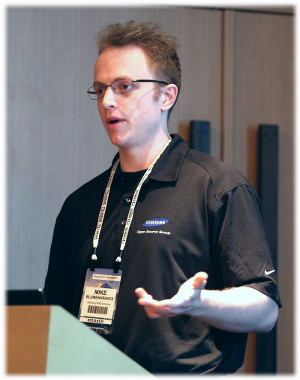
Blumenkrantz then discussed the embeddability of Servo. Project members decided they wanted to avoid the mistakes that other browser-engine projects have made, he said. The most oft-cited complaint about WebKit and Blink is that they have rapidly changing APIs and ABIs. "So you have to either be constantly updating your code or you have to package up the full engine with your application." Consequently, the Servo team wanted to establish a commitment to a reliable API.
They discovered Chromium Embedded Framework (CEF), a small project attempting to make an API-stable engine from Google's Chromium. CEF does not have many users (at least, not many compared to WebKit and Blink), but the users it does have are rather large ones, such as Adobe and Steam. The team decided to commit to supporting the same API as CEF. That would drastically simplify testing, since Servo could be a drop-in replacement for CEF in real workloads and with unit tests.
The implementation was a long and rough process, he said, starting with a massive list of issues in the GitHub repository, and grinding through the list one at a time—using LD_PRELOAD hacks to test individual components. Servo now has full symbol and ABI coverage for CEF's interfaces, he said, although some interfaces are placeholders. The functions are implemented as foreign function interfaces in Rust and all of the structs and memory alignments are identical. The work has now turned toward enforcing identical behavior, he said, like ensuring that two callbacks always fire in the same order in Servo that they do in CEF.
Bergstrom noted that Servo now passes the Acid1 and Acid2 tests and has implemented about 85% of the CSS2 specification. For those tracking feature parity on such matters, he said, "we're creeping right up on Internet Explorer 6." Progress is just a matter of knocking out more and more DOM and CSS features. Over the course of the next quarter, the team is focusing on features that demonstrably break real-world sites—such as the invisible pop-ups that CNN.com uses for trackers. There is still work to be done improving performance, especially in the graphics pipeline, but the team hopes to have an alpha release before the end of 2015. "I wouldn't recommend logging in to your bank with it," he said, "but it should be usable as a basic browser."
Both speakers encouraged interested volunteers to get involved. The entire project is developed in the open at GitHub, they said, and the team prides itself on maintaining a list of "easy bugs" (such as fixing function names) that are actually easy. As the roadmap indicates, while there is no plan to port desktop Firefox over to Servo, individual Servo components could make their way into Gecko. Bergstrom and Blumenkrantz also noted that Servo may have a future with Firefox for Android and Firefox OS; it is already testing on those platforms, via a Java wrapper on Android and over Firefox OS's interprocess communication (IPC) system.
There were a few technical questions from the audience at the end of the session. One attendee asked whether or not all of Servo was written in Rust. The speakers replied that Servo uses Mozilla's existing JavaScript engine, SpiderMonkey, as well as its Azure library for 2D graphics drawing (both of which are C++ projects). Another audience member asked if they had explored other forms of parallelism, such as GPU parallelism. The team had explored it, they replied, but found that as of now, the I/O overhead required to move page contents in and out of the GPU erased all performance gains. They had, however, found some additional performance gains through using SIMD instructions to compute bounding boxes, but that implementation was on hold for now because it would require altering a lot of data structures.
On a final note, Bergstrom and Blumenkrantz answered one audience question about the suitability of Rust for new projects. They responded that the tool support is good—the compiler could use some speed improvements, but it works well with Valgrind, GDB, and other standard tools. For someone used to writing C++ today, Rust is well worth considering. Developers who are already working well in Go or Python may find it a hard adjustment to make, though, since the ownership-based memory model is not as easy to use as garbage collection. In any case, they said, "don't bet the whole team on it. Start it as an experiment first." That seems to be the approach Mozilla is taking, although the signs point to the Servo experiment as having a bright future, at least on some platforms.
[The author would like to thank the Linux Foundation for travel assistance to attend LCJ 2015.]
Brief items
Quotes of the week
LinkedIn open-sources Pinot
LinkedIn has announced the release of its "Pinot" analytics system under the Apache license. "We’ve been using it at LinkedIn for more than two years, and in that time, it has established itself as the de facto online analytics platform to provide valuable insights to our members and customers. At LinkedIn, we have a large deployment of Pinot storing 100’s of billions of records and ingesting over a billion records every day."
GnuPG 2.1.5 released
GnuPG 2.1.5 has been released. This update adds support for the upcoming OpenPGP smartcard 3.0 specification and support for an external passphrase cache.
MATE 1.10 released
Version 1.10 of the MATE Desktop has been released. Perhaps the most notable new feature is that all MATE components can now be built with GTK+2 or GTK+3, although GTK+3 support is still labeled "experimental." Also new in this update are ePub support in the Atril document viewer and a new audio-mixing library named libmatemixer.
TeX Live 2015 is available
The 2015 edition of the TeX Live software distribution, the " The Unicode Consortium has released
version 8.0 of the Unicode text-encoding standard. This update adds
" SystemTap 2.8 is now available. Notable changes in this release include improved support for probing Go programs. "
easy way to get up and running with the TeX document production system
", has been released. DVDs are in production for members of the TeX Users Group (TUG), though many will probably prefer the downloadable release. The changes included in this edition include the merging of several LaTeX fixes from external packages into LaTeX itself, JPEG Exif support in pdfTeX, and image-handling fixes in XeTeX.
Unicode 8.0 standard available
41 new emoji characters (including five modifiers for
diversity), 5,771 new ideographs for Chinese, Japanese, and Korean,
the new Georgian lari currency symbol, and 86 lowercase Cherokee
syllables.
" There are also some additions to existing scripts
to support writing new languages (such as Arwi, which is the Tamil
language written in Arabic script). Concurrent with this release are
updates to several related specifications, such as the Unicode Collation
Algorithm for text sorting.
SystemTap 2.8 available
Work has been done to be able to handle DWARF information, reporting file names, line numbers, and column numbers, and tolerance of odd characters in symbol names.
" In addition, there are many new tapsets, new namespace-aware tapset functions, and improved netfilter probes.
Newsletters and articles
Development newsletters from the past week
- What's cooking in git.git (June 10)
- What's cooking in git.git (June 16)
- LLVM Weekly (June 15)
- OCaml Weekly News (June 16)
- OpenStack Community Weekly Newsletter (June 12)
- Perl Weekly (June 15)
- PostgreSQL Weekly News (June 14)
- Python Weekly (June 11)
- Ruby Weekly (June 11)
- This Week in Rust (June 16)
- Tor Weekly News (June 11)
- Wikimedia Tech News (June 15)
Cool new features coming to Blender 2.75 (Opensource.com)
Opensource.com takes a look at the upcoming release of Blender 2.75. "One of the biggest features merged into Blender this go-round were from the multiview branch. In short, Blender now fully supports the ability to create stereoscopic 3D images. With the increased pervasiveness of 3D films and televisions—not to mention VR headsets in gaming—a lot of people are interested in generating images that play nice in this format. And now Blender can."
Page editor: Nathan Willis
Announcements
Brief items
FSFE welcomes adoption of copyright report in EP's JURI committee
The Free Software Foundation Europe takes a look at a report on the Copyright Directive that was adopted by the Legal Affairs committee of the European Parliament. "FSFE, which provided input to the MEPs on the Legal Affairs committee ahead of the vote, views the adopted report as largely positive. The committee generally supported the idea that copyright exceptions and limitations should apply equally both on- and offline. The MEPs also voted in favour of allowing authors to dedicate their works directly to the public domain."
Articles of interest
Best practices to build bridges between tech teams (Opensource.com)
Opensource.com has an interview with Robyn Bergeron about her current position as Operations Advocate at Elastic, and past roles (such as Fedora Project Leader). "The ELK stack (that's Elasticsearch, Logstash, and Kibana), being incredibly flexible and adaptable to many use cases, appeals to both operations folks and developers—but my love for it really has grown from seeing how fantastically it has allowed folks working in ops to not just start more rapidly identifying that "something broke," but also to be able to visually identify the patterns that lead to those broken things. Getting to a point where you're not just on fire all the time fixing technology, and instead fixing the processes that lead to fires, or implementing ways to proactively avoid fires, is not just redeeming, but frees up time to do other things besides firefighting. People love breaking that loop, and it's fabulous being an advocate for something that is literally making people's work-life balance and general happiness levels better. I've been in those fires. It's not fun. It makes me happy to see users feeling awesome."
Calls for Presentations
RTLWS 17 Call for Papers
The 17th Real Time Linux Workshop will be held October 21 to 23 in Graz, Austria. The call for papers is out now; submissions are due by August 2.CFP Deadlines: June 18, 2015 to August 17, 2015
The following listing of CFP deadlines is taken from the LWN.net CFP Calendar.
| Deadline | Event Dates | Event | Location |
|---|---|---|---|
| June 19 | August 20 | Tracing Summit | Seattle, WA, USA |
| June 28 | August 28 September 3 |
ownCloud Contributor Conference | Berlin, Germany |
| June 28 | November 11 November 13 |
LDAP Conference 2015 | Edinburgh, UK |
| June 30 | November 16 November 19 |
Open Source Monitoring Conference 2015 | Nuremberg, Germany |
| July 5 | October 27 October 29 |
Open Source Developers' Conference | Hobart, Tasmania |
| July 15 | October 8 October 9 |
CloudStack Collaboration Conference Europe | Dublin, Ireland |
| July 15 | October 27 October 30 |
OpenStack Summit | Tokyo, Japan |
| July 15 | November 6 November 8 |
Jesień Linuksowa 2015 | Hucisko, Poland |
| July 17 | October 2 October 3 |
Ohio LinuxFest 2015 | Columbus, OH, USA |
| July 19 | September 25 September 27 |
PyTexas 2015 | College Station, TX, USA |
| July 24 | September 22 September 23 |
Lustre Administrator and Developer Workshop 2015 | Paris, France |
| July 31 | October 26 October 28 |
Kernel Summit | Seoul, South Korea |
| July 31 | October 24 October 25 |
PyCon Ireland 2015 | Dublin, Ireland |
| July 31 | November 3 November 5 |
EclipseCon Europe 2015 | Ludwigsburg, Germany |
| August 2 | February 1 February 5 |
linux.conf.au | Geelong, Australia |
| August 2 | October 21 October 22 |
Real Time Linux Workshop | Graz, Austria |
| August 2 | August 22 | FOSSCON 2015 | Philadelphia, PA, USA |
| August 7 | October 27 October 30 |
PostgreSQL Conference Europe 2015 | Vienna, Austria |
| August 9 | October 8 October 9 |
GStreamer Conference 2015 | Dublin, Ireland |
| August 10 | September 2 September 6 |
End Summer Camp | Forte Bazzera (VE), Italy |
| August 10 | October 26 | Korea Linux Forum | Seoul, South Korea |
| August 14 | November 7 November 9 |
PyCon Canada 2015 | Toronto, Canada |
| August 16 | November 7 November 8 |
PyCON HK 2015 | Hong Kong, Hong Kong |
If the CFP deadline for your event does not appear here, please tell us about it.
Upcoming Events
EuroPython 2015: Schedule online
EuroPython will take place July 20-26 in Bilbao, Spain. The schedule is now available. "With over 200 sessions, over 180 speakers, 5 days of talks, trainings, keynotes, lightning talks and open spaces, followed by 2 days of sprints, EuroPython will be one of the most exciting and vibrant Python events this year."
Akademy 2015 Talks announced
Akademy will take place July 25-31 in A Coruña, Galicia, Spain. The talk program is available. The event is free but registration is required. "For most of the year, KDE—one of the largest free and open software communities in the world—works online by email, IRC, forums and mailing lists. Akademy provides all KDE contributors the opportunity to meet in person to foster social bonds, work on concrete technology issues, consider new ideas, and reinforce the innovative, dynamic culture of KDE. Akademy brings together artists, designers, developers, translators, users, writers, sponsors and many other types of KDE contributors to celebrate the achievements of the past year and help determine the direction for the next year. Hands-on sessions offer the opportunity for intense work bringing those plans to reality. The KDE Community welcomes companies building on KDE technology, and those that are looking for opportunities."
Striving for more diversity at DebConf15
DebConf will take place August 15-22 in Heidelberg, Germany. DebConf is not just for Debian Developers. All members of the community active in different areas are encouraged to come. The DebConf team is designing a new diversity sponsorship program. "DebConf is not just for Debian Developers, we welcome all members of our community active in different areas, like translation, documentation, artwork, testing, specialized derivatives, and many other ways that help make Debian better. In fact, we would like to open DebConf to an even broader audience, and we strongly believe that more diversity at DebConf and in the Debian community will significantly help us towards our goal of becoming the Universal Operating System." Applications for sponsorship will be accecpted until July 6.
DebConf15 Invited speakers
The DebConf team has announced some confirmed keynote speakers, including Bradley M. Kuhn, Werner Koch, Bdale Garbee, and Jacob Appelbaum.Events: June 18, 2015 to August 17, 2015
The following event listing is taken from the LWN.net Calendar.
| Date(s) | Event | Location |
|---|---|---|
| June 16 June 20 |
PGCon | Ottawa, Canada |
| June 22 June 23 |
DockerCon15 | San Francisco, CA, USA |
| June 23 June 26 |
Red Hat Summit | Boston, MA, USA |
| June 23 June 25 |
Solid Conference | San Francisco, CA, USA |
| June 23 June 26 |
Open Source Bridge | Portland, Oregon, USA |
| June 25 June 26 |
Swiss PostgreSQL Conference | Rapperswil, Switzerland |
| June 25 June 28 |
Linux Vacation Eastern Europe 2015 | Grodno, Belarus |
| June 26 June 28 |
FUDCon Pune 2015 | Pune, India |
| June 26 June 27 |
Hong Kong Open Source Conference 2015 | Hong Kong, Hong Kong |
| July 3 July 5 |
SteelCon | Sheffield, UK |
| July 4 July 10 |
Rencontres Mondiales du Logiciel Libre | Beauvais, France |
| July 6 July 12 |
SciPy 2015 | Austin, TX, USA |
| July 7 July 10 |
Gophercon | Denver, CO, USA |
| July 15 July 19 |
Wikimania Conference | Mexico City, Mexico |
| July 18 July 19 |
NetSurf Developer Weekend | Manchester, UK |
| July 20 July 24 |
O'Reilly Open Source Convention | Portland, OR, USA |
| July 20 July 26 |
EuroPython 2015 | Bilbao, Spain |
| July 25 July 31 |
Akademy 2015 | A Coruña, Spain |
| July 27 July 31 |
OpenDaylight Summit | Santa Clara, CA, USA |
| July 30 July 31 |
Tizen Developer Summit | Bengaluru, India |
| July 31 August 4 |
PyCon Australia 2015 | Brisbane, Australia |
| August 7 August 9 |
GUADEC | Gothenburg, Sweden |
| August 7 August 9 |
GNU Tools Cauldron 2015 | Prague, Czech Republic |
| August 8 August 14 |
DebCamp15 | Heidelberg, Germany |
| August 12 August 15 |
Flock | Rochester, New York, USA |
| August 13 August 17 |
Chaos Communication Camp 2015 | Mildenberg (Berlin), Germany |
| August 15 August 16 |
I2PCon | Toronto, Canada |
| August 15 August 16 |
Conference for Open Source Coders, Users, and Promoters | Taipei, Taiwan |
| August 15 August 22 |
DebConf15 | Heidelberg, Germany |
| August 16 August 23 |
LinuxBierWanderung | Wiltz, Luxembourg |
If your event does not appear here, please tell us about it.
Page editor: Rebecca Sobol