

LWN.net Weekly Edition for September 25, 2014
Reviving TTX and FontTools
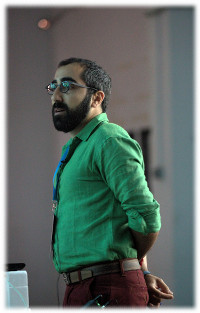
At ATypI 2014 in Barcelona, Google's Behdad Esfahbod gave a report on the work he has been doing to resurrect and reinvigorate the development of a long-dormant free-software project used for font manipulation. In addition to bug fixes and optimizations, he has added several new tools to the original set, and the code is now in use not only at Google, but by several third-party applications as well.
The project in question is known to most users as TTX/FontTools; FontTools is the name of the underlying Python library, while TTX is the most commonly used tool from the included suite of utilities. Esfahbod said he had been "working on a secret project" to revive FontTools for the past few years; he has now made the project public and is inviting users and contributors to get involved. Google started using it internally for font-production work in 2013, at which point he began adapting it and adding new features. His version is available on GitHub, and there is a discussion forum on Google Groups.
By way of background, he outlined the history of FontTools. The project was started in 1999 by Just van Rossum, but in a few years work on it had slowed down to "maintenance mode." Development virtually ceased in 2004, although the code lived on at its SourceForge project page and has continued to be packaged by multiple Linux distributions. The better-known TTX component is a command-line utility that converts font files to XML and vice-versa, since editing and processing XML is considerably easier than performing the same tasks on binary OpenType files. FontTools is the library that powers TTX, he said, but it can do much, much more.
The usefulness of TTX comes from the fact that its XML representation is extremely close to the internal format of OpenType tables. Thus, it is easy to convert a font through TTX and back again, getting a stable, usable output font without losing any information. "I'll make a bet," he said, "no matter what you use to create a font, if you round trip it through TTX, it will be functionally the same." It can look inside of a font file and extract data that other tools cannot. In other words, he said, "it expresses what you want to do with a font much more compactly" than other tools do.
Practical matters
FontTools's XML compiler/decompiler functionality, Esfahbod said, can also be used to optimize fonts—reducing redundancies, for example. The XML it produces is also more compact than that of other conversion tools, so operations are quite fast—fast enough for batch operations on the hundreds of fonts used in the Google Fonts service, for example. In addition, FontTools works with both Python 2 and Python 3, it has no external dependencies, and it introduces minimal abstractions, making it simple to learn.
He then discussed a series of practical usage examples. FontTools can read Type 1, TrueType, and Compact Font Format (CFF) fonts (as well as several less-common formats). It can be used to quickly figure out what a font file includes, such as character coverage, hinting, ligatures, and kerning. That makes it possible to "diff" font versions in a meaningful way, as well as to analyze and generate reports (particularly on large batches of fonts). It can also be used as the final step in producing fonts—for example, adding name-table entries and hints, or even subsetting (such as generating a Japanese-only font file) and merging font files. As a library rather than a graphical application, he said, FontTools is also one of the only options for doing server-side manipulation or reporting tasks, and its XML serialization feature can turn binary font files into a version-control-friendly text representation.
Another major use case for FontTools is "hotfixing" fonts, he said. Converting to XML and back makes it easy to regularize glyph names, fix encoding problems, or add missing characters—for example, he said that Google uses FontTools to make sure that its fonts are not missing the non-breaking space character, which is easy to overlook. As font engineers, he said, there are a number of such things that type designers do not need to worry about, "but are fun for those of us who enjoy writing scripts."
New work
Initially, Esfahbod said, his work on FontTools involved implementing longstanding bug fixes and feature requests that had gone unaddressed in the SourceForge project. He then moved on to ensuring that the XML format was stable, that conversion produced predictable output, and to optimizing the output to be as compact as possible (which he said was vital for Google's web-font service). He then focused on speed improvements, telling the audience that "Python can be slow—if you're not careful about it."
Eventually, though, he began adding new features to the library, and ultimately new utilities as well. Among the highlights are support for Web Open Font Format (WOFF) files and many additional OpenType tables—including bitmap tables and all of the competing chromatic font formats: SVG glyphs and the various formats promoted by Google, Apple, and Microsoft.
There are three new utilities available, he said: pyftsubset, pyftmerge, and pyftinspect. pyftsubset is for generating a subset of an existing font—only certain character blocks, for example, or even a minimal set of glyphs for use in a particular document. It supports both TrueType and CFF glyphs, and it optimizes file output size. pyftmerge is the opposite; it combines multiple fonts into a single file. At the moment it is a "very early prototype," he said, supporting just TrueType. It includes logic to handle conflicting characters and hinting, but in a naive manner at the moment: it preserves the contents of the first input file given. pyftinspect is a previewer, showing the font's table contents in a pop-up window.
In addition to Google Fonts, Esfahbod said that there were already several other users of his relaunched FontTools code. They include several font foundries, Adobe's AFDKO, the free-software font build-service tool Font Bakery, and even Adam Twardoch, one of the main developers at the proprietary font-design-software company FontLab. There are many more features still on the to-do list, Esfahbod said, including support for more input formats, a "lint" tool, better merging options, and better optimization. He would also like to add entirely new functionality, such as the ability to convert between TrueType and CFF, and the ability to optimize TrueType outlines.
There is more work already in development. An intern has been working for the past few months on a CFF subroutiner (which reduces file size by eliminating redundancy) that is expected to be released as free software soon. Esfahbod is also working with a faculty and student team at the University of Waterloo on code to analyze TrueType's bytecode language.
Impact
The font-development community is heavily invested in Python; it is the preferred scripting interface to essentially all font-design applications. But there are relatively few projects that provide a reusable library. In fact, the only other such open-source library that implements a large feature set is Robofab, which is developed primarily to serve as the scripting interface to the commercial font editor Robofont. Nevertheless, there are a lot of small free-software utilities and scripts out there that use Robofab.
But FontTools and Robofab are not direct competitors; they serve two very different purposes. Robofab is a library for working on font design: glyph drawing, spacing, kerning, and so on. The primitives it defines are limited to what is required for these tasks (points, segments, contours, glyphs, etc), and it is designed to work with the Unified Font Object (UFO) drawing format. FontTools, on the other hand, is designed to operate on already built font files: .TTFs, .OTFs, .WOFFs, etc. Its abstractions are not about the drawing of letters and numerals, but about the (arguably) more tedious process of verifying and manipulating all of the tables and embedded features required to make a font work. The fact that it has survived in most major Linux distributions for a decade without real maintainership is a testament to the demand for such a library.
Esfahbod's report on FontTools was also interesting in light of Adobe's subsequent release of AFDKO as an open-source project. Both of these projects attest to the fact that the font-development community is quickly learning the value of sharing tools. Whereas in past years much of the "open source discussion" at ATypI and similar events was focused on the design of open-font licensing, this year open source was more prevalent in conversation—but in a more subtle fashion.
In fact, the first talk of the week was on the subject of what commercial font-makers can learn from open source, and was given by Thomas Phinney, who works at FontLab. He cited advantages that people already enmeshed in FOSS will find familiar: the value of collaboration, the freedom to specialize on certain tasks by not reinventing the wheel for every task, the benefit to everyone of sharing information, and so on. Open source is still only one of multiple development models within the industry, but it has never looked healthier.
A Dark Room
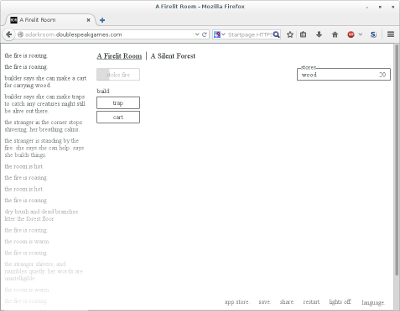
It's not often that an independent, open-source video game receives widespread mainstream attention and acclaim — let alone a game as quirky as A Dark Room (ADR). The game is a minimalist text adventure that starts in the eponymous room and expands over time into something much greater. In a face-to-face conversation, ADR's developer Michael Townsend detailed the game's origins and development, which may interest those considering common web-development tools (HTML5, JavaScript, and CSS) for game design.
Gameplay begins in a starkly described room.
Players will find that soon after they stoke the dark-and-freezing
room's dead
fire, "a ragged stranger stumbles through the door and collapses in
the corner
". The stranger's ability to construct buildings and tools
provides an early means to grow the game's mechanics, which subtly,
gradually, and uniquely paint a chilling portrayal of a post-apocalyptic
science fiction world.
The evolution of the gameplay over time, combined with its focus on "ludonarrative cohesion" (the use of gameplay mechanics themselves to progress a story in a video game), would win the game critical praise. A front page post on Hacker News was followed with positive attention from popular sites like The New Yorker and Slate Magazine. ADR would reach the #1 spot on the US and UK iOS App Store download charts for a few months following a proprietary release for Apple's mobile devices.
In 2013, when working full-time at a consulting company, Townsend was inspired by the game Candy Box, which features some similar mechanics: a minimalist text-adventure game with ASCII art that has game mechanics that deepen gradually over time. He felt that this style of gameplay had untapped potential, so he worked on evenings and weekends for several weeks before releasing ADR in June 2013.
Soon after release, the game hit the front page of Hacker News, with several positive comments from software developers who found themselves hooked on the game. A few weeks later, Townsend announced a formal open source release under the Mozilla Public License (MPL) along with a GitHub repository. He had thought that his decision not to obfuscate the game's code would be enough for curious developers, but the clamor for a formal open-source release of the gratis game led him to pick a license.
Townsend released ADR as open source out of a desire to encourage creativity and skill development. The game also gained some improvements following the open-source release:
Written from scratch in JavaScript, HTML5, and CSS, ADR's code was
hacked together without Townsend being concerned about optimizing it on a
technical level. He was more interested in getting the project done. He had
considered using pre-made solutions like Twine, which is an "open-source tool
for telling interactive, nonlinear stories
" that can be published
directly to HTML. But he found that it was too simple for his needs and not
as much fun as building the game completely on his own. When ADR got
attention on Hacker News, he felt a bit mortified about the code: "Oh no! The nerds are going to tear it apart!
"
The game's code is simple. After writing it, though, he discovered the AngularJS web application framework that he now realizes could have provided the technical foundation for the game. ADR connects with Dropbox for handling game save data, and uses Google Analytics to track how players progress through the game to give him feedback about how to improve it. Users can export saved games to continue from a different device; it's a simple matter of generating a unique code that can be entered from a different machine to resume.
"You probably shouldn't look at the code as a good project
", Townsend warned, as he was aware that his interview was for a technical news site. There is not much separation between the game's code and its assets (e.g. the strings making up the text of the game). This intermingling of code and assets makes it harder for an interested developer to write a new story using ADR's engine as a base. However, some separation has been made to facilitate translation, which is ongoing; thanks to outside contributions, the game is available in multiple languages. Townsend noted that one could replace certain modules of the game with new ones to create new scenes or game levels.
Although the game did make an impact in the independent video game scene
in 2013, it would be a later release on iOS that would garner the game
financial success and widespread news attention. A software developer named
Amir Rajan, who is a fan of the game, contacted Townsend soon after the Hacker News posting. Rajan wanted to "reboot his life
": he had recently quit his job, scaled down his living expenses, and was interested in pursuing a project out of pleasure, using his savings to pay for his day-to-day needs while developing it.
Rajan asked Townsend if he could port ADR to iOS devices (the iOS version remains proprietary; Townsend said it is up to Rajan whether or not that version will be opened up). Townsend agreed, on the condition that he retain a creative veto and receive 50% of any royalties. He did not hear from Rajan for several months, but ended up satisfied with his work. The game was ported to iOS using the proprietary RubyMotion implementation of the Ruby programming language.
Townsend ensured that third-party improvements to ADR's open-source code on GitHub were not incorporated into the iOS app:
Following a release toward the end of 2013, the iOS version would bring in a few hundred dollars a month in royalties, but exploded in popularity in 2014. Both Townsend and Rajan remain mystified as to the causes of the game's financial success; they could not find any correlation between an increase in sales and media coverage.
While the iOS version was its financially successful incarnation, ADR's GitHub repository for the original, open-source browser game remains active. Although Townsend hadn't touched the JavaScript and CSS in a while, he still continues to use the repository to make tweaks and merge pull requests. The bulk of the recent changes are translations, with a recent addition of Polish.
Notwithstanding the success of ADR's proprietary iOS version, Townsend emphasized the importance of open-source game development to him. He opened up the source for ADR's browser version to help other potential game developers learn from his experience. Nonetheless, some third-party use of his code has led to some irritations for Townsend, as quoted by Rajan on his blog:
There are a few versions of the browser-based ADR ported
to Android, but they are largely just copies of the browser game's code
wrapped in PhoneGap, which is "a
free and open source framework that allows you to create mobile apps using
standardized web APIs
". Without further optimization made for mobile
devices, it makes for a sub-par experience; users connecting to the web
game through their phones are given a warning page that the game works
poorly on mobile devices. No such warning is available on the Android
apps.
This has led to some individuals complaining to Townsend about the poor quality of the Android versions, which he had nothing to do with. He contacted some of the developers relaying his concerns; one was apologetic, explaining that they were just trying to learn about game development, while others refused to remove or alter their apps (some of which contain advertisements), citing the game's open-source license as justification.
Townsend has applied for a registered trademark on the name "A Dark Room" in association with video games, and is awaiting approval; if approved, he intends to use the trademark to demand name changes from these developers. He would be content if the game itself remains unchanged, as long as the title is changed to disassociate third-party versions from his authorized ones. Townsend does take comfort in the fact that these clones are nowhere near as popular as the iOS version; that an official Android app is currently in private beta may dull some of the sting as well.
Townsend continues to work a day job (he does full-stack web development for travel website TripAdvisor), while pursuing game development as a side project. His latest game, Gridland, is a fun mash-up of match-three puzzle games like Bejeweled with shelter building and survival mechanics vaguely reminiscent of a simplified Minecraft. It is available gratis online with an open-source release coming soon. Meanwhile, the ADR universe has expanded with Rajan releasing a proprietary prequel to ADR on iOS, The Ensign, and Townsend considering a sequel. Townsend remains committed to open-source game releases under the name Doublespeak Games; it will be interesting following his journey as a game developer in the years to come.
Adobe releases source code for OpenType font-development tools
Adobe made a surprise announcement at the annual ATypI conference in Barcelona, Spain, releasing one of the company's proprietary font-production tools under an open-source license. In addition, the team convinced another popular font-development project to release its core library as open source, too. Adobe framed the release as a move designed to help improve the quality of fonts produced with any application, but there may be other benefits as well—such as increasing the spread of Adobe's own open fonts. Up until now, those fonts have not been redistributable by many other free-software projects, precisely because the production tools needed to build them remained closed.
David Lemon, manager of Adobe's type team, made the announcement in his talk entitled "A win/win approach to open source." Lemon began the session by recounting Adobe's history with open-source software, as well as his personal involvement. Over the 28 years he has spent at Adobe, he said, he had gone from thinking that open source was "just plain crazy" to becoming one of its biggest advocates within the company.
Standardization and platforms
Lemon noted that free software has its roots in communities like academia that regard sharing information as the default policy and as an ethical position, while "open source" puts the emphasis on the quality of the code produced. Inside Adobe, he explained, both viewpoints have proven important at differing times. The company has long understood the value that comes from publishing a public specification, which it did, for example, with PostScript in 1984. Despite PostScript being given away, he noted, the product still makes money for Adobe today.

Similarly, Adobe published the Type 1 font format in 1990 in the face of competition from TrueType, which was a joint effort of Apple and Microsoft. There are many other reasons why Type 1 has survived, he said, but publishing an open specification was certainly one of them. The PDF specification was another such giveaway, and became a critical platform on which many other products are built. That cemented the idea within Adobe that publishing a standard rather than keeping it secret was a path to success.
At the same time, though, Adobe still struggled to make technologies like Type 1 viable in the marketplace because operating system vendors controlled the platform. The company's initial attempt to circumvent this hurdle was Adobe Type Manager (ATM), a proprietary product that added real-time Type 1 rasterization to Windows and Macintosh systems. Though popular with graphic designers (in part due to its other functions, like managing large font collections), ATM was never a money maker. Eventually, Adobe decided instead to work directly with Apple and Microsoft to get Type 1 rendering incorporated directly into the operating system. The result was that Type 1 gained "equal citizenship on the desktop."
As everyone now recognizes, though, Apple and Microsoft desktop systems are no longer the only platforms that matter—and perhaps not even the most important ones. So, Lemon said, when Adobe realized a few years ago that it was now facing a similar situation with mobile platforms and the web, it decided to take a different approach. The issue at hand was making the Compact Font Format (CFF), the modern successor to Type 1, viable for browsers and mobile devices. On those platforms, TrueType fonts still dominated, but essentially for legacy reasons.
So the company took its CFF rasterizing engine, released it as an open-source product, and donated it to the FreeType project—thus bringing high-quality CFF support to Android and to the most popular web browsers. Adobe still maintains the CFF rendering code to this day, Lemon added. And Adobe has rolled out many other open-source products and projects, he said: the company currently has 99 repositories active on GitHub.
Fonts and tools
One of Adobe's first major open-source products was the online code editor Brackets. Brackets and other such products require fonts with compatible licensing, of course, and Lemon noted that six or seven years ago when the effort began, Adobe did not see any open fonts it was satisfied with. So the company's type team "rolled it own"—first Source Sans Pro, followed by Source Code Pro, and, most recently, Source Serif Pro and the massive pan-CJK (Chinese-Japanese-Korean) font Source Han Sans. The family of fonts has expanded to numerous weights, added scripts like Cyrillic and Greek, and has added features at the request of Adobe product teams—and occasionally outsiders.
That said, Lemon did express some disappointment that there have been few contributions to the fonts from third parties. Adobe had donated fonts to the X Window Consortium years ago, he noted, but the Source Pro project was supposed to be different—a project, not a donation. The magnitude of the response from users was overwhelming, he said, and "although we're quite proud of our QA," the fonts' hundreds of thousands of users "find every little issue" to file a bug report on. To date, though, only one outside designer has contributed a significant number of glyphs.
But one major prerequisite to contributing is access to the tools for building and testing the fonts. This is where Adobe Font Development Kit for OpenType (AFDKO) comes into play. AFDKO is a suite of tools for validating and modifying fonts in the OpenType format (which can encapsulate either TrueType or CFF data). It is also a key part of Adobe's build and release processes. The company regards it as a platform-growing asset intended to spread OpenType adoption; although proprietary applications can work with it and the company provides AFKDO training, it is not a product intended for monetization. Lemon pointed out that it has been available free-of-charge since 2000 (at least for Windows and Mac OS X). The company even released a Linux version in March of 2014.
But free-of-charge simply is not sufficient for all users. Open-source projects could not package AFDKO for license-compatibility reasons, and some projects will not accept binaries (such as fonts) built with any proprietary tools. In addition, Lemon said, there were even some proprietary software companies that would not allow their employees to install and use AFDKO, because the company legal team objected to the end-user license agreement (he named Apple as one such company, but called it a recurring issue).
So, although Adobe wanted AFDKO to improve OpenType support everywhere, it was not having the desired effect. Furthermore, he added, "there is only one open-source font editor, and it sucks"—although he quickly added that was happy to see that there is a lot of recent work going into it, with a number of improvements.
The solution was to make AFDKO open-source software. Lemon said he was excited to announce that as of now, AFDKO is available under the Apache 2.0 license from the Adobe type team's GitHub repository. The existing, pre-packaged version will also remain available under the old terms, "for simplicity's sake," he said.
Around the FDK
Lemon then took a few minutes to detail the contents of the repository. There are around 20 utilities included. Many are Python or shell scripts, but he cautioned that the initial release was "batteries not included." Specifically, installation scripts are missing for the time being, and dependency issues or other hurdles should be expected.
The main use cases of the AFDKO tools are quickly adding the advanced features of the OpenType file format to an existing font, running quality-control and validation checks, and automating build operations. The AFDKO site maintains a description of each tool's capabilities.
Unfortunately, he said, there are two pieces of the original AFDKO that the team was unable to include in the open-source release. Both contain patented code from elsewhere in Adobe, which those other projects were not interested in releasing. One is the checkOutlines tool, which performs a number of validation checks on the Bézier curves in a font—most importantly, removing overlaps. The other is IS—for "intelligent scaling"—which is used to rescale fonts while automatically adjusting the embedded TrueType hints. Lemon noted that the team had identified a possible replacement for checkOutlines already.
Lemon also told the audience that, although he hopes the open-source AFDKO will help improve other font tools, he also hopes that people will contribute their own improvements back to AFDKO. Already the team has begun extending its capabilities, he said. The initial release includes a new set of interpolation functions based on the engine found in Erik van Blokland's highly successful Superpolator application.
Superpolator itself remains closed source, but the AFDKO team convinced Van Blokland to package the core engine into a reusable library, which he also released under an open-source license during the conference. The library is called MutatorMath, and is available from its own GitHub repository under a BSD license. MutatorMath can interpolate entire fonts based on an arbitrary number of interpolation axes (e.g., weight, width, slant, contrast, serif style, etc).
Up next
Lemon concluded his talk by promising that although open source may not take over Adobe, "as long as it continues improving our work, we'll keep doing it." He said more source code was still to come from the type team, starting with some CJK tools built during the development of Source Han Sans.
Outside of the ATypI venue, the AFDKO and MutatorMath releases did not go unnoticed by the free-software community. Shortly after the release announcements (which had been rumored, if not expected, in several circles), a Debian intent to package (ITP) issue was opened up for AFDKO. Bug reports have already started appearing in GitHub, particularly with regard to the dependencies and the build process.
Perhaps most interesting to note is that Debian developers have also announced their desire to package the Source Pro fonts in the wake of the AFDKO release. The software tools may benefit FontForge (the open-source font editor that, presumably, Lemon referred to in his critique) and other free-software applications, but that will take time. The most immediate impact of the release may be that it will, for the first time, be possible to build Adobe's open fonts from source using only free software. Lemon did not delve into the details of that issue during his talk, but being unable to build the Source Pro family with free software has undoubtedly kept at least some potential contributors away.
It is hard to predict whether or not any major contributions might arise as a result, of course, but a fully open-source build chain certainly opens the door to any number of new developments down the line.
Security
Schneier on incident response
Bruce Schneier is a cryptographer and security specialist who is well-known in computer circles even though he has often branched into more general security areas in recent years. His blog is a great source of security news (and, of "quotes of the week" for this page, as readers know). Beyond all that, he travels to many security conferences to give talks, which is just what he did at AppSec USA in Denver on September 18. The keynote topic was "incident response" (IR), which is an area that is finally getting more attention in the security-product space, he said.
Interestingly, Schneier's talk didn't really dwell all that much on IR. Instead, he looked at some trends that are changing the industry, along with some economic principles that are relevant to the computer security market. Along the way, he also described a feedback loop that is used by the US Air Force (USAF) and how it relates to network attacks and the response to them.
Three trends
There are three trends that are currently important to the security industry, he said. The first is that we are "losing control of our infrastructure", which is the result of two separate things. The rise of cloud computing "means we no longer have control of our data". Schneier uses Eudora for his email, "but I am a freak". His company (he is the CTO at Co3 Systems, which makes IR tools, as he disclosed near the end of the talk), however, outsources its email to Google.
Moving data to the cloud means that we cannot affect the security of the system any longer, he said. You can't ask Google for more security on your email storage, you just get what they provide. You also have no idea where the actual physical bits of your data reside; they could be anywhere in the world.
We are also accessing our data with devices that we have less control over, which is also a loss of infrastructure control. Mobile devices are often locked down, such that we can't even wipe their memory and storage because there is no access at that level. There are lots of good reasons for locking down devices in that manner, but it does affect security. The business case for companies like Apple and Microsoft to control these devices is quite strong, to the point that Schneier expects to see phone and desktop operating systems converge—to somewhere that is much closer to the "less user control" phone side of that continuum.
The second major trend is that attacks are getting more sophisticated, as we have seen over the last few years. There is a lot of "cyberwar" rhetoric and there is clearly an increase in the capabilities of attackers. He doesn't really like the term "cyberwar", since we are not actually fighting a war in cyberspace, but there are parallels between actual warfare and the internet-based attacks occurring today.
In real wars, you can generally determine who the attacker is by the weaponry used—a tank means a government, since no one else can afford them. In computer attacks, that is not true: everyone is using the same weapons.
You can place attackers on a two-axis graph, where the axes are "skill" and "focus", Schneier said. Script kiddies are clearly low skill, low focus, while attacks like that against Target are from high-skill, low-focus attackers—they didn't want Target's customers' credit card information, they just wanted credit card data. In that case, relative security matters. Since Target was not as well-secured as its "neighbors", it was attacked.
But high-skill, high-focus attacks, like advanced persistent threats (APTs), make for a completely different threat model. APTs are personal for some reason; the attacker wants to get at a particular target. Protecting against that kind of attack comes down to absolute security: is the attacker better than the defender?
As it turns out, we know the answer to that question: yes. When penetration testers attempt to get into a system or network, they essentially always do, he said. We do not know how to defend against targeted attacks. In the history of warfare, as weapons and defenses have evolved, sometimes the attacker has had the advantage and sometimes it has been the defender. On the internet right now, the attacker has the advantage and will for the foreseeable future, Schneier said.
The final trend that he noted was the increasing government involvement in cyberspace. It goes beyond the NSA and other secret services spying on internet activity. There is a "complicated regulatory environment", which means that there is a lot of "legal stuff that organizations have to know and follow". Businesses and other organizations tend to be collateral damage when governments act on the internet—to censor it, conduct espionage on it, or attack adversaries using it. All of that is only going to get worse, he said.
Economics
Schneier then moved into some economic principles that are important to consider when looking at the market of computer-security products. First, network effects are crucial to the success of a product. He cited Metcalfe's law (the value of a network is proportional to the square of the number of connected users) to explain how network effects work for things like SMS, Skype, and Facebook. It is also important to the battle between iOS and Android, or between Mac OS X and Windows. The "big get bigger" due to network effects; Facebook gets bigger because you are going to join the network where your friends are, not the network that is better.
Another important economic concept is fixed vs. marginal costs. For physical products, much of the cost is in marginal costs, whereas in software it is almost all in fixed costs. Creating the first copy of a program costs a lot, but each copy after that costs little to produce. Books are similar, he said. Some printing company could (illegally) start producing copies of his books and sell them for a few dollars, since they would not have to recover the fixed cost by paying him royalties. He could retaliate by temporarily dropping the cost of his book below that of the "competitor", to drive them out of business—which is the tactic that Walmart employs against its local competition, he said.
"Switching costs" is yet another principle that comes into play. It is much more expensive to switch cell phone providers than it is to switch cola brands. He cited Shapiro and Varian's "fundamental theorem" that the total value of a software company is the cumulative cost for its customers to switch to a competitor. In effect, "the higher the switching costs, the more the company can piss you off", he said. AT&T just has to "not suck", while a cola has to be better in some measure.
Another example of high switching costs is trying to move from iTunes to something else: "good luck taking your music" with you. The same goes for trying to move from a Kindle to a Nook (or vice versa). Cell-phone-number portability is an effort to lower switching costs, since a user can switch without having to update all of their contacts, print new business cards, and so on.
The "lemons market" is an idea by George Akerlof that won him the Nobel Prize in Economics. It concerns markets where sellers know a lot more than buyers (i.e. asymmetric markets). In those markets, "bad products drive good products out of the market". If the buyer cannot tell the difference between a good and a bad product, they will buy the bad because it is cheaper, he said. If there are two encryption products on the market, both with the same algorithms, but one is implemented well and the other not, buyers will buy the cheaper one.
This is why "signals" are important. Things like certifications and "those really dumb awards at conferences" are useful. Those are signals that allow the buyers to convince themselves they are buying a "not bad" product. The old adage that "no one ever got fired for buying IBM" is another kind of signal.
The final economic principle Schneier mentioned is "prospect theory", which came from two psychologists. They are the only non-economists to win the Nobel Prize in Economics and they did so by "telling economists that everything they believe is wrong", Schneier said with a chuckle. Unlike previous models, prospect theory shows that humans are risk-averse when it comes to losses, and risk-seeking when it comes to gains.

This behavior is also observed in other primates, Schneier said. The best explanation he has heard comes from evolutionary biology. If you consider a species on the edge of extinction, even a small loss means they are dead. If they can avoid any chance of that loss, they are better off. But a small gain is worth seeking because it will improve the chances to live to see another day.
That theory explains why it is difficult to sell cybersecurity. It is the same with insurance or burglar alarms, he said. If you go to your boss to say you need something to secure the network, he is likely to point out that you didn't have it last month and the network ran just fine. It is not impossible to sell cybersecurity, but it does require fighting against this basic psychological principle.
Response
In computer security, there is a need for response, because both prevention and detection are imperfect. He used to say that security is a process, not a product, but that was a "strategic idea". If you look at it more tactically, security is both a process and a product. He now talks about "people, process, and technology".
But there is a general idea that people can't help with security. There is a focus on automation for tasks like threat detection and system updates. However, response cannot be fully automated because it requires people to understand and react to what is happening. All attacks are different, the networks are different, the regulatory environments are different, and on and on. Those things are not necessarily different in technical ways, either; they are different in "people ways".
All of that means the people-to-technology ratio goes up for response. If you look at real-world emergency response (e.g. police and firefighters), it is similar. And, like with those organizations, security response needs technology that supports people, rather than replacing them.
That's where the USAF's feedback loop comes into play. An observe-orient-decide-act (OODA) loop is what pilots repeatedly use during a dogfight. If you can perform that loop faster than your opponent, you will win the fight. The USAF uses the OODA loop to evaluate technology—it wants technology that supports the pilot in handling one of those four functions.
The same OODA loop is present in incident response, Schneier said. The speed of handling that loop is crucial. Being faster than the attacker means getting them out of your system. So the security industry needs tools to facilitate the OODA loop.
That means better tools to observe what is happening (observe) and to fill in the context from the outside world (orient), which would provide information like the presence of new malware observed in the wild, an upheaval in some country, or that the company is going through a merger. Tools to help with the decision-making process are needed as well (decide), which is an area that needs a lot more work, he said. Who gets to decide, and how those decisions are audited after the fact, are two important pieces of the puzzle. Finally, there is a need for tools to help take the decision and make it happen (act). All those areas are ripe for new tools and we are starting to see them, he said.
For the security industry, the 1990s were the decade of protection, while the 2000s were the decade of detection. This decade will be the decade of response. But, unlike protection and detection tools, response tools will not suffer the same fate—bad products pushing out the good. Because response tools will be people-oriented, the good products will beat out the bad. Incident response tools and products will change the industry, Schneier concluded.
Brief items
Security quotes of the week
It is not hard to imagine, for example, a malicious patch to the RAM controller block which searches each byte group for a magic sync sequence written to consecutive addresses, then executes commands from the next few bytes. As long as Malfab is able to cause the target's system to write data of his choice to consecutive RAM addresses (perhaps by sending it as the payload of an Ethernet frame, which is then buffered in RAM) he can execute arbitrary commands on the backdoor engine.
We have one infrastructure. We can't choose a world where the US gets to spy and the Chinese don't. We get to choose a world where everyone can spy, or a world where no one can spy. We can be secure from everyone, or vulnerable to anyone. And I'm tired of us choosing surveillance over security.
What they do know about it makes it sound like a terrible idea: a bunch of Silicon Valley elites, backed by the Google panopticon and the Mozilla jerks who publicly executed Brendan Eich over his quiet support for traditional marriage, are demanding that the FCC impose sweeping regulations on the companies who bring the Internet to your door. With help from their close ally President Obama, these shysters have made tremendous forward progress against the so-called “evil” corporations who (in reality) own, develop, and generally manage the series of tubes that make up the Internet [YouTube] – corporations who have, in short, ushered in the entire Internet Age and all the good it entails. The only people in this drama who are holding off the regulators are the valiant heroes at the Wall Street Journal and the National Review, who are not afraid to stand athwart the regulatory agenda yelling “stop!,” demanding free markets and free peoples and not an iota less.
Simply Secure announces itself
A new organization to "make security easy and fun" has announced itself in a blog post entitled "Why Hello, World!". Simply Secure is targeting the usability of security solutions: "
If privacy and security aren’t easy and intuitive, they don’t work. Usability is key." The organization was started by Google and Dropbox; it also has the Open Technology Fund as one of its partners. "
To build trust and ensure quality outcomes, one core component of our work will be public audits of interfaces and code. This will help validate the security and usability claims of the efforts we support. More generally, we aim to take a page from the open-source community and make as much of our work transparent and widely-accessible as possible. This means that as we get into the nitty-gritty of learning how to build collaborations around usably secure software, we will share our developing methodologies and expertise publicly. Over time, this will build a body of community resources that will allow all projects in this space to become more usable and more secure."
Kali NetHunter turns Android device into hacker Swiss Army knife (Ars Technica)
Ars Technica takes a look at Kali Linux NetHunter, a penetration testing platform for Nexus devices. "NetHunter is still in its early stages, but it already includes the ability to have the Nexus device emulate a USB human interface device (HID) and launch keyboard attacks on PCs that can be used to automatically elevate privileges on a Windows PC and install a reverse-HTTP tunnel to a remote workstation. It also includes an implementation of the BadUSB man-in-the-middle attack, which can force a Windows PC to recognize the USB-connected phone as a network adapter and re-route all the PC’s traffic through it for monitoring purposes."
Security Collapse in the HTTPS Market (ACM Queue)
ACM's Queue has a lengthy article on the security failures in the HTTPS layer and the prospects for improvement. "This article outlines the systemic vulnerabilities of HTTPS, maps the thriving market for certificates, and analyzes the suggested regulatory and technological solutions on both sides of the Atlantic. The findings show existing yet surprising market patterns and perverse incentives: not unlike the financial sector, the HTTPS market is full of information asymmetries and negative externalities, as a handful of CAs dominate the market and have become 'too big to fail.' Unfortunately, the proposed E.U. legislation will reinforce systemic vulnerabilities, and the proposed technological solutions are far from being adopted at scale. The systemic vulnerabilities in this crucial technology are likely to persist for years to come"
A remotely exploitable hole in bash
The bash shell has a vulnerability in its environment variable processing that could be remotely exploited in some situations — with CGI scripts being at the top of the list. "The fact that an environment variable with an arbitrary name can be used as a carrier for a malicious function definition containing trailing commands makes this vulnerability particularly severe; it enables network-based exploitation." The problem was disclosed (a little) prematurely, so updates are still coming in from the distributors.
New vulnerabilities
apache-poi: two XML-handling flaws
| Package(s): | apache-poi | CVE #(s): | CVE-2014-3529 CVE-2014-3574 | ||||||||||||
| Created: | September 19, 2014 | Updated: | February 23, 2015 | ||||||||||||
| Description: | From the Red Hat bugzilla entries:
CVE-2014-3529: It was found that Apache POI would resolve entities in OOXML documents. A remote attacker able to supply OOXML documents that are parsed by Apache POI could use this flaw to read files accessible to the user running the application server, and potentially perform other more advanced XXE attacks. CVE-2014-3574: It was found that Apache POI would expand an unlimited number of entities in OOXML documents. A remote attacker able to supply OOXML documents that are parsed by Apache POI could use this flaw to trigger a denial of service attack via excessive CPU and memory consumption. | ||||||||||||||
| Alerts: |
| ||||||||||||||
apt: code execution
| Package(s): | apt | CVE #(s): | CVE-2014-6273 | ||||||||||||
| Created: | September 24, 2014 | Updated: | November 12, 2014 | ||||||||||||
| Description: | From the Debian advisory:
The Google Security Team discovered a buffer overflow vulnerability in the HTTP transport code in apt-get. An attacker able to man-in-the-middle a HTTP request to an apt repository can trigger the buffer overflow, leading to a crash of the 'http' apt method binary, or potentially to arbitrary code execution. | ||||||||||||||
| Alerts: |
| ||||||||||||||
bash: command execution
| Package(s): | bash | CVE #(s): | CVE-2014-6271 | ||||||||||||||||||||||||||||||||||||||||||||||||||||||||||||||||||||||||||||||||||||||||||||||||||||||||||||||||||||||||||||||||||||||||||||||||||||||||||||||||||||||||||||||||||||||||||||||||||||||||
| Created: | September 24, 2014 | Updated: | September 30, 2014 | ||||||||||||||||||||||||||||||||||||||||||||||||||||||||||||||||||||||||||||||||||||||||||||||||||||||||||||||||||||||||||||||||||||||||||||||||||||||||||||||||||||||||||||||||||||||||||||||||||||||||
| Description: | From the Red Hat advisory:
A flaw was found in the way Bash evaluated certain specially crafted environment variables. An attacker could use this flaw to override or bypass environment restrictions to execute shell commands. Certain services and applications allow remote unauthenticated attackers to provide environment variables, allowing them to exploit this issue. See this message for more details. | ||||||||||||||||||||||||||||||||||||||||||||||||||||||||||||||||||||||||||||||||||||||||||||||||||||||||||||||||||||||||||||||||||||||||||||||||||||||||||||||||||||||||||||||||||||||||||||||||||||||||||
| Alerts: |
| ||||||||||||||||||||||||||||||||||||||||||||||||||||||||||||||||||||||||||||||||||||||||||||||||||||||||||||||||||||||||||||||||||||||||||||||||||||||||||||||||||||||||||||||||||||||||||||||||||||||||||
c-icap: denial of service
| Package(s): | c-icap | CVE #(s): | CVE-2013-7401 CVE-2013-7402 | ||||||||||||||||
| Created: | September 22, 2014 | Updated: | January 5, 2015 | ||||||||||||||||
| Description: | From the Gentoo advisory:
c-icap contains a flaw in the parse_request() function of request.c that may allow a remote denial of service. The issue is triggered when the buffer fails to contain a ' ' or '?' symbol, which will cause the end pointer to increase and surpass allocated memory. With a specially crafted request (e.g. via the OPTIONS method), a remote attacker can cause a loss of availability for the program. | ||||||||||||||||||
| Alerts: |
| ||||||||||||||||||
chromium: denial of service
| Package(s): | chromium | CVE #(s): | CVE-2014-3178 CVE-2014-3179 | ||||||||||||||||||||
| Created: | September 22, 2014 | Updated: | October 10, 2014 | ||||||||||||||||||||
| Description: | From the CVE entries:
Use-after-free vulnerability in core/dom/Node.cpp in Blink, as used in Google Chrome before 37.0.2062.120, allows remote attackers to cause a denial of service or possibly have unspecified other impact by leveraging improper handling of render-tree inconsistencies. (CVE-2014-3178) Multiple unspecified vulnerabilities in Google Chrome before 37.0.2062.120 allow attackers to cause a denial of service or possibly have other impact via unknown vectors. (CVE-2014-3179) | ||||||||||||||||||||||
| Alerts: |
| ||||||||||||||||||||||
haproxy: denial of service
| Package(s): | haproxy | CVE #(s): | CVE-2014-6269 | ||||||||||||
| Created: | September 24, 2014 | Updated: | September 24, 2014 | ||||||||||||
| Description: | From the Red Hat advisory:
A buffer overflow flaw was discovered in the way HAProxy handled, under very specific conditions, data uploaded from a client. A remote attacker could possibly use this flaw to crash HAProxy. | ||||||||||||||
| Alerts: |
| ||||||||||||||
haproxy: unspecified vulnerabilities
| Package(s): | haproxy | CVE #(s): | |||||
| Created: | September 19, 2014 | Updated: | September 24, 2014 | ||||
| Description: | The Fedora advisory simply says:
Update to upstream stable release 1.5.4 | ||||||
| Alerts: |
| ||||||
kernel: three vulnerabilities
| Package(s): | kernel | CVE #(s): | CVE-2014-3186 CVE-2014-3181 CVE-2014-6410 | ||||||||||||||||||||||||||||||||||||||||||||||||||||||||||||||||||||||||||||||||||||||||||||||||||||||||||||||||||||||||||||||||||||||||||||||||||||||||||||||||||||||||||||||||
| Created: | September 19, 2014 | Updated: | December 11, 2014 | ||||||||||||||||||||||||||||||||||||||||||||||||||||||||||||||||||||||||||||||||||||||||||||||||||||||||||||||||||||||||||||||||||||||||||||||||||||||||||||||||||||||||||||||||
| Description: | From the Red Hat bugzilla entries:
CVE-2014-3186: Linux kernel built with the Human Interface Device(HID) Bus support(CONFIG_HID) along with a driver for Minibox PicoLCD devices support(CONFIG_HID_PICOLCD), is vulnerable to an OOB write flaw. It could occur if a device offers an HID report with arbitrary(>64) data size value. A local user with physical access to the system could use this flaw to crash the system resulting in DoS or potentially, escalate their privileges on the system. CVE-2014-3181: Linux kernel built with the Human Interface Device(HID) Bus support(CONFIG_HID) along with a driver for Apple Magic Mouse/Trackpad multi-touch, is vulnerable to an OOB write flaw. It could occur if a device offers an HID report of arbitrary length. A local user with physical access to the system could use this flaw to crash the system resulting in DoS or potentially, escalate their privileges on the system. CVE-2014-6410: Linux kernel built with the UDF file system support(CONFIG_UDF_FS) is vulnerable to a crash due to stack overflow through infinite recursion. It occurs while traversing a long ICB hierarchy. a user/program able to mount such a file system could use this flaw to crash the system kernel resulting in DoS. | ||||||||||||||||||||||||||||||||||||||||||||||||||||||||||||||||||||||||||||||||||||||||||||||||||||||||||||||||||||||||||||||||||||||||||||||||||||||||||||||||||||||||||||||||||
| Alerts: |
| ||||||||||||||||||||||||||||||||||||||||||||||||||||||||||||||||||||||||||||||||||||||||||||||||||||||||||||||||||||||||||||||||||||||||||||||||||||||||||||||||||||||||||||||||||
kernel: denial of service
| Package(s): | kernel | CVE #(s): | CVE-2014-3601 | ||||||||||||||||||||||||||||||||||||||||||||||||||||||||||||||||||||||||||||||||||||||||||||||||||||||||||||||||||||||||||||||||||||||||||||||||||||||||||||
| Created: | September 24, 2014 | Updated: | September 29, 2014 | ||||||||||||||||||||||||||||||||||||||||||||||||||||||||||||||||||||||||||||||||||||||||||||||||||||||||||||||||||||||||||||||||||||||||||||||||||||||||||||
| Description: | From the CVE entry:
The kvm_iommu_map_pages function in virt/kvm/iommu.c in the Linux kernel through 3.16.1 miscalculates the number of pages during the handling of a mapping failure, which allows guest OS users to (1) cause a denial of service (host OS memory corruption) or possibly have unspecified other impact by triggering a large gfn value or (2) cause a denial of service (host OS memory consumption) by triggering a small gfn value that leads to permanently pinned pages. | ||||||||||||||||||||||||||||||||||||||||||||||||||||||||||||||||||||||||||||||||||||||||||||||||||||||||||||||||||||||||||||||||||||||||||||||||||||||||||||||
| Alerts: |
| ||||||||||||||||||||||||||||||||||||||||||||||||||||||||||||||||||||||||||||||||||||||||||||||||||||||||||||||||||||||||||||||||||||||||||||||||||||||||||||||
libav: multiple unspecified vulnerabilities
| Package(s): | libav | CVE #(s): | CVE-2013-7020 | ||||||||||||
| Created: | September 18, 2014 | Updated: | November 25, 2014 | ||||||||||||
| Description: | The Debian advisory has the following information, but the link doesn't provide any real information on which are being fixed for 0.8.15 (or .16), which is evidently the version being used:
Several security issues have been corrected in multiple demuxers and decoders of the libav multimedia library. A full list of the changes is available at http://git.libav.org/?p=libav.git;a=blob;f=Changelog;hb=refs/tags/v0.8.15 | ||||||||||||||
| Alerts: |
| ||||||||||||||
nginx: virtual host confusion attacks
| Package(s): | nginx | CVE #(s): | CVE-2014-3616 | ||||||||||||||||||||||||||||
| Created: | September 22, 2014 | Updated: | February 9, 2015 | ||||||||||||||||||||||||||||
| Description: | From the Debian advisory:
Antoine Delignat-Lavaud and Karthikeyan Bhargavan discovered that it was possible to reuse cached SSL sessions in unrelated contexts, allowing virtual host confusion attacks in some configurations by an attacker in a privileged network position. | ||||||||||||||||||||||||||||||
| Alerts: |
| ||||||||||||||||||||||||||||||
pdns-recursor: denial of service
| Package(s): | pdns-recursor | CVE #(s): | CVE-2014-3614 | ||||||||
| Created: | September 19, 2014 | Updated: | September 24, 2014 | ||||||||
| Description: | From the Red Hat bugzilla entry:
Recently, we've discovered that PowerDNS Recursor 3.6.0 (but NOT earlier) can crash when exposed to a specific sequence of malformed packets. This sequence happened spontaneously with one of our largest deployments, and the packets did not appear to have a malicious origin. Yet, this crash can be triggered remotely, leading to a denial of service attack. There appears to be no way to use this crash for system compromise or stack overflow. | ||||||||||
| Alerts: |
| ||||||||||
phpmyadmin: privilege escalation
| Package(s): | phpmyadmin | CVE #(s): | CVE-2014-6300 | ||||||||||||||||||||||||
| Created: | September 22, 2014 | Updated: | September 25, 2014 | ||||||||||||||||||||||||
| Description: | From the Mageia advisory:
In phpMyAdmin before 4.1.14.4, by deceiving a logged-in user to click on a crafted URL, it is possible to perform remote code execution and in some cases, create a root account due to a DOM based XSS vulnerability in the micro history feature. | ||||||||||||||||||||||||||
| Alerts: |
| ||||||||||||||||||||||||||
ReviewBoard: two vulnerabilities
| Package(s): | ReviewBoard | CVE #(s): | |||||
| Created: | September 19, 2014 | Updated: | September 24, 2014 | ||||
| Description: | From the ReviewBoard release notes:
Fixed a vulnerability where a URL to a diff fragment could be crafted that would inject custom HTML into the page. An attacker could send such a URL to another user and execute code in their browser session. This was reported by Uchida. A CVE number is pending. The Original File and Patched File resources could be used to access files on a private review request that the user did not have access to, if they knew the appropriate database IDs. A CVE number is pending. | ||||||
| Alerts: |
| ||||||
Page editor: Jake Edge
Kernel development
Brief items
Kernel release status
The current development kernel is 3.17-rc6, released on September 21. Linus said: "It's been quiet - enough so that coupled with my upcoming travel, this might just be the last -rc, and final 3.17 might be next weekend."
Stable updates: no stable updates have been released in the last week.
Quotes of the week
Kernel development news
Non-blocking buffered file read operations
It is natural to think of buffered I/O on Unix-like systems as being asynchronous. In Linux, the page cache exists to separate process-level I/O requests from the physical requests sent to the storage media. But, in truth, some operations are synchronous; in particular, a read operation cannot complete until the data is actually read into the page cache. So a call to read() on a normal file descriptor can always block; most of the time this blocking causes no difficulties, but it can be problematic for programs that need to always be responsive. Now, a partial solution is in the works for this kind of code, but it comes at the cost of adding as many as four new system calls.The problem of blocking buffered reads is not new, of course, so applications have worked around it in a number of ways. One common approach is to create a set of threads dedicated to performing buffered I/O. Those threads can block while other threads in the program continue to do other work. This solution works and can be efficient, but it inevitably adds a certain amount of inter-thread communication overhead, especially in cases where the desired data is already in the page cache and a read() call could have completed immediately.
A recent patch set from Milosz Tanski attempts to solve the problem a different way. Milosz's approach is to allow a program to request non-blocking behavior at the level of a single read() call. Unfortunately, the current read() and variants do not have a "flags" argument, so there is no way to express that request using them. So Milosz adds two new versions of each of read() and write():
    int readv2(unsigned long fd, struct iovec *vec, unsigned long vlen, int flags);
    int writev2(unsigned long fd, struct iovec *vec, unsigned long vlen, int flags);
    int preadv2(unsigned long fd, struct iovec *vec, unsigned long vlen,
		unsigned long pos_l, unsigned long pos_h, int flags);
    int pwritev2(unsigned long fd, struct iovec *vec, unsigned long vlen,
		 unsigned long pos_l, unsigned long pos_h, int flags);
In each case, the system call is just like its predecessor with the exception of the addition of the flags argument. Note that the two offset parameters (pos_l and pos_h) to preadv2() and pwritev2() will be combined into a single off_t parameter at the C library level.
In Milosz's patch set, the only supported flag is RWF_NONBLOCK, which requests non-blocking operation. If a read request is accompanied by this flag, it will only complete if (at least some of) the requested data is already in the page cache; otherwise it returns EAGAIN. The current patch does not start any sort of readahead operation if it is unable to satisfy a non-blocking read request. The new write operations do not support non-blocking operation; the flags argument must be zero when calling them. Adding non-blocking behavior to write() is possible; such a write would only complete if memory were immediately available for a copy of the data in the page cache. But that implementation has been left as a future exercise.
Considering the alternatives
The patch is relatively simple and straightforward, but one might well wonder: why is it necessary to add a new set of system calls for non-blocking operation when the kernel has long supported this mode via either the O_NONBLOCK flag to open() or fcntl()? There are, it seems, a couple of reasons for not wanting to implement ordinary non-blocking I/O behavior for regular files, the first of which being that it will break applications.
Given that non-blocking I/O is an optional behavior that must be explicitly requested, it is not obvious that supporting it for regular files would create trouble. It comes down to the fact that passing O_NONBLOCK to an open() call actually requests two different things: (1) that the open() call, itself, not block, and (2) that subsequent I/O be non-blocking. There are applications that use O_NONBLOCK for the first reason; Samba uses it, for example, to keep an open() call from blocking in the presence of locks on the file. Since buffered reads have always blocked regardless of O_NONBLOCK, applications do not concern themselves with calling fcntl() to reset the flag before calling read(). If those read() calls start returning EAGAIN, the application, which is not expecting that behavior, will fail.
One could argue that this behavior is incorrect, but it has worked for decades; breaking these applications with a kernel change is not acceptable. Samba is not the only application to run into trouble here; evidently squid and GQview fail as well. So the problem is clearly real.
Beyond that, as Volker Lendecke explained, full non-blocking behavior would not play well with how applications like Samba want to use this feature. The wish is to attempt to read the needed data in the non-blocking mode; should the data not be available, the request will be turned over to the thread pool for synchronous execution. If the thread pool is using the same file descriptor, its attempts to perform blocking reads will fail. If it uses a different file descriptor, it can run into weird problems relating to the surprising semantics of POSIX file locks (see this article for more information). So the ability to request non-blocking behavior on a per-read basis is needed.
Another possibility would be to add a version of the fincore() system call, which allows a process to ask the kernel whether a specific range of file data is present in the page cache. Patches adding fincore() have been around since at least 2010. But fincore() is seen as a bit of an indirect route toward the real goal, and there is always the possibility that the situation might change between a call to fincore() and the application's decision to do something based on the result. Requesting non-blocking behavior with the read() avoids that particular race condition.
Finally, one could also consider the kernel's asynchronous I/O subsystem, which allows an application to obtain non-blocking behavior on a per-request basis. But asynchronous I/O has never been supported for buffered I/O, and attempts to add that functionality have bogged down in the sheer complexity of the problem. Adding non-blocking behavior to read() — where, unlike with asynchronous I/O, a request can simply fail if it cannot be satisfied immediately — is far simpler.
So the end result would appear to be that we will get a new set of Linux-specific system calls allowing applications to request non-blocking read() behavior on regular files. The rate of change on this patch set is slowing — though it is worth noting that readv2() and writev2() have been removed from the latest version (as of this writing) of the patch set. It is getting late to have this code ready for the 3.18 development cycle, but it should be more than ready for 3.19.
The BPF system call API, version 14
Things happen quickly in the Berkeley Packet Filter (BPF) world. LWN last looked at this work in July, when version 2 of the patch set adding the bpf() system call had been posted. Two months later, this work is up to version 14; quite a bit has been changed and some functionality has been removed in an attempt to make the patches small enough for reviewers to cope with. At this point, though, the core system call may be reaching a point where it is getting close to ready for entry into the mainline. It seems like a good time for another look at this significant addition to the kernel's functionality, with fervent hopes that it doesn't change yet again.BPF developer Alexei Starovoitov has certainly been energetic in his efforts to get this work in condition for merging — the posting of twelve versions in two months, many with significant changes, testifies to that. He has been responsive to requests for changes, but, as this complaint suggests, some developers have found him to be a little too pushy. That has not stopped some of his work from getting into the mainline, though, and, in the end, should not be a real impediment to the eventual merging of the rest.
As with previous versions, the BPF functionality is accessed by way of a single multiplexor system call, but that call has changed significantly:
   #include <linux/bpf.h>

   int bpf(int cmd, union bpf_attr *attr, unsigned int size);
The key change, made following a suggestion from Ingo Molnar, is to create a single large union type holding all of the possible parameter types for the various operations supported by bpf(). How that union is used depends on the specific command given to the system call.
Most of the operations in the current patch set are concerned with the management of maps — arrays of data that can be shared between a BPF program and user space. The process starts with the creation of a map, done with the BPF_MAP_CREATE command. With this command, the system call expects the relevant information to be in this member of the bpf_attr union:
    struct { /* anonymous struct used by BPF_MAP_CREATE command */
	__u32             map_type;
	__u32             key_size;    /* size of key in bytes */
	__u32             value_size;  /* size of value in bytes */
	__u32             max_entries; /* max number of entries in a map */
    };
The map_type field describes the type of the map. The plan is to have a wide range of types, including hashed arrays, ordinary arrays, bloom filters, and radix trees. The current implementation claims to only support the hash type, but even that implementation is missing from the actual submission. The key_size and value_size parameters tell the code how large the keys and associated values will be, while max_entries puts an upper bound on the number of items that can be stored in a map.
When a call is made to bpf() to create a map, everything in the bpf_attr union beyond the above structure must be set to zero, and size should be the size of the union as a whole. These rules, which apply to all bpf() operations, are enforced in the code; the purpose is to allow the addition of more information to this union to support future enhancements to BPF functionality. If new fields are added, newer applications can provide the needed information. Older applications, instead, will have to pass zeroes in those fields, so the right thing will happen.
Upon successful creation of a map, the return value from bpf() will be an open file descriptor which can be used to refer to that map.
There is a set of commands to operate on individual entries in a map; they all use this structure within the bpf_attr union:
    struct { /* anonymous struct used by BPF_MAP_*_ELEM commands */
	__u32             map_fd;
	__aligned_u64     key;
	union {
	    __aligned_u64 value;
	    __aligned_u64 next_key;
	};
    };
For all operations, map_fd is the file descriptor referring to the map to be used, and key is a pointer to the key of interest. To store an item in the map, the BPF_MAP_UPDATE_ELEM command should be used; in this case, value should be a pointer to the data to be stored. To look up an item, use BPF_MAP_LOOKUP_ELEM; if the item is present in the map, its value will be stored in the location pointed to by value. Items can be deleted with BPF_MAP_DELETE_ELEM.
Iterating through a map is done with BPF_MAP_GET_NEXT_KEY; it will return the next key following the provided key. The meaning of "next" is dependent on the type of the map. Should the given key not be found in the map, next_key will be set to the first key in the map, so a typical iteration is likely to be started by calling BPF_MAP_GET_NEXT_KEY with a nonsense key.
Note that there is no command to delete a map. Instead, the program that created the map need only close the associated file descriptor; when all descriptors are closed and no loaded BPF programs reference the map, it will be deleted.
Loading a BPF program into the kernel is accomplished with the BPF_PROG_LOAD command. The relevant structure in this case is:
    struct { /* anonymous struct used by BPF_PROG_LOAD command */
	__u32         prog_type;
	__u32         insn_cnt;
	__aligned_u64 insns;     /* 'const struct bpf_insn *' */
	__aligned_u64 license;   /* 'const char *' */
	__u32         log_level; /* verbosity level of eBPF verifier */
	__u32         log_size;  /* size of user buffer */
	__aligned_u64 log_buf;   /* user supplied 'char *' buffer */
    };
Here, prog_type describes the context in which a program is expected to be used; it controls which data and helper functions will be available to the program when it runs. BPF_PROG_TYPE_SOCKET is used for programs that will be attached to sockets, while BPF_PROG_TYPE_TRACING is for tracing filters. The size of the program (in instructions) is provided in insn_cnt, while insns points to the program itself. The license field points to a description of the license for the program; it may be used in the future to restrict some functionality to GPL-compatible programs.
All programs must pass the BPF verifier as part of the loading process. This verifier is meant to ensure that the program cannot do harm to the system as a whole. It will prevent accesses to arbitrary data, disallow programs that have loops, and more. Should a developer want to know why the verifier is rejecting a program, they can set up a logging buffer of length log_size, pointed to by log_buf. Actually turning on logging is done by setting log_level to a non-zero value.
Note that the "fixup" array found in early versions of the patch set is no longer present. That array indicated the instructions referring to BPF map file descriptors; said instructions were fixed to use internal pointers by the verifier. Current versions of the patch set, instead, define new BPF instructions for map access. The verifier can recognize those instructions directly, so user space is no longer required to point them out.
In the v14 patch set, there is no way to actually attach BPF programs to interesting events once they are loaded. Such features are meant to be added once the basic BPF functionality has gotten through review and found its way into the mainline. That point seems to be getting closer; the developers who have taken an interest in the API seem to be increasingly happy with what they have. A 3.18 merge seems ambitious at this point, but 3.19 might be a real possibility.
Update: this series was accepted into the net-next tree on September 26, so it almost certainly will show up in 3.18.
Who wrote 3.15 through 3.17
When writing up the 3.14 development statistics, your editor publicly wondered if compiling those reports for every development cycle made sense. That question was followed by a bit of a break; there were no "who wrote..." articles for the 3.15 or 3.16 development cycles. Now that just over six months have passed and the 3.17 kernel is nearing release, it seems like it may be time to take another look at how the kernel development process is working.Since 3.14, kernel release activity has looked like this:
Version Date CSets Devs Lines (thousands) Added Removed Delta 3.15 Jun 8 13,722 1492 1066 707 360 3.16 Aug 3 12,804 1478 578 329 249 3.17 Sep 28* 12,153 1408 692 708 -16 3.15–17 38,679 2546 2336 1744 593
A few interesting things jump out of these numbers. The 3.12 cycle had contributions from 1257 developers. By 3.13, that had increased to 1339, and 3.14 had patches from exactly 1400 developers. So the count of developers contributing to each kernel release, which had hovered in the 1200's for some time, has shown a significant increase. The active kernel development community continues to grow.
The kernel itself also continues to grow, but 3.17 looks like a rare exception. Thanks to the removal of a bunch of unloved code from the staging tree, 3.17 is actually smaller than its predecessor. That has only happened one other time in the history of the Linux kernel; 2.6.36 was smaller than 2.6.35 thanks to the removal of a pile of defconfig files. The overall trend remains unchanged, though; the kernel grew by almost 600,000 lines in the last three releases.
As of 3.17-rc6, Linus was thinking that he would be able to do the 3.17 final release on September 28. Should that schedule hold, the 3.17 kernel will have been produced in a mere 56 days — as was 3.16. Your editor has remarked on the trend of the shortening kernel release cycle for a while. Here is what that trend looks like now (again, assuming the 3.17 release is not delayed):
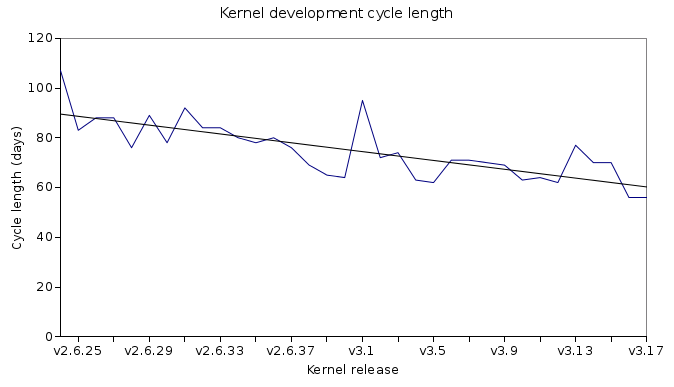
So the kernel development cycle, it seems, continues to get shorter. How much longer that trend can continue is unclear, though; there must be a minimum period required to get a high-quality release together. One other potentially interesting point: it should be remembered that the final stabilization of the 3.15 release overlapped with the 3.16 merge window. That probably had little to do with why the 3.15 cycle took longer than many others; it was the result of some difficult-to-find last-minute bugs. But one could argue that the 3.16 development cycle should really be counted as being one week longer than the release dates would indicate.
Contributors
As can be seen from the table above, 38,679 non-merge changesets were pulled into the mainline repository for the 3.15–3.17 development cycles. Of the 2546 developers who contributed changes during this time, the most active were:
Most active developers, 3.15–3.17
By changesets Hartley Sweeten 919 2.4% Jes Sorensen 767 2.0% Malcolm Priestley 544 1.4% Fabian Frederick 382 1.0% Navin Patidar 378 1.0% Laurent Pinchart 330 0.9% Sachin Kamat 327 0.8% Russell King 316 0.8% Axel Lin 301 0.8% Johan Hedberg 300 0.8% Geert Uytterhoeven 296 0.8% Daniel Vetter 278 0.7% Takashi Iwai 275 0.7% Jingoo Han 265 0.7% Thomas Gleixner 260 0.7% Alexander Shiyan 240 0.6% Ville Syrjälä 235 0.6% Joe Perches 233 0.6% Tejun Heo 231 0.6% Lars-Peter Clausen 226 0.6%
By changed lines Tomi Valkeinen 318894 10.9% Kristina Martšenko 165102 5.6% Larry Finger 164869 5.6% Andrzej Pietrasiewicz 108036 3.7% Mauro Carvalho Chehab 71253 2.4% Greg Kroah-Hartman 68260 2.3% Dave Chinner 48267 1.6% Devin Heitmueller 46125 1.6% Malcolm Priestley 35231 1.2% Jes Sorensen 29412 1.0% Navin Patidar 28871 1.0% Hans Verkuil 27813 0.9% Ben Skeggs 26293 0.9% Mark Hounschell 24285 0.8% Ken Cox 23213 0.8% Hartley Sweeten 21246 0.7% Jason Cooper 20344 0.7% Linus Walleij 19898 0.7% Jake Edge 18218 0.6% Maxime Ripard 14669 0.5%
As is usually the case, Hartley Sweeten contributed more changesets than any other developer; all of those were against the COMEDI drivers in the staging tree. All told, nearly 6,000 patches have been applied against just that subsystem since its entry into staging. Jes Sorensen's work was nearly all against the rtl8723au driver, while Malcolm Priestly worked on the vt6656 driver; both of those drivers are also in the staging tree. Fabian Frederick contributed cleanups throughout the kernel tree, while Navin Patidar focused on the rtl8188eu driver which, unsurprisingly, is also in the staging tree.
In the "lines changed" column, Tomi Valkeinen reached the top with extensive work on the ARM OMAP architecture code and related device tree files. Kristina Martšenko removed 14 drivers from the staging tree, making her the developer who removed the most code during this time. Larry Finger continues his work to rationalize the Realtek wireless drivers in the staging tree, Andrzej Pietrasiewicz did a lot of work in the USB gadget driver, and Video4Linux subsystem maintainer Mauro Carvalho Chehab did extensive work throughout that tree.
The 3.15–3.17 development cycles saw contributions from at least 312 employers, the most active of whom were:
Most active employers, 3.15–3.17
By changesets (None) 4492 11.6% Intel 4088 10.6% Red Hat 3577 9.2% (Unknown) 3409 8.8% Linaro 1702 4.4% Samsung 1646 4.3% SUSE 1243 3.2% IBM 1050 2.7% (Consultant) 1016 2.6% Texas Instruments 942 2.4% Vision Engraving Systems 919 2.4% 763 2.0% Renesas Electronics 753 1.9% Free Electrons 753 1.9% Freescale 620 1.6% C-DAC 400 1.0% Oracle 390 1.0% Imagination Technologies 361 0.9% NVidia 355 0.9% FOSS Outreach Program for Women 336 0.9%
By lines changed (None) 408176 13.9% Texas Instruments 357058 12.2% (Unknown) 338760 11.6% Red Hat 259264 8.8% Samsung 249613 8.5% Intel 180869 6.2% Linaro 93125 3.2% Linux Foundation 68988 2.4% SUSE 52213 1.8% (Consultant) 45952 1.6% IBM 44809 1.5% Free Electrons 42917 1.5% Cisco 33254 1.1% Freescale 32636 1.1% C-DAC 30405 1.0% Renesas Electronics 29973 1.0% 29957 1.0% Realtek 27888 1.0% NVidia 27232 0.9% COMPRO Intelligent Solutions 24722 0.8%
As usual, this picture has remained relatively stable from one release to the next. Mildly notable is the increase in contributions from developers working on their own time, though it would be hard to say that the long-term trend toward decreasing volunteer contributions has ended at this point.
Reviews and conclusion
Finally, it can be interesting to look at who is attaching Reviewed-by tags to patches. That tag is meant both as an indicator that the patch has been reviewed and a means for crediting developers who perform those reviews. The developers with the most Reviewed-by tags during this period were:
Developers with the most Reviewed-by tags Ian Abbott 766 11.0% Josh Triplett 207 3.0% Tomasz Figa 155 2.2% Christoph Hellwig 142 2.0% Ville Syrjälä 132 1.9% Chris Wilson 123 1.8% Johannes Berg 122 1.8% Jesse Barnes 103 1.5% Guenter Roeck 98 1.4% Pieter-Paul Giesberts 92 1.3% David Herrmann 87 1.3% Dave Chinner 86 1.2% Hartley Sweeten 86 1.2% Imre Deak 84 1.2% Alex Elder 84 1.2% Rodrigo Vivi 80 1.2% Alex Deucher 74 1.1% Damien Lespiau 73 1.1% Daniel (Deognyoun) Kim 71 1.0% Franky (Zhenhui) Lin 66 1.0%
Ian Abbott, it seems, has reviewed 766 patches in the 182 days covered by these three development cycles — just over four patches every day, with no breaks for weekends or holidays. It turns out that almost all of those patches were the COMEDI changes submitted by Hartley Sweeten. Josh Triplett, instead, reviewed a wide range of changes from many developers; most of those were changes related to or involving read-copy-update. Tomasz Figa concerns himself with ARM-related changes, Christoph Hellwig is a longstanding reviewer of storage- and filesystem-related patches, and reviews changes to DRM (graphics) drivers.
What is not reflected here, of course, is the vast amount of patch review work that never results in a Reviewed-by tag. In fact, your editor would assert that this mechanism is not working as intended at this point. It is failing to document the bulk of the review work that is being done and serves mostly to highlight which developers make the effort to offer an explicit Reviewed-by tag.
To summarize: what has changed in the six months since LWN last published a set of development statistics? The answer is "not much." The kernel development process continues to roll along, producing releases in a fairly predictable schedule. The pace continues to increase, the community continues to grow, and the development cycle continues to shorten. These are all trends that we have seen for a while, so, to a great extent, it all looks like business as usual.
Patches and updates
Kernel trees
Architecture-specific
Build system
Core kernel code
Development tools
Device drivers
Device driver infrastructure
Documentation
Filesystems and block I/O
Memory management
Networking
Miscellaneous
Page editor: Jonathan Corbet
Distributions
Gentoo discusses a Git migration
Gentoo has been considering (or just discussing) the conversion of its main repositories from CVS to Git for some time now—since 2009, at least. A recent "master plan" posted to the gentoo-dev mailing list resulted in a long, wide-ranging thread. While the discussion was mostly positive on the change, it is still unclear if it will lead Gentoo into making the switch any time soon.
The master plan was posted by Michał Górny in mid-September. He prefaced the plan with a statement of frustration:
He describes an ambitious plan, with a seemingly over-optimistic estimate of two hours of downtime to actually perform the switch. Górny envisions three separate repositories, each targeting a different sub-group of Gentoo users. The developer repository is, not surprisingly, for developers. Like any other Git repository, developers would push changes to Gentoo packages into it, and pick up changes from other developers from it.
Changes to the developer repository would then be automatically merged into a "user sync" repository that would target "power users" who want to fetch their Gentoo packages via Git. That repository would be read-only and would be made available to regular users. The user sync repository would also include some "extras", such as documentation files and the cache of MD5 hashes for package metadata.
The contents of the user sync repository would then be used to create the "rsync" repository, which would get the expected ChangeLog and Manifest files. Old ChangeLogs would be checked out of CVS and placed into the rsync repository; moving forward, ChangeLogs would be generated from the Git commit messages. The rsync repository would provide a "no change" option for users who do not want to work with Git, as rsync is an existing mechanism for users to keep their Portage tree up to date.
For the developer repository, Górny would leave all of the CVS history behind, which results in a 66M Git pack file. He is not convinced of the value of the history, nor of the fidelity of the history in the CVS-to-Git conversions that have been done as tests in the past. Furthermore:
The loss of history was not entirely popular, but it also may not be
necessary. As Rich Freeman pointed out,
converting Gentoo's CVS repositories to Git is "basically a solved
problem
". There
is already a process to generate two Git repositories from the existing CVS
repositories: one with history and
one without.
Freeman agreed with Górny's "sentiment
" expressed in the
master plan, but he
was not sure that the problems identified had not already been solved. In
particular, Górny kind of glosses over the "how to use Git" question. As
Freeman put it: "there are a
dozen different ways we COULD use git, and nobody has picked the ONE
way we WILL use it
". As might be guessed, there are lots of
different opinions about the right way for Gentoo developers to use Git.
In the thread, that led to some of the bikeshedding that Górny was
worried about.
But Julian Ospald (aka "hasufell") has been working on a step-by-step guide (also on the Gentoo wiki) that may help focus the Git workflow discussion. In another message, he was optimistic that such a guide can be worked up in two or three weeks.
Another major theme of the discussion was concern over the security implications of Git's use of the SHA-1 hash. The plan is to GPG-sign some commits to the developer repository, so there were questions about the security of coupling GPG signatures and SHA-1 hashes. But, as several in the thread pointed out, Git only uses SHA-1 as a consistency check, rather than directly as a security feature. It was also pointed out that adversaries who can create SHA-1 collisions probably have much easier ways to compromise Gentoo's repositories—including simply becoming a Gentoo developer and committing the code directly.
It would seem that the Gentoo
infrastructure team is not yet ready to
commit the resources that Górny has requested—at least not publicly in the
thread. Freeman
noted that he didn't see it as a lack of cooperation from the team,
"just lack of manpower or interest
". There was at least one
offer of server resources to use for
testing, but
nothing "official" has so far been seen.
Even if there are no server resources yet, it would seem that some progress has been made. Working out the Git workflow, as well as the repository structure, will be helpful whenever the conversion does come about. Given the level of interest (and the lack of features in the ancient CVS tool), it would seem that the conversion could come about relatively soon. On the other hand, there have been other times in Gentoo history where it looked like the conversion was near at hand (notably in 2011), so we will have to wait and see.
Brief items
Announcing the release of Fedora 21 Alpha
The Fedora project has released Fedora 21 Alpha. This is the first release of Fedora.next, which introduces three products rather than the traditional single deliverable. The Fedora 21 Base includes only the base set of packages (such as kernel, RPM, yum, systemd, and Anaconda) used by all the products. Fedora 21 Cloud includes images for use in private cloud environments like OpenStack, as well as AMIs for use on Amazon, and a new image streamlined for running Docker containers. The server product is aimed at making it easier to install discrete infrastructure services. The Fedora Server will introduce three new technologies in Fedora to handle this task, rolekit, Cockpit and OpenLMI. The third product is Fedora 21 Workstation, which is aimed at providing a platform for development of server side and client applications that is attractive to developers of all stripes. The final release of Fedora 21 is expected in December.LFS and BLFS Version 7.6 released
The Linux From Scratch community has announced the release of LFS 7.6, BLFS 7.6, LFS Systemd 7.6, and BLFS Systemd 7.6. The LFS releases include toolchain updates. BLFS (Beyond Linux From Scratch) includes about 750 packages beyond LFS and includes many updates.openSUSE 13.2 beta released
The openSUSE project has released the first beta for openSUSE 13.2. The beta includes Linux kernel 3.16, GNOME 3.12, Plasma Workspaces 4.11, KDE applications 4.13, Plasma 5.1, Frameworks 5.2, all of which are likely to be updated before the final release. Btrfs is the default filesystem. YaST has a revamped installer and many other improvements. There's plenty to test in this release.Oracle Linux Release 5 Update 11
Oracle has released version 5.11 of their Enterprise Linux distribution. Three kernel packages are available in this release. Oracle's Enterprise Kernel is booted by default. The second kernel is Red Hat compatible and is installed by default. The third kernel is also Red Hat compatible, but also includes additional bug fixes added by Oracle, and it must be manually installed.Whonix 9 released
Whonix Anonymous Operating System Version 9 has been released. "Whonix is an operating system focused on anonymity, privacy and security. It’s based on the Tor anonymity network, Debian GNU/Linux and security by isolation. DNS leaks are impossible, and not even malware with root privileges can find out the user’s real IP. Whonix consists of two parts: One solely runs Tor and acts as a gateway, which we call Whonix-Gateway. The other, which we call Whonix-Workstation, is on a completely isolated network. Only connections through Tor are possible." The announcement contains a lengthy changelog between version 8 and version 9.
Distribution News
Debian GNU/Linux
Bug-Squashing-Party in Munich, Germany
There will be a Bug-Squashing-Party in Munich, Germany beginning on Friday evening, November 21, and continuing through the weekend.
Newsletters and articles of interest
Distribution newsletters
- DistroWatch Weekly, Issue 577 (September 22)
- 5 things in Fedora this week (September 18)
- Ubuntu Weekly Newsletter, Issue 384 (September 21)
Page editor: Rebecca Sobol
Development
Mailpile's first beta release
The Mailpile project made quite a news splash in 2013, capitalizing on public anger over the government Internet surveillance disclosed by Edward Snowden, and launching a successful Indiegogo campaign to fund development. What Mailpile promised was a simple-to-use webmail experience that users could self host: all the convenience of GMail, but none of the ads, user-tracking, or spying eyes. Now, the project has announced its first beta release. The good news is that the fundamental email features are in place. The security and privacy features are also nearing completion—although, naturally, users should be wary of over-reliance on pre-release software for such matters.
Piling on
The beta was announced on September 13, with pre-built packages made available for Windows and Mac OS X, and a tagged release on GitHub available for Linux. The tag, interestingly enough, designates the release as version 0.4.0, although there does not appear to be a detailed roadmap between here and an eventual 1.0 release, which the release notes estimate will arrive in December.
The release includes a guided set-up process, but those interested in only taking a peek may prefer to check out the live demo running at www.mailpile.is/demos (for the curious, the screen shots shown here come from the live demo, rather than from the author's personal email). Installing the Mailpile beta locally requires OpenSSL, GnuPG, Python 2, and a handful of common Python libraries, but no external web server is required. Launching Mailpile opens the user interface running at http://localhost:33411.
We last looked at Mailpile just over a year ago, shortly after the project's public debut. At that time, the team—Bjarni Einarsson, Smári McCarthy, and Brennan Novak—pitched Mailpile as "personal web-mail." That is, an application that offered the ease-of-use (both within the interface and on administrative tasks) that contributes to the wide popularity of webmail services like GMail, but is private, decentralized, and offers security that a commercial service cannot match.
The original brief for Mailpile also specifies that the application will be implemented in HTML and JavaScript, running from a local web server, where it can remain under the user's control. Nevertheless, Mailpile itself does not handle the more security-sensitive tasks of sending and receiving mail: it requires either a separate mail server running on the local machine, or a POP/IMAP account on a remote host. At this point, the beta is quite simple to set up and get started with (at least when used with a remote email server).
It remains to be seen, though, whether or not the same degree of smoothness can be extended to include setting up local mail receipt and delivery. Considering Mailpile's public focus on the importance of user security and privacy, it is a bit odd to see its continued reliance on remote mail servers.
Usability
But, considering how complex some of the steps involved could be, Mailpile's guided setup and configuration process is remarkably smooth. During initial setup, users are asked to create an encryption key and passphrase that will be used to protect storage (but is not, for example, used for signing outgoing messages or decrypting incoming ones), and similar walk-throughs step through the process of setting up SMTP, POP, and IMAP configurations (which are, perhaps confusingly, called "routes" in the interface).
The user interface, on the whole, is definitely an improvement over the default UIs found in other common free-software webmail packages (such as SquirrelMail or RoundCube). The icons used are more-or-less self-explanatory and all of the buttons one would require during everyday use are both easy to reach and located close to where they are needed.
That said, there are some aspects of the UI that feel awkward. Icons and functional "action" links vary wildly in size. The "trash" button in the composer window, for instance, is 14 pixels tall, while the "reply" button is 40 pixels tall. Perhaps there is a case to made for varying the size of buttons considerably, but it feels more like a lack of design unity than a conscious choice. Similar inconsistencies are found in color, alignment of UI elements, and whether icons are labeled with text. There are other spots where functionality is simply missing. For instance, when an email thread is opened, every message is shown in collapsed form (with only the first line readable). Clicking on the message expands it, but there seems to be no way to collapse it again.
But, from an interface perspective, the most interesting choices are the conscious decisions, such as Mailpile's decision to eschew "folders" for a single "tag" namespace. An arbitrary decision, some might say, but one that integrates well with the project's emphasis on search as the main method for interacting with a message archive. GMail also took this approach at the beginning, but over the years it strayed away from it with "Priority Inbox," "Important/Not Important," "Categories," multiple flavors of "stars," and other such features that provide different avenues through which to wrangle a busy email account.
Only time will tell whether Mailpile can succeed without also complicating its simple model. Already, the sidebar that lists a user's tags also includes a set of special tags that show all file attachments, all photos (which are also shown by the general "attachments" tag), and all hyperlinks. The last category in particular could become a lengthy list indeed, especially if one subscribes to mailing lists or corresponds with online merchants who liberally sprinkle links into their missives.
Features
Sending and receiving messages works in the beta release, as do attachments, tagging, spam filtering, and basic OpenPGP usage. There is some functionality missing, such as HTML-message formatting, and the release notes point out several hiccups—in particular, when using IMAP (which is still missing several key features, such as synchronization) and when working with attachments other than images. Clicking on any of the "settings" options raises an error, at least on the demo.
Unfortunately, several of the known issues in this beta release relate directly to Mailpile's key feature: end-user security. Basic PGP signing and encryption is supposed to work (although there is an issue when dealing with non-ASCII characters in key IDs), but PGP/MIME support is currently broken. More troublingly, outgoing TLS connections neither validate certificates nor specify strong cipher choices. The automatic PGP-key-lookup function in the contact-editing screen seemed to hang indefinitely in my tests.
But not all is darkness on the security front, according to the project. The team has published a detailed security roadmap staking out its long-term goals and outlining how it intends to reach them. There are some creative and ambitious targets on the list.
For instance, the user interface can display Gravatar images for remote contacts. The plan is to send HTTP queries for Gravatar images over the Tor anonymizing network in order to guard against snooping. Tor is also planned to be used for masking search engine requests, PGP key lookup, and fetching HTML mail resources. Other goals include support for the Dark Mail protocol, whenever it sees the light of day, and automatic lossless conversion of attachments to "safe" data formats (although the examples listed, such as PDF-to-PostScript, are not explained in detail).
Perhaps the most ambitious security goals, however, are those that
come late in the list, such as "implementing a user interface
which helps the user avoid making common mistakes
" and enabling
access from remote locations—including mobile devices. So far,
the Mailpile team has done a good job of building a slick webmail-like
user interface; building a slick and foolproof PGP interface is at
least a different challenge—and likely a harder one, too.
The most practical challenge, however, will be seeing how much of this work the team is able to do by the scheduled 1.0 release date in December. That date, unfortunately, is not merely some arbitrary selection. The project has been operating for the past year using the funds it raised from its crowdsourcing campaign, and the beta announcement estimates that three or four months' worth of money remains. Then again, if the beta proves popular and if the project can show enough progress on the security front prior to running out of cash, that could easily be enough to motivate another successful round of fundraising from Mailpile users.
Brief items
Quotes of the week
- Fire means "Easy to install" because easy is hot!
- Curve on a monitor is "Cross-platform" because an OS supports monitors!
- Rocket means "Lightweight" because space travel is inexpensive and has minimal requirements!
- Empty brackets mean "Open Source" because there is nothing to hide!
PyPy 2.4.0 released
PyPy is an optimized implementation of the Python (2.x) programming language; the 2.4 release is now available. As is often the case, performance improvements top the list of changes in this release. "Benchmarks improved after internal enhancements in string and bytearray handling, and a major rewrite of the GIL handling. This means that external calls are now a lot faster, especially the CFFI ones. It also means better performance in a lot of corner cases with handling strings or bytearrays." Various bug fixes and an update to the Python 2.7.8 standard library are included as well.
Wayland and Weston 1.6.0 released
The version 1.6.0 releases of the Wayland display manager and Weston compositor are available. Wayland improvements include better error handling and an improved self-testing infrastructure. On the Weston side, they have made a number of xdg-shell protocol changes ("Yes, we broke it again since 1.5.0"), some keyboard repeat improvements, a switch to libinput by default, and more.
Tracker 1.2.0 available
Version 1.2.0 of the Tracker semantic data-storage system has been released. Among the changes are support for new file types, a Data provider feature "
to allow 3rd parties to supply their own data to Tracker to be indexed, for example for an online or proprietary service
", and numerous build fixes. Also noteworthy is that "
Extractor is now 'crash-aware';" a separate data source is now available for content whose metadata cannot be extracted, a situation that previously would cause repeated failures of tracker-extract, often triggering crashes.
GNOME 3.14 released
The GNOME project has released GNOME 3.14. "This is another exciting release for GNOME, and brings many new features
and improvements, including multitouch, captive portal support, greatly
improved sharing settings. This release also includes improved and
redesigned applications for weather, maps, PDF viewing, running VMs,
and more.
The Wayland support has matured to the point where it is ready for
day-to-day use.
" See the release notes
for details.
Newsletters and articles
Development newsletters from the past week
- What's cooking in git.git (September 18)
- What's cooking in git.git (September 19)
- Haskell Weekly News (September 18)
- LLVM Weekly (September 22)
- OCaml Weekly News (September 23)
- OpenStack Community Weekly Newsletter (September 19)
- Perl Weekly (September 22)
- PostgreSQL Weekly News (September 21)
- Python Weekly (September 18)
- Ruby Weekly (September 18)
- Tor Weekly News (September 24)
- Wikimedia Tech News (September 22)
Best practices for the new era of open source (opensource.com)
This opensource.com article holds out Ansible as an example of a project worth emulating and delves into the reasons for its success. "The idea that a user can try something out over a lunch break, and understand it—and then learn what is left to learn—is a key success driver for open source software. Too many projects fail needlessly because they don’t invest in this critical idea."
Hutterer: libinput - a common input stack for Wayland compositors and X.Org drivers
Here's a post from Peter Hutterer on why the X.Org input stack is a mess and the new "libinput" stack is needed. "It looks like a big happy family at first, but then you see that synaptics won't talk to evdev because of the tapping incident a couple of years back, mouse and keyboard have no idea what forks and knives are for, wacom is the hippy GPL cousin that doesn't even live in the same state and no-one quite knows why elographics keeps getting invited. The X server tries to keep the peace by just generally getting in the way of everyone so no-one can argue for too long. You step back, shrug apologetically and say 'well, that's just how these things are, right?'"
Page editor: Nathan Willis
Announcements
Brief items
FSF: Tor Challenge hits it out of the park
The Free Software Foundation reports that the Electronic Frontier Foundation's Tor Challenge has been a success. "The Tor Challenge has already been successful, but that doesn't mean it's too late to start a Tor relay! You can get started from the Challenge's beautifully-designed Web site."
New Books
New From Rocky Nook -- Advanced Software Testing—Vol. 2, 2nd Edition
Rocky Nook has released "Advanced Software Testing—Vol. 2, 2nd Edition" by Rex Black.
Calls for Presentations
CFP Deadlines: September 25, 2014 to November 24, 2014
The following listing of CFP deadlines is taken from the LWN.net CFP Calendar.
| Deadline | Event Dates | Event | Location |
|---|---|---|---|
| September 30 | November 25 | New Directions in Operating Systems | London, UK |
| September 30 | November 1 November 2 |
OpenFest 2014 | Sofia, Bulgaria |
| October 1 | January 31 February 1 |
FOSDEM 2015 | Brussels, Belgium |
| October 15 | October 29 | CentOS Dojo Barcelona, Spain | Barcelona, Spain |
| November 1 | April 10 April 12 |
PyCon North America 2015 | Montreal, Canada |
| November 7 | December 5 December 7 |
SciPy India | Bombay, India |
| November 9 | March 21 March 22 |
LibrePlanet 2015 | Cambridge, MA, USA |
If the CFP deadline for your event does not appear here, please tell us about it.
Upcoming Events
Events: September 25, 2014 to November 24, 2014
The following event listing is taken from the LWN.net Calendar.
| Date(s) | Event | Location |
|---|---|---|
| September 25 September 26 |
Kernel Recipes | Paris, France |
| September 26 September 28 |
PyCon India | Bangalore, India |
| September 27 September 28 |
EuroBSDCon 2014 | Sofia, Bulgaria |
| October 2 October 3 |
PyCon ZA 2014 | Johannesburg, South Africa |
| October 3 October 5 |
PyTexas 2014 | College Station, TX, USA |
| October 4 October 5 |
Iberian minority language groups reach out to open source | Santiago de Compostela, Spain |
| October 6 October 8 |
Operating Systems Design and Implementation | Broomfield, CO, USA |
| October 6 October 8 |
Qt Developer Days 2014 Europe | Berlin, Germany |
| October 6 October 9 |
Perl::Dancer Conference 2014 | Hancock, NY, USA |
| October 8 October 10 |
X Developers Conference | Bordeaux, France |
| October 11 October 12 |
AdaCamp Berlin | Berlin, Germany |
| October 12 | Enlightenment Developer Day 2014 | Düsseldorf, Germany |
| October 13 October 15 |
CloudOpen Europe | Düsseldorf, Germany |
| October 13 October 15 |
Embedded Linux Conference Europe | Düsseldorf, Germany |
| October 13 | Tracing Summit 2014 | Düsseldorf, Germany |
| October 13 October 15 |
LinuxCon Europe | Düsseldorf, Germany |
| October 14 October 16 |
KVM Forum 2014 | Düsseldorf, Germany |
| October 15 October 17 |
Linux Plumbers Conference | Düsseldorf, Germany |
| October 16 October 17 |
GStreamer Conference | Düsseldorf, Germany |
| October 18 October 19 |
openSUSE.Asia Summit | Beijing, China |
| October 20 October 21 |
Tizen Developer Summit Shanghai | Shanghai, China |
| October 21 October 24 |
PostgreSQL Conference Europe 2014 | Madrid, Spain |
| October 23 October 24 |
Free Software and Open Source Symposium | Toronto, Canada |
| October 23 October 25 |
FUDCon Managua 2014 | Managua, Nicaragua |
| October 24 October 25 |
Firebird Conference 2014 | Prague, Czech Republic |
| October 24 October 25 |
Seattle GNU/Linux Conference | Seattle, WA, USA |
| October 24 October 26 |
Ohio LinuxFest 2014 | Columbus, Ohio, USA |
| October 25 October 26 |
T-DOSE 2014 | Eindhoven, Netherlands |
| October 25 October 28 |
PyconFR | Lyon, France |
| October 28 October 29 |
2014 LLVM Developers' Meeting | San Jose, CA, USA |
| October 29 | CentOS Dojo Barcelona, Spain | Barcelona, Spain |
| October 31 November 2 |
Free Society Conference and Nordic Summit | Gothenburg, Sweden |
| November 1 November 2 |
OpenFest 2014 | Sofia, Bulgaria |
| November 3 November 5 |
Qt Developer Days 2014 NA | San Francisco, CA, USA |
| November 3 November 7 |
OpenStack Summit | Paris, France |
| November 4 November 7 |
Open Source Developers' Conference 2014 | Gold Coast, Australia |
| November 6 November 9 |
mini-DebConf | Cambridge, UK |
| November 7 November 9 |
Jesień Linuksowa | Szczyrk, Poland |
| November 8 | Open Source Days | Copenhagen, Denmark |
| November 9 November 14 |
Large Installation System Administration | Seattle, WA, USA |
| November 10 November 14 |
21'th Annual Tcl/Tk Conference | Portland, Oregon, USA |
| November 11 | Korea Linux Forum | Seoul, South Korea |
| November 13 | Hackaday Munich | Munich, Germany |
| November 16 November 21 |
Supercomputing 14 | New Orleans, LA, USA |
| November 17 November 21 |
ApacheCon Europe | Budapest, Hungary |
| November 18 November 20 |
Open Source Monitoring Conference | Nuremberg, Germany |
| November 19 November 21 |
CloudStack Collaboration Conference Europe | Budapest, Hungary |
| November 21 November 23 |
Debian Bug Squashing Party in Munich | Munich, Germany |
| November 22 November 23 |
AdaCamp Bangalore | Bangalore, India |
If your event does not appear here, please tell us about it.
Page editor: Rebecca Sobol