

Development
Enlightenment releases E19
The Enlightenment project has released version E19 of its desktop shell, along with the updated packages for the framework that powers it: the Enlightenment Foundation Libraries (EFL) toolkit and associated components. The project continues to forge its own path, in spite of the larger followings that competing toolkits like GTK+ and Qt have amassed. This newest release incorporates a number of new features, including support for Wayland, for modern GStreamer releases, and for other system components common to desktop Linux distributions.
EFL and foundational components
In recent years, EFL has been most prominently associated with the mobile version of the Tizen Linux platform, with a number of Enlightenment's core developers being employed by Tizen co-sponsor Samsung. Given that Tizen phones and tablets remain unavailable to many consumers, a number of free-software fans may not have taken a close look at Enlightenment in quite some time. But the team has steadily been releasing stable updates nonetheless. Most recently, EFL 1.11 was released on August 20, along with the 1.11 versions of the Elementary widget set (not to be confused with the elementary OS Linux distribution), the Emotion Generic Players suite of audio/video components, and the Evas General Loaders, which handle loading PDF, PostScript, and other common file types.
EFL includes a wide array of application-development libraries, from basic data types through Freedesktop.org menu- and desktop-integration support, and even a handful of less-common offerings, such as a physics simulation library. Version 1.11 includes a from-the-ground-up rewrite of EFL's C generator Eolian (which is used to produce C code and headers based on EFL's internal object system) as well as a new Lua runtime called Elua. The updated Eolian now supports complex data types, but perhaps more importantly, it supports better error checking, has fewer resource leaks, and in general is more consistent and predictable in its output.
The project's release notes highlight the new Eolian as the necessary next step toward developing a full set of language bindings for EFL. Apart from Elua, the only other major option for developers at the moment is the project's Python bindings, which were also updated to version 1.11 recently. Enlightenment is a relatively fast-moving project, of course; developers may wish to take note that the latest Python-EFL release drops compatibility with EFL 1.8 (released in December 2013) and older—releases which offered a different set of APIs.
On the other hand, EFL has kept pace with the changes that other desktop environments and graphical toolkits have made in recent years. Version 1.11 supports XInput 2.2, including the multitouch extension, as well as recent updates to FreeType, PulseAudio, and systemd. Understandably, the highest-profile of such system components to be officially supported by EFL is the Wayland display-server protocol. Wayland support is a key talking point for Tizen, of course, so support for it in EFL is no surprise, but it is still nice to see.
At the moment, neither Enlightenment nor EFL itself includes a standalone Wayland compositor, but Wayland client applications are supported through a compatibility layer in the EFL X11 compositor. The Enlightenment project describes its Wayland support as "quite usable," although the same document notes that the project expects to have to write several Wayland extensions. Wayland support is a compile-time option in the latest EFL release, and tracks the Wayland master branch upstream.
Another noteworthy development in the latest EFL updates is support for GStreamer 1.0, which introduced a new set of APIs that are intended to be supported for the long term. The Enlightenment project includes a handful of media-playback applications, such as the video player Rage, for anyone who wishes to see EFL's GStreamer support in action.
Enlightenment
Historically minded readers may be more likely to remember EFL in the context of the Enlightenment desktop environment, which in the late 1990s and early 2000s was—for a time—regarded by many as a serious competitor to GNOME and KDE in the battle for the Linux desktop. Enlightenment, or simply E, was originally a window manager project that slowly grew to encompass more and more aspects of a full desktop environment.
Perhaps such feature creep was ill-advised, because although E attracted loyal fans, new releases slowed to a trickle. Prior to this week's release of Enlightenment 19, the previous stable version (E17) took more than a decade to see the light of day (which it eventually did in December 2012). By that metric, the release of Enlightenment 19 represents a phenomenal improvement, of course. But the speed of the new release did involve setting a less ambitious bar; the project skipped beta releases completely during this development cycle, for example.
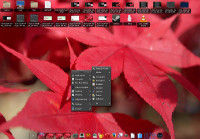
But the new release does include many of the features users have come to expect in desktop shells, such as XRandR, improved multi-monitor support, and multiple workspaces. Enlightenment naturally benefits from all of the improvements to EFL and related libraries, so core applications like the file manager can offer such niceties as previews of multimedia content. A lot of work has also evidently gone into Enlightenment's session-locking functionality, which is (perhaps) indicative of the explosive growth of Linux on laptop machines that has occurred in the years since E17 was first started.
On the whole, it is hard not to look at Enlightenment as something of a historical curiosity, given how much solid work has been done on the free-software desktop in the years since Enlightenment's first heyday. But that is, surely, unfair to the project. Whatever might have become of Enlightenment had it picked up steam in the late 1990s, the project today is alive based on the concerted efforts of its contributors. EFL may have found a new life as part of Tizen; if one side-effect of that is a renewed interest in alternative desktop environments and window managers, that is hardly a bad thing. There are scores of "alternative" desktops available today: MATE, elementary OS's Luna, Cinnamon, etc. Enlightenment certainly deserves to be given as much serious consideration as those project—perhaps more so, given its pedigree.
Brief items
Quotes of the week
We seem to have created a world centred on github where everyone has to manage dependencies by hand, like we had to in 1997. This problem was completely solved by apt twenty years ago, but the new cool github world is, it seems, too cool to care about that. Go off to get some new project by git cloneing it and it’s quite likely to say “oh, and it depends on $SOME_OTHER_PROJECT (here’s a link to that project’s github repo)”. And then you have to go fetch both and set them up yourself. Which is really annoying.
Valgrind 3.10.0 released
Version 3.10.0 of the Valgrind memory-profiling and debugging utility has been released. This version adds support for the AArch64, PPC64LE, and MIPS32 architectures, and provides inlining-aware stack unwinding.
LedgerSMB 1.4.0 released
Version 1.4.0 of the LedgerSMB accounting system is out. It features a new contact management subsystem, a reworked report generation subsystem, better integration with other business applications, and more. The announcement left out download information; those who are interested can find the software at ledgersmb.org.Enlightenment DR 0.19.0 available
Version 0.19 of the Enlightenment desktop shell has been released. New to this version are enhanced Wayland support, GStreamer 1.0 support, and many other fixes.
Phonon 4.8.0 available
Version 4.8.0 of KDE's Phonon audio framework has been released. The release consists of three major parts: the core library, the GStreamer backend, and the VLC backend. New features in this release include GStreamer 1.0 API support, improvements to PulseAudio interoperability, and numerous bugfixes.
RPM 4.12.0 released
Version 4.12.0 of the RPM package manager is out. New features include weak dependencies ("suggests," "recommends," "supplements," and "enhances" tags), a new rpm2archive utility to turn a package into a tar archive, lots of internal improvements, the removal of the "collections" feature, and, for those who think it is wise, the ability to put files larger than 4GB into a package.
Newsletters and articles
Development newsletters from the past week
- What's cooking in git.git (September 11)
- Haskell Weekly News (September 6)
- LLVM Weekly (September 15)
- OCaml Weekly News (September 16)
- OpenStack Community Weekly Newsletter (September 12)
- Perl Weekly (September 15)
- PostgreSQL Weekly News (September 14)
- Python Weekly (September 12)
- Ruby Weekly (September 11)
- Tor Weekly News (September 17)
- Wikimedia Tech News (September 15)
Klumpp: Listaller: Back to the future!
At his blog, Matthias Klumpp provides an update on recent work in Listaller, the cross-distribution framework for third-party package installation. The core issue is that Listaller currently relies on PackageKit's plugin infrastructure, which is going away. As a result, Klumpp has started work on a substantial rewrite of Listaller that will integrate with AppStream and other up-to-date tools. He is also, notably, taking this opportunity to trim down the project in other respects: "The new incarnation of Listaller will only support installations of statically linked software at the beginning. We will start with a very small, robust core, and then add more features (like dependency-solving) gradually, but only if they are useful. There will be no feature-creep like in the previous version.
"
Intel's Edison Brings Yocto Linux to Wearables (Linux.com)
Linux.com takes a look at Intel's Edison computing module. "Linux-based platforms for wearables include Android Wear, Samsung's Tizen SDK for Wearables, and now Intel's Yocto Linux and Intel Atom-based Edison computing module. The Edison was released last week in conjunction with the Intel Developer Forum. Prior to the formal launch, some 70 Intel Edison beta units have been seeded, forming the basis for about 40 Edison-based projects, says Intel."
The road to Rust 1.0
The Rust Programming Language Blog has an article describing recent changes to the language and what remains to be done for the eventual 1.0 release. "The key to all these changes has been a focus on the core concepts of ownership and borrowing. Initially, we introduced ownership as a means of transferring data safely and efficiently between tasks, but over time we have realized that the same mechanism allows us to move all sorts of things out of the language and into libraries. The resulting design is not only simpler to learn, but it is also much 'closer to the metal' than we ever thought possible before. All Rust language constructs have a very direct mapping to machine operations, and Rust has no required runtime or external dependencies."
Page editor: Nathan Willis
Next page:
Announcements>>