

LWN.net Weekly Edition for August 14, 2014
Lessons from the Novena laptop project
Flock is the annual conference for the Fedora distribution, but, like most free-software events, the program draws on a wide range of projects. At this year's event in Prague, keynote speaker Sean Cross spoke about his work on the Novena laptop project—including some speculation as to why it is succeeding in the demonstrably harsh space of open hardware products. Cross told the audience he hoped to get Fedora running on Novena (which runs Debian only at the moment) over the course of the conference, but he also hoped that the Novena story would be a helpful and informative tale for others undertaking a difficult, large-scale task—such as building a distribution.
Novena, for those unfamiliar, is a do-it-yourself laptop designed with hackers in mind. The specifications are unusual; among other things, the CPU is a quad-core ARM Cortex A9 from Freescale, there is a breakout connector for Arduino- or Raspberry Pi–like aftermarket hardware add-ons, and there is a built-in Xilinx Field-Programmable Gate Array (FPGA) on board. The project raised more than $720,000 in a crowdfunding campaign (against an initial target of $250,000), and is run by just two employees: Cross and Andrew "Bunnie" Huang.
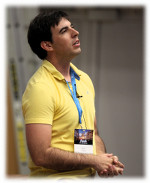
Cross met Huang when both were employees at Chumby, Cross explained. Huang was the hardware lead; Cross worked on kernel development. Both resided in Singapore, which, he explained, was almost a necessity when working on consumer electronics projects, due to its close proximity to China. Chumby was a fun company, he said, and he learned a lot from Huang. When Chumby closed its doors, Huang and Cross collaborated on a series of smaller open-hardware projects under the Kosagi company name. Those projects included the NeTV video overlay device and the Kovan robotics controller.
Both projects involved working with FPGAs during the development process, he explained, and they decided that their next project should be a platform for doing FPGA development. The Novena board itself started off as a design for a Tor router with a built-in FPGA. When they presented it at the 2013 Chaos Communication Congress (CCC), however, people kept telling them "that's a really cool laptop." Eventually, the outside interest persuaded them to attempt the crowdsourcing campaign. That campaign exceeded its target by a considerable margin in May, enabling the team to undertake several "stretch" goals.
The Novena is designed to be as free-software friendly as possible, Cross said. All of the schematics and hardware designs are publicly available, and the software is free of binary blobs. "Well," he added, "there is a small asterisk to that, depending on how you define 'blob.'" The device's WiFi module has free software drivers, he explained, but there are always other places where "blobs" can remain. The Novena board has a smart DMA controller and boot ROM, both of which do not have free firmware available. The Vivante video chip also needs non-free drivers to do 2D and 3D acceleration, at present, although progress is being made on reverse-engineering both cores ("it already plays Quake; the community is close to getting Wayland running," he said). Finally, there is hardware video core that requires a blob to accelerate certain codecs, though these are optional.
Whether these bits disqualify Novena as a "free hardware" device is a matter of contention, apparently; on his blog, Huang commented that the FSF would not certify the Novena in its "Respects Your Freedom" program, even though the laptop can be used with the binary-only units turned off and unloaded. Cross also asked, rhetorically, "what is a blob?" The Xilinx FPGA can only be programmed with Xilinx's IDE, he observed. You program it yourself, but it generates a binary—is that binary considered a "blob" or not, he asked.
Hardware design and development
Although the team was experienced with open-hardware products, Cross said, the laptop form factor quickly proved to be really complicated. For example, he compared the power circuit to that of the NeTV and Kovan board. Novena's power requirements necessitate handling far wider input voltages, employing separate switches to control power in different subsystems, battery control, battery charging logic, as well as over- and under-charge protection. They eventually had to design a custom power board for the device, running its own ARM CPU.
They also had to design custom boards for the laptop front panel, the Hall effect sensor (which detects if the lid is closed), and the cable connecting the mainboard to the embedded DisplayPort screen. He noted (in reference to the latter item) that most people don't think of cables as circuits, but they can be quite complex. Furthermore, the project has had to design every plastic and metal part used to assemble the device, down to the screen bezel and the switches. This can get expensive; the first quote they received for the metal-cutting bill alone was $250,000. By doing the CAD work in-house, though, they managed to find another supplier who would deliver for $100,000. The case is designed to be opened up and tinkered with, he explained, so it does not look like most traditional laptops—a factor that made it "interesting" to take through airport security.
The Novena includes several features not included on commercial laptops, Cross explained. In addition to the FPGA, the laptop includes USB On The Go (OTG), which allows the user to boot another computer off of the Novena's storage, dual Ethernet, and a header connector for electronics tinkering. This header was initially a direct copy of the Raspberry Pi header, he explained, so that users could run Raspberry Pi expansion boards ("but much, much faster"), but it was later reduced in size to save space—and bundled with a breakout cable. This was in the spirit of forking open source projects, Cross said, and it proved beneficial. A company called Myriad noticed that Novena used the same breakout header as its own software-defined radio (SDR) board, and offered to re-spin a version of the board specifically for use with the Novena.
The team has also spent a lot of time sourcing individual components. "If you like electronics," he said, "go to Shenzhen." The city is home to countless electronic supply markets that are "ehh ... I'll say 'gray' markets," he joked. Searching for surplus part lots that are in large quantity compared to what Novena needs, but are leftovers to major manufacturers like Foxconn, saved the project considerable money. Experience with the earlier devices and proximity to China helped a lot.
Software
On the software side, Cross said that the team decided to build Novena on ARM because they already had experience with it, and because an ARM-based machine could be used to compile software for virtually every mobile device on the market today—without requiring a cross-compiler. They chose the Freescale chip they use because it is the best documented: there are 5,827 pages of official documentation available on the web, all without requiring any non-disclosure agreement.
That said, he also reported that working with vendors' official board-support packages (BSPs) was not as smooth as it could be. BSPs tend to come with a specific bundle of "supported" modules (the kernel, Xorg, GStreamer, SurfaceFlinger, etc.). But they are rarely up-to-date and often only work with the other components in the BSP. "They're like off-brand LEGOs: they work okay within the kit, but you can't use them with your other toys." Consequently, the project stopped using vendor BSPs and has been working with upstream, mainline code. It takes longer, but support is much better and "is really long-term."
The development process has meant writing new drivers for several components (such as the onboard temperature sensor), he said, but he has been surprised at how quickly mainline kernel support has caught up. It helps that there are other projects working with the same Freescale parts, including Cubox, the Hummingboard, and the Riotboard.
Sometimes, support work flows in the other direction, too, he said. He pointed out that Freescale subcontracts subsystems like USB and video to other suppliers. In the case of PCIe, the Novena team had to write its own drivers, but discovered subsequently that several Samsung devices use the same PCIe components, so the patch benefits other device makers as well.
At this stage, the Vivante GPU requires a lot of work. As mentioned earlier, only non-free drivers are available for the 2D, 3D, and video cores. Luckily, the Etnaviv project is making progress on a free driver, which he hopes will be usable in the 3.17 or 3.18 time frame. The 3D core support is good, he said, but he wants to be able to use the 2D for as many operations as possible, since it consumes 1% of the 3D core's power.
Debian was chosen as the Linux distribution for the Novena because Debian has strong ties to Tor and the Novena mainboard was initially conceived of as a dedicated Tor platform. But, he added, "I have a spare SSD and a screwdriver with me, so if you want to help me get Fedora running, come talk." In an email, Cross said that he indeed did get Fedora running on the Novena hardware by the end of the event. There were a few stumbling blocks, he said, such as SELinux, but Fedora is now "working as well as Debian." GNOME Shell is not working smoothly yet, due to the 3D driver problems. But he estimates that in six months or so, even that could be solved.
Cross ended his talk with a few bits of stray advice he had gleaned from the work on Novena. First, he said, dogfooding is critical. He and Huang use their prototype Novena hardware as their daily machines; it is the only way to make sure that the solutions you work on really get exercised fully. Second, he said, work upstream. Vendor BSPs just aren't robust enough—the Novena hardware has not run Freescale's kernel for a long time.
Third, he advised the developers in the audience to stop assuming that their code was running on the x86 architecture. There are more and more ARM devices on the market, but there are also MIPS, IBM System z, and OpenPOWER boards coming out. They are all Linux, he said, but none are x86: assumptions about byte sizes and endianness need to go. Next, avoid optimization—or at least make sure you have a fallback. You may see some Intel vector instruction set that sounds great, but making your application depend on it will cause trouble for others. Sticking to a higher-level language instead means that anyone can get started—including those on homemade ARM laptops, presumably: the Kosagi wiki lists a few noteworthy examples.
Finally, Cross advised the audience to have fun. There are loads of options at every level of the free software stack, he said, so find a project that you are enthusiastic about.
The Novena hardware is already in production, according to Cross, although the final assembled units are not expected to ship for a while.
Pessimists might say that this means the Novena is not yet an "available" open-hardware device, but it is clearly much closer to completion than many of the other, canceled projects that the community has seen in the past few years. Having experience with prior devices and with the process of working with suppliers in China is clearly a big part of the equation, but there is probably something to be said for outside-the-box approach that Cross and Huang take. The Novena is almost nothing like a commercial laptop, and that is part of why it has so many fans. Which sounds like a good lesson for free software projects as well.
[The author would like to thank the Fedora project for travel assistance to attend Flock 2014.]
Plasma 5: Evolving the KDE desktop
On July 15, KDE announced the 5.0 release of the Plasma desktop environment. The new version appears to be a refresh of Plasma to keep pace with current design and computing trends, including "flatness" (i.e., avoiding 3D decorations), high-DPI displays, and mobile devices.
I tested Plasma 5 in VirtualBox using the Project Neon ISO, which is based on Ubuntu 14.04 and, as one other reviewer had noted [YouTube], it's "put together by people who know what they're doing". Plasma 5.0 reveals much to like after extended use, but with a caveat. As the announcement mentions, the 5.0 release represents a project that still has a number of bugs to squash and features to add.
New visible features include: new
high-contrast icons for the desktop that are part of the Breeze theme, which
replaced Oxygen from Plasma 4 as default theme pack; an extendable,
"converged shell" that allows different user interfaces (UIs) depending on
the device it is running on; and increased support for
resolution-independence, which allows for "better usability and display on
screens with very small pixels, such as Retina displays
". The
Plasma 5 announcement gives some more details on the converged shell,
saying that it "lays the base for a converged user experience
bringing up a suitable UI for a given target device. User experiences can
be switched dynamically at runtime, [for example] based on hardware events
such as plugging in a keyboard and a mouse
".
KDE also said that Plasma 5.0 is less demanding of the hardware it runs on:
Unfortunately, I was not able to test some of these features in VirtualBox. Performance improvements can't reasonably be determined through a virtual machine; I was unable to run it on "bare metal" for this review. I was also unable to test the "converged shell", since shells for other devices (e.g., tablets and media centers) are still under development.
Frameworks
For developers, KDE Frameworks 5, which are the foundational libraries
supporting Plasma 5, provide some interesting new features. Released
at the beginning of July, Frameworks 5 marks a major step for KDE, as it is
trying to position its libraries as a platform-independent solution for
developers of
Qt-based applications. That
is, developers working with Qt can hook into Frameworks 5 libraries to
easily provide functionality "to simplify, accelerate and reduce the cost
of Qt development
". For example, instead of having to code a file
compressor and decompressor, Qt developers can use KArchive. Another
library, Sonnet,
lets developers easily plug in spell-checking software for their
applications.
This is nice timing for KDE, as it can capitalize on Qt's recent popularity for cross-platform development. Boasting more than 50 libraries, the extensively documented APIs offer lots of tools for different developer needs. The KDE project divided the libraries into four "tiers", largely based on how complex the libraries are. Tier 1 libraries, like KArchive and Sonnet, are all cross-platform and have few dependencies, while Tier 2 libraries (such as KUnitConversion, for converting between various unit systems) and Tier 3 libraries (such as KDESu, that developers can use to handle asking for passwords among other things) depend on the lower tiers. Almost all of the Frameworks 5 libraries can run on Mac OS X and Windows as well as Linux.
Look and feel
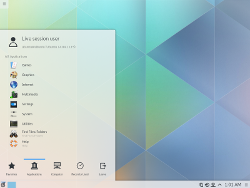
If we step away from the code and look at the desktop environment as an end user, an initial glance makes Plasma 5 look familiar, but modernized. Plasma 4 users should feel, largely, right at home, although they may miss some of the configuration depth that Plasma 4 is famous for. Influences of the recent trend toward "flatness" in user interface design — designing GUI elements to make them look two-dimensional, by avoiding decorations such as 3D borders and drop shadows — abound, such as the new look of the application launcher (seen at right).
The new high-contrast icon set is also in tune with the "flatter" look-and-feel of Plasma 5. However, there remain some 3D elements that jar with the increased flatness, including neon blue drop shadows behind windows. In addition, the minimize, maximize, and close buttons look 3D, so there was still some inconsistency there. The YouTube reviewer linked above did not see these problems; perhaps this particular ISO snapshot had some unintentional regressions.
Reflecting another popular trend, there are two visible instances of a "three parallel horizontal lines button", an increasingly widespread icon design that usually refers to a menu. One can be found in the top left corner, which allows various settings to be tweaked, and another in the bottom right corner as part of the panel; "the infamous Cashew of KDE" is gone.
Configuration options, which KDE is known for, are also to be found in Plasma 5, albeit in a more limited state now, as the project is still in development. I was not able to configure the window manager to use a "desktop cube" to navigate through workspaces, nor was I able to make windows wobble, features that one could set for Plasma 4.
When
playing around with the configuration options available, one may encounter
several bugs. For instance, none of my changes for desktop effects in
system settings worked. KDE was also unable to find the
providers.xml file for downloading more desktop effects. As the
Plasma 5.0 announcement noted, "many of [these features are] planned to
return with a subsequent release
", so users can expect later iterations
to implement some of these desktop effects.
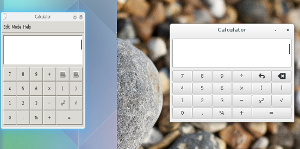
Some GTK+ and GNOME apps don't seem to play nicely with Plasma 5. For example, gnome-calculator had no icons for the undo and delete buttons (seen at right). Firefox looked and felt native, though, so this is not an issue with all GTK+ applications. There are also some other bugs — inevitable for a developmental ISO snapshot — that limited my ability to test the system fully. Muon Discover, the relatively new apt-get frontend for downloading software, can't be downloaded due to broken dependencies; the included Muon Package Manager works, but is less visually pleasing, since it looks more like Synaptic Package Manager than a polished "app store". Many packages were also unavailable to download, likely due to broken dependencies.
Those seeking to try out Plasma 5 outside the Project Neon ISO may encounter some difficulties. I first tried to run Plasma 5 by using the latest weekly snapshot for Kubuntu 14.04 in VirtualBox. I encountered some showstopper bugs there, including a bottom panel that disappeared completely when setting it to auto-hide. I then tried testing out the desktop on Fedora 20 using an unofficial repo, which refused to launch. The Project Neon ISO worked fine, though.
There's lots to look forward to for those following Plasma 5. Frameworks 5 will have new point releases every month this year. Plasma 5.0 will be focusing largely on squashing bugs, with a 5.1 release set for mid-October 2014. Development is lively; on August 12, KDE announced a 5.0.1 release that fixes bugs and adds translations.
Those still wanting to stick with Plasma 4 have no need to worry; the 4.14 Release Schedule shows that the KDE project is still planning to develop Plasma 4. Nonetheless, Plasma 5, the next generation of the KDE Plasma desktop, brings a fresh, modern look to the Linux desktop; it reflects some of the recent UI development trends in the desktop and mobile world, while still seeming, through and through, like a project made by the KDE team. I look forward to watching this desktop develop in the months to come.
Security
BadUSB: Clever but not novel
The annual Black Hat security conference often has eye-opening talks and demonstrations, but it also suffers from over-hyped presentations at times. The press coverage of this year's event was replete with references to the "BadUSB" talk that looked at the damage that can be caused by malicious USB devices. But, as discussions on the oss-security mailing list and elsewhere show, these ideas are not particularly new, nor especially surprising—at least to those who have been paying attention over the years.
The basic idea behind BadUSB is that USB devices have firmware that controls how they interact with the computers they get plugged into. If that firmware can be subverted—again, no real surprise that it can be—it can cause the USB device to do various surprising things: masquerade as a different kind of device (e.g. a storage device that acts like a keyboard), copy files, intercept file accesses to substitute malware, modify host network settings, and more. Changing the firmware of a USB device makes the device a persistent attack vector, but it is not just removable devices that are susceptible. Many systems, especially laptops, come with built-in USB devices (e.g. cameras). Infecting the firmware of those (which may not be as easy) would effectively persistently compromise the whole system.
But malicious USB devices are nothing new. In a Google+ post, Greg Kroah-Hartman pointed to the USB Rubber Ducky as an longstanding example of a programmable USB device that could used for malicious purposes. On the other side of the coin, Kees Cook used the Facedancer USB fuzzer to find lots of holes in the Linux USB stack (which have now been patched).
Whenever a USB device—a USB flash device, a phone for charging over USB, a mouse, or something more exotic—is plugged into a system, there is a fair amount of trust being placed in that device. If it claims to be an input device, the OS will treat it as such—even if it looks like a flash device to the user. That's part of where the problem lies; there are multiple types of USB devices that have different capabilities, but the type a device claims to be is not readily apparent from the outside. On the flip side, though, devices like the YubiKey can use that ability to do their job: presenting itself as a keyboard to input passwords.
Some of the attacks demonstrated and discussed at the Black Hat talk (slides [PDF], video [YouTube]) used the multi-function aspect of USB devices to inject commands as a keyboard or to redirect DNS queries when masquerading as network device (by replying to a DHCP request with the address of a malicious DNS server, but no default gateway, so traffic still routes over the existing network). The attacks presented are clever and, perhaps, not well-known, but they are hardly revolutionary—as some breathless articles might lead one to believe.
Dan Carpenter raised the issue on the oss-security mailing list, but the discussion there made it clear that there is nothing particularly new about BadUSB. In fact, Kroah-Hartman claimed:
In that thread, there were concerns about rewriting the firmware in the host controllers (the system hardware that handles USB communication), but no examples were offered (despite repeated requests). It is not just USB that suffers from these problems, however, as Dean Pierce (and others) pointed out; any bus or connector that allows hotplugging (e.g. Firewire, ExpressCard, Thunderbolt, even PCI) can have exactly the same issues. In fact, some of those hotpluggable devices can initiate direct memory access (DMA) operations, which leads to another whole level of attack possibilities.
But Pierce also wanted a way to disable USB hotplug, which is something
that the Linux kernel has provided for a long time. As Kroah-Hartman noted, you can turn off USB hotplug, but
"very few people take advantage of it
". This command:
echo "0" > /sys/module/usbcore/parameters/authorized_default
will turn off authorization for any USB devices that are plugged in,
effectively disabling any malfeasance that BadUSB (or anything else) might
attempt. In another message, he further
explained the values for authorized_default beyond the 0 used
above. The default -1 value
means that all plugged-in USB devices are authorized, except for
wireless network devices that must be explicitly authorized. The other
possible value is 1, which authorizes all USB devices that are
plugged in.
The only real benefit of all of the publicity around BadUSB (beyond Kroah-Hartman's tongue-in-cheek cost savings) is that it has raised the profile of this kind of attack. To those who are particularly security conscious or technically savvy, there may be nothing new here, but to many, including some with a lot of computer knowledge, BadUSB is surprising—even startling. So the publicity may lead to people being more careful with what devices they blithely plug into their systems.
It is pretty well established that allowing an attacker physical access to your system is not a path to happiness. In some sense, BadUSB just extends that idea further. Plugging random hardware into a system leaves you vulnerable to anything that hardware is capable of—whether you expect it or not.
Brief items
Security quotes of the week
Through suitable cryptanalysis and signal processing, we have extracted 4096-bit RSA keys and 3072-bit ElGamal keys from laptops, via each of these channels, as well as via power analysis and electromagnetic probing. Despite the GHz-scale clock rate of the laptops and numerous noise sources, the full attacks require a few seconds of measurements using Medium Frequency signals (around 2 MHz), or one hour using Low Frequency signals (up to 40 kHz).
Google boosting sites that use HTTPS
Google has announced that it is starting to look favorably on sites that use HTTPS. "We’ve seen positive results, so we’re starting to use HTTPS as a ranking signal. For now it's only a very lightweight signal—affecting fewer than 1% of global queries, and carrying less weight than other signals such as high-quality content—while we give webmasters time to switch to HTTPS. But over time, we may decide to strengthen it, because we’d like to encourage all website owners to switch from HTTP to HTTPS to keep everyone safe on the web."
New vulnerabilities
389-ds-base: information disclosure
| Package(s): | 389-ds-base | CVE #(s): | CVE-2014-3562 | ||||||||||||||||||||||||||||||||||||
| Created: | August 8, 2014 | Updated: | August 18, 2014 | ||||||||||||||||||||||||||||||||||||
| Description: | From the Red Hat advisory: "It was found that when replication was enabled for each attribute in 389 Directory Server, which is the default configuration, the server returned replicated metadata when the directory was searched while debugging was enabled. A remote attacker could use this flaw to disclose potentially sensitive information." | ||||||||||||||||||||||||||||||||||||||
| Alerts: |
| ||||||||||||||||||||||||||||||||||||||
ansible: code execution
| Package(s): | ansible | CVE #(s): | CVE-2014-4966 CVE-2014-4967 | ||||||||||||||||
| Created: | August 8, 2014 | Updated: | August 25, 2014 | ||||||||||||||||
| Description: | The ansible configuration management system suffers from two vaguely described privilege escalation vulnerabilities. | ||||||||||||||||||
| Alerts: |
| ||||||||||||||||||
chicken: code execution
| Package(s): | chicken | CVE #(s): | CVE-2014-3776 | ||||||||||||
| Created: | August 8, 2014 | Updated: | August 13, 2014 | ||||||||||||
| Description: | The chicken Scheme compiler suffers from a buffer overflow exploitable to cause denial of service (or worse) via a "#f" value in the NUM argument. | ||||||||||||||
| Alerts: |
| ||||||||||||||
drupal: denial of service
| Package(s): | drupal7 | CVE #(s): | CVE-2014-5265 CVE-2014-5266 CVE-2014-5267 | ||||||||||||||||||||||||||||
| Created: | August 11, 2014 | Updated: | September 26, 2014 | ||||||||||||||||||||||||||||
| Description: | From the Debian advisory:
A denial of service vulnerability was discovered in Drupal, a fully-featured content management framework. A remote attacker could exploit this flaw to cause CPU and memory exhaustion and the site's database to reach the maximum number of open connections, leading to the site becoming unavailable or unresponsive. More information can be found at https://www.drupal.org/SA-CORE-2014-004. Update: CVEs were assigned. See also the Red Hat bug report. | ||||||||||||||||||||||||||||||
| Alerts: |
| ||||||||||||||||||||||||||||||
drupal7-views: access control bypass
| Package(s): | drupal7-views | CVE #(s): | |||||||||
| Created: | August 11, 2014 | Updated: | August 13, 2014 | ||||||||
| Description: | From the Drupal advisory:
The module doesn't sufficiently check handler access when returning the list of handlers from view_plugin_display::get_handlers(). The most critical code (access plugins and field output) is unaffected - only area handlers, the get_field_labels() method, token replacement, and some relationship handling are susceptible. | ||||||||||
| Alerts: |
| ||||||||||
krb5: multiple vulnerabilities
| Package(s): | krb5 | CVE #(s): | CVE-2014-4341 CVE-2014-4342 CVE-2014-4343 CVE-2014-4344 | ||||||||||||||||||||||||||||||||||||||||||||||||||||||||||||||||||||||||
| Created: | August 8, 2014 | Updated: | August 13, 2014 | ||||||||||||||||||||||||||||||||||||||||||||||||||||||||||||||||||||||||
| Description: | The krb5 system suffers from a failure to properly process malformed GSSAPI messages, a double-free bug, and a null pointer dereference, all of which can be used to force an application crash. | ||||||||||||||||||||||||||||||||||||||||||||||||||||||||||||||||||||||||||
| Alerts: |
| ||||||||||||||||||||||||||||||||||||||||||||||||||||||||||||||||||||||||||
krb5: code execution
| Package(s): | krb5 | CVE #(s): | CVE-2014-4345 | ||||||||||||||||||||||||||||||||||||||||||||||||||||||||||||||||||||||||||||
| Created: | August 11, 2014 | Updated: | October 14, 2014 | ||||||||||||||||||||||||||||||||||||||||||||||||||||||||||||||||||||||||||||
| Description: | From the Debian advisory:
CVE-2014-4345: When kadmind is configured to use LDAP for the KDC database, an authenticated remote attacker can cause it to perform an out-of-bounds write (buffer overflow). | ||||||||||||||||||||||||||||||||||||||||||||||||||||||||||||||||||||||||||||||
| Alerts: |
| ||||||||||||||||||||||||||||||||||||||||||||||||||||||||||||||||||||||||||||||
libav: multiple vulnerabilities
| Package(s): | libav | CVE #(s): | CVE-2011-3934 CVE-2011-3935 CVE-2011-3946 CVE-2013-0848 CVE-2013-0851 CVE-2013-0852 CVE-2013-0860 CVE-2013-0868 CVE-2013-3672 CVE-2013-3674 CVE-2014-2263 | ||||||||||||||||||||
| Created: | August 11, 2014 | Updated: | February 9, 2015 | ||||||||||||||||||||
| Description: | From the libav changelog for version 0.8.14:
vp3: Copy all 3 frames for thread updates (CVE-2011-3934) mpegts: Do not try to write a PMT larger than SECTION_SIZE (CVE-2014-2263) error_concealment: avoid using the picture if not fully setup (CVE-2013-0860) cdgraphics: switch to bytestream2 (CVE-2013-3674) huffyuvdec: check width size for yuv422p (CVE-2013-0848) mmvideo: check horizontal coordinate too (CVE-2013-3672) huffyuv: Check and propagate function return values (CVE-2013-0868) h264: prevent theoretical infinite loop in SEI parsing (CVE-2011-3946) pgssubdec: Check RLE size before copying (CVE-2013-0852) eamad: use the bytestream2 API instead of AV_RL (CVE-2013-0851) | ||||||||||||||||||||||
| Alerts: |
| ||||||||||||||||||||||
openssl: multiple vulnerabilities
| Package(s): | openssl | CVE #(s): | CVE-2014-3505 CVE-2014-3506 CVE-2014-3507 CVE-2014-3508 CVE-2014-3509 CVE-2014-3510 CVE-2014-3511 CVE-2014-3512 CVE-2014-5139 | ||||||||||||||||||||||||||||||||||||||||||||||||||||||||||||||||||||||||||||||||||||||||||||||||||||
| Created: | August 7, 2014 | Updated: | December 29, 2014 | ||||||||||||||||||||||||||||||||||||||||||||||||||||||||||||||||||||||||||||||||||||||||||||||||||||
| Description: | The August 6, 2014 OpenSSL security advisory describes a number of newly fixed vulnerabilities:
| ||||||||||||||||||||||||||||||||||||||||||||||||||||||||||||||||||||||||||||||||||||||||||||||||||||||
| Alerts: |
| ||||||||||||||||||||||||||||||||||||||||||||||||||||||||||||||||||||||||||||||||||||||||||||||||||||||
openstack-keystone: privilege escalation
| Package(s): | openstack-keystone | CVE #(s): | CVE-2014-2828 CVE-2014-3476 | ||||||||
| Created: | August 8, 2014 | Updated: | October 23, 2014 | ||||||||
| Description: | Versions of openstack-keystone prior to 2013.2.4 suffer from a denial of service vulnerability due to failed input sanitization (CVE-2014-2828) and a privilege escalation vulnerability resulting from a failure to properly handle chained delegation (CVE-2014-3476). | ||||||||||
| Alerts: |
| ||||||||||
trafficserver: mysterious vulnerability
| Package(s): | trafficserver | CVE #(s): | CVE-2014-3525 | ||||||||||||
| Created: | August 8, 2014 | Updated: | July 6, 2015 | ||||||||||||
| Description: | According to this advisory, versions of Apache Traffic Server prior to 4.2.11 or 5.0.1 are affected by some sort of unspecified vulnerability. | ||||||||||||||
| Alerts: |
| ||||||||||||||
v8: denial of service
| Package(s): | v8 | CVE #(s): | |||||||||
| Created: | August 8, 2014 | Updated: | August 15, 2014 | ||||||||
| Description: | From the Fedora update: "A memory corruption vulnerability, which results in a denial-of-service, was identified in the versions of V8 that ship with Node.js 0.8 and 0.10. In certain circumstances, a particularly deep recursive workload that may trigger a GC and receive an interrupt may overflow the stack and result in a segmentation fault." | ||||||||||
| Alerts: |
| ||||||||||
wireshark: multiple vulnerabilities
| Package(s): | wireshark | CVE #(s): | CVE-2014-5164 CVE-2014-5165 CVE-2014-5163 CVE-2014-5161 CVE-2014-5162 | ||||||||||||||||||||||||||||||||
| Created: | August 8, 2014 | Updated: | September 2, 2014 | ||||||||||||||||||||||||||||||||
| Description: | Another set of dissector vulnerabilities has been fixed in wireshark; this time, the RLC, IrDA, Catapult DCT2000, GTP and GSM Management, and ASN.1 BER dissectors are affected. | ||||||||||||||||||||||||||||||||||
| Alerts: |
| ||||||||||||||||||||||||||||||||||
wordpress: multiple vulnerabilities
| Package(s): | wordpress | CVE #(s): | CVE-2014-5203 CVE-2014-5204 CVE-2014-5205 CVE-2014-5240 | ||||||||||||||||
| Created: | August 11, 2014 | Updated: | August 26, 2014 | ||||||||||||||||
| Description: | From the WordPress advisory:
This release fixes a possible denial of service issue in PHP’s XML processing, reported by Nir Goldshlager of the Salesforce.com Product Security Team. It was fixed by Michael Adams and Andrew Nacin of the WordPress security team and David Rothstein of the Drupal security team. This is the first time our two projects have coordinated joint security releases. WordPress 3.9.2 also contains other security changes:
Update: CVEs were added. | ||||||||||||||||||
| Alerts: |
| ||||||||||||||||||
Page editor: Jake Edge
Kernel development
Brief items
Kernel release status
The 3.17 merge window is still open as of this writing, so there is no current development kernel.Stable updates: the 3.15.9, 3.14.16, 3.10.52, and 3.4.102 updates were released on August 7. Greg warns that there will only be one more 3.15 update, so 3.15 users should be thinking about moving on.
Quotes of the week
Stultz: 2038 Kernel Summit Discussion Fodder
For those interested in the year-2038 problem, this posting from John Stultz is worth a read. He covers the problem, the work that has been done so far to try to mitigate it, and options for the future.
Kernel development news
3.17 merge window, part 2
As of this writing, Linus has pulled 9,894 non-merge changesets into the kernel repository for the 3.17 development cycle; that is 3,750 since last week's merge window summary was written. The pace has fallen off in recent days; Linus is evidently traveling and will eventually arrive at the 2014 Kernel Summit, which begins on August 18.Some of the more interesting user-visible changes merged since last week include:
- The memfd and file sealing patches
have been merged. A "memfd" is a region of memory identified by a
file descriptor that may be passed between processes. File sealing
allows a process to freeze the contents of a memfd, disallowing any
further changes. Together, these features are meant to be a key part
of the upcoming kdbus subsystem.
- The new kexec_file_load()
system call is available. It allows the kernel to perform signature
checking on a new kernel before booting into it. That, in turn,
should allow nervous distributors to enable the kexec functionality on
systems running in a UEFI secure boot environment.
- Initial multiqueue support has been
added to the SCSI subsystem. Multiqueue operation should provide
increased performance and scalability. This code is experimental in
this release and off by default; the use_blk_mq module
parameter must be provided to turn it on.
- KVM virtualization now works on big-endian ARM systems.
- DRM "render
nodes," which provide access to the rendering hardware in graphics
processors independently of the display, are now enabled by default.
- Support for the old POWER3 and rs64 architectures has been removed
from the kernel. These architectures have evidently been broken for a
number of
releases and nobody noticed. Support for Samsung S5P6440, S5P6450,
and S5PC100 systems has also been removed.
- New hardware support includes:
- Processors and systems:
Mediatek MT6589 systems-on-chip (SoCs),
Broadcom BCM7XXX-based boards, and
Hisilicon HiX5HD2 SoCs.
- Audio:
Cirrus Logic CS4265 codecs,
Realtek ALC286 and ALC5670 codecs,
Freescale asynchronous sample rate converters,
Intel Broadwell Wildcatpoint audio DSPs,
Hardkernel Odroid-X2 and Odroid-U3 audio controllers,
SiRF SoC USP interfaces, and
Texas Instruments TAS2552 mono audio amplifiers.
- Graphics:
STMicroelectronics SoC stiH41x chipsets and
Cirrus Logic CLPS711X framebuffers.
- Input:
Microchip CAP1106 six-channel capacitive touch sensors and
Wacom protocol 4 serial tablets.
- Miscellaneous: HP iPAQ Atmel Micro ASIC battery controllers, Intel Crystal Cove power management ICs, Maxim MAX77802 power management ICs, Freescale i.MX1 pin controllers, Qualcomm 8960 pin controllers, MSI GT68xR LED controllers, NVIDIA Tegra XUSB pad controllers, NXP PCF85063 real-time clocks, and Xilinx Zynq GPIO controllers.
- Processors and systems:
Mediatek MT6589 systems-on-chip (SoCs),
Broadcom BCM7XXX-based boards, and
Hisilicon HiX5HD2 SoCs.
Changes visible to kernel developers include:
- The ALSA sound driver core is now able to work with hardware setups where multiple codecs are attached to a single digital audio interface.
By normal standards, the 3.17 merge window would be expected to close on August 17. Linus has suggested that, in compensation for the time when he is traveling, the window may stay open for a bit longer, allowing him to complete the merging process during the slower moments at the Kernel Summit. Regardless of how that turns out, next week's Kernel Page will include a summary of the final patches merged for this development cycle.
Ftrace: The hidden light switch
You may think, as I did, that analyzing the Linux kernel is like venturing through a dark dungeon: without the addition of advanced tracers like SystemTap, there's much that can't be seen, and can only be inferred. However, I've recently found hidden switches that turn on some bright lights, strategically placed by Steven Rostedt and others since the 2.6.27 release. These are the ftrace profilers. I haven't even tried all the switches yet, but I'm stunned at what I've seen so far, and I'm having to rethink what I previously believed about Linux kernel performance analysis.
Recently at Netflix (where I work), a Cassandra database was performing poorly after a system upgrade, and disk I/O inflation (a massive increase in the number of I/O operations submitted) was suspected. There can be many causes for this: a worse cache-hit ratio, record-size inflation, readahead inflation, other applications, even other asynchronous kernel tasks (file system background scrubs). The question was: which one, and how do we fix it?
1. iosnoop
I started with basic server health checks, and then my iosnoop tool. iosnoop is a shell script that uses the /sys/kernel/debug ftrace facilities, and is in my perf-tools collection on GitHub, along with other ftrace hacks. These work on Netflix's existing servers (which often run Linux 3.2 with security patches) without any other addition to the system, and without requiring kernel debuginfo. In this case, iosnoop was run both with and without -Q to see the effect of queuing:
  # ./iosnoop -ts
  STARTs          ENDs            COMM         PID    TYPE DEV      BLOCK        BYTES     LATms
  13370264.614265 13370264.614844 java         8248   R    202,32   1431244248   45056      0.58
  13370264.614269 13370264.614852 java         8248   R    202,32   1431244336   45056      0.58
  13370264.614271 13370264.614857 java         8248   R    202,32   1431244424   45056      0.59
  13370264.614273 13370264.614868 java         8248   R    202,32   1431244512   45056      0.59
  [...]
  # ./iosnoop -Qts
  STARTs          ENDs            COMM         PID    TYPE DEV      BLOCK        BYTES     LATms
  13370410.927331 13370410.931182 java         8248   R    202,32   1596381840   45056      3.85
  13370410.927332 13370410.931200 java         8248   R    202,32   1596381928   45056      3.87
  13370410.927332 13370410.931215 java         8248   R    202,32   1596382016   45056      3.88
  13370410.927332 13370410.931226 java         8248   R    202,32   1596382104   45056      3.89
  [...]
I didn't see anything out of the ordinary: a higher disk I/O load was causing higher queue times.
The tools that follow are all from the same collection: they demonstrate existing capabilities of ftrace, and how they are useful for solving real problems.
2. tpoint
To investigate these disk reads in more detail, I used tpoint to trace the block:block_rq_insert tracepoint:
  # ./tpoint -H block:block_rq_insert
  Tracing block:block_rq_insert. Ctrl-C to end.
  # tracer: nop
  #
  #       TASK-PID    CPU#    TIMESTAMP  FUNCTION
  #          | |       |          |         |
          java-16035 [000] 13371565.253582: block_rq_insert: 202,16 WS 0 () 550505336 + 88 [java]
          java-16035 [000] 13371565.253582: block_rq_insert: 202,16 WS 0 () 550505424 + 56 [java]
          java-8248  [007] 13371565.278372: block_rq_insert: 202,32 R 0 () 660621368 + 88 [java]
          java-8248  [007] 13371565.278373: block_rq_insert: 202,32 R 0 () 660621456 + 88 [java]
          java-8248  [007] 13371565.278374: block_rq_insert: 202,32 R 0 () 660621544 + 24 [java]
          java-8249  [007] 13371565.311507: block_rq_insert: 202,32 R 0 () 660666416 + 88 [java]
  [...]
I was checking for anything obviously odd, but the I/O details looked normal. The -H option prints column headers.
Next, I traced the code path that led to this I/O by printing stack traces (-s), to see if they contained an explanation. I also added an in-kernel filter to match reads only (when the "rwbs" flag field contains "R"):
  # ./tpoint -s block:block_rq_insert 'rwbs ~ "*R*"' | head -1000
  Tracing block:block_rq_insert. Ctrl-C to end.
          java-8248  [005] 13370789.973826: block_rq_insert: 202,16 R 0 () 1431480000 + 8 [java]
          java-8248  [005] 13370789.973831: <stack trace>
   => blk_flush_plug_list
   => blk_queue_bio
   => generic_make_request.part.50
   => generic_make_request
   => submit_bio
   => do_mpage_readpage
   => mpage_readpages
   => xfs_vm_readpages
   => read_pages
   => __do_page_cache_readahead
   => ra_submit
   => do_sync_mmap_readahead.isra.24
   => filemap_fault
   => __do_fault
   => handle_pte_fault
   => handle_mm_fault
   => do_page_fault
   => page_fault
          java-8248  [005] 13370789.973831: block_rq_insert: 202,16 R 0 () 1431480024 + 32 [java]
          java-8248  [005] 13370789.973836: <stack trace>
   => blk_flush_plug_list
   => blk_queue_bio
   => generic_make_request.part.50
  [...]
Great! The output is similar to the previous example, but with stack traces beneath each tracepoint event. I limited the output using head as it is verbose.
tpoint is another ftrace-based tool. It's usually better to use perf events (the perf command) for this particular use case, as it can handle multi-user access to performance data and a higher event rate, although it is more time-consuming to use. I just wanted to quickly eyeball a few dozen stack traces for a given tracepoint.
The stacks were mostly the same as the example above, which provided a couple of leads: page faults and readahead. This Ubuntu system was using 2MB direct-mapped pages, instead of 4KB like the old system. It also had readahead set to 2048KB, instead of 128KB. Either of these differences could be causing the inflation, although tuning readahead had already been tested, and found to make no difference.
3. funccount
I wanted to understand that stack trace better, so I started by counting calls using funccount, which uses ftrace function profiling. Starting with the per-second rate of submit_bio():
  # ./funccount -i 1 submit_bio
  Tracing "submit_bio"... Ctrl-C to end.

  FUNC                              COUNT
  submit_bio                        27881

  FUNC                              COUNT
  submit_bio                        28478
  [...]
This rate, about 28,000 calls per second, is on par with what the disks are doing as seen from iostat. funccount is counting events in the kernel for efficiency.
Now checking the rate of filemap_fault(), which is closer in the stack to the database:
  # ./funccount -i 1 filemap_fault
  Tracing "filemap_fault"... Ctrl-C to end.

  FUNC                              COUNT
  filemap_fault                      2203

  FUNC                              COUNT
  filemap_fault                      3227
  [...]
This is consistent with what we believed the application was requesting from the filesystem. There is about a 10x inflation between these calls and the issued disk I/O (as evidenced by the submit_bio() calls).
4. funcslower
Just to confirm that the database is suffering latency caused by the stack trace I was studying, I used funcslower (another ftrace-based tool, which uses in-kernel timing and filtering for efficiency) to measure filemap_fault() calls taking longer than 1000 microseconds (1ms):
  # ./funcslower -P filemap_fault 1000
  Tracing "filemap_fault" slower than 1000 us... Ctrl-C to end.
   0)   java-8210    | ! 5133.499 us |  } /* filemap_fault */
   0)   java-8258    | ! 1120.600 us |  } /* filemap_fault */
   0)   java-8235    | ! 6526.470 us |  } /* filemap_fault */
   2)   java-8245    | ! 1458.30 us  |  } /* filemap_fault */
  [...]
These latencies look similar to those seen from disk I/O (with queue time). I'm in the right area.
5. funccount (again)
I noticed that the stack has "readpage" calls and then "readpages". Tracing them both at the same time:
  # ./funccount -i 1 '*mpage_readpage*'
  Tracing "*mpage_readpage*"... Ctrl-C to end.

  FUNC                              COUNT
  mpage_readpages                     364
  do_mpage_readpage                122930

  FUNC                              COUNT
  mpage_readpages                     318
  do_mpage_readpage                110344
  [...]
Here's our inflation: mpage_readpages() is being called about 300 times per second, and then do_mpage_readpage() over 100k times per second. This still looks like readahead, although we did try to adjust readahead sizes as an experiment, and it didn't make a difference.
6. kprobe
Maybe our readahead tuning didn't take effect? I can check this using dynamic tracing of kernel functions. Starting with the above stack trace, I saw that __do_page_cache_readahead() has nr_to_read (number of pages to read) as an argument, which comes from the readahead setting. Using kprobe, an ftrace- and kprobes-based tool, to dynamically trace this function and argument:
  # ./kprobe -H 'p:do __do_page_cache_readahead nr_to_read=%cx'
  Tracing kprobe m. Ctrl-C to end.
  # tracer: nop
  #
  #   TASK-PID    CPU#    TIMESTAMP  FUNCTION
  #      | |       |          |         |
      java-8714  [000] 13445354.703793: do: (__do_page_cache_readahead+0x0/0x180) nr_to_read=200
      java-8716  [002] 13445354.819645: do: (__do_page_cache_readahead+0x0/0x180) nr_to_read=200
      java-8734  [001] 13445354.820965: do: (__do_page_cache_readahead+0x0/0x180) nr_to_read=200
      java-8709  [000] 13445354.825280: do: (__do_page_cache_readahead+0x0/0x180) nr_to_read=200
  [...]
I used -H to print the header, and p: to specify that we will create a probe on function entry, which we'll call "do" (that alias is optional). The rest of that line specifies the function and optional arguments. Without kernel debuginfo, I can't refer to the nr_to_read symbol, so I need to use registers instead. I guessed %cx: If true, then our tuning hasn't taken hold, as 200 in hex is 512 pages: the original 2048KB.
7. funcgraph
To be sure, I read the code to see how this value is passed around, and used funcgraph to illustrate it:
  # ./funcgraph -P filemap_fault | head -1000
   2)   java-8248    |               |  filemap_fault() {
   2)   java-8248    |   0.568 us    |    find_get_page();
   2)   java-8248    |               |    do_sync_mmap_readahead.isra.24() {
   2)   java-8248    |   0.160 us    |      max_sane_readahead();
   2)   java-8248    |               |      ra_submit() {
   2)   java-8248    |               |        __do_page_cache_readahead() {
   2)   java-8248    |               |          __page_cache_alloc() {
   2)   java-8248    |               |            alloc_pages_current() {
   2)   java-8248    |   0.228 us    |              interleave_nodes();
   2)   java-8248    |               |              alloc_page_interleave() {
   2)   java-8248    |               |                __alloc_pages_nodemask() {
   2)   java-8248    |   0.105 us    |                  next_zones_zonelist();
   2)   java-8248    |               |                  get_page_from_freelist() {
   2)   java-8248    |   0.093 us    |                    next_zones_zonelist();
   2)   java-8248    |   0.101 us    |                    zone_watermark_ok();
   2)   java-8248    |               |                    zone_statistics() {
   2)   java-8248    |   0.073 us    |                      __inc_zone_state();
   2)   java-8248    |   0.074 us    |                      __inc_zone_state();
   2)   java-8248    |   1.209 us    |                    }
   2)   java-8248    |   0.142 us    |                    prep_new_page();
   2)   java-8248    |   3.582 us    |                  }
   2)   java-8248    |   4.810 us    |                }
   2)   java-8248    |   0.094 us    |                inc_zone_page_state();
  [...]
funcgraph uses another ftrace feature: the function graph profiler. It has moderate overhead, since it traces all kernel functions, so I only use it for exploratory purposes like this one-off. The output shows the code-flow in the kernel, and even has time deltas in microseconds. It's the call to max_sane_readahead() that is interesting, as that fetches the readahead value it wants to use.
8. kprobe (again)
This time I'll trace the return of the max_sane_readahead() function:
  # ./kprobe 'r:m max_sane_readahead $retval'
  Tracing kprobe m. Ctrl-C to end.
      java-8700  [000] 13445377.393895: m: (do_sync_mmap_readahead.isra.24+0x62/0x9c <- \
  			max_sane_readahead) arg1=200
      java-8723  [003] 13445377.396362: m: (do_sync_mmap_readahead.isra.24+0x62/0x9c <- \
  			max_sane_readahead) arg1=200
      java-8701  [001] 13445377.398216: m: (do_sync_mmap_readahead.isra.24+0x62/0x9c <- \
  			max_sane_readahead) arg1=200
      java-8738  [000] 13445377.399793: m: (do_sync_mmap_readahead.isra.24+0x62/0x9c <- \
  			max_sane_readahead) arg1=200
      java-8728  [000] 13445377.408529: m: (do_sync_mmap_readahead.isra.24+0x62/0x9c <- \
  			max_sane_readahead) arg1=200
  [...]
This is also 0x200 pages: 2048KB, and this time I used the $retval alias instead of guessing registers. So the tuning really did not take effect. Studying the kernel source, I saw that the readahead property was set by a function called file_ra_state_init(). Under what circumstances is that called, and how do I trigger it? ftrace/kprobes to the rescue again:
  # ./kprobe -s p:file_ra_state_init
  Tracing kprobe m. Ctrl-C to end.
            kprobe-20331 [002] 13454836.914913: file_ra_state_init: (file_ra_state_init+0x0/0x30)
            kprobe-20331 [002] 13454836.914918: <stack trace>
   => vfs_open
   => nameidata_to_filp
   => do_last
   => path_openat
   => do_filp_open
   => do_sys_open
   => sys_open
   => system_call_fastpath
            kprobe-20332 [007] 13454836.915191: file_ra_state_init: (file_ra_state_init+0x0/0x30)
            kprobe-20332 [007] 13454836.915194: <stack trace>
   => vfs_open
   => nameidata_to_filp
  [...]
This time I used -s to print stack traces, which showed that this often happens from the open() syscall. As I'd left Cassandra running while tuning readahead, it may not have reopened its files and run file_ra_stat_init(). So I restarted Cassandra to see if the readahead tuning would then take effect, and re-measured:
  # ./kprobe 'r:m max_sane_readahead $retval'
  Tracing kprobe m. Ctrl-C to end.
      java-11918 [007] 13445663.126999: m: (ondemand_readahead+0x3b/0x230 <- \
   			max_sane_readahead) arg1=80
      java-11918 [007] 13445663.128329: m: (ondemand_readahead+0x3b/0x230 <- \
  			max_sane_readahead) arg1=80
      java-11918 [007] 13445663.129795: m: (ondemand_readahead+0x3b/0x230 <- \
  			max_sane_readahead) arg1=80
      java-11918 [007] 13445663.131164: m: (ondemand_readahead+0x3b/0x230 <- \
  			max_sane_readahead) arg1=80
  [...]
Success!
iostat showed a large drop in disk I/O, and the database latency measurements were much better. This was simply a readahead change, where the new Ubuntu instances defaulted to 2048KB. What had misled us earlier was that tuning it had not appeared to make a difference, as the setting wasn't taking effect.
Another tunable we checked was the I/O scheduler, and whether changing it from "deadline" to "noop" was immediate. Using:
  ./funccount -i 1 'deadline*'
  ./funccount -i 1 'noop*'
gave us the answer: they showed the rate of the related kernel functions, and that the tuning was indeed immediate.
ftrace and perf-tools
All the tools I used here are from my perf-tools collection, which are front-ends to ftrace and related tracers (kprobes, tracepoints, and the function profiler). I've described some of them as hacks, which they are, as they use creative workarounds for the lack of some in-kernel features. For example, iosnoop reads both issue and completion events in user space, and calculates the latencies there, instead of doing that more efficiently in kernel context.
These tools are for older Linux systems without kernel debuginfo, and show what Linux can do using only its built-in ftrace. There's even more to ftrace that I didn't show here: profiling function average latency, tracing wakeup events, function probe triggers, etc. There is also Steven Rostedt's own front-end to ftrace, a multi-tool called trace-cmd (covered on LWN in 2010), which can do more than my collection of smaller tools, and is also much easier to use than operating on the /sys files directly.
To do even more, perf_events (which is also part of the Linux kernel source) with kernel debuginfo lets me examine complex data structures, and even trace kernel code by line number and watch local variables. What I still can't do, however, is perform complex in-kernel aggregations until I add other advanced tracers like SystemTap, ktap, or coming up: eBPF.
Future Work
Changes are on the way for the Linux kernel, as regular LWN readers likely know. The capabilities I need, to avoid using hacks, may be provided by eBPF, which may be merged as soon as Linux 3.18. If that happens, I'll be happy to create new versions of these tools making use of eBPF. They will likely look and feel the same, but their implementation will be much more efficient and reliable. I'll also be able to create many more tools without the fear of maintaining too many hacks.
Although, even if Linux does bring these capabilities in an upcoming release, it’ll be some time before I can really use them in production in my work environment, depending on how quickly we can or want to be on the latest kernel. So, while my hacks are temporary workarounds, they may be useful for some time to come.
Conclusion
We have a large number of Linux cloud instances to analyze at Netflix, and some interesting and advanced performance issues to solve. While we've been looking at using advanced tracers like SystemTap, I've also been studying what's there already, including the ftrace profilers. The scripts I showed in this post use ftrace, so they work on our our existing instances as-is, without even installing kernel debuginfo.
In this particular example, a Cassandra database experienced a disk I/O inflation issue caused by an increased readahead setting. I traced disk I/O events and latencies, and how these were created in the kernel. This included examining stack traces, counting function-call rates, measuring slow function times, tracing call graphs, and dynamic tracing of function calls and returns, with their arguments and return values.
I did all of this using ftrace, which has been in the Linux kernel for years. I found the hidden light switches.
If you are curious about the inner workings of these ftrace tools, see "Secrets of the Ftrace function tracer" by Steven Rostedt, "Debugging the kernel using Ftrace" part 1 and part 2, and Documentation/trace/ftrace.txt in the kernel source. The most important lesson here isn't about my tools, but that this level of tracing is even possible on existing Linux kernels. And if eBPF is added, a lot more will be possible.
Control groups, part 7: To unity and beyond
The original justification for this series was so that we all could understand Linux control groups enough that we might be able to enjoy the occasional debates that crop up around them. It is now time to see how that worked — to see how well you, or I, can assess some proposal or challenge in the context of all the issues that appear to surround control groups. In this, the final installment of the series, we have two opportunities to test our new skills.
An obvious first target is the "unified hierarchy" that is available as a developer preview in Linux 3.16, which was covered recently on these pages. If you haven't done so already, now might be a good time to go back and re-read the article to see whether (and how) various issues we have found are being addressed. If you want to be thorough, read the unified-hierarchy.txt documentation too.
It might help to start by writing down a list of the issues that seemed important to you. It can also help to list some design patterns, or anti-patterns, to be on the lookout for. Four that I find helpful were identified in a previous series on the "Ghosts of Unix Past": full exploitation, conflated designs, unfixable designs, and high maintenance designs, all of which are summarized at the end of that last article.
The unified hierarchy: A score card
Having identified your key issues and arrived at your conclusions, you will no doubt want to either have them affirmed, or have an opportunity to defend them. To meet this need, I present some of my own conclusions.
Unification of hierarchy
It is nearly indisputable that the number of hierarchies allowed by classic cgroups is excessive. It is less clear that reducing the number to one is ideal. In our investigations we found very different uses of hierarchy: some subsystems imposed control downward, others collected accounting upward. These are very different uses involving different implementation concerns. It is arguable that they justify distinct hierarchies.
The unified hierarchy is clearly working toward the removal of excessive duplication, which is good. It doesn't seem to acknowledge that different subsystems might genuinely have incompatible needs, but then it hasn't completely closed the door to separate hierarchies yet. So this aspect deserves a B — good work, but room for improvement.
Processes only permitted in the leaves
The unified hierarchy requires that processes only exist in the leaves of the tree. The enforcement approach for this is somewhat clumsy. Leaves are "any node that doesn't extend any subsystem to children" and there is a two-step dance when creating a new level in the hierarchy. Processes must be moved down first, then subsystems can be extended down afterward.
This complexity achieves an end result that is already possible anyway (system administrators and tools could easily choose to keep processes in leaves) and, thus, is largely uninteresting. It's not clear that the kernel needs to enforce a sane policy of processes-only-in-leaves any more than it should enforce the sane policy that the filesystem root be read-only to most users.
I was going to give this issue a C (too complex), but there is a wart on the design that should be highlighted. Processes are excluded from internal cgroups except for the root cgroup, apparently because the root needs "special treatment". This exception actually leads to a score of C+ for reasons which will become apparent later.
Taming the chaotic subsystems
We have seen that the correlation between cgroup subsystems and elements of functionality is rather chaotic. This is not a new observation: at the 2011 Kernel Summit, Paul Turner was reported as saying that:
While that sort of rewrite may be too much, it would be nice if we
could de-emphasize the current division into subsystems in the hope
that more meaningful groupings could emerge, possibly between the
control of processes and the control of other resources. The unified
hierarchy seems well-placed to advance this need, but unfortunately
goes in the opposite direction. Lists of subsystems now appear
throughout the cgroups filesystem in the cgroup.controllers and
cgroup.subtree_control files. It is true that attribute files are
already named after their subsystem, but having a
freezer.state file makes
sense whether "freezer" is a separate subsystem or just an element of
functionality.
Explicitly listing enabled subsystems in cgroup.controllers
effectively entrenches the current structure, so this issue gets a
D from me.
Providing a resource-consumer ID
We saw in part five that pages in memory can identify who gets the refund when the memory is freed, but not who gets charged for IO when the content is written out. By insisting that all subsystems use a single hierarchy, a single cgroup can serve as a resource consumer ID for all resources types. This is clearly a solution to the problem, but it is hard to tell if it is a good solution (different resources may be very different) so I'm reserving judgment for now and only giving a B.
Processes or threads
Classic cgroups allows individual threads within a process to be in different cgroups. Imagining a credible use case for this is difficult, but not quite impossible.
The cpuset controller can restrict processes to a set of CPUs and,
separately, to a set of memory nodes in a NUMA system. The former
restriction can be imposed on any thread using the
sched_setaffinity() system call or the
taskset
program, without involving cgroups. But the set
of memory nodes can only be configured through cgroups.
Imposing different memory nodes on different threads (which share
one address space) doesn't make much sense, so that doesn't justify
cgroups per thread, but there are other values that
can only be set through cgroups.
The Linux scheduler allows the priority of a thread to be set with
much finer granularity than the traditional 40 point "nice" scale.
It allows each thread or group to have a "weight" which ranges up to
about 100,000
(weight = 1024 * 0.8nice, approximately).
This weight can only be set using cgroups. If you want that fine
control of individual threads, you need threads in cgroups.
These are both examples of what I would call the "procfs problem". The procfs filesystem became a way for various ad hoc functionality to be added to the kernel with minimal design review, because there were no clear design guidelines. Consequently, it handles much more than processes. Similarly, cgroups seems to allow "back door" access for functionality that is not at all specific to the control of groups of processes. If the only use for threads-in-cgroups is to benefit from these back doors, then disallowing them might encourage better API design.
The unified hierarchy does exactly this and only allows processes (also known as thread groups) to be in different cgroups. This seems like a good idea but does raise a question: what exactly should we try to control? Threads? Processes? Something else? Whatever the answer, dropping support for moving individual threads seems like a good idea, so this gets an A.
Code simplicity
The unified hierarchy is only one step in what could be a long process. There have been a lot of improvements in the code leading up to the current state, but the full value of the changes won't be fully realized until some old functionality can be removed. When that might be is unknown.
What we do know is that only processes (not threads) will ultimately need to be in cgroups and they will only need to be in a single cgroup each. This will certainly bring simplicity, so an A is clearly in order.
Summary
The less-than-stellar scores assigned above probably have several causes, not least my own personal bias. The most significant single cause is almost certainly the foundation on which the unified hierarchy is being built. Like many first implementations, cgroups really isn't very good: The role of hierarchy and the purpose of subsystems are at best confused. If a sow's ear is all you have, a silk purse is really too much to ask for.
One of the premises of the unified hierarchy is that we have to stay
with control groups in some form. Tejun Heo would have preferred a
different structure layered "over the process tree like sessions
or program groups
", but mourned "that ship sailed long
ago
". A little
over a year earlier, something happened which has implications that
might not be so melancholy.
Auto-group Scheduling
As was reported in late 2010, there are ways other than cgroups to control groups of processes. Using the group scheduling support that was developed for cgroups, Mike Galbraith created a different, automatic mechanism to group processes together for scheduling.
The standard Unix scheduler, and most successors, attempts to be fair to processes, but processes aren't necessarily the best focus for fairness. On the AUSAM Unix variant I used as a student (Australian Unix Share Accounting Method, which evolved into SHARE II), fairness was aimed at users first, so that one student running six processes (the local limit at the time) would not get more CPU time than another student running only one. On a modern developer's desktop, the "job" (in the job-control sense — a process group) is a very logical grouping. Different jobs (browser, game, make -j 40) could reasonably compete against each other on an equal footing, and processes or threads within a job should reasonably compete against each other, but not, as individuals, against other threads.
There are two issues with automatic scheduling using process groups that were raised in the mailing list thread that records the history of auto-group scheduling. The issues were raised by very different people and received very different responses.
The first, raised by Linus Torvalds, is a suggestion that process groups are too fine-grained for this purpose. Creating a new scheduling group does have some cost, so doing it too often could introduce unacceptable slowness. Unfortunately there is no record of anyone measuring the cost (despite some encouragement from Linus) and only a vague assessment of what constituted "too often" — somewhere between "one for every command invocation in the shell" and "tens of thousands of times a second".
This claim was never really challenged. The final implementation used "sessions" rather then "process groups", which certainly do get created less often. However, this doesn't really seem like the right grouping. If you run:
make -j 40 >& log &
to compile your project,
and then frozen-bubble to pass the time — both from the same terminal
window — your game will compete with 40 processes instead of with one
job.
It is fairly easy to test the overhead that a
fork()+exec() suffers if a
scheduler group is also created: /bin/env /bin/echo hello and
/bin/setsid /bin/echo hello will do exactly the same
things except
the latter creates a new session and hence a new scheduler group (if
both are run from a shell script, not from an interactive shell):
    time bash -c 'for i in {1..10000}; do /usr/bin/setsid /bin/echo hi ; done > /dev/null'
    time bash -c 'for i in {1..10000}; do /usr/bin/env /bin/echo hi ; done > /dev/null'
The
difference between those two is certainly in the noise.
The second issue was raised by Lennart Poettering: "On the desktop
this is completely irrelevant.
" At the time this claim was made, it
was true to a substantial extent, because auto-grouping was being done
based on "controlling tty" and most desktop applications would
equally have no controlling tty. A video editor and a browser would
be in the same scheduling group, so the multiple rendering threads used
by one could swamp the single thread used by the other. By the end of
the discussion, it was again true to a different extent. Auto-grouping
was now done based on "sessions", and most desktop session managers did
not put each application into a different session. One session manager
that was under development did: systemd already used setsid() as
required.
Despite the fact that Lennart's comments were not well received, he was at that time working on software that could easily bring the benefits of auto-group scheduling to a larger group of users. No one seemed to realize that.
But, back to the main story, the key lesson from auto-group scheduling
is that the cgroups effort inspired some useful functionality in the
scheduler, and this functionality can be used quite separately from
cgroups. When a process is in a non-root cgroup (from the perspective
of the cpu subsystem), it is scheduled as directed by cgroups. When
it is in the root, it is scheduled according to auto-groups (unless
auto-groups has been disabled). This is why it is a positive that the
unified hierarchy allows processes to remain in the root of the
hierarchy even when the root is no longer a leaf. It means that the
way is left open for independent resource management to be developed
in parallel to cgroups, and for both cgroups and non-cgroups
management to happen on the same system. This leads to the second
challenge.
We have something that the original cgroups developers didn't start with: years of experience and working code. This is a wealth that we should be able to turn to our advantage. So, to test your new-found understanding of resource management, the challenge is this: inspired by auto-groups for scheduling, how would you implement resource management and process control in Linux alongside, but independently of, cgroups? Once you've thought that through, you can come back and compare your results to mine. Don't worry, we'll still be here when you're done.
Hindsight groups: highlighting some issues through contrast.
Contrast is a powerful tool for helping us see things more clearly. So to present the issues that I found to be important, I've embedded them in a different context. Hindsight groups, a name which reflects their origin, are sometimes different to make a point, and sometimes different just to be different. Hindsight groups are focused: they are only about restricting groups of processes. Any need that doesn't match that description needs to seek a home elsewhere.
In hindsight groups (or "hgroups"), the base unit of control is the
process group, as created by interactive shells, by systemd, and,
potentially, by any other session manager. Control can still be
imposed on individual processes using prlimit() or
similar commands, but controlling groups has no finer granularity than
the process group.
To provide a management structure for these process groups, a new level
in the PID hierarchy is added. A "process domain" is introduced above
sessions and process groups. Processes are initially in domain zero.
A process that is in domain zero and is alone in its session and its
process group can call set_domainid() to start a new domain that
is subordinate to domain zero, thus creating a two-level hierarchy of
domains. When a new PID namespace is created, the domain containing
the starting process appears as domain zero in the new namespace and
new domains in that namespace are subordinate to the local domain
zero, thus establishing a multi-level hierarchy.
The hierarchy formed by domains strongly constrains processes. Once inside a domain, a process cannot get out of that domain. Each domain is associated with a process group — the process group of the process that created it. All other process groups in the same domain are considered to be subordinate to that first process group. This effectively places all process groups into a hierarchy. It is very much an organizational hierarchy, rather than a classification hierarchy. It provides structural groupings like "login session" or "container" or "job". It collects processes based on the task they perform more than the way they behave.
With this new, more strongly defined role for process groups comes a
new data structure that is allocated per-process-group, much like a
signal_struct is allocated per-process. It contains a set of
restrictions that apply to processes in the group. Some of these,
like an access control list of devices (similar to that provided by
the devices cgroup subsystem), are referred to whenever the process
needs to check if something is permitted and cgroups is not configured
or provides only the "root" cgroup. Others, like a set of CPUs that
may be used, need to be pushed out to all processes and threads in the
process group whenever they change. This is uniformly done by sending
a virtual signal to all processes (similar to the approach taken by
the freezer cgroup subsystem). During handling of that virtual
signal, a process will update its local understanding based on
restrictions in the process group.
The per-process-group restrictions can be changed by any process that has an appropriate user ID or has superuser permissions. However, a process can only give extra permissions (i.e. reduce restrictions) that its own process group has, and that every process group above it in the hierarchy has. Changes are not propagated down by the kernel, but a user-space tool can propagate the lifting or imposing of restrictions reliably.
One important restriction identifies certain actions that processes cannot perform, and causes them to block if they try. One setting of this restriction effectively freezes all processes in the group, much like the cgroups freezer. Another setting only freezes a process when it tries to create a new process group. This makes it possible to impose some restriction on all process groups in a domain in a race-free way.
The various shared resources: memory, CPU, network, and block I/O, each have specific needs and are managed separately. They benefit from these groupings and this hierarchy, but they are not tied to it.
Networking and block I/O have some similarities, as they generally
involve capping or sharing data throughput. They are also quite
easily virtualized, so that a sub-domain can be given access to a
virtual device that routes data to and from a real device. They can
have multiple separate devices to manage and have other concerns
beyond just the process that is involved. The network system needs to
manage its own link-control traffic and possibly traffic forwarded
from another interface. The block-I/O subsystem already makes an
internal distinction between metadata (using the REQ_META flag) and
other data, and so needs to classify requests in different ways.
Consequently, these two systems have their own queuing management structures and are not known to hgroups. The various queuing algorithms may classify requests based on the originating domain, or they may support some labeling of individual processes (similar to the cgroups network classes subsystem), but that is beyond the interest of hgroups.
Memory usage management is quite different from the other shared resources because it is measured in space more than in time. With the other three (network, block I/O, CPU) a process can start or stop using the resource at any moment or can be temporarily barred from the resource with no ill effects. With memory, the resource is useless unless it is constantly available for some non-trivial period of time.
This means, as we saw in an earlier installment, that memory must be charged to some entity that persists for quite a while. It also means that it is difficult to impose proportional sharing. The cgroups memory controller imposes two limits: a hard limit that must not be exceeded and a soft limit that is only imposed when memory is very tight. Varying the soft limit doesn't really affect the proportion of sharing, but instead affects the proportion of pain imposed when memory must be freed.
These twin needs of persistence and imposing restrictions is met perfectly by process domains, and they serve much the same role as cgroups do in the hierarchy used by the mem subsystem. The memory resources used in each process group are charged to the containing domain, and to that domain's containing domain if there is one. If any limit is reached the allocation fails and memory reclaim is instigated. There are hard and soft limits just as with cgroups.
It is possible for a privileged process to redirect the memory accounting for any process group in a subordinate domain so that usage within that process group is charged to some other domain instead. This can be used, for example, to cause all domains belonging to a given user to have a single overall memory limit imposed, even though the primary hgroups structure doesn't recognize users. In any case, a PID number (currently 24 bit) is sufficient to identify a memory resource owner. This would allow two or even three identifiers for different resources to be attached to a request or a page of memory to charge subsequent handling properly.
CPU throughput limits are imposed in nearly the same way as memory allocation limits. The only difference is that the limits can be imposed on the local process group as well as just the domain. Limits can be both raised and lowered by a suitably privileged process.
CPU scheduling is probably the most complex of the resource managers. Scheduling groups are formed roughly following the domain/process-group/process hierarchy, but with grouping optional at each level. If grouping is enabled for domain 0, then the processes in each domain are grouped and those groups are scheduled against each other. If it isn't enabled, then the individual process groups in each domain are all scheduled against each other, creating a result quite similar to the current auto-groups. As with memory resources, a privileged process can direct a process group to be scheduled in the context of some other process group.
On a single-user system, it is likely that domain scheduling would be disabled, and the top-level scheduling would be between process groups. In a multi-user system, the extra cost of domain-level scheduling would probably be justified. Inside containers, the same choices can be made, independently in each container.
This enabling of CPU scheduling independently at each level is a little bit like the approach the unified hierarchy takes of optionally enabling different subsystems at different levels. It is more general, though, as the set of enabled levels does not need to be contiguous.
Hgroups CPU scheduling has another important difference from both
cgroups and auto-groups. One of the problems with auto-groups
scheduling is that it changes the effect of using nice to make a
program run at a lower priority. The fact that nice doesn't really
work anymore has been reported
but not yet fixed. It seems that
some regressions are less important than others, though possibly it
hasn't been reported on the right forum.
The problem is that each scheduling group has a priority that is
independent of the processes in the group. When you set the
niceness of some process, it only causes it to be nice to
processes in the same group (same session for auto-groups). When a
user has multiple sessions (which is the whole point of auto-groups)
they cannot easily be nice to each other.
Hgroups is not in the business of setting priorities, only of imposing restrictions. The restriction it imposes on a process group is to set an upper bound for the priority weight of that group. The effective weight of a group is then the sum (or possibly the maximum) of the weights of active members, providing that does not exceed the upper bound. This allows a low-priority process to continue to be genuinely nice to all other users, not just those in the same scheduling group. When there are no low-priority processes, it works much the same as the present scheme.
Epilogue
I have certainly found this adventure to be very educational and I'm thankful that you could join me on it. It has achieved the goal of a deep understanding, but I cannot yet tell if it will achieve the goal of improving entertainment. When the next chapter in the cgroups story is revealed, I am prepare to be excited or dismayed; thrilled or disgusted; challenged or affirmed. But the one thing I don't expect to be is bored.
Patches and updates
Kernel trees
Architecture-specific
Build system
Core kernel code
Device drivers
Device driver infrastructure
Filesystems and block I/O
Memory management
Security-related
Virtualization and containers
Page editor: Jonathan Corbet
Distributions
Fedora considers a new governance structure
At Flock 2014 in Prague, members of the Fedora project took the first steps toward a significant change in the project's governance structure. Most of the details have yet to be worked out, but there appears to be a rough consensus about what type of change is required. At issue is how the Fedora Board, ostensibly the top-level governing body for the distribution, functions. While the Board is, today, an elected body chosen by the project as a whole, in the future it may be made up of representatives selected separately by Fedora's many sub-projects. The goal would be a governing entity better poised to provide clear long-term guidance for the distribution.
The primary discussion took place during a two-hour workshop session on the last day of the event. Toshio Kuratomi and Haïkel Guémar moderated, as well as providing a general introduction to the topic, but the majority of the discussion, fittingly, came from members of the audience.
The central idea up for discussion was a proposal first put forward in late 2013 by Josh Boyer in an email to the board-discuss list. Boyer contended that the Board's job description is too vague, and that in practice it does very little, particularly in the realm of setting "long-term vision" for the project—which is allegedly one of its primary functions. In contrast, everyone seems very clear on what tasks the Fedora Engineering Steering Committee (FESCo) does, from making technical decisions that range from the "go/no-go" vote on each release to setting practical goals for each development cycle.
One reason the Board is not very effective, Boyer said, may be that it is composed of essentially random people who were elected or appointed, but do not necessarily represent the Fedora community as a whole. During the session, he elaborated a little on that point, saying that many people run for the Board simply because the Board exists, and that the project-wide elections basically boil down to a name-recognition contest.
Boyer's original proposal was that the Board be replaced with a "community council" that was guaranteed to include representatives from all of the major sub-projects in Fedora: engineering, documentation, infrastructure, design, QA, marketing, and so on. This Board-replacement body would be better suited to think about long-term strategy for the project, which is especially important now that Fedora is moving toward its new "three product" approach: separate deliverables for desktops, servers, and cloud instances.
The solution Boyer proposed was to dissolve the Board and replace it with a new council. The details have changed somewhat in the months since his original email—and, indeed, many variations on how such a replacement would be chosen and what it would do were discussed during the session.
Today's Board
In its current form, the Board consists of ten members: the Fedora Project Leader (FPL), four board members appointed by the FPL, and five elected directly by the members of the Fedora project as a whole. As current FPL Matthew Miller pointed out, this ten-member structure has a safeguard against deadlocking on decisions in the form of the FPL's "trump" vote, which can be used to break ties. However, this special vote can only be used as a veto, to vote no on a proposal, so it is limited in its utility.
At the start of the session, Kuratomi and Guémar outlined a few current concerns that Fedora project members have about the Board—some related to Boyer's proposal, but not all. Among them is the perception that the Board is completely passive (i.e., it only considers questions that others bring to it, rather than setting direction), that there is no clear delegation of power from the Board to the project (e.g., when the Board makes a decision, it is rarely clear who should implement it and how), and that it does not produce useful documentation of the policies and guidance that it is responsible for.
Several, including Boyer and Miller, said that this makes the board much like the US Supreme Court: it stays out of the way unless appealed to, it makes its decisions as narrowly as possible with others left to interpret them, and it produces only "case law" to refer to, rather than legislation. There are good facets to this model, of course, but, at a practical level, there are already a large number of Fedora teams and committees outside the Board that do the day-to-day work of setting the direction of the project and stewarding its development. Perhaps it would be better, the argument goes, for the Board to be more of an executive body.
There would be a general benefit to having a more active Board—one that meets regularly and considers the direction of the project—and such a revised Board would be particularly helpful at present, when Fedora is undertaking several significant (and, at times, confusing) changes to how it makes releases, packages software, and interacts with users.
A council rather than a board?
Perhaps predictably, the open discussion during the session consisted of quite a bit of back-and-forth about the details of how a Board-replacement body might function (as well as quite a few tangents, which Kuratomi and Guémar admirably strove to reign in). But a straw poll (which, of course, is non-binding) taken halfway through the session revealed that participants in the room universally supported a community council designed to guarantee representation from a wide swath of the Fedora project's teams.
But the details are not as clear. Miller illustrated the problem of defining a council that is representative of the whole project when he drew a diagram of all of Fedora's teams and sub-projects on a whiteboard. The diagram took up an entire classroom-sized panel, and even then, audience members pointed out multiple missing pieces. A council with 100 members might represent all of the active teams, but would find it nearly impossible to conduct (or even schedule) meetings.
Furthermore, it is not clear than every individual team in the project needs its own representative on the council. As an example, Miller pointed out that he only recently discovered that there is a separate team that works on QA just for translations. While that is an important task, perhaps the team would be well represented by a committee member from the translation community or the QA team (although which one, in this case, is yet another open question).
Exactly what a Board-replacing council would be charged to do is another topic still up for debate. Ultimately, those in the meeting generally agreed that a representative council would be better suited to tackle tasks like setting long-term vision for Fedora—say, three-to-five years out—while FESCo could handle the issues that arise for each development cycle.
A second straw-poll vote was taken on the topic of whether or not the council should take an active role in setting policy. On that question, a large majority voted yes, but the yes was not universal. Vít Ondruch pointed out that the Fedora.next long-term plan, which includes the multiple "product" deliverables, was made (and so far has been implemented) without a new, active community council, and was not driven by the existing Board, either.
Debate.next
Naturally, even a two-hour session was not enough time to discuss all of the possibilities. Most of the last hour of session was spent brainstorming and debating the merits of various possible council designs and configurations: having proportional representation for the larger "supercommunities" in Fedora, having two council chambers, having the FPL personally select representatives versus having individual communities select their own council delegates, and so on.
The discussion is clearly nowhere near its end, but then again it should not be: as several in the room pointed out, restructuring the governance of Fedora is a major undertaking that affects hundreds of contributors. A few dozen people in one session room at Flock are not enough to capture every viewpoint, much less make decisions for all.
Unfortunately for the FPL and Board, those decisions will eventually have to be made. At this point, it seems like Miller and the current Board members will have to guide the decision-making process to its next stage. But there does appear to be momentum in play to restructure Fedora's top-level governance, providing more active guidance and a voice to more participants. It is a scary thing to contemplate changing the head of a large organization. Although, as Boyer pointed out, Fedora has done well pushing out release after release for years now even with a governance model that many feel does not work; if it tries something new that doesn't work, it knows how to adapt and move on to the next idea.
[The author would like to thank the Fedora project for travel assistance to attend Flock 2014.]
Brief items
Quote of the week
Distribution News
Debian GNU/Linux
Debian Installer for Jessie Beta 1 release
The Debian Installer team has announced the availability of the first beta for the Debian 8 ("Jessie") installer. It will install GNOME by default, rather than Xfce, as well as systemd instead of sysvinit. There were also major changes to the parted partition manager.
openSUSE
Official openSUSE 13.1 Docker containers released
The openSUSE project has announced that official Docker containers for openSUSE 13.1 are now available. "The Docker project was released in March last year. Until now, during this short amount of time, more than 450 people contributed with patches and 14,000 containers have been published on its central index. Docker recently released version 1.0, the first one declared enterprise-ready. The container technology has been around since quite some time, think about FreeBSD jails, Solaris zones, OpenVZ, LXC. However none of these tools has ever attracted as much attention as Docker. Docker has been so successful because it makes easy to harness the power of containers and at the same time it provides two important features: a developer oriented work flow to manage containers’ life cycle and a set of collaborative functionalities."
Red Hat Enterprise Linux
Red Hat Enterprise Linux 6.6 beta now available
Red Hat has announced the availability of a beta version of Red Hat Enterprise Linux (RHEL) 6.6. This will be the next point release in the RHEL 6 series and comes with performance improvements, enhancements to running as a virtual guest, and better system administration capabilities. The release notes have all the details of what has changed in this version.
Ubuntu family
Ubuntu 12.04.5 LTS released
The fifth point release of the Ubuntu 12.04 LTS (Precise Pangolin) series, 12.04.5, has been released for several members of the Ubuntu family: Desktop, Server, Cloud, and Core versions of Ubuntu, as well as for Kubuntu, Edubuntu, and Ubuntu Studio. The release notes list the changes for each of the different flavors. "As usual, this point release includes many updates, and updated installation media has been provided so that fewer updates will need to be downloaded after installation. These include security updates and corrections for other high-impact bugs, with a focus on maintaining stability and compatibility with Ubuntu 12.04 LTS."
Other distributions
Elementary OS Freya beta 1 available
The first beta of the next version of elementary OS, Freya, is now available. "Freya inherits core components from Ubuntu 14.04.1 LTS such as the Linux kernel (version 3.13), hardware drivers, and graphics stack. This includes support for EFI stub-loading, which is a kernel feature that enables booting directly from (U)EFI, without the need for an additional bootloader such as GRUB. Ubiquity does not yet have support for this configuration, but one of our developers has created a guide for a GRUB-free install of Freya on modern Mac computers using rEFInd. Additionally, we’re shipping the latest stable GTK+ release, 3.12, rather than Ubuntu 14.04’s outdated 3.10. This beta release brings a number of new features including new widgets and an improved GtkCSSProvider. Vala has been updated to version 0.24 bringing an incredible number of new bindings to elementary OS including Gstreamer 1.0, GeoCode, and more." We looked at the earlier "Luna" version last August.
KNOPPIX 7.4.0 released
Version 7.4.0 of KNOPPIX has been released. KNOPPIX is a live Linux system that can be booted from CD, DVD, or USB devices. "Version 7.4.0 of KNOPPIX is based on the usual picks from Debian stable (wheezy) and newer Desktop packages from Debian/testing and Debian/unstable (jessie). It uses kernel 3.15.6 and xorg 7.7 (core 1.16.0) for supporting current computer hardware." It comes with an experimental version (0.9.11.1) of the compiz 3D window manager. By default, KNOPPIX uses LXDE for its desktop, though both KDE and GNOME are available in the DVD version. It also includes software for sight-impaired beginners: "
A.D.R.I.A.N.E. (Audio Desktop Reference Implementation And Networking Environment) is a talking menu system, which is supposed to make work and internet access easier for computer beginners, even if they have no sight contact to the computers monitor. A graphical environment with also talking programs and arbitrary magnification using compiz-fusion, is another option."
Newsletters and articles of interest
Distribution newsletters
- DistroWatch Weekly, Issue 571 (August 11)
- 5 things in Fedora this week (August 12)
- Tails report, June and July, 2014 (August 8)
- Ubuntu Weekly Newsletter, Issue 378 (August 10)
Peppermint OS 5: Light, Refreshing Linux (LinuxInsider)
LinuxInsider takes a look at Peppermint OS 5, which provides a "hybrid of traditional Linux desktop applications and cloud-based apps". This version was released in late June. It uses a tool called "Ice" to facilitate access to cloud-based applications. "
For me, using the Ice technology in the Peppermint OS is much like launching a Web service or other Internet location on my Android smartphone and Android tablet. Hey, Android is a Linux flavor. I think of Android as just another Linux desktop. For example, I can launch Google Docs, Gmail, Twitter, Yahoo Mail, YouTube, Pandora or Facebook as if they were self-contained apps on a mobile device -- but these pseudo apps never need updating."
Page editor: Rebecca Sobol
Development
Merging GTK+ and Clutter
At GUADEC 2014 in Strasbourg, France, Emmanuele Bassi presented an update on his progress in merging the scene-graph capabilities of the Clutter toolkit into GTK+. This project is, to many in the GNOME and GTK+ community, one worth watching carefully. It has been a perceived shortcoming of the platform that GTK+ and Clutter both provided applications with drawing APIs—but separate and incompatible ones. Bassi announced his intention to add Clutter-like functionality to GTK+ at GUADEC 2013; this year, he reported, he has made progress, but it is only now approaching a state where it is ready to be made public.
The delay in completing the project is only the result of other work projects requiring his time, Bassi said. He is still committed to simplifying GTK+'s offerings for application developers by adding a scene-graph library that shares the same basic concepts and makes the same assumptions about the window manager as standard GTK+.
In fact, he said, the truth is that GTK+ has been migrating steadily to a Cascading Style Sheet (CSS)-based model for how widgets are styled, rendered, and animated, and GTK+ by itself is hitting the limits of what it can do. Shadows, borders, padding, and style properties have well-defined semantics in CSS, and it is becoming painful to try and implement some of those semantics in the basic GTK+ drawing model. There were major changes to the drawing model between GTK+ 3.8 and 3.10,which was difficult for application developers.
The project is also hitting the limits of what CSS-style animations can do. For example, he said, CSS can animate the transition between one widget state and another (such as opening a menu), but it cannot animate other events—like the mouse pointer appearing in a widget. Anyone wishing to tackle these other animations would need to write their own layer-management code; thus, such code is a clearly needed addition to GTK+.
Reexamining the plan and taking detours

Over the past year, Bassi said, he has rewritten almost all of the demo code he had ready at the last GUADEC. Last year, he had started off by adding OpenGL support to the GIMP Drawing Kit (GDK), which is GTK+'s low-level drawing library. He got as far as writing a GLX context for GDK, then realized that his approach meant that he would have to duplicate the same effort for all of GDK's supported platforms. Some searching revealed that there was already a good, compact library called libepoxy that handles all of the needed OpenGL function dispatching on all of the target platforms—and is even in use by other mature projects like KDE. Consequently, he dropped his own code and switched to libepoxy.
But enabling OpenGL support is only the first step. Developers don't want to do drawing in OpenGL; they want to composite and blend. As an aside, Bassi noted that Broadway, the HTML5 backend for GDK,is likely to require special handling for OpenGL rendering with a scene graph. The problem is that a GTK+ scene graph composites and blends graphics internally; getting the composited image into an HTML5 app could be done either by dumping everything into an <canvas> element or by adding WebGL support to GDK in addition to OpenGL.
Either way, he said, the result will be different enough that GNOME needs to think about a long-term maintenance model for it. Without one, Broadway might have to removed, which Bassi said he really did not want to see. Although Broadway is not among the most-popular GDK backends, he noted that it is evidently in production usage.
Next, he looked at what would be needed to do the 3D transformation operations that blending and styling will require of the scene graph. Cairo might seem to be the obvious choice, he said, but it has the serious shortcoming of only supporting affine transformation. Cairo also does not support basic geometry primitives needed by OpenGL, such as points, rectangles, vectors, quaternions, and matrices. Here again, he speculated that the maintenance question presented a roadblock.
Adding geometry primitives and transformations to Cairo would be a massive undertaking, and one that would "likely sit unreviewed for a long time." The past few years, he said, have demonstrated that Cairo's release-management model is not a good fit for GTK+, and that the situation "needs to be addressed sooner rather than later."
Without the necessary support in Cairo, Bassi's next step was to write a small (about 7,000 line) geometry library called Graphene. Graphene provides an API for working with geometric objects as primitives, rather than manually operating on C arrays of floating-point numbers. The first release took place in May at the GNOME Developer Experience Hackfest, and he hopes the library will prove useful for projects outside of GTK+.
Introducing GSK
With libepoxy and Graphene in place, Bassi then turned to the actual scene-graph code. The original approach, he said, had been to take Clutter and graft it directly into GDK, attaching Clutter's top-level ClutterActor object to a GdkWindow. Several obstacles make this impossible, though. First, exposing all of Clutter's existing object types directly in GTK+ would cause symbol collisions. Any application that linked against both GTK+ and the (existing) Clutter would be unable to run if the same types are exposed in both shared libraries. But second, and more importantly, Clutter contains a lot of old assumptions and designs that need to be removed anyway.
As a result, he decided to start over from scratch, "or at least as close as I can without getting the frontal lobotomy it would take for me to forget having written Clutter." The new-from-scratch code is called GTK+ Scene-graph Kit, or GSK, and Bassi walked the audience through the header file.
GSK's base type is a transparent rectangle called GskLayer. The top-level GskLayer is attached to a windowing system surface, and the scene graph is a hierarchy of layers attached below it. Children of the top-level layer can be positioned, drawn in, and transformed. By default, child layers are not constrained to the bounding boxes of their parent (except for the top-level layer), although they can be clipped.
The "layer" terminology is a departure from Clutter's own "stage" and "actor" monikers—which Bassi called "an inside joke that was nice enough, but stupid." The layer hierarchy is similar to the model used by Apple, he said, which validates its overall approach. Every layer has parent, sibling, and child relationships, and the graph can be traversed in both depth-first or breadth-first fashion.
Each layer has its own coordinate system, based in the top left corner, and a "pivot point" that is normalized to the size the layer: the default is in the middle, at (0.5, 0.5). Each layer also contains a transformation matrix that is applied before the layer is drawn; multiple transformations are applied in the order that the developer lists them. Drawing the contents of the layer is done with the @GskLayerClass.draw() virtual function.
There are also virtual functions for queuing changes to the layer layout and to layer content. These functions pass along the origin of the redraw or relayout request, so that parent layers can intercept them and handle them without necessitating full recursion up to the top-level layer. Most of the rest of the API—for adding, inserting, and removing layers from the graph, is little changed from Clutter. One of the biggest points is the use of virtual functions like @GskLayerClass.draw(), rather than having each layer draw itself directly. This, he said, was done to enforce a delegation-first model, which he called one of the best decisions made in Clutter's API design.
GSK is not yet finished, Bassi said. Setting visibility, positioning, essential transformations, and clipping are all implemented. Other pieces, such as layout rules concerning grids and box models, will be left to GTK+ itself. He hopes to complete the core API by the time GTK+ 3.15 development begins, although it might be too big a crunch to plan for integrating GSK into 3.16.
That core API will cover embedding a scene graph in a GTK+ widget and embedding a GTK+ widget in a scene graph—a scope that covers the same functionality of the current Clutter and Clutter-GTK. With that in place, existing applications using both Clutter and GTK+ for rendering (of which there are only a handful of major examples) should be able to begin migrating off of the old toolkit, once and for all.
[The author would like to thank the GNOME Foundation for travel assistance to attend GUADEC 2014.]
Brief items
Quotes of the week
Inside was a copy of their privacy policy. Nothing else.
The policy didn't say whether their privacy policy included sealing the envelope when they send me things.
DNF 0.6.0 available
Version 0.6.0 of the DNF package manager has been released. Major changes include the ability to list update information that accompanies a new package release and the ability to handle package groups as currently installed by Yum. The update information is particularly important as a means of communicating security advisories.
Batsov: The State of Some Emacs Packages for Clojure Development
Bozhidar Batsov provides a round-up of Emacs packages for Clojure developers, especially those from the clojure-emacs GitHub organization that have been superseded by the recent release of the CIDER 0.7 IDE. Several venerable projects have been either deprecated in favor of CIDER tools or have been rolled into the project; Clojure developers would be well-advised to make note of the changes going forward.
GNU APL 1.4 released
Version 1.4 of the GNU APL interpreter has been released. New are interfaces to MySQL and PostgreSQL, a centralized server for shared variables, and two component filesystems as described in the APL specification, ISO 13751.
Newsletters and articles
Development newsletters from the past week
- What's cooking in git.git (August 8)
- Haskell Weekly News (August 7)
- LLVM Weekly (August 11)
- OCaml Weekly News (August 12)
- OpenStack Community Weekly Newsletter (August 8)
- ownCloud Community Update (July 27)
- Perl Weekly (August 11)
- PostgreSQL Weekly News (August 10)
- Python Weekly (August 7)
- Ruby Weekly (August 7)
- Tor Weekly News (August 13)
- Wikimedia Tech News (August 11)
FSF: GNU Radio controls the ISEE-3 spacecraft
The Free Software Foundation has put out a press release on the use of free software to recover control of the ISEE-3 spacecraft. "To do this, the group turned to GNU Radio, a free software toolkit for implementing software-defined radios and signal processing systems. Modifying the software to communicate in the 1970s satellite protocol, members of the reboot project were able to gain access to the spacecraft and fire its thrusters in early July, and will soon attempt to move the satellite into an orbit close to Earth."
Pfeiffer: Progress with rtc.io
At her blog, Silvia Pfeiffer has an
update examining the progress of WebRTC implementations over the
past year. In particular, though, she singles out WebRTC's data channel as
being in need of more attention from developers, due to its potential in web
applications beyond audio/video chat. "We need a more
structured module reuse approach to JavaScript. Node with JavaScript
on the back end really only motivated this development. However, we’ve
needed it for a long time on the front end, too. One big library
(jquery anyone?) that does everything that anyone could ever need on
the front-end isn’t going to work any longer with the amount of
functionality that we now expect Web applications to support.
"
Page editor: Nathan Willis
Announcements
Brief items
SFC and OSI team up to work on tax exemption issues for US organizations
The Software Freedom Conservancy (SFC) and Open Source Initiative (OSI) have announced (and here) that they are both founding members of a working group "focused on tax exemption issues for organizations in the United States". The working group will be open to participation by any concerned groups or individuals and will be looking for legal experts to join in. Aaron Williamson, formerly of the Software Freedom Law Center, will be chairing the group. "
Recent activity by the Internal Revenue Service in response to applications for tax exempt status have sparked a lot of interest and discussion amongst free and open source software communities. OSI and Conservancy recognize that the IRS's understanding and evaluation of free and open source software can impact both new organizations created to promote the public good as charities (known as 501(c)(3) organizations after the corresponding tax code provision), as well as new organizations formed to forward a common business interest (known as 501(c)(6) organizations)." We looked at the issue in July after the Yorba Foundation's unsuccessful attempt to become a US tax-exempt organization.
Articles of interest
LPC: An In-Depth Look: Live Kernel Patching Microconference
The Linux Plumbers Conference (LPC) has a new blog post looking at the live kernel patching microconference. "There has been a great deal of interest in live kernel patching (see this LWN.net article) over the past few months, with several different approaches proposed, including CRIU+kexec, kGraft, and kpatch, all in addition to ksplice. This microconference will host discussions on required infrastructure (including tracing, checkpoint/restart, kexec, and live patching), along with expositions and comparisons of the various approaches. The purpose, believe it or not, is to work towards a common implementation that everyone can live with." LPC will be held in Düsseldorf, Germany, October 15–17, co-located with LinuxCon Europe; the front-page blog for LPC has looks at many of the other microconferences along with other interesting information about the conference.
Calls for Presentations
PyCon 2015: Call for Proposals is open
On the Montréal-Python blog, Mathieu Leduc-Hamel has announced that the 2015 PyCon Call for Proposals (CFP) is now open. The conference will be held in Montréal April 8–16, 2015; CFPs will be accepted until September 15. "There are likely 95 talk slots to fill, assuming we keep the usual balance of 30/45 minute slots the same, and we'll have room for 32 tutorials. This makes for some steep competition given the potential to reach over 600 talk proposals, while seeing three to four times as many tutorial proposals as available slots. While proposals will be accepted through September 15, we encourage submissions as early as possible, allowing reviewers more time to assess and provide feedback which may prove beneficial as the various rounds of review begin."
2nd Call For Papers, 21th Annual Tcl/Tk Conference 2014
The 21'th Annual Tcl/Tk Conference will be held November 10–14 in Portland, Oregon, USA. The conference has put out a second call for papers (CfP). Submissions are due by September 8.
CFP Deadlines: August 14, 2014 to October 13, 2014
The following listing of CFP deadlines is taken from the LWN.net CFP Calendar.
| Deadline | Event Dates | Event | Location |
|---|---|---|---|
| August 15 | September 25 September 26 |
Kernel Recipes | Paris, France |
| August 15 | August 25 | CentOS Dojo Paris, France | Paris, France |
| August 15 | November 3 November 5 |
Qt Developer Days 2014 NA | San Francisco, CA, USA |
| August 15 | October 20 October 21 |
Tizen Developer Summit Shanghai | Shanghai, China |
| August 18 | October 18 October 19 |
openSUSE.Asia Summit | Beijing, China |
| August 22 | October 3 October 5 |
PyTexas 2014 | College Station, TX, USA |
| August 31 | October 13 | Tracing Summit 2014 | Düsseldorf, Germany |
| August 31 | October 25 October 26 |
T-DOSE 2014 | Eindhoven, Netherlands |
| September 1 | October 2 October 3 |
PyCon ZA 2014 | Johannesburg, South Africa |
| September 1 | October 28 October 29 |
2014 LLVM Developers' Meeting | San Jose, CA, USA |
| September 2 | November 11 | Korea Linux Forum | Seoul, South Korea |
| September 7 | October 4 October 5 |
Iberian minority language groups reach out to open source | Santiago de Compostela, Spain |
| September 8 | November 10 November 14 |
21'th Annual Tcl/Tk Conference | Portland, Oregon, USA |
| September 10 | October 8 October 10 |
X Developers Conference | Bordeaux, France |
| September 11 | October 6 October 9 |
Perl::Dancer Conference 2014 | Hancock, NY, USA |
| September 14 | December 27 December 30 |
31st Chaos Communication Congress | Hamburg, Germany |
| September 17 | October 25 October 28 |
PyconFR | Lyon, France |
| September 30 | November 25 | New Directions in Operating Systems | London, UK |
| September 30 | November 1 November 2 |
OpenFest 2014 | Sofia, Bulgaria |
| October 1 | January 31 February 1 |
FOSDEM 2015 | Brussels, Belgium |
If the CFP deadline for your event does not appear here, please tell us about it.
Upcoming Events
The Linux Plumbers Conference is almost full
The 2014 Linux Plumbers Conference (October 15-17, Düsseldorf, Germany) has sent out an advisory that the registration limit is about to be reached. "We are very rapidly approaching our attendance limit, this year faster than in any past editions of the conference. We expect that the conference general registration will be sold out soon, possibly even within a few days. If you have a vested interest in participating in the discussions, please register now, to guarantee that you will obtain a ticket for the conference."
Also, the conference is seeking submissions for Microconference discussion and BOF topics.
CloudStack Collaboration Conference Europe schedule available
The program for the 2014 CloudStack Collaboration Conference Europe is now online. The event will take place November 19–21 in Budapest, Hungary.
Events: August 14, 2014 to October 13, 2014
The following event listing is taken from the LWN.net Calendar.
| Date(s) | Event | Location |
|---|---|---|
| August 15 August 17 |
GNU Hackers' Meeting 2014 | Munich, Germany |
| August 18 August 19 |
Linux Security Summit 2014 | Chicago, IL, USA |
| August 18 August 20 |
Linux Kernel Summit | Chicago, IL, USA |
| August 18 | 7th Workshop on Cyber Security Experimentation and Test | San Diego, CA, USA |
| August 18 August 19 |
Xen Developer Summit North America | Chicago, IL, USA |
| August 19 | 2014 USENIX Summit on Hot Topics in Security | San Diego, CA, USA |
| August 20 August 22 |
USENIX Security '14 | San Diego, CA, USA |
| August 20 August 22 |
LinuxCon North America | Chicago, IL, USA |
| August 20 August 22 |
CloudOpen North America | Chicago, IL, USA |
| August 22 August 23 |
BarcampGR | Grand Rapids, MI, USA |
| August 23 August 31 |
Debian Conference 2014 | Portland, OR, USA |
| August 23 August 24 |
Free and Open Source Software Conference | St. Augustin (near Bonn), Germany |
| August 25 | CentOS Dojo Paris, France | Paris, France |
| August 26 August 31 |
ownCloud Contributor Conference and Hackathon | Berlin, Germany |
| August 27 August 30 |
LaKademy 2014 | São Paulo, Brazil |
| September 2 September 5 |
LibreOffice Conference | Bern, Switzerland |
| September 5 September 7 |
BalCCon 2k14 | Novi Sad, Serbia |
| September 5 | The OCaml Users and Developers Workshop | Gothenburg, Sweden |
| September 6 September 12 |
Akademy 2014 | Brno, Czech Republic |
| September 7 September 12 |
CppCon | Bellevue, WA, USA |
| September 11 September 13 |
Free and Open Source Software Expo and Technology Conference | Orlanda, Florida, USA |
| September 12 September 14 |
Kiwi PyCon | Wellington, New Zealand |
| September 15 September 19 |
GNU Radio Conference | Washington, DC, USA |
| September 15 September 19 |
Linaro Connect USA 2014 | Burlingame, CA, USA |
| September 17 September 19 |
PostgresOpen 2014 | Chicago, IL, USA |
| September 19 September 21 |
Octave Conference 2014 | Montréal, Canada |
| September 22 September 23 |
Open Source Backup Conference | Köln, Germany |
| September 22 September 23 |
Lustre Administrators and Developers workshop | Reims, France |
| September 25 September 26 |
Kernel Recipes | Paris, France |
| September 26 September 28 |
PyCon India | Bangalore, India |
| September 27 September 28 |
EuroBSDCon 2014 | Sofia, Bulgaria |
| October 2 October 3 |
PyCon ZA 2014 | Johannesburg, South Africa |
| October 3 October 5 |
PyTexas 2014 | College Station, TX, USA |
| October 4 October 5 |
Iberian minority language groups reach out to open source | Santiago de Compostela, Spain |
| October 6 October 8 |
Operating Systems Design and Implementation | Broomfield, CO, USA |
| October 6 October 8 |
Qt Developer Days 2014 Europe | Berlin, Germany |
| October 6 October 9 |
Perl::Dancer Conference 2014 | Hancock, NY, USA |
| October 8 October 10 |
X Developers Conference | Bordeaux, France |
| October 11 October 12 |
AdaCamp Berlin | Berlin, Germany |
| October 12 | Enlightenment Developer Day 2014 | Düsseldorf, Germany |
If your event does not appear here, please tell us about it.
Page editor: Rebecca Sobol