

LWN.net Weekly Edition for July 17, 2014
On satellite and aerial imagery for free software
In our recent look at running a Google-free Android system, it was noted that the free-software mapping and routing application OsmAnd lacks support for using satellite photos as a background layer. OsmAnd is not unique in this limitation, of course; Navit lacks it as well, and it is an oft-cited issue in in-vehicle infotainment (IVI) discussions. Even the OpenStreetMap (OSM) community unsuccessfully attempted to build an open-source companion project using aerial imagery, eventually finding the task impractical. But the free-software community may be able to work around this obstacle by using other flavors of map data.
To recap, members of the OSM community launched an "OpenAerialMap" project in 2007, which ultimately ended up shutting down in 2008. The plan had been to merge several sources of freely licensed orthographic imagery, including satellite images and aerial photographs—the latter of which, in general, are the more useful option, since they are far less expensive (per-pixel) at any meaningfully high resolution. Aerial photographs are frequently available due to government land surveys and other research; airplanes can not only get better resolution than satellites, they are also better at collecting cloud-free images by flying lower.
The root cause of OpenAerialMap's shutdown was that raster images are simply far more difficult to work with on a global-scale map than are the vector-based maps that form the backbone of OSM. Many hundreds of terabytes of storage would be required to hold the images (images that compress far less than vector data even in those unpopulated regions with few roads), every image requires processing and alignment, and tremendous bandwidth would be needed to send it out to users as a map layer. Some day, perhaps, increased computing power and cheap connectivity may change all of the equations, but it was simply not a viable project.
Furthermore, even at the time, there were other freely-available (albeit not freely-licensed) aerial data options available for use with OSM: Yahoo agreed to let the project use its aerial-photo database as a background layer in the OSM map editor. The arrangement between Yahoo and OSM was discontinued in 2011—but, in its absence, OSM has an even better relationship with MapQuest. The company makes a "MapQuest Open Aerial Tiles" layer available for free to any application that credits MapQuest as the source and whose developers contact MapQuest if they think usage will exceed 4,000 tiles per second.
The MapQuest data is culled from US government sources, including NASA and the Department of Agriculture's (USDA) Farm Service Agency, so it would likely be the same as the images available to a project like OpenAerialMap. In addition, the USDA imagery is available directly from the US government, which has its own policy for attribution, thus making its terms of usage quite similar to MapQuest's.
Finally, although it might be wise from a software-freedom (and redundancy) standpoint for there to be more than one source for such data, as a practical matter, each end user tends to use aerial map layers in a transient fashion only. That is, the tiles directly under the current map or route are of interest, but caching them long term or storing them permanently does not add anything. Combine these factors together, then weigh them against the cost of running an aerial-data web service, and MapQuest Open Aerial Tiles have effectively nixed the desire for the community to run a competing service.
Alternative alternatives
On the other hand, it can also be instructive to consider what purpose an aerial photo layer serves in a mapping application. It is purely for the benefit of the user; all computation is performed on the vector layer (including finding routes and placing points of interest). To the user, an aerial data layer can assist in several ways. It can help the user better visualize the surrounding area and spot inconsistencies with the vector map, such as a road that leads directly into a lake. It can also provide a more realistic visualization of what lies ahead—showing buildings, hills and valleys, hazardous-looking sinkholes, and so forth.
The importance of the map-inconsistency case depends on how good the map is. OSM and other free-software mapping projects are very much of the "best effort" variety and, in theory, an inconsistency between OSM data and the real world will get spotted and corrected by OSM contributors. Thus, an aerial photo layer would be good, but it would also be a hedge against problems, rather than directly providing a necessary function.

For the improved-realism case, though, OSM is proceeding on two separate fronts. The first is to create a more realistic rendering of the map terrain by using topographic relief data. The largest project here is TopOSM, which is based on bulk data-set imports from government agencies (many of which are the same agencies that provide aerial photography data).
As of right now, TopOSM is limited in coverage to the United States, but on the plus side, the TopOSM layer can render its elevation data in shaded relief that presents a quasi-3D view of the terrain. For simply getting a feel for what the surrounding countryside should look like, this makes it a fairly good substitute for an overhead photo. There are several other OSM-based efforts that focus on other regions, such as OpenTopoMap in Germany and Alpenkarte for the Alps.
The other front is visualizing buildings and other man-made structures. For this, OSM already supports the addition of 3D models. This, like all OSM sub-projects, is volunteer-driven, so 3D building coverage varies considerably from one place to another. Coverage in Germany is extensive; there is even a separate OSM-3D project (maintained by the University of Heidelberg) that focuses on providing a usable 3D map interface.

How useful a 3D model is for visualization also depends on its level of detail; on that front there is yet another OSM sub-project called—perhaps confusingly—OSM-4D that seeks to apply realistic textures to the 3D building and item objects in the OSM database.
Although it is not quite the same issue as aerial photography, the "Street View" function in Google Maps could be considered a related feature, since it, too, helps the user visualize the real world depicted in the map. Here again, OSM has a crowd-sourced project in the works that aims to fill the same niche. It looks to be in its early days, but there are also other ways to find geotagged photos associated with a location on the OSM map. Naturally, coverage in such a crowd-sourced project will be best near high-traffic spots like tourist sights.
There is always a chance that some as-yet-unforeseen development will suddenly make an OSM-like open database of aerial and satellite imagery a viable project. In that case, history suggests that the OSM community will not be slow to jump on the opportunity. In the meantime, though, it is interesting to see how the community has routed around the unavailability of such a free database.
Based on exploring TopOSM and OSM-3D in the web browser, both projects certainly go a long way toward meeting the needs of the user who is stuck without a satellite imagery option. Perhaps the more pertinent question is why the various mapping application projects have been slower to add support for these alternatives. It may be that the incompleteness of the topographic and 3D data sets makes for a less-than-inspiring map experience for many users. Although, if that is the case, nothing seems to motivate an OSM contributor quite like seeing a blank spot on the map.
Steam comes to Linux
Linux has frequently been viewed as a second-rate desktop gaming platform. While Linux has a number of compelling open-source games, including the 3D kart racer, SuperTuxKart, and the turn-based strategy game, Battle For Wesnoth, the number of quality native Linux games with high production values has been small for a long time. With the relatively low install base of Linux, and its fragmentation into multiple distributions, one could understand why game developers not otherwise familiar with desktop Linux would be hesitant to develop for the platform. But that has changed with the advent of Steam for Linux.
A bit of history
Things started getting better in May 2010, when the first Humble Indie Bundle was unleashed. Gamers could pay what they wanted (including setting aside any portion of that money they'd like for charity) to download a group of DRM-free copies of high-quality video games made by independent developers or development teams. These games, and most games in the many Humble Indie Bundles to come, included support for Linux, as well as Windows and Mac OS X. With Linux purchasers of the first Humble Indie Bundle voluntarily paying more for the bundle than the Windows or Mac OS X gamers paid, there was suddenly hard evidence that Linux might be a profitable platform for game developers.
The Humble Indie Bundles, then, effectively paved the way for increased interest in Linux from the major players in the video game industry—those making the games with the highest production values and largest budgets on the planet, also known as "AAA" games. For personal computer gamers, the biggest gorilla in the jungle is Valve, which not only makes highly acclaimed and widely popular games, but also owns Steam. Steam is a proprietary software distribution platform with over 3,000 games (as well as some non-game software), most developed by third parties, and an estimated 75% of the worldwide market for PC gaming.

With development of a Steam for Linux client officially announced in 2012, and a stable release in early 2013, the biggest commercial player in desktop gaming effectively announced to game developers worldwide that it thinks Linux is part of the future of desktop gaming. Steam also recently concluded a Summer Sale, which had many Linux games available at a steep discount. All of that adds up to a good time for a detailed look at Steam for Linux.
Steam for Linux
Initially available for Ubuntu only, Steam for Linux is now available for download for almost any recent Linux distribution. System requirements for the client itself are fairly light, with the biggest hurdle being graphics card support; at least Intel HD 3000 integrated graphics is needed, though having an AMD or NVIDIA card will let one play more games—using the binary drivers will give one access to even more. Individual games on Steam have their own system requirements (example), and while many need something more powerful, like a recent NVIDIA card using the binary driver, there are lots of quality games (including fairly recent AAA games) available for someone with integrated graphics and open-source drivers.
Before installing the software, the user must agree to the EULA. The user then creates an account, which is no more difficult than making, say, a new Gmail account. When Steam launches, the user is greeted with the storefront to find games to buy. Linux gamers can choose to browse by platform, where they can find hundreds of games available for Linux.

Steam comes with a number of conveniences for gamers. Aside from the integrated store, it acts as a library, neatly organizing a player's games. Some games also feature "cloud saving" to allow gameplay to continue on one computer from where a player left off on another. Steam automates and simplifies game updates, providing bug fixes and new features. It also provides social networking features to connect with friends on the service and to find players for multiplayer games.
Linux gamers on a tight budget and with fairly low-end graphics can find a lot of high-quality entertainment at no cost. A great starting point, for those unsure where to begin, is Valve's own Team Fortress 2, a wildly popular and critically acclaimed first-person shooter. It has a comical but high-quality graphical style with nine different playable classes to suit a variety of different playing styles.

Those who like stealth games can choose the Spy, who uses a cloaking device, disguises, and a knife to sneak up on and assassinate opposing players. Those with a more strategic bent can play as the Engineer, who can build a Sentry gun for offensive or defensive purposes, or build a number of supporting buildings to assist teammates. Those interested in simply running straight into the fray—guns blazing—can pick the minigun-toting Heavy, with the highest maximum health among the different classes and a devastating default weapon.
Team Fortress 2 works with relatively modest graphics processing, and is free-to-play, with a completely unintrusive and optional microtransaction system; I've logged 16 hours of game time, so far, without spending a penny, and I've loved every minute of it. Gamers can purchase cosmetic items for their characters, like hats, as well as alternate weapons. Many of these items are also given to players automatically for free after completing certain tasks, so budget players don't feel like they're deprived of all of the fun the game has to offer.
Another free-to-play game with optional, non-game-breaking microtransactions is Dota 2. It is currently the most popular multiplayer online battle arena game in the world, with millions of players and millions of dollars in cash prizes available for winners of official tournaments. Those interested in single-player gaming can try Floating Point, a free and relaxing "physics" game, where your character swings from a grappling hook to collect points in a procedurally generated 3D environment accompanied by great ambient music.
While there are some open-source games targeting the platform, such as Narcissu 1st & 2nd, the overwhelming majority of games are closed-source. Interestingly, the open-source Krita painting program has a release on Steam, but only for Windows. Steam users can buy Krita Gemini, which is based on the regular Krita desktop program, but adds a touch-friendly interface for tablets and uses Steam's convenient automatic updating functionality. $49.99 buys upgrades through to version 3.0 (roughly a year of upgrades) or lifetime upgrades are available for $119.99.
The future
With Linux users only making up 1.20% of Steam's
user base (click on "OS Version"), compared to Windows gamers making up
95.04% of Valve's customers, some might be wondering what Valve is
thinking. Valve is playing a long-term game here, guarding against what it
perceives to be Microsoft's
alienation of its users due to Windows 8, as well as the global decline in PC sales. By focusing on an open-source platform that they can control, Valve can pivot to protect itself from these market conditions. Following the July 2012 announcement of the development of Steam for Linux, Valve co-founder Gabe Newell made clear that he sees Linux as the company's future: "We want to make it as easy as possible for the 2,500 games on Steam to run on Linux as well. It's a hedging strategy. I think Windows 8 is a catastrophe for everyone in the PC space.
"
This is where SteamOS, and the Steam Machines it will run on, come into the picture. Based on Debian, SteamOS is a full desktop Linux operating system that launches by default into Steam's Big Picture mode, which is a user interface for Steam optimized for television sets. Currently, SteamOS is in beta; it will launch later this year on various Steam Machines—multiple video game console hardware platforms made by different manufacturers.
SteamOS gives Valve much greater control over the Steam platform's future. Steam Machines would also expand Valve's target market to "living room" gamers. As only native Linux games will work on SteamOS and Steam Machines, Valve needs its games to work on desktop Linux and needs third-party developers to release native Linux games on Steam. Hence the big push for Steam on Linux first, and then the focus on SteamOS and Steam Machines.
DRM and privacy
Perhaps the biggest concerns with Steam on Linux, aside from the flood of proprietary games that have concerned some free-software hardliners, are Digital Rights Management (DRM) and privacy. By default, Steam is online; users must authenticate before activating "Offline Mode" to be able to play indefinitely without an Internet connection. On top of that, Steam offers third-parties the option to use its DRM technology through its Steamworks API. This optional DRM includes "Custom Executable Generation", which ties a game copy to a particular account. Validating these executables does not rely on authenticating the hardware itself, so users would be free to play the game on any supporting computer, as long as they can log in to their account.
Valve also offers optional encryption to allow pre-ordering users to download the game before release date, but to prohibit them from playing until that day. Steamworks also provides hooks for third-party DRM integration, so some games have stricter restrictions on their players.
Steam's own DRM measures remain fairly light for an industry notorious
for aggressive DRM. But others have been concerned about privacy for Steam
users; the Valve
privacy policy contains broad language allowing Valve considerable
leeway with its use of personal information. For example: "Personally
identifiable information is used internally by Valve to develop, deliver
and improve our products, content and services.
" The most visible
user-facing issue here is the Valve Anti-Cheat (VAC) software that runs in
the Steam client and aims to detect cheaters in certain multiplayer games
and ban them from Steam.
In March 2014, there were allegations
on Reddit that VAC was sending its users' entire DNS cache to
Valve. After some fury and concern by video game players, Newell
responded by explaining clearly what VAC was doing. While that
response may have dispelled the rumors, the explanation, combined with the privacy policy, may be enough to deter some potential users. One notable line from his post explains why VAC can be unnerving: "VAC is inherently a scary looking piece of software, because it is trying to be obscure, it is going after code that is trying to attack it, and it is sneaky.
"
Those concerns aside, in less than two years, Steam has already had a major and, arguably, positive effect on desktop Linux. Valve has put some of its considerable resources into improving the open-source graphics stack, including its financial backing of experimental development work on Mesa. But perhaps the most substantial effect is the positive perception that gamers on other platforms will be getting of Linux. With hundreds of games available, and more in development, ranging from independent, experimental games to some of the best that the AAA world has to offer, desktop Linux has finally cleared one major hurdle to widespread adoption: availability of quality video games.
Genealogy research with Gramps
Genealogy is a fairly popular pursuit, and those wishing to use open-source software in their hobby have their choice cut-out for them—Gramps is the only complete, actively-developed free-software solution. The project was started in 2001 and initially known as GRAMPS; the first stable release was in 2004. The latest, version 4.1.0 ("Name go in book") was released on June 18.
Before looking into Gramps's internals, it would be prudent to examine what genealogy entails. Researching family history is not just a matter of raw data (names, birth, death and marriage dates, locations, etc.), but also of understanding the lifestyles and motivations of people. Research can be focused on an individual and their ancestors and descendants, as is common in hobbyist genealogy, but it could also focus on a single surname (a one-name study) or a location (one-place study); the scope might simply be constrained by the free time of the researcher.
The de-facto standard format for genealogy data exchange is GEDCOM (GEnealogical Data COMmunication), though most applications also have their own, more full-featured formats, addressing issues in the slow-to-develop GEDCOM standard (the latest version was released in 1996). Gramps is able to import and export a number of file formats, while internally it uses XML.

At its core, the Gramps model uses three basic object types: Person, Family, and Event. A Person has one or more names and a gender, while a Family represents two Persons and their children (i.e., a "nuclear family"). There is no larger structure connecting Family objects; Persons are just members of multiple Families—typically, one with their parents and one with their spouse. Events can either be connected to a Person or to a Family, and contain a date (or date range) and, optionally, a Place.
Other object types are used as well. Notes and Media can be attached to any other object. A Source object contains information about a single data source, while multiple Sources can grouped in a Repository object. Finally, Citation objects are used to connect a Source to other objects. All of these objects together form a Family tree. Although this relational scheme might appear complicated at first glance, it allows great flexibility for Gramps in adapting to a given workflow.
Giving freedom to the user is a defining characteristic of Gramps. There are plenty of Event types already available, encompassing everything from Birth, Baptism, Death, and Cremation to various vocational (e.g., Occupation, Military service), academic (Education, Graduation) and travel (Migration, Naturalization) events. But the user can just as easily create a custom Event by simply typing in the drop-down menu instead of selecting an Event. The same freedom is available everywhere else, though the "official" names should be preferred whenever possible (as they can be localized, used automatically in reports, etc). I have never had to introduce a custom type, as everything required was already provided by Gramps, but the option is there.

The Gramps interface is organized around the listed object types, with two additional tabs available, "Relationships", which provides a more intuitive representation of a Family object, and "Charts", where the user can quickly view several visualizations around the currently selected "Active person": included are a pedigree, timeline pedigree, as well as fan charts of descendants and ancestors. Each screen also has a sidebar and a bottom bar, where the user can use "Gramplets" to show whatever is required. Gramplets are a type of plugin; they represent mini-views which can be used to personalize the interface: Age on Date, Citations, and a simple to-do list are some of the available Gramplets. By default, the sidebar contains the Filter Gramplet, which can be used to quickly filter the data shown in the main window.
A workflow example
Whenever an object is opened, a new window pops out containing the data associated with the object; clicking on other objects will pop out yet more windows. This can sometimes result in many windows being open at once, which can be confusing. To make the entire process more understandable, I will provide an example of my typical workflow.

All data should be sourced, so I first check whether or not I have used this particular source before. Let's say I have found a marriage certificate on some microfilm that I had overlooked earlier. As I already have the Source object in Gramps, I would open the Family view and find the family of interest. Next, directly on the Family object, I would add a new Citation, using an existing Source, to confirm that the family in fact is indeed married. The crucial information on every Citation is the volume, page, or other information I would need to find the relevant entry again. I could also specify the confidence of the citation (a feature I do not currently use) in case I have multiple conflicting sources (for example, a birth certificate will likely have more accurate birth date information than a marriage certificate, but both pieces of data should be recorded).
Since my source has additional information, I would then open the useful Clipboard Gramplet and drag-and-drop my Citation there. Now I can easily drag it to any other object I decide to cite, simplifying my workflow and ensuring no duplicates occur. Having all of my data connected in such a way makes it easy to add an alternate source location (for example, if the certificate becomes available online) or I can attach a Media object containing a scan of the page.
Readers should note that this is just my personal workflow, and others might be equally valid; some professionals might have just cringed at my butchering of data and some hobbyists might think I am over-complicating the simple matter of drawing a pedigree. Luckily, as noted above, Gramps makes no presumptions on its users' workflow, so can be used as seen fit. For those unhappy with their current data representation, Gramps offers a number of tools for database management, including merging objects and automatic extractions of data. All of these features combine together to offer very flexible data input.

However, collecting data is only half of genealogy, with the other half being arguably more interesting—visualization of said data. Other than the aforementioned "Charts" views, which can be used for quick inspection of data, Gramps offers "Reports," divided into textual, graphical, and web. By default, 14 textual and 10 types of graphical reports are offered, though there is some overlap. Textual reports, such as an Ahnentafel table or a detailed ancestor report, can be created in various formats, including HTML, PostScript, and ODT. Graphical reports offer various tree views of data and are available in PostScript, SVG, and other formats.
Perhaps the most interesting is the narrative web report, which can represent the entire database as a website, and can be an attractive way to present the data to non-users. The plugin generates a static website, containing a page for each selected Person and all of the appropriate index pages; here's an example. All reports can be customized as appropriate or printed in any of the supported languages. Special care is given to privacy; it is easy to mark select records as private, or to not print records related to living people (and optionally those recently deceased).
Internationalization is another major focus of Gramps, exploiting a niche that proprietary software makers tend to avoid. Not only is Gramps translated into over 20 languages, it is also possible to define custom date handlers, which allow for locale-specific data parsing and display, and relationship calculators, which offer translated kinship terms (e.g., a "second cousin, thrice removed" in one culture is simply called a "brother" elsewhere). When adding dates, it is possible to use several calendars: the standard Gregorian, but also the French Republican, Swedish, and several others. Adapting any of these features to a new language or locale is relatively simple.

Gramps also offers a plugin system, which can be used to update or download new reports, or to write Gramplets, new tools, relationship calculators, and several other possibilities. Plugins are written in Python, the language Gramps itself is programmed in—at over 450,000 lines, it is one of the larger open-source Python applications. Gramps has plenty of dependencies, so installing it can be somewhat bothersome. In particular, osm-gps-map library is required for a Geography view, which I haven't successfully managed to get working. Binary packages of Gramps are available for download and most distributions provide Gramps in their package repositories (although distribution packages other than Debian and Ubuntu tend to lag behind the project). Gramps is also available for Mac OS and Windows.
Gramps switched to GTK+3 in version 4.0 and has full Python 3 support as of version 4.1. The major feature in 4.1 is a new place hierarchy model. There are also improvements to localization capabilities and other assorted updates; a full list is available in the release announcement and on the bug tracker. Unfortunately, it seems that the move to GTK+3 has resulted in performance regressions; these will undoubtedly be worked on and fixed. The program is still fast enough, but it certainly felt "snappier" in earlier versions. As is common with open-source projects, Gramps has too few developers working on it and help is always appreciated. The plugin architecture and a robust API make it easier to jump into development.
In short, Gramps is a powerful, flexible, and mature project, offering many features, with a strong focus on user freedom and internationalization. While it can certainly feel rough around the edges sometimes, it also easily surpasses proprietary solutions on several fronts; perhaps no open-source alternative has developed because Gramps can already accomplish almost everything. Anyone with an interest in genealogy will be well-served by giving Gramps a try.
Security
The security of git.centos.org
Two weeks ago, we looked at the new location for the Red Hat Enterprise Linux (RHEL) source code, which now (as of RHEL 7) resides in a Git repository at CentOS.org. Switching away from a directory full of signed source RPMs (SRPMs), as Red Hat used to release, to Git caused some consternation about the ability for RHEL-rebuilds to ensure the provenance of the code. While much of that concern was dampened by explanations and tooling, there are still some who would like to see Red Hat sign Git commits and/or tags in the repository to eliminate some (fairly to wildly unlikely, depending on whom you listen to) possible avenues of source code corruption. As is often the case, it partly comes down to a question of threat models.
Nico Kadel-Garcia initiated the discussion with a request for signed tags on the import of SRPM contents into the RHEL source Git repositories. His concern is about man-in-the-middle (MITM) attacks against developers who are cloning or updating from the CentOS repositories, as he outlined in a later message:
Using GPG (aka OpenPGP) signatures
on tags (or other commits) would provide a
separate check that could help detect the kind of problems that a MITM can cause, he
said. But CentOS project lead Karanbir Singh was not convinced that signatures provided
anything more than the current TLS/SSL encryption does. He argued that the
key exchange would likely happen via TLS/SSL anyway: "So the only way to get the originating gpg key ( that you'd verify
against ) is over ssl on the internet, which also implies that having
git.centos.org behind the same [level of] trust puts us no worse
off.
" There are some major differences between TLS/SSL encryption of the
data transfer and GPG signature verification of the data received, as Mark
Mielke pointed out:
A PGP-signed tag makes a promise about the content but does *not* make a promise about the origin host.
However, getting CentOS to sign objects in the Git repository doesn't really address the problem, Chris St. Pierre said. CentOS is simply a downstream consumer of those repositories, just like any other RHEL-rebuild distribution (or any other user of the repositories). To ensure that the code committed is the proper code, Red Hat would need to sign the tags or commits. St. Pierre ended his strongly worded message with an amusing (or, perhaps, almost amusing) warning:
Others argued that signed CentOS tags would add value, in much the same way
that the signed SRPMs that CentOS produces are useful. But St. Pierre was
having none of that: "If I, the end user, am concerned about
the sources having been illicitly tampered with, all this tells me is that
I've got the same (untrusted, possibly trojaned) sources as CentOS. Big
whoop.
" If Red Hat had signed the content it pushed into those
repositories, he said, then there is a chain of trust that can be
established. But even the signed SRPMs from CentOS are not able to
complete a chain:
The only real argument against signatures
came from Singh, who saw some procedural problems, and was also worried
about the proliferation of distribution keys: "putting distro keys on developer laptops and circulating them
around town [isn't] a nice thing, expand that with increasing contributor
base who are able to branch and build their own content into SIG's [Special
Interest Groups] etc,
and you dramatically expand that problem base
". He is looking at it
from a CentOS perspective, as is only reasonable. So far, no one from the
RHEL team has
commented one way or the other about signing tags, though it is hard to
believe the team is unaware of the issue. Given that Red Hat no longer
distributes the signed SRPMs, it would seem that a conscious decision was
made not to sign the source provided for RHEL 7.
There's no reason to believe that the source on git.centos.org has been
tampered with. The CentOS developers are confident that the "the authenticity of
the code is not in question
", as project member Johnny Hughes put
it. For his part, Kadel-Garcia does not seem to question the security of
git.centos.org itself, he is more concerned with downstream users of the
repositories getting code that has been tampered with.
It is clear that GPG-signed commits could help in a number of different scenarios. But some have been more directly concerned with the security of git.centos.org. LWN commenter "jcpunk" noted that if a bad commit were to get into the CentOS repositories (somehow), it might not be discovered for quite some time. Mike Gerwitz's Git Horror Story was referenced by jcpunk; it covers some of the situations where even signed commits don't completely alleviate those kinds of problems.
The lack of a signed foundation on which to rebuild RHEL for CentOS, Scientific Linux, and others does seem a little strange upon further reflection. It may have no practical effect, which is essentially what many (including the CentOS developers) have been arguing, but it does require at least a small leap of faith. But, then, signed SRPMs from Red Hat require a (different) leap. In the final analysis, even signatures are based on trust.
Brief items
Security quotes of the week
2014 Linux Security Summit schedule published
James Morris has a blog post announcing that the schedule for this year's Linux Security Summit (LSS) is now available. It starts with a keynote from James Bottomley of Parallels, then there are seven refereed talks, as well as other sessions: "Discussion session topics include Trusted Kernel Lock-down Patch Series, led by Kees Cook; and EXT4 Encryption, led by Michael Halcrow & Ted Ts’o. There’ll be kernel security subsystem updates from the SELinux, AppArmor, Smack, and Integrity maintainers. The break-out sessions are open format and a good opportunity to collaborate face-to-face on outstanding or emerging issues." LSS will be held August 18-19 in Chicago, overlapping the first two days of the Kernel Summit and it is followed by LinuxCon North America; all are being held in the same location.
First Release of LibreSSL Portable Available
OpenBSD Journal is reporting
that the first release of LibreSSL Portable is available for download from
OpenBSD project servers. LibreSSL is the OpenSSL fork
started in April by members of the OpenBSD development community after the
"Heartbleed" vulnerability; the "Portable" version is designed to run
on operating systems other than OpenBSD itself, including Linux. The
announcement calls this release "
Update: This issue has been fixed in LibreSSL 2.0.2.
an initial release to allow the
community to start using and providing feedback;" it is tagged
as version 2.0.0.
OpenSSL fork LibreSSL is declared “unsafe for Linux” (Ars Technica)
Ars Technica reports
that a security researcher has found what he calls a "catastrophic failure"
in the Linux version of LibreSSL. "The failure results in cases where the same 16-bit PID is used to designate two or more processes. Linux ensures that a process can never have the same ID as the child process it spawned, but it remains possible for a process to have the same PID as its grandparent process. The condition appears to be an edge case, but it's one that may be possible if the Linux fork_rand program forks enough times to produce identical PIDs. OpenSSL, the open-source program LibreSSL aims to replace, has ways to recover from such cases. LibreSSL does not, at least not on Linux.
"
Google's "Project Zero"
Google's newly announced
Project Zero is focused on making the net as a whole safer from attackers.
"We're not placing any particular bounds on this project and will
work to improve the security of any software depended upon by large numbers
of people, paying careful attention to the techniques, targets and
motivations of attackers. We'll use standard approaches such as locating
and reporting large numbers of vulnerabilities. In addition, we'll be
conducting new research into mitigations, exploitation, program
analysis—and anything else that our researchers decide is a worthwhile
investment.
" Their policy of only reporting bugs to the vendor
looks like it could result in the burying of inconvenient vulnerabilities,
but presumably they have thought about that.
New vulnerabilities
ansible: unspecified vulnerability
| Package(s): | ansible | CVE #(s): | |||||||||
| Created: | July 11, 2014 | Updated: | July 16, 2014 | ||||||||
| Description: | From the Fedora advisory: Update to 1.6.6 with more security tweaks Update to 1.6.5. Further fixes on security issue. Update to 1.6.4 with a security fix | ||||||||||
| Alerts: |
| ||||||||||
claws-mail: code execution
| Package(s): | claws-mail | CVE #(s): | |||||||||
| Created: | July 14, 2014 | Updated: | July 16, 2014 | ||||||||
| Description: | From the Red Hat bugzilla:
There's a stack-based off-by-one in Claws Mail's HTML parsing. NOTE: I've not investigated this properly and currently have no plans to do so. Depending on our stack layout and whether or not stack corruption mitigation is in place, this could be anything from no issue at all to possible code execution. My guess is that this is not really an issue for us, but then again it looks suspicious enough to get this fixed. It looks like this got introduced with 3.10.0 and was fixed in 3.10.1. F20 ships 3.10.0, for F19 3.10.0 is only in updates-testing. | ||||||||||
| Alerts: |
| ||||||||||
docker-io: privilege escalation
| Package(s): | docker-io | CVE #(s): | CVE-2014-3499 | ||||||||
| Created: | July 14, 2014 | Updated: | July 16, 2014 | ||||||||
| Description: | From the Red Hat bugzilla:
It was found that the socket used to manage the Docker service was world readable and writable. A local user could use this flaw to escalate their privileges to root. | ||||||||||
| Alerts: |
| ||||||||||
eglibc: privilege escalation
| Package(s): | eglibc | CVE #(s): | CVE-2014-0475 | ||||||||||||||||||||||||||||||||||||||||||||||||||||||||||||||||||||||||||||||||||||||||||||||||
| Created: | July 11, 2014 | Updated: | October 20, 2014 | ||||||||||||||||||||||||||||||||||||||||||||||||||||||||||||||||||||||||||||||||||||||||||||||||
| Description: | From the Debian advisory: Stephane Chazelas discovered that the GNU C library, glibc, processed ".." path segments in locale-related environment variables, possibly allowing attackers to circumvent intended restrictions, such as ForceCommand in OpenSSH, assuming that they can supply crafted locale settings. | ||||||||||||||||||||||||||||||||||||||||||||||||||||||||||||||||||||||||||||||||||||||||||||||||||
| Alerts: |
| ||||||||||||||||||||||||||||||||||||||||||||||||||||||||||||||||||||||||||||||||||||||||||||||||||
java-1.7.0-openjdk: multiple vulnerabilities
| Package(s): | java-1.7.0-openjdk | CVE #(s): | CVE-2014-2483 CVE-2014-2490 CVE-2014-4209 CVE-2014-4216 CVE-2014-4218 CVE-2014-4219 CVE-2014-4221 CVE-2014-4223 CVE-2014-4244 CVE-2014-4252 CVE-2014-4262 CVE-2014-4263 CVE-2014-4266 | ||||||||||||||||||||||||||||||||||||||||||||||||||||||||||||||||||||||||||||||||||||||||||||||||||||||||||||||||||||||||||||||||||||||||||||||||||||||||||||||||||||||||||||
| Created: | July 16, 2014 | Updated: | September 2, 2014 | ||||||||||||||||||||||||||||||||||||||||||||||||||||||||||||||||||||||||||||||||||||||||||||||||||||||||||||||||||||||||||||||||||||||||||||||||||||||||||||||||||||||||||||
| Description: | From the Red Hat advisory:
It was discovered that the Hotspot component in OpenJDK did not properly verify bytecode from the class files. An untrusted Java application or applet could possibly use these flaws to bypass Java sandbox restrictions. (CVE-2014-4216, CVE-2014-4219) A format string flaw was discovered in the Hotspot component event logger in OpenJDK. An untrusted Java application or applet could use this flaw to crash the Java Virtual Machine or, potentially, execute arbitrary code with the privileges of the Java Virtual Machine. (CVE-2014-2490) Multiple improper permission check issues were discovered in the Libraries component in OpenJDK. An untrusted Java application or applet could use these flaws to bypass Java sandbox restrictions. (CVE-2014-4223, CVE-2014-4262, CVE-2014-2483) Multiple flaws were discovered in the JMX, Libraries, Security, and Serviceability components in OpenJDK. An untrusted Java application or applet could use these flaws to bypass certain Java sandbox restrictions. (CVE-2014-4209, CVE-2014-4218, CVE-2014-4221, CVE-2014-4252, CVE-2014-4266) It was discovered that the RSA algorithm in the Security component in OpenJDK did not sufficiently perform blinding while performing operations that were using private keys. An attacker able to measure timing differences of those operations could possibly leak information about the used keys. (CVE-2014-4244) The Diffie-Hellman (DH) key exchange algorithm implementation in the Security component in OpenJDK failed to validate public DH parameters properly. This could cause OpenJDK to accept and use weak parameters, allowing an attacker to recover the negotiated key. (CVE-2014-4263) | ||||||||||||||||||||||||||||||||||||||||||||||||||||||||||||||||||||||||||||||||||||||||||||||||||||||||||||||||||||||||||||||||||||||||||||||||||||||||||||||||||||||||||||||
| Alerts: |
| ||||||||||||||||||||||||||||||||||||||||||||||||||||||||||||||||||||||||||||||||||||||||||||||||||||||||||||||||||||||||||||||||||||||||||||||||||||||||||||||||||||||||||||||
kernel: multiple vulnerabilities
| Package(s): | kernel | CVE #(s): | CVE-2014-4715 CVE-2014-4699 | ||||||||||||||||||||||||||||||||||||||||||||||||||||||||||||||||
| Created: | July 11, 2014 | Updated: | July 25, 2014 | ||||||||||||||||||||||||||||||||||||||||||||||||||||||||||||||||
| Description: | From the CVE entry: Yann Collet LZ4 before r119, when used on certain 32-bit platforms that allocate memory beyond 0x80000000, does not properly detect integer overflows, which allows context-dependent attackers to cause a denial of service (memory corruption) or possibly have unspecified other impact via a crafted Literal Run, a different vulnerability than CVE-2014-4611. (CVE-2014-4715) From the Red hat bug report: On Intel CPUs sysret to non-canonical address causes a fault on the sysret instruction itself after the stack pointer is set to user mode value but before the CPL is changed. Systems running on AMD CPUs are not vulnerable to this issue as sysret on AMD CPUs does not generate a fault before the CPL change. It was found that certain Linux kernel's ptrace subsystem code paths allow the tracer to set tracee's instruction pointer to non-canonical address which is later used on tracee's return to user mode via the sysret instruction, effectively bypassing the hardening introduced via the fixes for CVE-2005-1764 (introduced guard page between the end of the user-mode accessible virtual address space and the beginning of the non-canonical) and CVE-2006-0744 (system call handler hardening). An unprivileged local user could use this flaw to increase their privileges on the system. (CVE-2014-4699) | ||||||||||||||||||||||||||||||||||||||||||||||||||||||||||||||||||
| Alerts: |
| ||||||||||||||||||||||||||||||||||||||||||||||||||||||||||||||||||
libav: code execution
| Package(s): | libav | CVE #(s): | CVE-2014-4609 | ||||||||||||
| Created: | July 11, 2014 | Updated: | February 9, 2015 | ||||||||||||
| Description: | From the Debian advisory: Don A. Baley discovered an integer overflow in the lzo compression handler which could result in the execution of arbitrary code. | ||||||||||||||
| Alerts: |
| ||||||||||||||
pnp4nagios: cross-site scripting
| Package(s): | pnp4nagios | CVE #(s): | CVE-2014-4908 CVE-2014-4907 | ||||||||||||
| Created: | July 14, 2014 | Updated: | May 12, 2015 | ||||||||||||
| Description: | From the Red Hat bugzilla:
CVE-2014-4908: Two vulnerabilities have been reported in PNP4Nagios, which can be exploited by malicious people to conduct cross-site scripting attacks. 1) Input appended to the URL is not properly sanitised in "views/kohana_error_page.php" before being returned to the user. This can be exploited to execute arbitrary HTML and script code in a user's browser session in context of an affected site. 2) Input appended to the URL is not properly sanitised in "views/template.php" before being returned to the user. This can be exploited to execute arbitrary HTML and script code in a user's browser session in context of an affected site. CVE-2014-4907: The 0.6.22 release of PNP4Nagios fixes a cross-site scripting flaw in an error page. An attacker could use this flaw to perform cross-site scripting attacks. | ||||||||||||||
| Alerts: |
| ||||||||||||||
ror40-rubygem-activerecord: SQL injection
| Package(s): | ror40-rubygem-activerecord | CVE #(s): | CVE-2014-3483 | ||||||||||||||||
| Created: | July 15, 2014 | Updated: | August 25, 2014 | ||||||||||||||||
| Description: | From the CVE entry:
SQL injection vulnerability in activerecord/lib/active_record/connection_adapters/postgresql/quoting.rb in the PostgreSQL adapter for Active Record in Ruby on Rails 4.x before 4.0.7 and 4.1.x before 4.1.3 allows remote attackers to execute arbitrary SQL commands by leveraging improper range quoting. | ||||||||||||||||||
| Alerts: |
| ||||||||||||||||||
ruby193-rubygem-activerecord: SQL injection
| Package(s): | ruby193-rubygem-activerecord | CVE #(s): | CVE-2014-3482 | ||||||||||||
| Created: | July 15, 2014 | Updated: | August 25, 2014 | ||||||||||||
| Description: | From the CVE entry:
SQL injection vulnerability in activerecord/lib/active_record/connection_adapters/postgresql_adapter.rb in the PostgreSQL adapter for Active Record in Ruby on Rails 2.x and 3.x before 3.2.19 allows remote attackers to execute arbitrary SQL commands by leveraging improper bitstring quoting. | ||||||||||||||
| Alerts: |
| ||||||||||||||
transmission: code execution
| Package(s): | transmission | CVE #(s): | CVE-2014-4909 | ||||||||||||||||||||||||
| Created: | July 16, 2014 | Updated: | August 15, 2014 | ||||||||||||||||||||||||
| Description: | From the Ubuntu advisory:
Ben Hawkes discovered that Transmission incorrectly handled certain peer messages. A remote attacker could use this issue to cause a denial of service, or possibly execute arbitrary code. | ||||||||||||||||||||||||||
| Alerts: |
| ||||||||||||||||||||||||||
Page editor: Jake Edge
Kernel development
Brief items
Kernel release status
The current development kernel is 3.16-rc5, released on July 13. Linus said: "Things are looking normal, and as usual, I _wish_ there was a bit less churn going on since it's getting fairly late in the rc cycle, but honestly, it's not like there is anything that really raises any eyebrows here."
Stable updates: 3.15.5, 3.14.12, 3.10.48, and 3.4.98 were released on July 9. The 3.15.6, 3.14.13, 3.10.49, and 3.4.99 updates are in the review process as of this writing; they can be expected on or after July 17.
Quotes of the week
https://www.kickstarter.com/projects/324283889/potato-salad
So in consequence we might turn RT into a crowdfunded nonsense project which serves the purpose of controlling the potato-salad machine to make sure that Zack Danger Brown can deliver all the potato salad people have pledged for.
Linux Foundation Technical Advisory Board election
Elections for five members of the Linux Foundation's Technical Advisory Board wil be held at the 2014 Kernel Summit on August 20. Nominations are being sought now. Incumbent members Chris Mason, James Bottomley, and John Linville are seeking re-election, while Ric Wheeler and Jesse Barnes have decided to step down.
Kernel development news
Anatomy of a system call, part 2
The previous article explored the kernel implementation of system calls (syscalls) in its most vanilla form: a normal syscall, on the most common architecture: x86_64. We complete our look at syscalls with variations on that basic theme, covering other x86 architectures and other syscall mechanisms. We start by exploring the various 32-bit x86 architecture variants, for which a map of the territory involved may be helpful. The map is clickable on the filenames and arrow labels to link to the code referenced:

x86_32 syscall invocation via SYSENTER
The normal invocation of a system call on a 32-bit x86_32 system is closely analogous to the mechanism for x86_64 systems that was described in the previous article. Here, the arch/x86/syscalls/syscall_32.tbl table has an entry for sys_read:
3 i386 read sys_read
This entry indicates that read() for x86_32 has syscall number 3, with entry point sys_read() and an i386 calling convention. The table post-processor will emit a __SYSCALL_I386(3, sys_read, sys_read) macro call into the generated arch/x86/include/generated/asm/syscalls_32.h file. This, in turn, is used to build the syscall table, sys_call_table, as before.
Moving outward, sys_call_table is accessed from the ia32_sysenter_target entry point of arch/x86/kernel/entry_32.S. However, here the SAVE_ALL macro actually pushes a different set of registers (EBX/ECX/EDX/ESI/EDI/EBP rather than RDI/RSI/RDX/R10/R8/R9) onto the stack, reflecting the different syscall ABI convention for this platform.
The location of the ia32_sysenter_target entry point gets written to a model-specific register (MSR) at kernel start (in enable_sep_cpu()); in this case, the MSR in question is MSR_IA32_SYSENTER_EIP (0x176), which is used for handling the SYSENTER instruction.
This shows the invocation path from userspace. The standard modern ABI for how x86_32 programs invoke a system call is to put the system call number (3 for read()) into the EAX register, and the other parameters into specific registers (EBX, ECX, and EDX for the first 3 parameters), then invoke the SYSENTER instruction.
This instruction causes the processor to transition to ring 0 and invoke the code referenced by the MSR_IA32_SYSENTER_EIP model-specific register — namely ia32_sysenter_target. That code pushes the registers onto the (kernel) stack, and calls the function pointer at entry EAX in sys_call_table — namely sys_read(), which is a thin, asmlinkage wrapper for the real implementation in SYSC_read().
x86_32 syscall invocation via INT 0x80
The sys_call_table table is also accessed in arch/x86/kernel/entry_32.S from the system_call assembly entry point. Again, this entry point saves registers to the stack, then uses the EAX register to pick the relevant entry in sys_call_table and call it. This time, the location of the system_call entry point is used by trap_init():
    #ifdef CONFIG_X86_32
    	set_system_trap_gate(SYSCALL_VECTOR, &system_call);
    	set_bit(SYSCALL_VECTOR, used_vectors);
    #endif
This sets up the handler for the SYSCALL_VECTOR trap to be system_call; that is, it sets it up to be the recipient of the venerable INT 0x80 software interrupt method for invoking system calls.
This is the original user-space invocation path for system calls, which is now generally avoided because, on modern processors, it's slower than the instructions that are specifically designed for system call invocation (SYSCALL and SYSENTER).
With this older ABI, programs invoke a system call by putting the system call number into the EAX register, and the other parameters into specific registers (EBX, ECX, and EDX for the first 3 parameters), then invoking the INT 0x80 instruction. This instruction causes the processor to transition to ring 0 and invoke the trap handler for software interrupt 0x80 — namely system_call. The system_call code pushes the registers onto the (kernel) stack, and calls the function pointer at entry EAX in the sys_call_table table — namely sys_read(), the thin, asmlinkage wrapper for the real implementation in SYSC_read(). Much of that should seem familiar, as it is the same as for using SYSENTER.
x86 syscall invocation mechanisms
For reference, the different user-space syscall invocation mechanisms on x86 we've seen so far are as follows:
64-bit programs use the SYSCALL instruction. This instruction was originally introduced by AMD, but was subsequently implemented on Intel 64-bit processors and so is the best choice for cross-platform compatibility.
Modern 32-bit programs use the SYSENTER instruction, which has been present since Intel introduced the IA-32 architecture.
Ancient 32-bit programs use the INT 0x80 instruction to trigger a software interrupt handler, but this is much slower than SYSENTER on modern processors.
x86_32 syscall invocation on x86_64
Now for a more complicated case: what happens if we are running a 32-bit binary on our x86_64 system? From the user-space perspective, nothing is different; in fact, nothing can be different, because the user code being run is exactly the same.
For the SYSENTER case, an x86_64 kernel registers a different function as the handler in the MSR_IA32_SYSENTER_EIP model-specific register. This function has the same name (ia32_sysenter_target) as the x86_32 code but a different definition (in arch/x86/ia32/ia32entry.S). In particular, it pushes the old-style registers but uses a different syscall table, ia32_sys_call_table. This table is built from the 32-bit table of entries; in particular, it will have entry 3 (as used on 32-bit systems), rather than 0 (which is the syscall number for read() on 64-bit systems), mapping to sys_read().
For the INT 0x80 case, the trap_init() code on x86_64 instead invokes:
    #ifdef CONFIG_IA32_EMULATION
    	set_system_intr_gate(IA32_SYSCALL_VECTOR, ia32_syscall);
    	set_bit(IA32_SYSCALL_VECTOR, used_vectors);
    #endif
This maps the IA32_SYSCALL_VECTOR (which is still 0x80) to ia32_syscall. This assembly entry point (in arch/x86/ia32/ia32entry.S) uses ia32_sys_call_table rather than the 64-bit sys_call_table.
A more complex example: execve and 32-bit compatibility handling
Now let's look at a system call that involves other complications: execve(). We'll again work outward from the kernel implementation of the system call, and explore the differences from the simpler read() call along the way. Again, a clickable map of the territory we're going to explore might help things along:
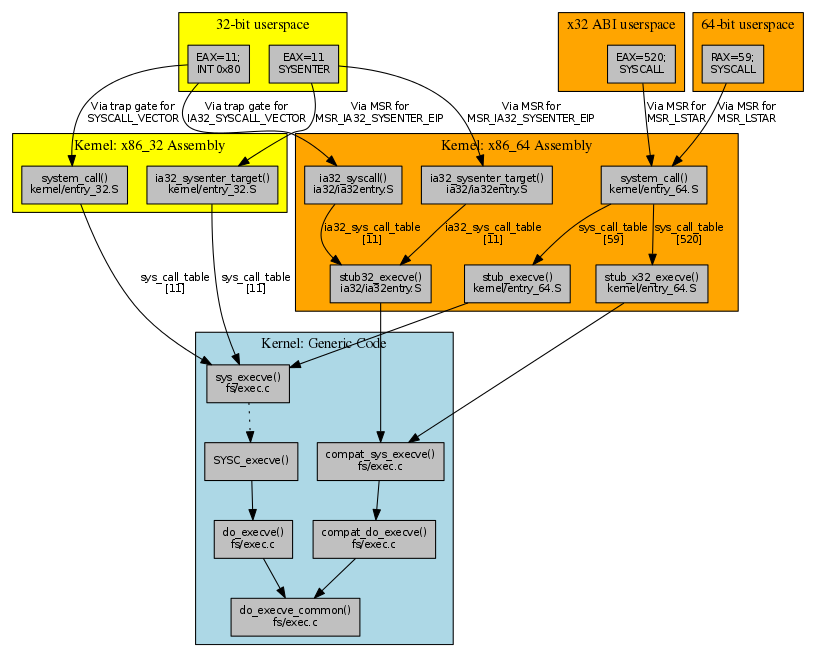
The execve() definition in fs/exec.c looks similar to that for read(), but there is an interesting additional function defined right after it (at least when CONFIG_COMPAT is defined):
    SYSCALL_DEFINE3(execve,
		    const char __user *, filename,
    		    const char __user *const __user *, argv,
    		    const char __user *const __user *, envp)
    {
    	    return do_execve(getname(filename), argv, envp);
    }
    #ifdef CONFIG_COMPAT
    asmlinkage long compat_sys_execve(const char __user * filename,
    	    const compat_uptr_t __user * argv,
    	    const compat_uptr_t __user * envp)
    {
    	    return compat_do_execve(getname(filename), argv, envp);
    }
    #endif
Following the processing path, these two implementations converge on do_execve_common() to perform the real work (sys_execve() → do_execve() → do_execve_common() versus compat_sys_execve() → compat_do_execve() → do_execve_common()), setting up user_arg_ptr structures along the way. These structures hold those syscall arguments that are pointers-to-pointers, together with an indication of whether they come from a 32-bit compatibility ABI; if so, the value being pointed to is a 32-bit user-space address, not a 64-bit value, and the code to copy the argument values from user space needs to allow for that.
So, unlike read(), where the syscall implementation didn't need to distinguish between 32-bit and 64-bit callers because the arguments were pointers-to-values, execve() does need to distinguish, because it has arguments that are pointers-to-pointers. This turns out to be a common theme — other compat_sys_name() entry points are there to cope with pointer-to-pointer arguments (or pointer-to-struct-containing-pointer arguments, for example struct iovec or struct aiocb).
x32 ABI support
The complication of having two variant implementations of execve() spreads outward from the code to the system call tables. For x86_64, the 64-bit table has two distinct entries for execve():
    59	64	execve			stub_execve
    ...
    520	x32	execve			stub_x32_execve
The additional entry in the 64-bit table at syscall number 520 is for x32 ABI programs, which run on x86_64 processors but use 32-bit pointers. As a result of the 64 and x32 ABI indicators, we will end up with stub_execve as entry 59 in sys_call_table, and stub_x32_execve as entry 520.
Although this is our first mention of the x32 ABI, it turns out that our previous read() example did quietly include x32 ABI compatibility. As no pointer-to-pointer address translation was needed, the syscall invocation path (and syscall number) could simply be shared with the 64-bit version.
Both stub_execve and stub_x32_execve are defined in arch/x86/kernel/entry_64.S. These entry points call on sys_execve() and compat_sys_execve(), but also save additional registers (R12-R15, RBX, and RBP) to the kernel stack. Similar stub_* wrappers are also present in arch/x86/kernel/entry_64.S for other syscalls (rt_sigreturn(), clone(), fork(), and vfork()) that may potentially need to restart user-space execution at a different address and/or with a different user stack than when the syscall was invoked.
For x86_32, the 32-bit table has an entry for execve() that's slightly different in format from that for read():
11 i386 execve sys_execve stub32_execve
First of all, this tells us that execve() has syscall number of 11 on 32-bit systems, as compared to number 59 (or 520) on 64-bit systems. More interesting to observe is the presence of an extra field in the 32-bit table, holding a compatibility entry point stub32_execve. For a native 32-bit build of the kernel, this extra field is ignored and the sys_call_table holds sys_execve() as entry 11, as usual.
However, for a 64-bit build of the kernel, the IA-32 compatibility code inserts the stub32_execve() entry point into ia32_sys_call_table as entry 11. This entry point is defined in arch/x86/ia32/ia32entry.S as:
PTREGSCALL stub32_execve, compat_sys_execve
The
PTREGSCALL macro
sets up the stub32_execve entry point to call on to compat_sys_execve() (by putting its
address into RAX), and saves additional registers (R12-R15, RBX, and RBP) to
the kernel stack (like stub_execve() above).
gettimeofday(): vDSO
Some system calls just read a small amount of information from the kernel, and for these, the full machinery of a ring transition is a lot of overhead. The vDSO (Virtual Dynamically-linked Shared Object) mechanism speeds up some of these read-only syscalls by mapping the page containing the relevant information (and code to read it) into user space, read-only. In particular, the page is set up in the format of an ELF shared-library, so it can be straightforwardly linked into user programs.
Running ldd on a normal glibc-using binary shows the vDSO as a dependency on linux-vdso.so.1 or linux-gate.so.1 (which ldd obviously can't find a file to back); it also shows up in the memory map of a running process ([vdso] in cat /proc/PID/maps).
Historically, vsyscall was an earlier mechanism to do something similar, which is now deprecated due to security concerns. This older article by Johan Petersson describes how vsyscall's page appears as an ELF object (at a fixed position) to user space.
There's a Linux Journal article that discusses vDSO setup in some detail (although it is now slightly out of date), so we'll just describe the basics here, as applied to the gettimeofday() syscall.
First, gettimeofday() needs to access data. To allow this, the relevant vsyscall_gtod_data structure is exported into a special data section called .vvar_vsyscall_gtod_data. Linker instructions then ensure that this .vvar_vsyscall_gtod_data section is linked into the kernel in the __vvar_page section, and at kernel startup the setup_arch() function calls map_vsyscall() to set up a fixed mapping for that __vvar_page.
The code that provides the core vDSO implementation of gettimeofday() is in __vdso_gettimeofday(). It's marked as notrace to prevent the compiler from ever adding function profiling, and also gets a weak alias as gettimeofday(). To ensure that the resulting page looks like an ELF shared object, the vdso.lds.S file pulls in vdso-layout.lds.S and exports both gettimeofday() and __vdso_gettimeofday() into the page.
To make the vDSO page accessible to a new user-space program, the code in setup_additional_pages() sets the vDSO page location to a random address chosen by vdso_addr() at process start time. Using a random address mitigates the security problems found with the earlier vsyscall implementation, but does mean that the user program needs a way to find the location of the vDSO page. The location is exposed to user space as an ELF auxiliary value: the binary loader for ELF format programs (load_elf_binary()) uses the ARCH_DLINFO macro to set the AT_SYSINFO_EHDR auxiliary value. The user-space program can then find the page using the getauxval() function to retrieve the relevant auxiliary value (although in practice the libc library usually takes care of this under the covers).
For completeness, we should also mention that the vDSO mechanism is used for another important syscall-related feature for 32-bit programs. At boot time, the kernel determines which of the possible x86_32 syscall invocation mechanisms is best, and puts the appropriate implementation wrapper (SYSENTER, INT 0x80, or even SYSCALL for an AMD 64-bit processor) into the __kernel_vsyscall function. User-space programs can then invoke this wrapper and be sure of getting the fastest way into the kernel for their syscalls; see Petersson's article for more details.
ptrace(): syscall tracing
The ptrace() system call is implemented in the normal
manner, but it's particularly relevant here because it can cause system calls of the traced kernel task to behave
differently. Specifically, the PTRACE_SYSCALL request aims to "arrange for the tracee to be stopped
at the next entry to or exit from a system call
".
Requesting PTRACE_SYSCALL causes the TIF_SYSCALL_TRACE thread information flag to be set in thread-specific data (struct thread_info.flags). The effect of this is architecture-specific; we'll describe the x86_64 implementation.
Looking more closely at the assembly for syscall entry (in all of x86_32, x86_64, and ia32) we see a detail that we skipped over previously: if the thread flags have any of the _TIF_WORK_SYSCALL_ENTRY flags (which include TIF_SYSCALL_TRACE) set, the syscall implementation code follows a different path to invoke syscall_trace_enter() instead (x86_32, x86_64, ia32). The syscall_trace_enter() function then performs a variety of different functions that are associated with the various per-thread flag values that were checked for with _TIF_WORK_SYSCALL_ENTRY:
- TIF_SINGLESTEP: single stepping of instructions for ptrace
- TIF_SECCOMP: perform secure computing checks on syscall entry
- TIF_SYSCALL_EMU: perform syscall emulation
- TIF_SYSCALL_TRACE: syscall tracing for ptrace
- TIF_SYSCALL_TRACEPOINT: syscall tracing for ftrace
- TIF_SYSCALL_AUDIT: generation of syscall audit records
Epilogue
System calls have been the standard method for user-space programs to interact with Unix kernels for decades and, consequently, the Linux kernel includes a set of facilities to make it easy to define them and to efficiently use them. Despite the invocation variations across architectures and occasional special cases, system calls also remain a remarkably homogeneous mechanism — this stability and homogeneity allows all sorts of useful tools, from strace to seccomp-bpf, to work in a generic way.
Control groups, part 3: First steps to control
Having spent two articles exploring some background context concerning the grouping of processes and the challenges of hierarchies, we need to gain some understanding of control, and for that we will look at some details of the current (Linux 3.15) cgroups implementation. First on the agenda is how control is exercised in cgroups, then, in later articles, we will look at how hierarchy is used.
Some degree of control existed long before cgroups, of course, with the
"nice" setting to control how much CPU time each process received and
the various limits on memory and other resources that can be
controlled with the setrlimit() system call. However, this control
was always applied to each process individually or, possibly, to each
process in the context of the whole system. As such, those controls don't
really provide any hints on how grouping of processes affects
issues of control.
Cgroup subsystems
The cgroups facility in Linux allows for separate "subsystems" that each independently work with the groupings that cgroups provides. The term "subsystem" is unfortunately very generic. It would be nicer to use the term "resource controller" that is often applied. However, not all "subsystems" are genuinely "controllers", so we will stay with the more general term.
In Linux 3.15, there are twelve distinct subsystems which, together, can provide some useful insights into a number of issues surrounding cgroups. We will look at them roughly in order of increasing complexity; not the complexity of what is controlled, but of how the groups and, particularly, the hierarchy of groups, is involved in that control. Slightly over half will be discussed in this article with the remainder relegated to a subsequent article.
Before detailing our first seven, a quick sketch of what a subsystem can do will be helpful. Each subsystem can:
- store some arbitrary state data in each cgroup
- present a number of attribute files for each cgroup in the cgroup filesystem that can be used to view or modify this state data, or any other state details
- accept or reject a request to attach a process to a given cgroup
- accept or reject a request to create a new group as a child of an existing one
- be notified when any process in some cgroup forks or exits
Naturally, a subsystem can also interact with processes and other kernel internals in arbitrary ways in order to implement the desired result. These are just the common interfaces for interacting with the process group infrastructure.
A simple debugging aid
The debug subsystem is one of those that does not "control" anything, nor does it remove bugs (unfortunately). It does not attach extra data to any cgroup, never rejects an "attach" or "create" request, and doesn't care about forking or exiting.
The sole effect of enabling this subsystem is to make a number of internal details of individual groups, or of the cgroup system as a whole, visible via virtual files within the cgroup filesystem. Details include things like the current reference count on some data structures and the settings of some internal flags. These details are only likely to be at all interesting to someone working on the cgroups infrastructure itself.
Identity — the first step to control
It was Robert Heinlein who first exposed me to the idea that
requiring people to carry identity cards is sometimes a first step toward
controlling them. While doing this to control people may be
unwelcome, providing clear identification for controlling processes can be
quite practical and useful. This is primarily what the net_cl and
net_prio cgroup subsystems are concerned with.
Both of these subsystems associate a small identifying number with
each cgroup which is then copied to any socket created by a process in
that group. net_prio uses the sequence number that the cgroups core provides each
group with (cgroup->id) and stores this in the
sk_cgrp_prioidx attribute. This
is unique for each cgroup.
net_cl allows an identifying number to be explicitly given to each
cgroup, and stores it in the sk_classid attribute. This is
not necessarily unique
for each cgroup.
These two different group identifiers are used for three different
tasks.
-
The
sk_classidset bynet_clcan be used withiptablesto selectively filter packets based on which cgroup owns the originating socket. -
The
sk_classidcan also be used for packet classification during network scheduling. The packet classifier can make decisions based on the cgroup and other details, and these decisions can affect various scheduling details, including setting the priority of each message. -
The
sk_cgrp_prioidxis used purely to set the priority of network packets, so when used it overrides the priority set with theSO_PRIORITYsocket option or by any other means. A similar effect could be achieved usingsk_classidand the packet classifier. However, according to the commit that introduced thenet_priosubsystem, the packet classifier isn't always sufficient, particularly for data center bridging (DCB) enabled systems.
Having two different subsystems controlling sockets in three different ways, with some overlap, seems odd, though it is a little familiar from the overlap we saw with process groups previously. Whether subsystems should be of lighter weight, so it is cheap to have more (one per control element), or whether they should be more powerful, so just one can be used for all elements, is not yet clear. We will come across more overlap in later subsystems and maybe that will help clarify the issues.
For the moment, the important issue remaining is how these subsystems interact with the hierarchical nature of cgroups. The answer is that, for the most part, they don't.
Both the class ID set for net_cl and the (per-device) priorities set
for net_prio apply just to that cgroup and any sockets associated
with processes in that cgroup. They do not automatically apply to
sockets in processes in child cgroups. So, for these subsystems,
recursive membership in a group is not relevant, only immediate
membership.
This limitation is partially offset by the fact that newly created groups inherit important values from their parent. So if, for example, a particular network priority is set for all groups in some subtree of the cgroup hierarchy, then that priority will continue to apply to all groups in that subtree, even if new groups are created. In many practical cases, this is probably sufficient to achieve a useful result.
This near-disregard for hierarchy makes the cgroups tree look, from the perspective of these subsystems, more like an organizational hierarchy than a classification hierarchy (as discussed in the hierarchies article) — subgroups are not really sub-classifications, just somewhere convenient that is nearby.
Other subsystems provide more focus on hierarchy in various ways;
three worth contrasting are devices, freezer, and perf_event.
Ways of working with hierarchy
One of the challenges of big-picture thinking about cgroups is that the individual use cases can be enormously different and place different demands on the underlying infrastructure. These next three subsystems all make use of the hierarchical arrangement of cgroups, but differ in the details of how control flows from the configuration of a cgroup to the effect on a process.
devices
The devices subsystem imposes mandatory access control for some or
all accesses to device-special files (i.e. block devices and character
devices). Each group can either allow or deny all accesses by
default, and then have a list of exceptions where access is denied or
allowed, respectively.
The code for updating the exception list ensures that a child never has more permission than its parent, either by rejecting a change that the parent doesn't allow or by propagating changes to children. This means that when it comes time to perform a permission check, only the default and exceptions in one group need to checked. There is no need to walk up the tree checking that ancestors allow the access too, as any rules imposed by ancestors are already present in each group.
There is a clear trade-off here, where the task of updating the permissions is made more complex in order to keep the task of testing permissions simple. As the former will normally happen much less often than the latter, this is a sensible trade-off.
The devices subsystem serves as a mid-point in the range of options
for this trade-off. Configuration in any cgroup is pushed down to all
children, all the way down to the leaves of the hierarchy, but no further.
Individual processes still need to refer back to the relevant cgroup
when they need to make an access decision.
freezer
The freezer subsystem has completely different needs, so it
settles
on a different point in the range. This subsystem presents a
"freezer.state" file in each cgroup to which can be written
"FROZEN" or
"THAWED". This is a little bit like sending SIGSTOP or SIGCONT to
one of the process groups that we met in the first article in that
the whole group of processes is stopped or restarted. However, most of
the remaining details differ.
In order to implement the freezing or thawing of processes, the
freezer subsystem walks down the cgroup hierarchy, much like the
devices subsystem, marking all descendant groups as frozen or
thawed. Then it must go one step further. Processes do not regularly
check if their cgroup has been frozen, so freezer must walk beyond
all the descendant cgroups to all the member processes and explicitly
move them to the freezer or move them out again. Freezing is arranged
by sending a virtual signal to each process, since the signal handling
code does check if the cgroup has been marked as frozen and acts
accordingly. In order to make sure that no process escapes the
freeze, freezer requests notification when a process
forks, so it can catch newly created processes — it is the only
subsystem that does this.
So the freezer occupies one extreme of the hierarchy management
spectrum by forcing configuration all the way down the hierarchy and
into the processes. perf_event occupies the other extreme.
perf_event
The perf facility collects various performance data for some
set of processes. This set can be all processes on the system, all
that are owned by a particular user, all that descended from some
particular parent, or, using the perf_event cgroup subsystem, all
that are within some particular cgroup. The perf_event cgroup
subsystem interprets
"within" in a fully hierarchical sense — unlike net_cl which also
tests group membership but does so based on an ID number that may be
shared by some but not all groups in a subtree.
To perform this hierarchical "within a group" test, perf_event uses
the cgroup_is_descendant() function which simply walks up the
->parent links until it finds a match or the root.
While this is not an overly expensive exercise, particularly if the
hierarchy isn't very deep, it is certainly more expensive than simply
comparing two numbers. The developers of the networking code are
famous for being quite sensitive to added performance costs,
particularly if these costs could apply to every packet. So it is not
surprising that the networking code does not use
cgroup_is_descendant().
The ideal, of course, would be a mechanism for testing membership that was both fully hierarchical and also highly efficient. Such a mechanism is left as an exercise for the reader.
For perf, we can see that configuration is never pushed down the
hierarchy at all. Whenever a control decision is needed (i.e. should this event
be counted?), the code
walks up the tree from a process to find the answer.
If we look back to net_cl and net_perf and ask exactly how they
fit into this spectrum that contrasts pushing configuration down from cgroups
with processes reaching up to receive control, they are most like
devices. Processes do refer back to a single cgroup when
creating a socket, but don't proceed up the hierarchy. Their distinction
is that the pushing-down of
configuration is left up to user space rather than being imposed by
the kernel.
cpuset: where it all began
The final cgroup subsystem to examine for this installment is cpuset,
which was the first one to be added to Linux. In fact, the
cpuset mechanism for controlling process groups predates the more
generic cgroups implementation. One reminder of this is that there is
a distinct cpuset virtual filesystem type that is equivalent to the
cgroup virtual filesystem when configured with the
cpuset subsystem. This subsystem doesn't really introduce anything new, but it does
serve to emphasize some aspects we have already seen.
The
cpuset cgroup subsystem is useful on any machine with multiple CPUs, and particularly
on NUMA machines, which feature multiple nodes and, often, wildly different speeds
for access within and between nodes. Like net_cl,
cpuset provides two distinct, but related, controls.
It identifies a set of processors on which each process in a group may
run, and it also identifies a set of memory nodes from which processes
in a group can allocate memory. While these sets may often be the
same, the implementation keeps them completely separate; enforcing
the sets involves two completely different approaches. This is most
obvious when moving a process from one cgroup to another. If the set
of allowed processors is different, the process can trivially be placed
on the run queue for a new processor on which it is permitted. If the
set of allowed memory nodes has changed, then migrating all the memory
across from one node to another is far from trivial (consequently this
migration is optional).
Similar to the device subsystem, cpuset propagates any changes
made to a parent into all descendants when appropriate. Unlike
device, where the cgroup contained the authoritative control
information, each process has its own CPU set that the scheduler
inspects. Once changes are imposed on descendant groups, cpuset
must take the same final step as freezer and impose the new settings
on individual processes. Exactly why cpuset doesn't request
notification of forks, while freezer does, will have to remain a mystery.
Combined with this, cpuset will sometimes also walk up the
hierarchy looking for an appropriate parent. One such case is when a
process finds itself in a cgroup that has no working CPU in its
set, possibly due to a CPU being taken offline. Another is when a
high-priority memory allocation finds that all nodes in the
mems_allowed set have exhausted their free memory. In both these
cases, some borrowing of resources that are granted to ancestor nodes
can be used to get out of a tight spot.
Both of these cases could conceivably be handled by maintaining an
up-to-date set of "emergency" processors and memory nodes in each cgroup. It is likely that the complexity of keeping this extra
information current outweighs the occasional cost of having to
search up the tree to find a needed resource. We saw before that some
subsystems will propagate configuration down the tree while others
will search for permission up the tree. Here we see that cpuset
does both, each as appropriate to a particular need.
The story so far
These seven cgroup subsystems have something in common that separates them from the five we will look at in the next article, and this difference relates to accounting. For the most part, these seven cgroup subsystems do not maintain any accounting, but provide whatever service they provide with reference only to the current instant and without reference to any recent history.
perf_event doesn't quite fit this description as it does record some
performance data for each group of processes, though this data is
never used to impose control. There is still a very clear difference
between the accounting performed by perf_event and that performed by
the other five subsystems, but we will need to wait until next time to
clarify that difference.
Despite that commonality, there is substantial variety:
- Some actually impose control (
devices,freezer,cpuset), while others provide identification to enable separate control (net_cl,net_prio) and still others aren't involved in control at all (debug,perf_event). - Some (
devices) impose control by requiring the core kernel code to check with the cgroup subsystem for every access, while others (cpuset,net_cl) impose settings on kernel objects (threads, sockets) and the relevant kernel subsystems take it from there. - Some handle hierarchy by walking down the tree imposing on children, some by walking up the tree checking on parents, some do both and some do neither.
There is not much among these details that relates directly to the various issues we found in hierarchies last time, though the emphasis on using cgroups to identify processes perhaps suggests that classification rather than an organization is expected.
One connection that does appear is that, as these subsystems do not
depend on accounting, they do not demand a strong hierarchy. If there
is a need to use net_prio to set the priority for a number of
cgroups and they don't all have a common parent, that need not be a
problem. The same priorities can simply be set on each group that
needs them. It would even be fairly easy to automate this if some rule
could be given to identify which groups required the setting. We have
already seen that net_prio and net_cl require consistent initial
settings to behave as you might expect, and this simply extends that
requirement a little.
So, for these subsystems at least, there is a small leaning toward wanting a classification hierarchy, but no particular desire for multiple hierarchies.
Looking further back to the issues that process groupings raised, we see there continue to be blurred lines of demarcation, with different subsystems providing similar services, and distinct services being combined in the same subsystem. We also see that naming of groups is important, but apparently not trivial, as we potentially have two different numeric identifiers for each cgroup.
Of course we haven't finished yet. Next time we will look at the
remaining subsystems: cpu, cpuacct, blkio, memory, and
hugetlb, to see what they can teach us, and what sort of
hierarchies might best suit them.
Filesystem notification, part 2: A deeper investigation of inotify
In the first article in this series, we briefly looked at the original Linux filesystem notification API, dnotify, and noted a number of its limitations. We then turned our attention to its successor, inotify, and saw how the design of the newer API addressed various problems with the dnotify API while providing a number of other benefits as well. At first glance, inotify seems to provide a complete solution for the task of creating an application that reliably monitors the state of a filesystem. However, we are about to see that this isn't quite the case.
So, now we dig deeper into the use of inotify, looking at how the API can be used to create an application that monitors the dynamic state of a directory tree. Our goals are, on the one hand, to demonstrate how inotify can be used to robustly achieve this task and, on the other hand, to discover some of the challenges inherent in the task, and thereby discover some of the limitations of inotify.
Our application, inotify_dtree.c, serves as a proof-of-concept, rather than performing any practical task. It is invoked with a command of the following form:
./inotify_dtree <directory> <directory>...
The goal of the application is to robustly and accurately maintain an internal representation ("a cache") of the dynamically changing set of subdirectories under each of the directories named in its command line. This is somewhat similar to the task of programs such as GUI file managers, which must present the user with an accurate representation of (some part of) a filesystem tree.
In addition to caching the state of the directory trees, the program also provides a command-line interface that allows the user to do such things as dumping the contents of the cache and triggering a consistency check of the cache against the current state of the directory trees.
In order to keep the program to a manageable size, we make a number of simplifications:
- The application caches only the subdirectories under a directory tree. Other types of files are ignored. Caching other file types is reasonably straightforward, but we focus on monitoring subdirectories because they are the most challenging part of the problem.
- For each directory, the only information we cache is the directory name and the corresponding watch descriptor. In a real-world application, we might want to cache other information as well, such as file ownership, permissions, and last modification time.
- The cache data structure is simply a list (a dynamically allocated array of structures that is resized as needed). The list is searched linearly by pathname or watch descriptor. This allows a simple implementation, at the expense of efficiency. In a real-world application, we might instead elect to use a tree data structure whose form matches the directory tree.
Even with these simplifications, we will see that programming with inotify presents a number of challenges.
Challenge 1: recursively monitoring a directory tree
Inotify does not perform recursive monitoring of directories. If we monitor the directory mydir, then we will receive events for the directory itself and for its immediate children, but not for children of subdirectories.
Therefore, in order to monitor an entire directory tree, we must create a watch for each subdirectory in the tree. This requires a recursive process whereby, for each directory, we create a watch and scan for subdirectories that should also be watched. The fun starts when we consider some of the possible race conditions. For example, suppose that we handle the tasks in the following order:
- We scan mydir, adding watches for the subdirectories that we find.
- We add a watch for mydir.
Suppose that between these two steps, a new subdirectory, mydir/new, is created (or a directory is renamed into mydir). No watch will be created for that directory, since, on the one hand, it was created after the scan of subdirectories, and, on the other hand, it will not generate an event for inotify, because it was created before a watch was added for the directory mydir.
The solution is to ensure that we perform the above steps in the reverse order, first creating a watch for the parent directory, and then scanning for subdirectories. If a new subdirectory is created between these two steps, then it might both generate an inotify event and be caught by the scanning step, which may result in a watch being created twice for the subdirectory. However, with careful programming, this is harmless, since repeated inotify_add_watch() calls for the same filesystem object will generate the same watch descriptor number.
There are other race conditions to consider as well. For example, during the scanning step we may find a subdirectory and attempt to add a watch for it, only for the inotify_add_watch() call to fail because the directory has already been deleted or renamed. The correct approach in such cases is to silently ignore the error.
The standard nftw() library function can assist with the task of creating a watch list for an entire directory tree. nftw() performs a traversal (preorder by default) of all of the files in a directory, calling a user-defined function once for each file. Among the arguments supplied to that function are the pathname of the file being visited and a stat structure containing attributes of that file, including the file type.
Here's an edited version of our function that is called by nftw() as it recursively traverses a directory tree that we want to add to the cache:
   static int
   traverseTree(const char *pathname, const struct stat *sb, int tflag,
                struct FTW *ftwbuf)
   {
       int wd, slot, flags;

       if (! S_ISDIR(sb->st_mode))
           return 0;               /* Ignore nondirectory files */

       flags = IN_CREATE | IN_MOVED_FROM | IN_MOVED_TO | IN_DELETE_SELF;
       if (isRootDirPath(pathname))
           flags |= IN_MOVE_SELF;

       wd = inotify_add_watch(ifd, pathname, flags | IN_ONLYDIR);
A few points in the above code warrant explanation. The S_ISDIR() check allows us to skip non-directory files. We initialize the inotify_add_watch() flags argument with the set of flags that are relevant for monitoring the creation, renaming, and deletion of directories.
Our isRootDirPath() function returns true if the given path is one of those supplied on the command line. For these directories, we are interested in events that rename the directories themselves, so we include the IN_MOVE_SELF flag. When an IN_MOVE_SELF event is processed, the program ceases monitoring the corresponding directory and all of its subdirectories.
The IN_ONLYDIR flag causes inotify_add_watch() to check that the monitored file is a directory. Although we already checked (via the S_ISDIR() macro) that pathname is a directory, there is a chance that in the meantime the directory was deleted and a regular file with the same name was created. In other words, IN_ONLYDIR provides us with a race-free way of ensuring that a monitored object is a directory.
The remainder of the function handles the consequences of the various race conditions described earlier, and then caches the new watch descriptor and pathname:
       if (wd == -1) {

           /* By the time we come to create a watch, the directory might
              already have been deleted or renamed, in which case we'll get
              an ENOENT error. In that case, we log the error, but
              carry on execution. Other errors are unexpected, and if we
              hit them, we give up. */

           logMessage(VB_BASIC, "inotify_add_watch: %s: %s\n",
                   pathname, strerror(errno));
           if (errno == ENOENT)
               return 0;
           else
               exit(EXIT_FAILURE);
       }

       if (findWatch(wd) > 0) {

           /* This watch descriptor is already in the cache;
              nothing more to do. */

           logMessage(VB_BASIC, "WD %d already in cache (%s)\n", wd, pathname);
           return 0;
       }

       slot = addWatchToCache(wd, pathname);

       return 0;
   }
Challenge 2: handling overflow events
Queueing inotify events until they are read requires kernel memory. Therefore, the kernel imposes a per-queue limit on the number of events that can be queued. (The various inotify limits are exposed, and can, with privilege, be modified via /proc files, as described in the inotify(7) man page.) When this queue limit is reached, the kernel adds an inotify overflow event (IN_Q_OVERFLOW) to the event queue and then discards further events until the application has drained some events from the queue.
This behavior has a number of implications. First of all, it means that when an overflow situation occurs, the application loses information about filesystem events. Or, to put things another way, inotify can't be used to produce a completely accurate log of filesystem activity.
Overflow events also have implications for applications such as our example application. Once an overflow occurs, the cache state in our application is no longer synchronized with the filesystem state. Furthermore, even if we drain the inotify event queue so that future events can be queued, we are likely to encounter problems because some of those events will likely be inconsistent with the now-out-of-sync cache. In this circumstance, there is only one thing to do: close the inotify file descriptor, discard the existing cache, open a new inotify file descriptor and then repopulate the cache and re-create all of our watch descriptors by rescanning the monitored directories. This may take some time, if we are monitoring a large number of directories. These steps are handled in the reinitialize() function of our example application.
Although the inotify queue limit can be raised in order to make overflow events less likely, there nevertheless always remains a risk that the limit will be hit in an application. Therefore, all inotify applications must be written to properly handle overflow events.
In passing, it's worth noting that unexpected corner cases or program bugs also may cause an application cache to become inconsistent with the state of the filesystem. A robust application should allow for this possibility: if such inconsistencies are detected, it is probably necessary to take the same steps as for the queue overflow case.
Challenge 3: handling rename events
As noted in our previous article, inotify provides much better support than dnotify for monitoring rename events. When a filesystem object is renamed, two events are generated: an IN_MOVED_FROM event for the source directory from which the file is moved, and an IN_MOVED_TO for the target directory to which the file is moved. Those events are only generated for directories that are being watched, so an application will only get both if it is monitoring both the source and destination. The name fields of these two events provide the old and new names of the file. The two events will have the same (unique) value in their cookie field, which provides an application with the means to connect them.
 Rename events present a number of challenges. One of these is
that, depending how we cache pathnames, a rename event may affect
multiple items in the cache. For example, in our application, each
item in the cache consists of a watch descriptor plus the complete
pathname string corresponding to that watch descriptor. Suppose
that we had a subtree containing the directories shown in the
diagram to the right.
If the directory abc was renamed to def under directory xyz, then three pathname strings inside our cache would need to be modified (so, for example, mydir/abc/man would become mydir/xyz/def/man).
More sophisticated cache designs may mitigate or eliminate this problem. For example, if the cache employs a tree data structure that mirrors the structure of the directory tree, and each node contains just the filename (rather than the full pathname) of the corresponding filesystem object, then only a single cache object would be affected by a rename (it would be relocated inside the tree structure, and its pathname string would be modified).
Rename events present other, more serious challenges, however. First, it's important to note that the IN_MOVED_FROM and IN_MOVED_TO events are generated only if, respectively, the source and target directories are each in the set being monitored by our inotify file descriptor. If only the target directory is in the set, then we will receive only an IN_MOVED_TO event. This can be dealt with straightforwardly: it is the same as the case of (recursively) adding a complete subtree to the set of watch subtrees.
On the other hand, if only the source directory is in the monitored set, then only an IN_MOVED_FROM event is generated. Notionally, this can be treated like a deletion event: for all of the monitored objects in the renamed subtree, we destroy each of the corresponding objects in our cache and destroy each of the watch descriptors using inotify_rm_watch().
However, there is a problem: when we receive an IN_MOVED_FROM event, we do not yet know if there will be a following IN_MOVED_TO event. In other words, we do not yet know whether to treat this as a deletion event or as a "true rename" event. And it gets worse. If there are multiple processes generating events in the monitored trees, then there is no guarantee that, for a true rename event, the IN_MOVED_FROM and IN_MOVED_TO events will be returned as consecutive items in the buffer of events returned when reading from the inotify file descriptor; other events may be returned between the pair. The upshot is that when we encounter an IN_MOVED_FROM event, we need to do some measure of forward searching to see if there is a corresponding IN_MOVED_TO event.
At this point, one might ask: rather than going to the effort of detecting whether there is an event pair, why not simply always treat IN_MOVED_FROM as a deletion event and IN_MOVED_TO as a creation event? This approach simplifies the programming in some respects, but it has some costs. If this is a true rename event, then we will waste effort in deleting items from our cache and destroying watch descriptors only to immediately repopulate the cache with the same filesystem objects and re-create a new set of watch descriptors. If the subtree that is being renamed is large, this may be rather expensive. Furthermore, when the watches are re-created they will use different watch descriptors. This means that there may be a series of events ahead in the inotify queue that contain watch descriptors that no longer exist. The simplest thing to do with these events is to discard them.
Because of the problems described in the previous paragraph, it is usually worth going to some effort to detect whether there is an IN_MOVED_TO that matches the IN_MOVED_FROM. The only question is: how much effort do we make? It turns out that even on a busy filesystem where multiple processes are generating events, the two events are almost always consecutive. So, a simple approach when encountering IN_MOVED_FROM is to check whether the very next event is IN_MOVED_TO, in which case this can be treated as a true rename, otherwise the IN_MOVED_FROM can be treated as a deletion event. Occasionally, we will fail to detect true renames because the events are not consecutive, in which case we fall back to the situation described in the preceding paragraph.
However, even when performing this simplified detection of IN_MOVED_FROM+IN_MOVED_TO pairs, some care is required. A read() from an inotify descriptor will (given a sufficiently large buffer) return multiple events if they are available. This means that, generally, if there is a true rename operation, the IN_MOVED_FROM and IN_MOVED_TO events will be read in the same buffer. However, it may happen that only the IN_MOVED_FROM can fit at the end of the buffer returned by one read() and the IN_MOVED_TO event is fetched by the next read(). The application should deal with this possibility.
It is also possible, of course, that there is no following IN_MOVED_TO, and indeed there might not (for the moment) be any more events at all. Furthermore, from the point of view of user space, the IN_MOVED_FROM+IN_MOVED_TO pair that is generated by a rename is not inserted atomically into the event queue: this means that having read an IN_MOVED_FROM from the queue, the following IN_MOVED_TO may not yet be available if we try to immediately fetch it with a nonblocking read(). Therefore, the second read() that tries to fetch the possibly following IN_MOVED_TO event must be performed with a (small) timeout.
The processInotifyEvents() function in our example application provides one example of how to do this. It employs a 2-millisecond timeout for the second read(), which was found to be sufficient to catch around 99.8% of the true renames even when the monitored directory tree was subject to a high level of rename activity.
For the purposes of testing, I created a test program, rand_dtree.c, that randomly performs either subdirectory creations, subdirectory deletions, or subdirectory renames at a specified location. During testing, I simultaneously ran ten instances of the program in rename mode against a directory tree that contained approximately 200 subdirectories.
A similar timeout technique is used in the inotify-kernel.c source file of the GIO library in GLib, where a 0.5 millisecond timeout is used. In my tests, this was sufficient to detect true renames with only 95% accuracy.
Challenge 4: using pathnames for notifications
When an event is generated for an object inside a monitored directory, inotify produces an event containing the name of the file. This is more information than given to us by dnotify. However, notification via pathname has some difficulties. The problem is that pathnames exist independently of filesystem objects. (One must also bear in mind that a filesystem object may have multiple pathnames, since a file can have multiple hard links.) Thus, by the time we read a notification that contains a filename, that filename may already have been deleted or renamed. Applications must be designed to handle this possibility.

Notification via pathname also produces some other oddities. Suppose that a filesystem object has two links, one inside a directory (mydir/abc) that we are monitoring for all possible events via inotify, and another link inside a directory (mydir/xyz) that we are not monitoring, as shown in the diagram to the right.
If the inode 5139 is opened via the link mydir/abc/x1, then an event will be generated. On the other hand, if it is opened via mydir/xyz/x2, no event is generated. More generally, inotify events are generated for files only when they occur via pathnames that are in the monitored set. This behavior is not the consequence of a kernel limitation, but rather is a limitation of the notification method. In some circumstances, notifying the application about an event that occurred via one pathname using a different pathname would be confusing. For example, suppose that the pathname mydir/xyz/x2 was deleted, how should an IN_DELETE event for mydir/abc/x1 be interpreted? A similar question can be asked about rename events. To avoid these sorts of confusions, inotify only notifies events that occur via pathnames in the monitored set.
Other limitations of the inotify API
In addition to the various challenges dealt with by our example application, there are several other limitations of the inotify API that an application may encounter:
- Event notifications do not include information about the process that generated the event. Nevertheless, it would sometimes be useful to have the process ID and user ID of the triggering process. One particularly notable case is that if a monitoring application itself touches files inside the monitored directories, then it may also generate events, but it has no way (for example, a PID) to distinguish those events from events generated by other processes.
- Inotify does not provide any gatekeeping functionality. That is to say, inotify only informs us about filesystem activity; it provides no way to block filesystem actions by other processes. This type of functionality is needed by antivirus software and some types of user-space file servers, for example.
- Inotify reports only events that a user-space program triggers through the filesystem API. This constitutes a fairly serious limitation of the API. For example, it means that inotify does not inform us of events on monitored objects via a remote filesystem (e.g. NFS) operation. Likewise, no events are generated for virtual filesystems such as /proc. Furthermore, events are not generated for file accesses and modifications that may occur via file mappings created using mmap(). To discover changes that occur via these mechanisms, an application must revert to polling the filesystem using stat() and readdir().
Inotify improves on dnotify in many respects. However, a number of limitations of the API mean that reliably monitoring filesystem events still presents quite a challenge. In the next article in this series, we will consider the fanotify API, which, although more restricted than inotify in its range of applications, addresses some of the limitations of inotify.
Patches and updates
Kernel trees
Architecture-specific
Build system
Core kernel code
Development tools
Device drivers
Device driver infrastructure
Filesystems and block I/O
Janitorial
Memory management
Networking
Security-related
Miscellaneous
Page editor: Jonathan Corbet
Distributions
Debian adds continuous integration
In June, Debian formally unveiled the Debian Continuous Integration (debci) project, which is an effort to integrate dependency-based automated testing into the rather sizable Debian package archive. So far, only a fraction of Debian's packages are making use of the service, but many more could be added with a little effort—and the benefits for Debian are potentially large.For years, Debian has enjoyed the reputation of having one of the largest collections of available packages among Linux distributions; according to various project statistics, there are more than 20,000 source packages in the unstable distribution, which result in more than 40,000 binary packages and an untold number of inter-package dependencies. For a project without a corporate parent and relying on volunteer package maintainers, that adds up to quite a quality-assurance challenge. Some of the larger packages (such as GNOME and KDE) can pull in well over 1,000 dependencies, which makes manual testing at the very least impractical.
Consequently, as debci developer Antonio Terceiro explained in a blog post, there has long been an interest in deploying an automated testing system. A key piece of the puzzle was Ian Jackson's autopkgtest, which can execute tests on installed binary packages within a testbed system. In 2011, the autopkgtest framework was accepted as Debian Enhancement Proposal 8 (DEP-8).
DEP-8 was accompanied by a specification for defining tests within a Debian source package. The autopkgtest tool can run tests against the source package itself, but it can also execute tests designed for the corresponding binary package. The debci effort is geared toward finding regressions (particularly those that might result from changes in a dependency) rather than build errors, though, so it focuses on the binary tests.
Although not all Debian packages include their own tests, quite a few already do. At the end of 2013, Terceiro started experimenting with a tool that would run autopkgtest against the entire archive. That codebase is what eventually became debci.
Currently, an instance of debci is running on ci.debian.net, and it executes tests against roughly 350 packages. The server updates its Apt cache four times per day, looking for updated packages that have autopkgtest tests defined. If a package or any of its dependencies have changed since the last test was run against it, it is scheduled for a new run. In addition, tests are run once every month even if there are no changes.
Several test-execution backends are supported in autopkgtest, including LXC containers, QEMU/KVM virtual machines, and "ssh testbeds" (which assume nothing other than a working ssh connection). Each option provides a different way to isolate the test environment from the host system. The ci.debian.net server makes use of the schroot backend for most packages. Schroot creates a clean chroot environment and, according to the documentation, is the fastest option that provides filesystem isolation, although it has some limitations (such as tests not being able to start system services or alter the network configuration).

For a given package, debci sets up the schroot environment, updates the target package and all of its dependencies, then extracts and executes the target package's test suite using autopkgtest and logs the results. Autopkgtest supports quite a bit of variety in its test output (including no output, simple TEST: FAIL messages, and more detailed reports). The ci.debian.net server publishes new test results once every hour. In addition to global success/failure statistics for the entire archive, each individual package's results are published as an Atom feed, and there is a combined whole-archive feed.
The individual test results are also accessible through the site's web interface. For example, here is the apt package's test-result history. The debci log for each entry indicates what triggered the test (i.e., a change in the package itself or a change in a dependency), the current dependency list, the test result, and the test execution time. The autopkgtest logs and raw test output are also available for each run. In the test run linked to above, the test session seems to have failed due to a configuration problem in the test, rather than a bug in Apt; debci will also mark some problems as tmpfail situations, such as this evolution-data-server test for which the dependencies could not be satisfied.
Terceiro noted in his blog post that the number of packages including test suites has grown from around 200 to its current level of about 350 since the server was first brought online in January. In addition—and perhaps more importantly—the percentage of packages passing all of their own tests has grown considerably over that same time frame, from less than half to over 75%.
Of course, 350 packages is a drop in the bucket compared to 40,000, but one must start somewhere. The fact that the number of package maintainers who are participating is on the rise, coupled with the fact that more tests are passing, suggests that debci is proving to be a useful tool for the Debian project. Terceiro also noted in his blog post that there are now multiple contributors to the project, including current autopkgtest maintainer Martin Pitt and two Google Summer of Code (GSoC) students. It may still take quite a while for debci to achieve majority coverage (much less full coverage) of Debian's vast package archive, but with easy-to-see results, its popularity might also catch on in hurry.
Brief items
Distribution quote of the week
Often Gnome doesn't work either -- then I fall back to Xfce install. That is the definition of Rawhide......
Debian 7.6 released
The Debian project has announced the sixth update of its stable distribution Debian 7 "wheezy". "This update mainly adds corrections for security problems to the stable release, along with a few adjustments for serious problems. Security advisories were already published separately and are referenced where available."
FreeBSD 9.3 released
The FreeBSD Release Engineering Team has announced the availability of FreeBSD 9.3. This update adds support for the bookmarks feature in the zfs filesystem and the fetch library now supports SNI (Server Name Identification). See the release notes for details on these and many other updates and improvements.
Newsletters and articles of interest
Distribution newsletters
- DistroWatch Weekly, Issue 567 (July 14)
Boyer: At the playground
Fedora kernel team member Josh Boyer, writes about a Fedora kernel-playground Copr (Cool Other Project Repository) on his blog. The idea is to provide an unsupported kernel that has some new features for those who want to help develop and test them. "OK, now that we have that out of the way, let's talk about what is actually in kernel-playground. At the moment there are two additions on top of the standard rawhide kernel; overlayfs (v22) and kdbus. Overlayfs is one of the top competing "union" filesystems out there, and has actually been posted for review for the past few releases. It has the best chance of landing upstream sometime this decade, and there has been interest in it for quite a while. I believe things like Docker would also be able to make use of it as a backend. I'll track upstream submissions and update accordingly. kdbus is of course the thing that Lennart Poettering and Kay Sievers have been talking about at various conferences for a while now. It is the in-kernel d-bus replacement. It has not been submitted for upstream review yet, but systemd already has support for it and things seem to be progressing well there."
Best Linux Desktop: Top 10 Candidates (Datamation)
Matt Hartley picks his favorites for best Linux desktop: some for newcomers and some for experienced enthusiasts. Some popular distributions are completely missing from the list (e.g. Debian, Fedora, and openSUSE), while you may not have heard of some of his other choices. In the newcomer category we have Ubuntu, Linux Mint, Zorin OS, SolydX, PCLinuxOS, and Lubuntu/Xubuntu. For more experienced users he starts with a brief mention of Arch Linux, Gentoo, and Slackware, but moves on to Antergos, Sabayon Linux, WattOS Microwatt Edition, and VectorLinux.
Page editor: Rebecca Sobol
Development
The glibc s390 ABI break
The GNU C library (glibc) project has long lived up to a reputation for conservatism; glibc developers know that an ill-chosen change can create a great deal of pain downstream, so they proceed with caution. Even so, mistakes can happen. A recent slip-up involving the s390 architecture makes it clear how one of those mistakes can cascade into a significant mess that is hard to clean up afterward.The setjmp() and longjmp() functions have been part of the standard C library since something close to the beginning. They can be used to perform stack unwinding — a sort of "long return" from a function that skips over any number of intervening function calls. Both of these functions take an opaque jmp_buf data structure as an argument. The caller provides the buffer to setjmp(), which fills it with the information needed to make another return to the location of that call. A later call to longjmp() with that buffer will then cause setjmp() to appear to have returned a second time.
Back in April, developers from IBM committed a patch that changed the size of the jmp_buf structure on the s390 architecture; this change, which subsequently became part of the 2.19 release, was apparently needed to enable better hardware support for setjmp() and longjmp(). Since jmp_buf is a type that is visible to applications, this was a clear ABI change, with all of the possible problems that can go with it. For example, newer glibc releases expect the larger jmp_buf size, but they may be linked (at run time) against applications that have not been rebuilt and, thus, are still working with the older version of jmp_buf.
This possibility was taken into account, though. Symbol versioning was used to provide compatible versions of setjmp() and longjmp() for these older applications. So, in theory, things should Just Work without additional problems. This particular theory did not last long after its encounter with the real world, though.
The problem is that jmp_buf structures are often embedded into other structures, so a change in the size of that structure will change the containing structures too. To find victims, one need not even look outside of glibc; it turns out that glibc's POSIX threads (pthreads) implementation embeds a jmp_buf structure into its own __pthread_unwind_buf_t structure which, in turn, is visible to applications. So, as a result, a number of pthreads functions need to become versioned as well.
Versioning does not work, though, for problems that pop up outside of glibc. Consider, for example, the Perl interpreter, which embeds a jmp_buf in its main "this is a running Perl instance" structure. That has caused various Perl modules to fail (example) and can only really be fixed by rebuilding the entire Perl environment. The PNG image format library (libpng) also has an embedded jmp_buf — in a structure that is used by all PNG-using applications.
Debian's developers, who were trying to clean up this mess, considered
rebuilding all of Perl and then, perhaps, all (500 or so) packages
depending on the PNG library. But, by this point, it became clear that
the ripples from this change spread widely indeed and that playing
whack-a-mole may never get all of them fixed. So the Debian developers
have figured
that the course they may have to consider is to "do like Red Hat, ie
just rebuild everything and warn the users their system might break during
upgrade.
" Needless to say, this approach lacks appeal, especially
in the Debian world, where mass rebuilds are a rare event.
Even then, of course, there is the problem of end-user applications. Distributors cannot rebuild those; even worse, the user may not be able to either. So some things might just be broken.
One might be thinking that there is a mechanism in place for this kind of incompatible ABI change. Shared libraries have a shared-object name ("soname") built into them; applications linked against those libraries also contain that name. For glibc on your editor's system, for example, the soname is "libc.so.6". The runtime linker will not link an application against a shared object if the sonames do not match. In this way, the system can disallow running against a library that will not work. It also enables, in theory, the parallel installation of multiple versions of the library; older applications would continue to use the older library, while newly built binaries would use the current version.
So the glibc project could consider making a point release with a different soname (libc.so.6.1, say); distributors could then install the result alongside an older version of the library and, in theory, things should work. Except that glibc developer Carlos O'Donell tried it and concluded that:
The SO name bump in a mixed-ABI environment like debian results in two libc's being loaded and competing for effectively the same namespace of symbols with resolution (and therefore selection of the ABI) being determined by ELF interposition and scope rules. It's a nightmare. It's possible a worse solution than just telling everyone to rebuild and get on with their lives.
It also turns out to be painful to bootstrap a system with a new, ABI-incompatible version of the C library. So it seems that the soname change will not happen and that, on s390, a lot of rebuilding is going to have to go on. It will also become impossible to move affected applications between systems with pre- and post-change libraries. Not fun, but, as David Miller put it:
That leads to the obvious question: what can be done to avoid this kind of
problem in the future? Carlos plans to put
together a policy on how to manage ABI changes, with "don't break
ABI ever
" as
the first item. There has been talk of improving the testing tools in an
attempt to catch this kind of ABI break in the future.
In the end, though, nothing can replace a high level of care on the part of the developers involved. Glibc developers have always shown that care, which is why stories like this one are rare. In the aftermath of this mistake, one can assume that they will be doubly careful in the future. That, along with some testing support, should help to ensure that upcoming glibc releases are free of this kind of issue.
Brief items
Quotes of the week
KDE Plasma 5.0
KDE has announced the release of Plasma 5.0. "Plasma 5.0 introduces a new major version of KDE's workspace offering. The new Breeze artwork concept introduces cleaner visuals and improved readability. Central work-flows have been streamlined, while well-known overarching interaction patterns are left intact. Plasma 5.0 improves support for high-DPI displays and ships a converged shell, able to switch between user experiences for different target devices. Changes under the hood include the migration to a new, fully hardware-accelerated graphics stack centered around an OpenGL(ES) scenegraph. Plasma is built using Qt 5 and Frameworks 5."
GNU CSSC 1.4.0 available
Version 1.4.0 of the GNU "Compatibly Stupid Source Control" (CSSC) revision-control suite is now available. This stable release makes some changes to the way headers are produced by sccsdiff, alters the output ordering in sccs unedit to match Solaris, and changes the tar archive format used. "Up to now we have used the v7 Unix tar format, but this does not cope correctly with filenames longer than 99 characters, and we now have one of those. We now use the the ustar format defined by POSIX 1003.1-1988. If you need to unpack a CSSC distrubition with a version of tar which only deals with the v7 format, unpack the distribution somewhere else, rename or delete the long files (they are not essential to the build process) and re-pack it. This new tar format will likely also be used for all future releases.
"
Announcing Gitorious 3.1
The Gitorious code-hosting service has announced
the release of version 3.1 of the AGPL-licensed software platform
behind the site. Changes include an administrative interface for
managing SSH keys, improvements to the commenting system, and "super
groups": "One of the requested features was ability to
automatically grant access to all of the repositories for all of the
users in Gitorious installation. We’re happy to introduce this feature
in the form of the “super group”. Super group is a special system
group that contains all of the users, and it’s added to all of the
projects, both existing and new ones.
"
AppStream 0.7 available
At his blog, Matthias Klumpp announces the availability of version 0.7 of the AppStream specification and library. Notably, this revision introduces and API/ABI break from version 0.6, so downstream users should proceed with caution. New features include an addon component type that indicates a package is a plugin for use with another package (such as a Firefox extension) and tags for developer names and contact addresses. The library has also changed licensed, from LGPL3+ to LGPL2.1+.
State of Rust 0.11.0
The Rust 'n Stuffs blog is running an article looking back on the past six months of Rust development, including both the changes in the Rust community and those in the project proper. The changes include moving into a separate "organization" on GitHub (rather than being a sub-project of Mozilla), a new discussion forum, an RFC process, and a public of meeting minutes. In addition, there is an official nightly channel, a plugin system for the compiler, and many, many other changes since the last "State of Rust" update.
Newsletters and articles
Development newsletters from the past week
- What's cooking in git.git (July 14)
- What's cooking in git.git (July 16)
- GNU Toolchain Update (July 14)
- LLVM Weekly (July 14)
- OCaml Weekly News (July 15)
- OpenStack Community Weekly Newsletter (July 11)
- Perl Weekly (July 14)
- PostgreSQL Weekly News (July 13)
- Python Weekly (July 10)
- Ruby Weekly (July 10)
- Tor Weekly News (July 16)
- Wikimedia Tech News (July 14)
Day: Sandboxed applications for GNOME
In the first of a two-part series, GNOME contributor Allan Day looks at sandboxed applications for the GNOME desktop. In this installment, he looks at the benefits of application sandboxes from a couple of different angles. "Security and privacy, I think, are core beliefs for Free Software. Users should be able to trust us to have their interests at heart, and should be able to have more faith in our products than proprietary alternatives. Ironically, though, the Free Software desktop world hasn’t done a great job at security. It is actually pretty scary what a malicious desktop application could do if it wants to. We rely on transparency and good faith to ensure that applications do not infringe on user privacy, rather than robust technical architecture."
Mozilla: Improving JPEG Image Encoding
The Mozilla Blog is running a
piece written by CTO Andreas Gal describing Mozilla's recent work
to improve the quality of JPEG compression without sacrificing
quality. "We published a study last year which compares JPEG
with a number of more recent image formats, including WebP. Since
then, we have expanded and updated that study. We did not find that
WebP or any other royalty-free format we tested offers sufficient
improvements over JPEG to justify the high maintenance cost of adding
a new image format to the Web.
" The enhanced encoder (called
"mozjpeg"), Gal said, "reduces the size of both baseline and
progressive JPEGs by 5% on average, with many images showing
significantly larger reductions.
" Even more detail is
available in a Mozilla Research blog
post by developer Josh Aas.
Page editor: Nathan Willis
Announcements
Articles of interest
Justin Miller on how Mapbox runs like an open source project (Opensource.com)
Opensource.com has been running a series of interviews with OSCON speakers. In this article Justin Miller, a developer at Mapbox, talks with Michael Harrison.
[Justin] This is the meat of my talk, but basically, the organization is flat and open. People join in on projects based on interest and available time, or start their own projects based on an idea and the ability to convince a couple coworkers that it's a worthwhile effort. If you have an idea for improvement, talk is cheap and putting in the code to demonstrate its potential is preferred. It's a very exciting way to choose direction and participation and lets everyone engage based on their interests and skill set. And nearly everything we write, anything that's easily reusable by someone else, is completely open source.
Calls for Presentations
Tracing Summit 2014 Call for Presentations
There will be a Tracing Summit on October 13 in Düsseldorf, Germany, co-located with LinuxCon.eu. Registration to LinuxCon or CloudOpen is required in order to register for the Tracing Summit 2014. The call for papers closes August 31.CFP Deadlines: July 17, 2014 to September 15, 2014
The following listing of CFP deadlines is taken from the LWN.net CFP Calendar.
| Deadline | Event Dates | Event | Location |
|---|---|---|---|
| July 20 | January 12 January 16 |
linux.conf.au 2015 | Auckland, New Zealand |
| July 21 | October 21 October 24 |
PostgreSQL Conference Europe 2014 | Madrid, Spain |
| July 24 | October 6 October 8 |
Qt Developer Days 2014 Europe | Berlin, Germany |
| July 24 | October 24 October 26 |
Ohio LinuxFest 2014 | Columbus, Ohio, USA |
| July 25 | September 22 September 23 |
Lustre Administrators and Developers workshop | Reims, France |
| July 27 | October 14 October 16 |
KVM Forum 2014 | Düsseldorf, Germany |
| July 27 | October 24 October 25 |
Seattle GNU/Linux Conference | Seattle, WA, USA |
| July 30 | October 16 October 17 |
GStreamer Conference | Düsseldorf, Germany |
| July 31 | October 23 October 24 |
Free Software and Open Source Symposium | Toronto, Canada |
| August 1 | August 4 | CentOS Dojo Cologne, Germany | Cologne, Germany |
| August 15 | September 25 September 26 |
Kernel Recipes | Paris, France |
| August 15 | August 25 | CentOS Dojo Paris, France | Paris, France |
| August 15 | November 3 November 5 |
Qt Developer Days 2014 NA | San Francisco, CA, USA |
| August 15 | October 20 October 21 |
Tizen Developer Summit Shanghai | Shanghai, China |
| August 18 | October 18 October 19 |
openSUSE.Asia Summit | Beijing, China |
| August 22 | October 3 October 5 |
PyTexas 2014 | College Station, TX, USA |
| August 31 | October 13 | Tracing Summit 2014 | Düsseldorf, Germany |
| August 31 | October 25 October 26 |
T-DOSE 2014 | Eindhoven, Netherlands |
| September 1 | October 2 October 3 |
PyCon ZA 2014 | Johannesburg, South Africa |
| September 1 | October 28 October 29 |
2014 LLVM Developers' Meeting | San Jose, CA, USA |
| September 2 | November 11 | Korea Linux Forum | Seoul, South Korea |
| September 7 | October 4 October 5 |
Iberian minority language groups reach out to open source | Santiago de Compostela, Spain |
| September 8 | November 10 November 14 |
21'th Annual Tcl/Tk Conference | Portland, Oregon, USA |
| September 10 | October 8 October 10 |
X Developers Conference | Bordeaux, France |
| September 11 | October 6 October 9 |
Perl::Dancer Conference 2014 | Hancock, NY, USA |
| September 14 | December 27 December 30 |
31st Chaos Communication Congress | Hamburg, Germany |
If the CFP deadline for your event does not appear here, please tell us about it.
Upcoming Events
Events: July 17, 2014 to September 15, 2014
The following event listing is taken from the LWN.net Calendar.
| Date(s) | Event | Location |
|---|---|---|
| July 18 July 20 |
GNU Tools Cauldron 2014 | Cambridge, England, UK |
| July 19 July 20 |
Conference for Open Source Coders, Users and Promoters | Taipei, Taiwan |
| July 20 July 24 |
OSCON 2014 | Portland, OR, USA |
| July 21 July 27 |
EuroPython 2014 | Berlin, Germany |
| July 26 August 1 |
Gnome Users and Developers Annual Conference | Strasbourg, France |
| August 1 August 3 |
PyCon Australia | Brisbane, Australia |
| August 4 | CentOS Dojo Cologne, Germany | Cologne, Germany |
| August 6 August 9 |
Flock | Prague, Czech Republic |
| August 9 | Fosscon 2014 | Philadelphia, PA, USA |
| August 15 August 17 |
GNU Hackers' Meeting 2014 | Munich, Germany |
| August 18 August 19 |
Linux Security Summit 2014 | Chicago, IL, USA |
| August 18 August 20 |
Linux Kernel Summit | Chicago, IL, USA |
| August 18 | 7th Workshop on Cyber Security Experimentation and Test | San Diego, CA, USA |
| August 18 August 19 |
Xen Developer Summit North America | Chicago, IL, USA |
| August 19 | 2014 USENIX Summit on Hot Topics in Security | San Diego, CA, USA |
| August 20 August 22 |
USENIX Security '14 | San Diego, CA, USA |
| August 20 August 22 |
LinuxCon North America | Chicago, IL, USA |
| August 20 August 22 |
CloudOpen North America | Chicago, IL, USA |
| August 22 August 23 |
BarcampGR | Grand Rapids, MI, USA |
| August 23 August 31 |
Debian Conference 2014 | Portland, OR, USA |
| August 23 August 24 |
Free and Open Source Software Conference | St. Augustin (near Bonn), Germany |
| August 25 | CentOS Dojo Paris, France | Paris, France |
| August 26 August 31 |
ownCloud Contributor Conference and Hackathon | Berlin, Germany |
| August 27 August 30 |
LaKademy 2014 | São Paulo, Brazil |
| September 2 September 5 |
LibreOffice Conference | Bern, Switzerland |
| September 5 September 7 |
BalCCon 2k14 | Novi Sad, Serbia |
| September 5 | The OCaml Users and Developers Workshop | Gothenburg, Sweden |
| September 6 September 12 |
Akademy 2014 | Brno, Czech Republic |
| September 7 September 12 |
CppCon | Bellevue, WA, USA |
| September 11 September 13 |
Free and Open Source Software Expo and Technology Conference | Orlanda, Florida, USA |
| September 12 September 14 |
Kiwi PyCon | Wellington, New Zealand |
If your event does not appear here, please tell us about it.
Page editor: Rebecca Sobol