

LWN.net Weekly Edition for July 10, 2014
GENIVI assesses driver distraction and builds on location data
At the 2014 Automotive Linux Summit (ALS) in Tokyo, the GENIVI Alliance showcased several new open-source software projects that are slated to make their way into future in-vehicle systems. They included a framework for tracking driver attention (and, consequently, distraction level) and several new location-based services. For those who do not pay close attention to the automotive software field, these new efforts represent some of the first efforts that push open-source software past the existing, relatively predictable confines of navigation or entertainment—and into more experimental territory.
Driver workload management

Yusuke Nakamura from Denso Corporation presented a session about Driver Workload Assessor (DWA), GENIVI's new open-source framework to track the attention of a driver and adjust the behavior of the in-vehicle infotainment (IVI) system accordingly. The need for such a system is well-known, he said; the vehicle is an increasingly complex environment, and society is more and more concerned that driver distraction will result in accidents. He pointed to several studies about the increase in distraction-related crashes, noting that there is a rising trend of distractions from integrated devices—which, as opposed to accidents involving cell phones and other portable devices, is something GENIVI can address directly.
On the flip side, he pointed out, drivers expect and even demand continual access to their information systems; consequently GENIVI's challenge is to not simply keep information away from the driver, but to design a human-machine interface (HMI) system that lets drivers focus on driving when it requires high attention, but adapts to not dissatisfy them on the straight, low-traffic stretches of road when the attention level required drops.
The "smart" solution is to monitor and manage the driver's "workload"—roughly defined as the number and intensity of physical, visual, and cognitive tasks the driver is engaged in. This is a broader definition than "driver distraction," he said; "distraction" is what happens when the workload exceeds the driver's capacity. Even so, some distractions are unhelpful (such as text messages), while other are beneficial (such as alerts and warnings).
The naive approach to managing driver workload, Nakamura said, is to consider only two states: stopped and in-motion. Such an IVI system might simply disable all user input and notifications while in motion, and allow everything when stopped. But this ignores the fact that driver workload goes up and down according to the driving task. DWA defines some middle states in between the naive "all" and "nothing" options; the current version essentially has three in-between states, for "low," "medium," and "high" levels of driver workload.
The plan is that the IVI system would respond to the current workload level by allowing or suppressing input and output. Either individual applications could monitor the current workload level, or a management process could broker API requests, restricting or delaying them when the driver is overly occupied. GENIVI's current approach is to have a "workload manager" process handle the brokering of other applications.
The trick, in either case, is that "driver workload" is fundamentally a cognitive concept. As a result, Nakamura said, software cannot measure it directly. But it can be at least partially inferred from car and environmental conditions. DWA tracks a number of vehicle system states to approximate how busy the driver is: whether the speed is constant, accelerating, or braking, whether the steering wheel is turned, whether the windshield wipers are engaged, and so on. Changes in each of these conditions increment or decrement the current driver workload level—if the driver brakes suddenly and turns the steering wheel, then clearly driving requires more attention at the moment. If a notification comes in at just such a time—for example, an incoming call on the phone paired via Bluetooth—then the workload manager might suppress the phone ringer until the steering wheel straightens out and speed returns to a constant.
Such basic vehicle states are already measured by most modern cars' diagnostic buses. Nakamura demonstrated DWA with a dummy app, in which he could change the simulated vehicle speed and change the steering angle, and DWA would suppress output messages from the dummy app in response. But there are other factors that could also be used to contribute to the driver-workload estimate in the future, he said, including rain sensors, other environmental factors, and even messages from nearby vehicles or infrastructure. There is clearly a lot more to be done, but the benefits are an IVI system that is considerably more responsive to changing conditions than the simplistic all-on/all-off design in use today.
Location-based services

Philippe Colliot of Peugeot Citroën presented the recent work of GENIVI's Location-based services (LBS) expert group, which includes developing several API standards and a demonstration app for GENIVI-compliant IVI systems. The APIs represent the next level up from generic geolocation information, and are intended to let application developers create more complex services. The demo app is called Fuel Stop Advisor, and it represents one example use case: it builds on geolocation, point-of-interest (POI) data, and vehicle status to recommend the best times to stop and refuel.
The LBS group is working on a set of APIs that work in conjunction with the W3C Geolocation API. At present there are four. The Navigation Core API [PDF] (currently at version 3.0) provides a way requesting routing between destinations, including multiple transportation types, breaking the route into segments, and getting "guidance" instructions that can be used as turn-by-turn directions. The Positioning API [PDF] provides dead reckoning, taking gyroscope and compass sensor readings and establishing the vehicle's orientation and motion—so that its position can be tracked on a map even when GPS lock is lost. It is currently at version 2.0.
The Point-of-Interest (POI) Service API [PDF] is designed to serve as a bridge between a POI database and any of several applications that might request POI information. For example, a map application might simply need to display all of the POIs in a rectangular region, while a search application might request all of the POIs in some category (e.g., restaurants) within a given radius of the current position or some other specified location. The POI Service API was recently declared 1.0.
The fourth API is a traffic information API. Colliot explained that GENIVI was attempting to "not reinvent the wheel" where possible, which led to the Traffic API being developed jointly with the European Transport Protocol Experts Group (TPEG), an existing standardization project. Colliot said that the Traffic API had also recently been declared 1.0, although it does not seem to be published on the LBS Git repository.
There are still other areas where the LBS is working on additional specifications, Colliot said, including a Log Replayer API that will allow for easier application testing by playing back position and sensor data. But the group is also working on submitting its APIs to the W3C in the hopes of getting them approved as standards. The Navigation Core API has been submitted, he said, and there are already pending changes in the works based on feedback from navigation services.
Apart from writing specifications, the LBS group has also developed its first open-source app, Fuel Stop Advisor (FSA), "to show people that it is fun to write GENIVI apps." FSA uses the Navit routing engine and Open Street Map (OSM) data. It requires that the car have an active navigation route, and calculates whether or not the current fuel level is enough to get to the destination without stopping. If there is not enough, it recommends alternate routes to stop and refuel along the way.
Colliot showed a demonstration of FSA on his laptop. The user interface is "proof of concept"-level, he said, so it does not look like a finished product. But work continues; the next steps are to port the interface to Qt 5, port the graphics to use GENIVI's Layer Manager (which allows it to be composited with other running applications), and to add the ability to search for refueling stations from additional POI providers.
FSA represents new ground for GENIVI in the sense that it is an end-user application, rather than a base layer. As Colliot indicated in his talk, GENIVI is not changing its mandate—it still targets a middleware layer of software that carmakers do not want to individually reimplement. But it is progress to see that the middleware has gotten to a point where usable applications can be developed.
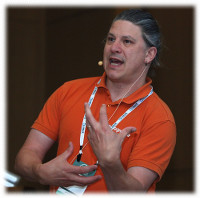
GENIVI's community manager Jeremiah Foster also gave a talk, in which he pointed to other projects that are reaching the point where application developers can use them. There is an IVI radio service, for example, that can handle AM, FM, and a variety of digital broadcast standards, and a speech output framework that can be used for anything from turn-by-turn directions to reading text alerts out loud.
The Media Manager project, on which GENIVI is collaborating with Automotive Grade Linux, should have a release ready by October. The goal is an API for connecting to consumer electronics devices for media playback; Foster noted that the team started with the Media Player Remote Interfacing Specification (MPRIS) and has worked with developers from several existing open source projects (like VLC) to make sure that Media Manager meets their needs as well.
Foster ended his session by asking the audience to get involved in the effort; GENIVI wants to know "what is currently missing." As the other GENIVI talks suggested, the project is reaching the point where several of the low-level tasks it has been focusing on are essentially complete, an attention now turns to more user-visible software.
[The author would like to thank The Linux Foundation for travel assistance to attend ALS 2014.]
Yorba, the IRS, and tax-exemption
On June 30, Yorba Foundation director Jim Nelson posted a blog entry reporting that the US Internal Revenue Service (IRS) had denied Yorba's application to be registered as a tax-exempt 501(c)(3) charity. Nelson and others contend that this denial is cause for concern to other players in the FOSS arena, but there are voices who disagree about the implications.
As Nelson's blog post explains, Yorba had filed its 501(c)(3) application in 2009. In the US, 501(c)(3) organizations are one of several types of tax-exempt nonprofit, but there are additional benefits to being a 501(c)(3) rather than, say, a 501(c)(6) trade association. Most notably, Nelson said, donations made to 501(c)(3)s are tax deductible for the donor, and that makes fundraising easier. Many high-profile organizations in the free and open-source software realm are 501(c)(3)s, including the GNOME Foundation, the Mozilla Foundation, the Apache Software Foundation, and the Linux kernel project.
Last year, news broke that the IRS had flagged "open source" tax-exemption applications for increased scrutiny, reportedly out of concern that for-profit companies might seek to run their operations out of a nonprofit organization to evade taxes. That "be on the lookout" (or "BOLO") issue, as it was known, had allegedly started in 2010, and Nelson reported that Yorba received two requests for further information from the IRS that year.
Yorba's application was as a "charitable, scientific, and
educational organization
". Nelson reported that the IRS's
rejection notice was dated May 22, 2014, and gave several reasons for
the decision—reasons he called "hair-raising
" statements
that "could have a direct impact on the free software movement,
at least here in the United States.
"
Nelson quoted five snippets from the IRS's justification for its
decision, including the fact that Yorba's software could be used
" Nelson pointed out that several of these rationales seem to conflict
with the IRS's recognition of other open-source software foundations
as 501(c)(3)s, and that several of them seem to suggest that Yorba
should impose restrictions on its projects, such as limiting their
usage or requiring copyright assignment from all contributors.
" He added that the potential impact of these statements by the IRS
would be chilling to FOSS as a whole:
and concluded by saying that Yorba does not intend to appeal the
rejection, but will continue developing its application software nonetheless.
The story was picked up by the general tech press in short order,
many of whom paired it with the news that the OpenStack Foundation had
received
a rejection from the IRS for its 501(c)(6) application in March (a
decision that OpenStack has already appealed). According to that blog
post, the IRS listed three issues with the OpenStack application:
The rules for 501(c)(3)s and 501(c)(6)s differ, of course, but both
rejections share some common themes, like the assertion that the
projects are essentially engaging in normal software development
practices as many for-profit companies do. To a lot of commenters,
that amounted to a rejection of the core principles of FOSS. Simon
Phipps, for example, in a story titled "Are open source foundations nonprofits? The IRS says
no," said
" But others have pointed out that the decision in Yorba's case does
not set precedent for any other FOSS project's application. Bradley
Kuhn, in a comment
on Nelson's post, said that the decision is the opinion of one IRS examiner,
and should not be treated as broader in scope. Furthermore, it
" Karen Sandler noted in a blog
post of her own that the IRS has said more than once in the past
that a decision about one non-profit application has no effect on
existing non-profits. Concern that existing organizations will lose their
tax-exempt status would seem to be overblown.
Nevertheless, Yorba's multi-year wait for a decision from the IRS
does seem to be the norm. Perhaps that is a good thing in and of
itself; although no organization seems to be happy about the lengthy
wait, vetting an organization is probably a process that ought to
require some in-depth investigation, lest gaming the system be too
easy. But the lengthy wait clearly has an impact on the projects and
foundations in question, consuming time and resources.
It is also possible that the IRS (or some portion of its reviewers)
is developing an attitude toward FOSS software that is fundamentally
at odds with the common practice of developing and releasing free
software while finding other means to fund operations. In a 2013 WIRED article, Luis
Villa commented that he had heard from several projects that the IRS
wanted them to put non-commercial usage restrictions into their
licenses.
No doubt there are unscrupulous individuals out there who would
love to be paid to write software but not have to pay taxes (and if
there were none before, the idea has surely occurred to them in the wake
of the Yorba story). It is a tricky problem for the IRS to sort out,
determining whose work is truly in the public interest and who might
be developing a standard-issue software product but putting an
open-source license on it for tax purposes.
For those who are genuine in their commitment to the ideals of
software freedom, though, it is just one more uphill battle among
many. Hopefully others will not take the Yorba rejection as a
discouragement, and hopefully Yorba will not be discouraged either.
Many commenters, both on Nelson's blog post and elsewhere, spoke up to
offer their encouragement in general, and their encouragement that
Yorba should appeal this initial rejection.
At the 2014 Automotive
Linux Summit (ALS) in Tokyo, several sessions highlighted new work
from the Automotive Grade
Linux (AGL) and Tizen
IVI projects, including a flexible speech recognition and generation
framework and a graphical user interface (GUI) for in-dash head units.
In addition, AGL offered teasers of several upcoming new releases and put out a
call for application developers interested in open-source automotive
software.
Formally speaking, AGL is a working group of the Linux Foundation
focused on the task of increasing Linux adoption in vehicles. But as
a practical matter, this has meant group members putting resources into
developing open source software. Just prior to ALS 2014, AGL
announced the release of its reference Linux platform, which is built
on top of the in-vehicle infotainment (IVI) version of Tizen.
The AGL release contains several components not found in the
contemporaneous Tizen IVI release, but there is clearly a close working
relationship between the two projects. Some of the AGL release's
additions may not make it upstream into Tizen IVI in the foreseeable
future, either because they are contributed by member companies who
have not yet shown an interest in Tizen, because there are licensing
issues, or because they are evidently intended only as
proof-of-concept code with less general appeal. The exact reasons,
though, are not always clear.
For example, the AGL release includes support for controlling a
MOST-connected audio amplifier. MOST (Media Oriented Systems Transport) is an automotive industry
standard data bus that runs over fiber-optic cable; it provides a number of
benefits compared to other vehicle buses (such as high throughput and
resistance to electrical noise), but the standard is proprietary and
there is reportedly no interest from MOST's governing organization to
the idea of opening up the specification or loosening its licensing
restrictions. There is, therefore, little chance that general-purpose
MOST support will come to Tizen IVI, but AGL has an interest in
demonstrating that MOST integration is possible.
On the other hand, Intel's Geoffrey van Cutsem gave a talk about
Tizen IVI's new GUI project, Modello, which
actually started off as an AGL add-on project but is now developed
within Tizen IVI. Modello is a suite of
free-software HTML5 applications that cover basic GUI functionality.
There is a "home" screen, a dashboard that shows vehicle statistics
and sensor readings, a media player, a heater/air-conditioner
controller, a phone-tethering application for hands-free usage, and a
navigation tool that connects to Google Maps.
The Modello system is completely modular, Van Cutsem said; the home
screen launcher can launch any application, not just those already
mentioned. But the official Modello applications are all designed to
look the same; they pick up the same UI elements from a central
theme. As of right now, there are just two themes
to choose from—and they differ only in color—but the
theming engine is a flexible one. Someone could create a "nighttime"
theme, he said, and have it activated automatically when the car's
light sensors indicate that it is getting dark.
The Modello applications are also designed to run on 720p
portrait-orientation screens, which are not the norm in today's
vehicles. Van Cutsem explained the rationale: Modello is targeting
the IVI systems of the future, when larger screens are expected to be
commonplace. Most center consoles are "portrait-shaped," he said, and
if the screen replaces many of the physical controls in use today
(including climate-control knobs), users are likely to expect the
biggest screen that will fit. The Tesla Model S, he said, is a good
example: it sports a 17-inch portrait display.
The Modello project has also been filling in some miscellaneous
missing pieces in Tizen IVI; it implements a GUI system settings utility,
which has been prominently missing from prior Tizen releases. Perhaps
most importantly, it allows GUI configuration of Bluetooth and WiFi
networking, which, up until now, had only been configurable with
command-line tools.
There is still more to come, he said. The navigation application
is still quite rough; as of today it only supports pre-set
destinations. Although Van Cutsem did not discuss it, navigation is
in a state of flux in both Tizen and AGL at present. Tizen IVI dropped
the navigation application Navit from its builds in
2013. The word around the project is that either Navit or some other
free-software routing application will return in due course; the
Google Maps tool may not last due it its reliance on a single, proprietary
data provider.
Also still to come in Modello is a port from Tizen IVI's older web
runtime to the newer Crosswalk, support for localization, and
integration with the Wayland-based Layer Manager. A new release is
expected within the week. Van Cutsem also noted that the Modello project would be working to
add support for "twenty plus" new applications written by AGL. Jaguar
Land Rover's Matt Jones provided a preview of that application
collection in part of his ALS keynote talk. The new additions being
developed include Modello-compatible versions of older software, such
as the SmartDeviceLink
mobile device tethering and screen-sharing tool. But they also
include several entirely new applications, such as fingerprint
recognition and voiceprint recognition utilities, a weather
application, and a news
carousel.
Jones pointed out that Jaguar Land Rover was interested
in funding open-source projects like these AGL reference
applications, and told anyone interested in contributing to get in
touch. The company has found working with open-source developers to
be in its best interests, he said. The average time from concept to
deployment in a car is 39 months, but the average software startup
only has a lifespan of 18 months. So pairing with startups is not a
strategic option.
In contrast, he said, for every dollar that the
company puts into Tizen and open source, it estimates that it
generates at least 20. He now hopes that the company can start
working on more interesting new applications, such as the biometric
systems mentioned above. "I hope we're done with implementing
Bluetooth profiles and FM radio, and can start doing the unique
stuff."
Intel's Jaska Uimonen provided a look at one of those possible new
developments in his presentation on Winthorpe, an open-source
framework for adding speech support to Tizen IVI applications.
Winthorpe supports both speech recognition for input and speech
synthesis for output, and it provides both as a system-wide service.
This design is distinct from most of the other speech recognition
systems on the market, he said. The others tend to either be a
standalone, "assistant" application like Apple's Siri, or else each
individual app (search, navigation,
etc.) is its own "silo"—linked internally to a third-party provider's
speech recognition module.
The assistant model can be linked to other apps (such as voice
dialing and web searching), but adding new features to these apps
requires making changes to the assistant. The close linking approach
may also mean multiple apps have speech support, but it has serious
drawbacks: the apps are not aware of each other, so they cannot
cooperate, and their fate depends entirely on the continued support of
the third-party speech engine supplier. In addition, he said, most of
the popular speech recognition services (including Google's and
Apple's) rely on an active network connection to a remote cloud
service. Winthorpe attempts to improve on these shortcomings. It provides a
platform-level API service with multiple back-ends, so that
speech-enabling an application is a one-time process—you do not
need to rewrite your code to start using a different speech engine.
The API also lets applications stay simple, offloading the speech
processing to the service.
The process of speech-enabling an application is straightforward,
he said. The program registers itself with the Winthorpe process and
declares a set of commands that it wants to listen for. Winthorpe
listens for speech input, then notifies its registered client if it
recognizes a command—delivering the notification event and, if
requested, passing the speech input buffer to the application.
For deciding which registered application gets "voice focus" for a
recognized command when there are multiple options, Winthorpe
delegates the decision to Tizen IVI's Murphy policy manager—though
how Murphy makes that decision is up to the system implementor. Winthorpe is
context-aware, he said. When the user makes or answers a phone call,
all audio is sent to the phone application and speech recognition is
switched off.
The Winthorpe architecture is modular; there can be multiple
speech-recognition
plugins installed, and there are plugins for disambiguation and for
speech synthesis. Currently the plugins include only one open-source
recognition engine, Carnegie Mellon University's Pocketsphinx. There are
two open-source speech synthesis plugins, one based on Emacspeak and
one based on Festival. The Winthorpe team has written demo extensions
for media players and for simple web searching.
In addition to registering for callbacks to specific commands,
applications can also make use of some special Winthorpe tokens,
Uimonen said. One is the wildcard operator * for free-form
input. An application can use it to have Winthorpe send the raw audio
input rather than having Winthorpe process it as speech. This might
be useful for recording notes or calls. Another is "dictionary
switch" command, which tells Winthorpe to match speech input against a
special dictionary rather than the general-purpose one. This can
dramatically improve recognition quality, he said. For instance, if
one knows that the speech input will be numeric, switching to a
"digits" dictionary will reduce the error rate.
Speech output is considerably simpler than speech recognition,
Uimonen said. Winthorpe supports selecting from among multiple
installed "voices," multiple languages, and includes commands to
adjust the voice's rate and pitch.
One of the weaknesses of the system is how few open-source speech
projects there are, he said. Pocketsphinx is currently the only
open-source recognition engine because there are few others available,
although he said the project is
working with the Julius engine
that is designed for Japanese. Between the two synthesis engines,
Festival is noticeably weaker than Emacspeak. He added that most
existing IVI systems use a proprietary speech recognition back-end.
Future work for the project includes Julius integration,
improvements to the Murphy integration, the ability to reconfigure the
speech-decoding pipeline on the fly, and tools to better pronounce
unrecognized words.
Together, the AGL and Tizen IVI projects appear to be making
progress on multiple fronts. While some of the work (such as
Winthorpe) is of interest primarily to developers, the details of the
project indicate that the team is trying to improve on the status quo
available in other IVI systems. And other new pieces, such as
Modello, indicate that polished, end-user code is within reach for the
first time, which is good news for those who are interested in seeing
an open-source IVI platform reach the market.
[The author would like to thank The Linux Foundation for travel assistance to attend ALS 2014.]
by any person for any purpose, including nonexempt purposes
such as commercial, recreational, or personal purposes
", that
Yorba does not own all of the copyrights on its software, and that
releasing the source code to software does not constitute an
educational function since "
anything learned by people studying
the source code is incidental
". The IRS also contended that
developing and distributing software is not a "public work" because
software is not something ordinarily provided at public expense, and
that open-source software is available worldwide and therefore does
not "serve a community
" as 501(c)(3) rules require.
In other words,
" he surmised in one place, "we
(and, presumably, everyone else) cannot license our software with a
GNU license and meet the IRS’ requirements of a charitable
organization.
"
it seems that the IRS no longer thinks collaborating on open
source is a public good.
" Other news outlets took their
interpretations to even greater extremes, applying them to FOSS as a
whole (headlines such as "IRS says free software projects can't be
nonprofits" and "The IRS wages war on open source nonprofits" are
easy-to-find examples).
doesn’t change the status of orgs that are already operating
properly under 501(c)(3) status.
"
A speech framework and a GUI for automotive systems
The Modello user interface

At last: the talking car

Page editor: Nathan Willis
Inside this week's LWN.net Weekly Edition
- Security: Evaluating the LZO bug; New vulnerabilities in dbus, ffmpeg, lzo, owncloud, ...
- Kernel: System calls, part 1; cgroups, part 2; Filesystem notification, part 1.
- Distributions: Debian and the PHP license, CentOS 7, Wayland in Fedora, ...
- Development: The future of Ardour; KDE Frameworks 5; Juju 1.20; Next-generation Klipper; ...
- Announcements: Andrew Tanenbaum retires, news from FSFE, internet safety, ...