

LWN.net Weekly Edition for May 9, 2013
Fedora's invisible passwords and visible squabbles
The relative quiet recently experienced on the Fedora development mailing list felt a bit like the calm before the storm. And, indeed, the storm duly arrived in the form of a heated discussion over the proper behavior of the password forms in the Anaconda installer. When the dust had settled, the status quo ante prevailed. But some interesting governance questions were raised in between.
The problem
After the Fedora 19 alpha release, the installer developers decided to stop masking the passwords supplied by the user during the installation process. Passwords only remained visible for as long as the keyboard focus remained on the relevant input box; as soon as the focus moved on, the password would be masked. But that still left the password visible for an arbitrary period of time to anybody who chose to look.
Some users, suffice to say, were unamused. A bug report was filed — and promptly closed:
The above-mentioned unamused users were, strangely enough, equally unamused by this response. The bug was reopened, and the massive mailing list discussion was launched. The arguments covered whether it ever made sense to show passwords in the clear, whether passwords still make sense at all, and more. The new behavior had few defenders, a trend not helped by the near absence of the Anaconda developers from the discussion. On May 6, the change was reverted with no explanation. At that point, naturally, the discussion was done.
Heard in the debate
While there was a lot of talk about the security issues associated with the clear display of passwords, there was also a lot of meta-discussion on how issues like this should be handled. Some participants, Matthew Garrett in particular, took issue with the tactic of reopening the bug entry:
Anybody who spends any significant time reading bug tracker entries knows that they often host spirited debates about the merits of specific changes. These entries can serve as a focal point for a discussion of a particular issue that the relevant developers will have a relatively hard time ignoring. On the other hand, bug trackers can be painful places to hold any kind of detailed discussion. They tend to have all of the disadvantages of forum sites, without the polished interfaces and enhanced searchability that such sites provide. A desire to keep such discussions on the mailing lists — and to avoid using the bug tracker to bug the relevant developers — is understandable.
A few people tried to bring up matters of policy, claiming, understandably,
that policies are a big part of what distinguishes a distribution from a
random collection of software. Fedora does not appear to have an explicit
policy on how password forms should behave. Perhaps it should: it would be
better if such forms behaved consistently throughout the distribution
rather than surprising users with occasional novelties.
Eric Sandeen suggested that Anaconda's
unique role in the distribution should maybe subject it to more scrutiny
than other packages, asking "How much of the Anaconda team's job is
it to set Fedora OS policies and behaviors, vs. to implement them?
"
He pointed out that a decision by the Anaconda developers to change the
default filesystem used with new installs would probably not be seen as an
Anaconda-only matter, for example.
It was suggested that the issue could be forwarded to the Fedora Engineering Steering Committee (FESCo) in an attempt to force the change to be reverted. FESCo member Kevin Fenzi expressed the low level of enthusiasm most participants seemed to feel for that approach:
Fedora, arguably, does not defend the independence of its package maintainers as fiercely as, say, Debian does. But a developer's package still tends to be their castle; even those who were opposed to this particular change were, for the most part, unwilling to try to revert it by force. As a community, we remain disinclined toward dictating instructions to our developers.
The discussion clearly covered a number of ways in which this particular technical decision should be debated and decided. The one thing it did not do, unfortunately, is provide any indication of how the decision was made to revert the password change. So a discussion that might have led to a better understanding of how security-related decisions should be made within Fedora ended up, instead, with the possibility that the developer involved simply backed out the change rather than face the mob. That gives the Fedora community no guidance on either policy or the best way to handle technical disagreements; as such, it represents a missed opportunity. Passwords, arguably, should be invisible, but policy decisions usually belong in plain sight.
Miro 6, video, and the web
The Participatory Culture Foundation (PCF) released version 6.0 of its GPL-licensed desktop video application Miro in April. There are performance improvements and important new functionality, as one might expect. But Miro's development over the years also serves as a barometer for the state of online multimedia content—and the trend these days seems to be pulling away from RSS and other open standards.
For the benefit of the unfamiliar, Miro is a cross-platform GUI application designed to consolidate online audio and video sources into a single player that automatically handles subscriptions and other sources of recurring content. In the early days, it was named Democracy Player, and the emphasis was on managing RSS and Atom feeds for video sources, akin to a podcasting client for video. PCF's larger mission centers around promoting decentralized media creation and distribution; its other projects include Miro Community, a web platform for building video-sharing sites, the Amara framework for user-contributed video subtitles, and Miro Video Converter, a video conversion application (whose functionality is also available in Miro itself).
Over the years, support for additional means of content delivery have been added to Miro, including Bittorrent, web-based video sites (i.e., those that embed video content but do not produce a parsable feed), and dedicated services like Hulu. The application's interface resembles a desktop music player: content sources are listed in sidebar, with a collapsible tree grouping sources by type. Feed subscriptions are listed under "Podcasts," and Miro indicates the availability of new material with a numeric indicator next to the feed title. Each feed has separate settings regarding whether new items are automatically downloaded, how long they are retained, and so on.
Links to web video sites and digital music stores are each grouped in their own category, but Miro does not check either of these service types for new content automatically. The application can also manage a local music collection much like any other audio player. Oddly enough, although the music management feature allows users to browse by album and artist, the video management feature does not sport similar library-like options for managing a collection of local video files. Instead, it presents a sorted list and highlights entries that have not yet been watched—the emphasis is on watching what is new and moving on.
Feed me, see more
Miro is written primarily in Python, and the Linux version uses GStreamer for media playback and FFmpeg for format conversion. Although the earliest versions of the application focused on video feed management, an embedded browser engine has been available in Miro since the 1.0 release, allowing users to search for and bookmark video sites that do not produce a proper feed. Initially the engine was Gecko on all platforms, but starting with the 3.0 series in 2010, Miro has used WebKit on Linux.
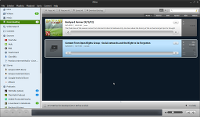
By far the most noteworthy change in the 6.0 release is that it finally restores working Flash support on Linux (which had been broken since 2009), without which many of the web-based video services were unusable. However, Flash support is not an all-or-nothing proposition, and its value to the user depends on a number of variables.
The Linux version of 6.0 comes with a handful of well-known web video services (YouTube, Hulu, and PBS) pre-listed in the application's sidebar. Users can add their own by entering the URL, and the sidebar entries are essentially just browser bookmarks—nothing prevents one from loading up the sidebar with non-video sites (music services like Spotify, popular destinations like LWN.net, etc.). Flash videos do indeed play, although playback is dependent on having a Flash plugin by default. The official plugin, of course, is a proprietary binary blob, which not every Linux user will be thrilled with. The grim reality, however, is that avoiding the proprietary Flash plugin remains a process fraught with difficulty.
There are alternatives, albeit imperfect ones. If one visits the YouTube HTML5 trial page, for instance, one can switch on delivery of the HTML5 <video> element instead, and enjoy YouTube content in WebM or H.264 format instead. Getting to the trial page within Miro is not simple, unfortunately: one can only navigate to the URL directly by adding it as a sidebar entry (and the only other option is logging in to a registered YouTube account and changing the account settings). At present, however, YouTube remains one of the few video services that offers an HTML5 option. Ironically, it is also one of the only video sites supported by the other option: the open source Flash plugins Gnash and Lightspark.
In practice, visiting most Flash-driven video sites in Miro is little different than visiting them in Firefox or another browser. Since fewer and fewer services seem interested in distributing video over RSS or Atom, preferring instead to draw the user into their own little captive portals, offering a better-than-browser experience is a challenge that Miro will have to rise to meet. The application does do its best to parse content that does not come in standard feed form—for example, one can add a YouTube "channel" or search results page to the Podcasts sidebar, and Miro will attempt to pick out its video content and download it, but the results are unreliable. PCF also takes a firm stance against what is perceived as illegal activity: it will not allow the user to download videos embedded in a web page, nor is there any way to add a browser extension which adds such functionality.
Other than the long-awaited Flash fix on Linux, the 6.0 release of Miro is primarily a performance upgrade. Whether or not there are real-world speed gains can be hard to gauge, particularly on Linux where previous releases only handled feed-delivered video (where the speed of one's Internet connection is the biggest factor), but in my testing 6.0 is certainly no slower than it predecessors, and it is much less crash-prone. The side features, such as video conversion and portable device synchronization, have received updates as well, so they support newer phones and media codecs. Miro 6.0 also restores compatibility with the MythTV DVR platform; MythTV includes a tool called MiroBridge that treats Miro downloads as a virtual channel on a MythTV backend. MiroBridge broke on Linux during the Miro 4.x cycle, and PCF only implemented the fix for 6.0, skipping the 5.0 series altogether.
Although Miro does offer a smooth playback experience, it has its drawbacks, starting with the embedded browser. Much as there is no simple way to download a video from a web site in Miro's browser, there is no way to install an ad-blocking extension or tweak other settings. Thus, users for whom annoying web ads are usually a distant memory may be shocked by the sensory assault of giant, animated commercials plastered in every corner. There also appears to be no way to add music download stores that are not built-in by default (perhaps because PCF uses referral codes from store purchases as a means of fundraising).
Miro also grabs the first media file it finds from each podcast episode, which is not always desirable. Sometimes the user might prefer one of the "fallback" options, either due to the format (e.g., Theora instead of H.264) or due to file size (not everything must be seen in HD).
The $64,000 question: who cares?
Taken on its merits alone, Miro is a capable application. The integrated MiroGuide service run by PCF is an excellent way to find watchable and listenable content online amidst all the garbage, and Miro itself greatly simplifies managing and watching video (or audio) podcasts. Its player works well, offering full-screen functionality and a unified interface even for disparate sources. It even boasts simple format conversion and can synchronize portable devices. Watching video and listening to podcasts in Miro is a noticeably better experience than accessing the same material in the browser—just like reading blog content aggregated into a feed reader is noticeably better (for most people) than visiting the same blogs in the browser.
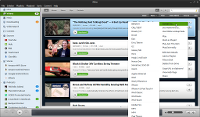
Nevertheless, Miro remains a comparatively little-known application, even among those who passionately mourn the impending demise of Google Reader. Perhaps the amount of content each reader consumes is part of the difference; I have 623 blog subscriptions at the moment, which dwarfs by several orders of magnitude the number of video and audio podcasts I have time for. On the other hand, video fanatics have plenty of other choices available, from set-top boxes like the Roku to open source media centers like MythTV or XBMC (which typically rely on third-party developers maintaining screen scraper code to extract video from web sites—which periodically break). Miro may simply be stuck in the middle: better than a browser (which gets the casual viewer by default), but less convenient than XBMC (which captures the obsessive viewer).
Miro's biggest obstacle, however, is something entirely beyond its control: the trend of commercial video sites to move away from RSS feed delivery towards self-contained, browser-only video. The trend is not technical in its motivations; businesses are rejecting feed-delivered video for financial reasons. But it still puts Miro in a difficult position. On a technical level, Miro for Linux may soon face yet another obstacle, since Adobe has decided to discontinue the NSAPI version of the Flash plugin for Linux. Perhaps switching to Chromium's embedded browser engine would help, perhaps Gnash and Lightspark will see renewed interest, or perhaps Mozilla's Shumway will make progress. But whatever happens, eventually a major shift will have to be made in order to retain Flash video playback on Linux. We are, of course, told that Flash is dying, but its longevity is legendary enough by now that few are willing to hold their breath and wait.
Miro may occupy a small niche, caught between the existing web browser experience on one hand and the media center experience on the other, but a small niche does not make a project unimportant. Miro's adeptness with video feed management is still unique; in comparison, the RSS feed support in XBMC and MythTV is awkward and second-class. The closest parallel is probably to audio podcasting clients like gPodder. To many users, the podcasting support in generic desktop audio players like Rhythmbox is good enough. But it isn't great, and gPodder still attracts plenty of users who prefer the first-class feed support. Miro's early release, too, proved that if you can do one thing and do it well, users will appreciate you. The restoration of Flash video support in 6.0 muddies the water a bit, but it does not detract from Miro's core strength.
LFCS: A $99 supercomputer
Parallel computing is at least part of the future of computing. When even fairly low-end phones have multiple cores, it is clear where things are headed. In the future, hardware with even more parallelism will be available, but parallel programming is not keeping up. Part of the problem there is the lack of availability of inexpensive, highly parallel hardware—which is exactly what Andreas Olofsson and his team at Adapteva have set out to address.
In his keynote at the 2013 Linux Foundation Collaboration Summit (LFCS), Olofsson described the Parallella—a $99 supercomputer that Adapteva ran a Kickstarter project to design and build. He began by noting that his keynote followed one from Samsung, which is the world's largest electronics company while he was representing "perhaps the smallest" electronics company. Olofsson is not only the CEO, he is also one-third of the engineering team, he said with a chuckle. Despite being so small, the company was able to build a 64-core 28nm chip that runs 100 GigaFLOPS at 2 watts.
Adapteva created that chip two years ago and went around the world trying to sell it, but that effort was met with "crickets", he said. The world just wasn't ready yet, so that's where the Kickstarter idea came from. Adapteva is turning into a systems company because "people want computers, they don't just want chips".
Energy efficiency has not kept up with Moore's law, which creates an "efficiency gap" that impacts both battery powered and plugged-in systems, he said. The gap has only started to widen in the last few years, which is why most people don't care—yet. But it is a problem that is getting worse and worse and will be quite severe by 2020 or 2025. We have to start thinking differently, he said.
The architecture that everyone wants is an infinitely fast single-threaded CPU with infinite memory and infinite bandwidth to that memory, which is, of course, impossible to have. We keep trying new things when we hit various limitations, scaling up the processor frequency, issuing multiple instructions per cycle, adding SIMD (single instruction, multiple data), and eventually adding more cores. "Now what?", he asked. We are "running out of tricks". We have seen this play out in servers and desktops, and are seeing it play out in mobile "as we speak".
When he started the company in 2008, there were a number of chip-design trends that he believed would shape the future of computing: things like power consumption, memory bottlenecks, thermal density, yield issues, software complexity, and Amdahl's law. But we have a very different example of computing that is close to hand: our brains. Whenever you look at the brain, you realize that what we have been designing is so primitive in comparison to what nature has already accomplished, he said. It is massively parallel (billions of neurons), energy efficient (30 watts), heterogeneous (different parts of the brain handle different functions), and robust (losing a small part generally does not shut the whole thing down).
The "practical vision" for today is heterogeneous, Olofsson said. We have system-on-chips (SoCs) that can combine different kinds of functional units, such as "big" CPUs, GPUs, and FPGAs. But, we won't see 1000 ARM cores on a single SoC, he said. What Adapteva has done is to add hundreds, or even thousands, of small RISC CPUs into a SoC with ARM or x86 cores as the main processor.
Programming
The current state of parallel programming is not up to the task of writing the code that will be needed for massively parallel systems of the future. The challenge is to make parallel programming as productive as Java or Python is today, Olofsson said. We should get to the point where GitHub has thousands of projects that are using parallel programming techniques that run on parallel hardware.
To get to this world of parallel ubiquity, the challenges are "immense". The computer ecosystem needs to be rebuilt. Billions of lines of code need to be rewritten, and millions of programmers need to be re-educated. In addition, the computer education curriculum needs to change so that people learn parallel programming in the first year of college—or even high school.
In his mind, there is no question that the future of computing is parallel; "how else are you going to scale?". Where else can you get the next million-times speedup, he asked. But there is a question of "when?" and it is "going to hurt before we get there". There is no reason not to start now, though, which is where some of the ideas behind Parallella come from.
Inspired by the Raspberry Pi, Parallella is a $99 credit-card-sized parallel computer. Adapteva is trying to create a market for its chip, but it is also "trying to do good at the same time". The only way to build up a good-sized community around a device like Parallella is to make it open, "which is hard for a hardware guy", he said. But that makes the platform accessible to interested hackers.
Parallella is cheap and easy to use, Olofsson said. He wishes Adapteva could sell a million of them (like Raspberry Pi), but thinks that's unlikely. If it sold 10,000 and people took them and did innovative things using Parallella, that would be a big success.
The Kickstarter tried to raise $750,000 in 30 days and was successful in doing so. He and his team have spent the last six months trying to deliver what had been promised. The goal was a 5 watt computer that could do 100GFLOPS, which was achieved. There are many different applications for such a device including software defined radio, ray tracing, image processing, robotics, cryptography, gaming, and more.
The system has a dual-core Cortex-A9 processor that runs Linux. It has most of the peripherals you would expect, but it also has a built-in FPGA. That device can be configured to "do anything" and is meant to augment the main processor. In addition, there is Adapteva's Epiphany co-processor, which brings many small RISC cores to the system.
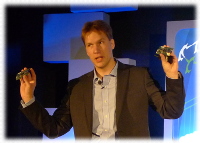
At the time of the talk, it had only been five days since Adapteva had received the boards. Both 16-core and 64-core Epiphany versions were delivered (Olofsson is holding one of each in the photo above). Each consumes around 5 watts and he is "excited to get them in the hands of the right people". By the second day, the team could run "hello world" on the main CPU. Earlier in the day of the talk (day 5), he heard from another member of the team that it could talk to the Epiphany and run longer programs on the A9. Six months ago, he didn't know if you could actually build this type of system in credit card form factor with a $99 price point, but it can be done.
Now Adapteva needs to ship 6300 systems to people who donated to the Kickstarter, which is no easy task. There are some serious logistics to be worked out, because "we want people to be happy" with their boards. Adapteva also wants to give away free kits to universities. Building a sustainable distribution model with less than five people in the company will be challenging. It is running a little late, he said, but will be shipping all of the boards in the (northern hemisphere) summer.
Olofsson concluded with Adapteva's plans after all the shipping and handling: next up is "massive parallelism" with 1024-core Epiphany co-processors. It will be interesting to see what folks will do with that system when it becomes available.
Security
IBM's homomorphic encryption library
IBM has released a new GPL-licensed encryption library called HElib which boasts the property of being fully homomorphic. This means that the encrypted message can be manipulated (subject to certain constraints), and the transformations applied to it will propagate correctly to the plaintext message. For example, given a number n and its encrypted "ciphertext" E(n), a homomorphic encryption scheme might allow you to multiply by a constant, and decrypting 42 * E(n) would give you 42 * n.
Exactly which operations preserve this property varies with the encryption scheme used. Schemes which are partially homomorphic preserve the homomorphic property only for addition or for multiplication, but not both. A fully homomorphic scheme preserves computation for both addition and multiplication, which is considerably more powerful. Such a system also preserves the useful algebraic properties of a ring:
- The associative property of addition: (a + b) + c = a + (b + c)
- The commutative property of addition: a + b = b + a
- The associative property of multiplication: (a * b) * c = a * (b * c)
- The distributive property: a * (b + c) = (a * b) + (a * c)
In short, with a fully homomorphic encryption scheme, you can perform a wide variety of computations on a file without decrypting it first. Consequently, untrusted programs can operate on encrypted data without risking the disclosure of its information. Remote servers could adjust financial documents without knowing their contents (for example, crediting an account, or computing sales tax on a purchase), voting machines could track totals without disclosing what the intermediate counts are, sensitive databases can be recklessly stored on public web sites, and so on (well, perhaps not that final example). There are several well-known cryptosystems which are partially homomorphic; for example, RSA encryption is homomorphic over multiplication only. But only recently have there been practical systems that are fully homomorphic.
The downside is that the few known fully homomorphic systems are considerably slower than are partially homomorphic schemes. The very first was described in 2009 by Craig Gentry. It used lattice-based cryptography, but it was not particularly practical, because the complexity of the operations needed scaled exponentially with the degree of attack-resistance desired. Just as importantly, the tendency is for ciphertext in a homomorphic encryption scheme to get longer (often drastically longer) every time additional operations are applied to it. Thus, the scheme was inefficient in space as well as in time. Gentry's original method also involved setting up an initial lattice that is "somewhat" homomorphic (meaning that it is very limited in the functions that it can be used to evaluate), then "bootstrapping" it by iteratively improving it. Subsequent advances allowed faster computation of Gentry's original method, eliminating bootstrap stages and replacing some of the lattice-based operations with integer math.
HElib implements Brakerski-Gentry-Vaikuntanathan (BGV) encryption, first published in 2011 by Zvika Brakerski, Gentry, and Vinod Vaikuntanathan. It too is a derivative of Gentry's work, building on several intermediate schemes devised during the years in between. HElib also incorporates a number of speed optimizations, including single instruction, multiple data (SIMD) operations to parallelize some encryption steps, and other methods for keeping the ciphertext as compact as possible (thus making it faster to process). For a bit of real-world comparison, one commenter on the Hacker News coverage of the release looked at the results described in one of the optimization papers and estimated that computing AES-128 rounds was about 10 billion times slower in the homomorphic system than when using the straightforward mathematical approach.
HElib is written in C++ using the NTL mathematical library. Currently, one does need to have a good understanding of homomorphic encryption to make much use of HElib—one does not simply pipe a text file to it and drag the result into a spreadsheet cell. So its importance is more about the impact that will be felt in the long term than it is about the prospect of drag-and-drop homomorphic encryption for the average user.
In the future, homomorphic storage might make sense in databases or in a number of different places where a form of "write only" access is desirable. An example is the voting-machine scenario mentioned above. The voting machine's tally for each candidate can be encrypted, so no intruder can read the result. But each voter's ballot can add an encrypted 1 to their selection and an encrypted 0 to each of the others. The voter could theoretically decrypt his or her ballot and verify its contents, but no one else can; the count in the machine is still incremented correctly, without ever needing to be in possession of the ballot in plaintext form. The same approach could be applied to secure event logging, message routing, or any number of other tasks.
Even if practical applications remain years away, it is a big win that HElib is being made available to the public under the GPL, rather than debuting in a proprietary tool. For decades, homomorphic encryption was not even known to be possible; now there is considerable work still remaining in order to develop a practical tool (as well as scrutiny by other cryptographers to analyze the scheme for overlooked weaknesses)—but there is also working code where before there was not.
Brief items
Security quotes of the week
Before we start blaming agencies for failing to stop the Boston bombers, and before we push "intelligence reforms" that will shred civil liberties without making us any safer, we need to stop seeing the past as a bunch of obvious dots that need connecting.
Garrett: A short introduction to TPMs
Matthew Garrett has posted an introduction to the trusted platform module (TPM) chip and what can be done with it. "I've been working on TPMs lately. It turns out that they're moderately awful, but what's significantly more awful is basically all the existing documentation. So here's some of what I've learned, presented in the hope that it saves someone else some amount of misery."
Remote execution vulnerability in nginx
The nginx web server suffers from a remotely exploitable buffer overflow that can lead to the execution of arbitrary code. Versions 1.4.1 and 1.5.0 contain the fix; there is also a workaround in the announcement. This seems like a good one to apply quickly.Linux Security Summit CFP
James Morris has announced the CFP for the 2013 Linux Security Summit. The CFP is open until 14 June and the summit will be held on September 19 and 20 in New Orleans, Louisiana, co-located with LinuxCon North America and the Linux Plumbers Conference (it overlaps the latter). "We'll be following a similar format to last year, with a day of refereed presentations, followed by subsystem updates and break-out sessions on the second day." We have covered previous Linux Security Summits and hope to do so again this year.
New vulnerabilities
drupal: denial of service
| Package(s): | drupal | CVE #(s): | CVE-2013-0316 | ||||||||||||
| Created: | May 3, 2013 | Updated: | May 8, 2013 | ||||||||||||
| Description: | From the Mageia advisory: Drupal core's Image module allows for the on-demand generation of image derivatives. This capability can be abused by requesting a large number of new derivatives which can fill up the server disk space, and which can cause a very high CPU load. Either of these effects may lead to the site becoming unavailable or unresponsive (CVE-2013-0316). | ||||||||||||||
| Alerts: |
| ||||||||||||||
gogoc: not built with PIE flag
| Package(s): | gogoc | CVE #(s): | |||||
| Created: | May 6, 2013 | Updated: | May 8, 2013 | ||||
| Description: | From the Red Hat bugzilla:
http://fedoraproject.org/wiki/Packaging:Guidelines#PIE says that "you MUST enable the PIE compiler flags if your package is long running ...". This update enables PIE in the build. | ||||||
| Alerts: |
| ||||||
kernel: multiple vulnerabilities
| Package(s): | linux | CVE #(s): | CVE-2012-6549 CVE-2013-1848 CVE-2013-2634 CVE-2013-2635 | ||||||||||||||||||||||||||||||||||||||||||||||||||||||||||||||||||||||||||||||||||||||||||||||||||||||||||||||||||||||||||||||||||||||||||||||||||||||||||||||||
| Created: | May 2, 2013 | Updated: | July 18, 2013 | ||||||||||||||||||||||||||||||||||||||||||||||||||||||||||||||||||||||||||||||||||||||||||||||||||||||||||||||||||||||||||||||||||||||||||||||||||||||||||||||||
| Description: | From the Ubuntu advisory: Mathias Krause discovered an information leak in the Linux kernel's ISO 9660 CDROM file system driver. A local user could exploit this flaw to examine some of the kernel's heap memory. (CVE-2012-6549) A format-string bug was discovered in the Linux kernel's ext3 filesystem driver. A local user could exploit this flaw to possibly escalate privileges on the system. (CVE-2013-1848) An information leak in the Linux kernel's dcb netlink interface was discovered. A local user could obtain sensitive information by examining kernel stack memory. (CVE-2013-2634) A kernel stack information leak was discovered in the RTNETLINK component of the Linux kernel. A local user could read sensitive information from the kernel stack. (CVE-2013-2635) | ||||||||||||||||||||||||||||||||||||||||||||||||||||||||||||||||||||||||||||||||||||||||||||||||||||||||||||||||||||||||||||||||||||||||||||||||||||||||||||||||||
| Alerts: |
| ||||||||||||||||||||||||||||||||||||||||||||||||||||||||||||||||||||||||||||||||||||||||||||||||||||||||||||||||||||||||||||||||||||||||||||||||||||||||||||||||||
kernel: privilege escalation
| Package(s): | kernel | CVE #(s): | CVE-2013-1959 | ||||
| Created: | May 3, 2013 | Updated: | May 9, 2013 | ||||
| Description: | From the CVE entry: kernel/user_namespace.c in the Linux kernel before 3.8.9 does not have appropriate capability requirements for the uid_map and gid_map files, which allows local users to gain privileges by opening a file within an unprivileged process and then modifying the file within a privileged process. | ||||||
| Alerts: |
| ||||||
mesa: code execution
| Package(s): | mesa | CVE #(s): | CVE-2012-5129 | ||||||||||||||||
| Created: | May 7, 2013 | Updated: | May 13, 2013 | ||||||||||||||||
| Description: | From the Ubuntu advisory:
It was discovered that Mesa incorrectly handled certain arrays. An attacker could use this issue to cause Mesa to crash, resulting in a denial of service, or possibly execute arbitrary code. | ||||||||||||||||||
| Alerts: |
| ||||||||||||||||||
phpmyadmin: multiple vulnerabilities
| Package(s): | phpmyadmin | CVE #(s): | CVE-2013-3238 CVE-2013-3239 | ||||||||||||||||||||||||
| Created: | May 3, 2013 | Updated: | May 9, 2013 | ||||||||||||||||||||||||
| Description: | From the Mageia advisory: In some PHP versions, the preg_replace() function can be tricked into executing arbitrary PHP code on the server. This is done by passing a crafted argument as the regular expression, containing a null byte. phpMyAdmin does not correctly sanitize an argument passed to preg_replace() when using the "Replace table prefix" feature, opening the way to this vulnerability (CVE-2013-3238). phpMyAdmin can be configured to save an export file on the web server, via its SaveDir directive. With this in place, it's possible, either via a crafted filename template or a crafted table name, to save a double extension file like foobar.php.sql. In turn, an Apache webserver on which there is no definition for the MIME type "sql" (the default) will treat this saved file as a ".php" script, leading to remote code execution (CVE-2013-3239). | ||||||||||||||||||||||||||
| Alerts: |
| ||||||||||||||||||||||||||
python-pip: insecure tempdir usage
| Package(s): | python-pip | CVE #(s): | CVE-2013-1888 | ||||||||||||||||||||
| Created: | May 6, 2013 | Updated: | September 13, 2013 | ||||||||||||||||||||
| Description: | From the Fedora advisory:
1.3.1, fix for CVE-2013-1888, insecure tempdir usage. See the pip changelog for details. | ||||||||||||||||||||||
| Alerts: |
| ||||||||||||||||||||||
subscription-manager: man-in-the-middle attack
| Package(s): | subscription-manager | CVE #(s): | CVE-2012-6137 | ||||
| Created: | May 7, 2013 | Updated: | May 8, 2013 | ||||
| Description: | From the Red Hat advisory:
It was discovered that the rhn-migrate-classic-to-rhsm tool did not verify the Red Hat Network Classic server's X.509 certificate when migrating system profiles registered with Red Hat Network Classic to Certificate-based Red Hat Network. An attacker could use this flaw to conduct man-in-the-middle attacks, allowing them to obtain the user's Red Hat Network credentials. | ||||||
| Alerts: |
| ||||||
telepathy-idle: certificate validation error
| Package(s): | telepathy-idle | CVE #(s): | CVE-2007-6746 | ||||||||||||||||||||||||
| Created: | May 3, 2013 | Updated: | June 10, 2013 | ||||||||||||||||||||||||
| Description: | From the Red Hat bug report: It was reported [1],[2] that telepathy-idle, an IRC backend for the Telepathy framework, did not check the server's SSL/TLS certificate for validity [3]. This could allow an attacker to carry out man-in-the-middle attacks. This flaw has existed in the source since 2007, and versions 0.1.11 through to 0.1.14 use GLib for TLS, so they did very basic checks on certificates, but did not check that the certificate issuer was a trusted CA, that the identity matched the server's hostname, or that the certificate had not expired. The forthcoming 0.1.15 release will fix this flaw; a patch is attached to the upstream bug [4]. | ||||||||||||||||||||||||||
| Alerts: |
| ||||||||||||||||||||||||||
webmin: multiple vulnerabilities
| Package(s): | webmin | CVE #(s): | CVE-2012-2981 CVE-2012-2982 CVE-2012-2983 CVE-2012-4893 | ||||||||
| Created: | May 3, 2013 | Updated: | March 17, 2014 | ||||||||
| Description: | Webmin 1.590 and earlier allows remote authenticated users to execute arbitrary Perl code via a crafted file associated with the type (aka monitor type name) parameter. (CVE-2012-2981) file/show.cgi in Webmin 1.590 and earlier allows remote authenticated users to execute arbitrary commands via an invalid character in a pathname, as demonstrated by a | (pipe) character. (CVE-2012-2982) file/edit_html.cgi in Webmin 1.590 and earlier does not perform an authorization check before showing a file's unedited contents, which allows remote attackers to read arbitrary files via the file field. (CVE-2012-2983) Multiple cross-site request forgery (CSRF) vulnerabilities in file/show.cgi in Webmin 1.590 and earlier allow remote attackers to hijack the authentication of privileged users for requests that (1) read files or execute (2) tar, (3) zip, or (4) gzip commands, a different issue than CVE-2012-2982. (CVE-2012-4893) Additionally: Input passed via the real name field is not properly sanitised before being returned to the user. This can be exploited to execute arbitrary HTML and script code in a user's browser session in context of an affected site. (fixed in webmin 1.600) | ||||||||||
| Alerts: |
| ||||||||||
xen: privilege escalation
| Package(s): | xen | CVE #(s): | CVE-2013-1964 | ||||||||||||||||||||||||
| Created: | May 6, 2013 | Updated: | May 13, 2013 | ||||||||||||||||||||||||
| Description: | From the xen advisory:
When releasing a non-v1 non-transitive grant after doing a grant copy operation, Xen incorrectly recurses (as if for a transitive grant) and releases an unrelated grant reference. A malicious guest administrator can cause undefined behaviour; depending on the dom0 kernel a host crash is possible, but information leakage or privilege escalation cannot be ruled out. | ||||||||||||||||||||||||||
| Alerts: |
| ||||||||||||||||||||||||||
Page editor: Jake Edge
Kernel development
Brief items
Kernel release status
The 3.10 merge window remains open; see the separate article below for a summary of what has been merged so far.Stable updates: 3.9.1, 3.8.12, 3.4.44, and 3.0.77 were all released on May 7.
Quotes of the week
It was a real fight to get any Linux hardware support at all. The vast amount of hardware documentation was locked away or simply unavailable.
Working on memory management or filesystems or scheduling was always the Sexy Rock Star PhD work that attracted engineers. OTOH, I felt, device drivers were ignored as boring, unsexy grunt work. Which, ok, maybe it was. Each new device driver, though, spread Linux to more and greater locales. Alan Cox and Don Becker did enormous heavy lifting back then. Now Linux is where it is today, with most hardware vendors actively seeking open source driver support (except NVIDIA, natch). The kernel has come a long way.
Time for new open source pastures outside the kernel, for me.
Kernel development news
What's coming in 3.10, part 2
As of this writing, 10,892 non-merge changesets have been pulled into the mainline repository for the 3.10 development cycle, nearly 5,800 since last week's summary. That does not yet make 3.10 the busiest merge window ever, but chances are good that the current record holder (3.8, at 10,901 changesets) will be surpassed in the very near future. In other words, there has been a lot going on.User-visible changes merged since last week's summary include:
- The "full dynamic tick" patch set has been merged, allowing non-idle
CPUs to run without the periodic timer interrupt in some situations.
See this article for more information
about this feature.
- The TCP stack has gained support for the tail
loss probe algorithm, which can speed recovery when a packet is
dropped at the end of a connection. Many connections are short and
latency-sensitive, so tail loss has a bigger effect than one might
think. From the
commit: "
The TLP patch series have been extensively tested on Google Web servers. It is most effective for short Web transactions, where it reduced RTOs [retransmission timeouts] by 15% and improved HTTP response time (average by 6%, 99th percentile by 10%).
" - The batman-adv mesh networking subsystem now supports "network
coding," a mechanism that can, in some situations, transmit two
packets to two destinations simultaneously by exclusive-ORing them
together.
- The TCP
cookie transactions mechanism has been removed. It was never
fully implemented and had a performance cost.
- The IPv6 protocol is now supported over IEEE 1394 ("Firewire").
- The netlink interface now supports memory-mapped I/O, eliminating the
need to copy data between user and kernel space. Unsurprisingly, this
involves the addition of yet another ring buffer implementation to the
kernel. See Documentation/networking/netlink_mmap.txt
for details.
- The "single zImage" goal for the ARM architecture is getting closer;
several more platforms have gained multiplatform support. The
biggest holdout at this point is Samsung's Exynos, which was reverted
prior to the pull request because it turned out not to be quite ready.
- The XFS filesystem continues to gain checksums and other identifying
information in all metadata blocks, aiding filesystem consistency
checks and the cleanup process if something goes wrong. The new
documentation file Documentation/filesystems/xfs-self-describing-metadata.txt
has more information about this work and its goals.
- The ARM multi-cluster power management
patch set has been merged, clearing the way for further big.LITTLE
support, including the just-posted in-kernel switcher code.
- The Ceph filesystem has new support for RBD layering,
essentially a mechanism for the quick creation of copy-on-write clones
of filesystem snapshots.
- Various tweaks to the reader/writer semaphore code have led to some impressive performance improvements
for some workloads. Pgbench results improved as much as 100% in one
case.
- New hardware support includes:
- Boards and processors:
Atmel SAMA5D3 processors,
Freescale T4240 QDS and B4 QDS boards,
Renesas R8A73A4, R8A7778, and R8A7790 processors, and
Freescale i.MX6 DualLite/Solo processors.
- Audio:
TI TAS5086 codecs and
Asahi Kasei AK5386 codecs.
- Input:
IMS passenger control units (in-seat controllers for airline
entertainment systems).
- Miscellaneous:
Samsung S3C64XX SoC pin controllers,
VIA VT8500 and Wondermedia WM8xxx-series pinmux/gpio controllers,
Freescale SAHARA crypto accelerators,
Broadcom BCM2835 random number generators,
ChromeOS embedded I2C, SPI, and keyboard controllers,
Silicon Laboratories 4761/64/68 AM/FM radios,
NVIDIA Tegra host1x DMA engines,
Aeroflex Gaisler GRGPIO cores,
TI LP5562 LED controllers,
Samsung S3C, S5P and Exynos SoC PWM timers,
Renesas R-Car GPIO controllers, and
TI DA8xx/OMAP-L13x remote processors.
- Networking:
Ralink RT5572 wireless network interfaces,
Realtek RTL8188EE wireless network adapters, and
Realtek RTL8152-based Ethernet adapters.
- Virtualized: CAIF link layer over virtio and QXL virtual GPUs.
- Boards and processors:
Atmel SAMA5D3 processors,
Freescale T4240 QDS and B4 QDS boards,
Renesas R8A73A4, R8A7778, and R8A7790 processors, and
Freescale i.MX6 DualLite/Solo processors.
Changes visible to kernel developers include:
- NAPI-using network drivers that set themselves up with a weight
greater than 64 will generate a user-visible warning. Larger weights
can create unfairness on systems with multiple interfaces; they can
also interfere with the proper functioning of the byte queue limits mechanism.
- The I2C layer has a new bus
arbitration module for multi-master situations and a new bus
recovery infrastructure as well.
- The ALSA ASoC subsystem has a new generic
dmaengine_pcm driver that is able to replace a lot of
platform-specific PCM implementations.
- Developers wanting to tweak the randomness of "randconfig" builds can
do so with the new KCONFIG_PROBABILITY environment variable.
- The release() function in struct
block_device_operations now returns void.
- There is a new "reset controller" driver class. Reset controllers are able to force-reset another system component by way of a mechanism like a GPIO line.
A two-week merge window would close on May 13. Given the volume of code merged so far, though, it would not be at all surprising if Linus declared the end a little sooner than that.
(Nearly) full tickless operation in 3.10
On a typical Linux system, each running CPU will be diverted between 100 and 1000 times each second by the periodic timer interrupt. That interrupt is the CPU's cue to reconsider which process should be running, catch up with read-copy-update (RCU) callbacks, and generally handle any necessary housekeeping. This periodic "tick" can be reasonably compared to the infamous big kernel lock (BKL): it is convenient to have around, but it also has an effect on performance that makes developers wish to abolish it. The key difference might be that getting rid of the timer tick has taken rather longer than was required to eliminate the BKL. The 3.10 kernel will take an important step in that direction, though, with the addition of the "full NOHZ" mode — but a lot of limitations still apply.Linux has had a partial solution to the timer tick problem for years in the form of the CONFIG_NO_HZ configuration option. If that option is set, the timer tick will be turned off, but only when the CPU is idle. This mode improves the situation considerably; it allows idle CPUs to stay in deep sleep states, reducing power use. Systems with virtualized guests also benefit, since, otherwise, each guest would be servicing timer interrupts when it should be doing nothing. In short: disabling the timer tick when the processor is idle makes enough sense that most distributions do it by default.
Indeed, given that letting sleeping CPUs lie is generally a good policy, one might wonder why this behavior is optional at all. The answer is that it increases the cost of moving into and out of the idle state, (very) slightly increasing the time it takes to get an idle CPU back to work. That cost may be considered excessive in highly latency-sensitive environments. For everybody else, disabling the timer tick for idle CPUs is almost certainly the right thing to do; for battery-powered systems that is doubly true.
The next step — disabling the tick for non-idle processors — is a lot more work with a smaller reward, so it is not surprising that it has taken a while to come about. Frederic Weisbecker finally took up the challenge in 2010; after a lot of changes and help by others (Paul McKenney made some significant RCU changes, for example), this work has been pulled into the 3.10 kernel.
In 3.10, the CONFIG_NO_HZ option has been replaced by a three-way choice:
- CONFIG_HZ_PERIODIC is the old-style mode wherein the timer tick runs at all times.
- CONFIG_NO_HZ_IDLE (the default setting) will cause the tick to be disabled at idle, the way setting CONFIG_NO_HZ did in earlier kernels.
- CONFIG_NO_HZ_FULL will enable the "full" tickless mode.
The build-system code has been set up so that "make oldconfig" on 3.10 should yield a configuration that matches the previous setting of CONFIG_NO_HZ with no intervention required. Full tickless mode defaults to off; selecting that mode will enable tasks to run without the timer tick, but there are a number of things to be aware of.
Among those are the requirement that the CPUs available for running without a timer tick must be designated at boot time using the nohz_full= command-line parameter. The boot CPU cannot run in this mode — at least one CPU needs to continue to receive interrupts and do the necessary housekeeping. The CONFIG_NO_HZ_FULL_ALL configuration option causes all CPUs (other than the boot CPU) to run in the full tickless mode by default; it can still be overridden with nohz_full=, though. The set of full tickless CPUs cannot be changed after boot; the amount of work required to make that possible would be large, and there does not seem to be a pressing need for this ability.
Even then, a running CPU will only disable the timer tick if there is a single runnable process on that CPU. As soon as a second process appears, the tick is needed so that the scheduler can make the necessary time-slice decisions. And even with a single runnable process, it is not technically tickless, since the timer tick still needs to happen at least once per second to keep the scheduler happy. But dropping from as high as 1000Hz to 1Hz is obviously a significant improvement. Response-time jitter due to timer interrupts will be nearly eliminated, and, according to Ingo Molnar, as much as 1% of the CPU's time will be saved.
There are workloads out there that will benefit significantly from those improvements. High-performance computing (HPC) and realtime are obvious candidates; in both cases, dedicating a CPU to a single task is a fairly common tactic already. But, in an era where even phones have quad-core processors, having a single runnable process on a given CPU is not an uncommon situation.
There are a lot more details to making full tickless operation work properly; setting up a system to use this feature requires a fair amount of fiddling at this time. At a minimum, the administrator should make extensive use of CPU affinities to keep unwanted processes (including kernel threads) off the relevant processors. Some RCU configuration is required as well; see Documentation/timers/NO_HZ.txt for lots of details on the various options.
Full tickless operation, as seen in 3.10, is clearly a significant step forward, but, equally clearly, this project is not yet complete. There is a fair amount of detail work to be done, including making the feature work on 32-bit processors (a patch exists), getting rid of that final once-per-second tick, mitigating some unfortunate side effects on the scheduler's statistics and load balancing, and fixing the inevitable bugs. This is a large and invasive change to how the core kernel works; there will almost certainly be some surprising behaviors that emerge once the tickless mode starts to get wider testing.
The biggest item on the "to do" list, though, must surely be getting rid of the single-runnable-process requirement. Just in case the developers involved did not already feel that way, Linus made his opinion on the matter clear:
So, chances are, this limitation will be removed from the tickless implementation in some future development cycle, along with the other various rough edges. In the meantime, the 3.10 kernel will contain a significant step forward in the evolution of the core Linux kernel: the partial removal of a source of latency and overhead that has been there since the very first kernel release. Not even the big kernel lock endured anywhere near that long.
LFCS: The LLVMLinux project
The Linux Foundation Collaboration Summit (LFCS) seems to be a likely venue for an update on the status of building the kernel with Clang/LLVM. Both in 2011 and 2012, we covered those updates. LFCS 2013 continued the trend as LLVMLinux project lead Behan Webster presented the status and plans for the project at LFCS. The gathering lived up to its name as well, since two problems faced by the project were solved through collaboration at the summit.

Webster is a computer engineer who has worked in a lot of different industries: automotive, telecommunications, embedded systems, etc. For 20 years or so, he has worked on Linux, using it either as a development environment or as the operating system of a shipping product. He is the project lead for the LLVMLinux project, which is an effort to get the Linux kernel to build with Clang and LLVM.
LLVM is a set of libraries that can be used to build tools, he said. Those tools could be compilers, linkers, or JITs, or they could be tools for source code analysis, metadata extraction, code refactoring, and so forth. Most of the latter kinds of tools don't directly relate to LLVMLinux, but the toolchain for building C, C++, and Objective C programs does. The toolchain starts with Clang, the frontend for C-family programs, but there are other pieces as well, including the compiler-rt library, lld and MCLinker linkers, checker static analyzer, LLDB debugger, and others.
Why?
There are a number of reasons, beyond just simply having a choice, that make compiling Linux with LLVM a useful endeavor. For one thing, it compiles faster, which is important to reduce the time of the code-compile-run-debug cycle. LLVM is a fast-moving project, Webster said, and it is "amazing how fast Clang has caught up" to GCC in some areas. It generates faster code than GCC in some areas—slower code in others.
LLVM is already being used in many different domains, like audio and video in such projects as llvmpipe, CUDA, and Renderscript. There is an advantage to having a single toolchain used in all of these different domains as compiler extensions only need to be written once and can then apply in lots of different places. LLVM also has a different license—BSD-style—which is not better or worse than others, Webster said, but it allows tool vendors to do things with LLVM that they couldn't with GCC. LLVM is also well-supported by a large group of full-time developers.
The static analyzer for LLVM is "amazing", though it does not yet work on the kernel code. This tool has traditionally done better than other, similar tools. One of the headline features is "fix-it hints", which are suggestions for fixing small, localized problems in the source; a similar feature now appears in GCC 4.8. That is one example where we are seeing "more and better" development from both projects because of the competition between them, Webster said.
The Google compiler team has built a tool around LLVM that shows a novel use of the compiler toolkit. The tool looks for common problems that appear as certain patterns in the LLVM intermediate representation and can map them back to the C++ code to show the programmer where they made an error. This shows things that you can do that we haven't seen before, he said.
Beyond Android's use of LLVM for Renderscript and Gallium3D's llvmpipe driver, there are also distributions looking at building all or parts of their repositories using LLVM. For Debian, Sylvestre Ledru has been building the repository using Clang. His most recent results show that there are more failures than before, Webster said, because new versions of Clang are more strict. Gentoo is looking at support for LLVM/Clang, as is FreeBSD.
LLVMLinux
The goal of the LLVMLinux project is to get to the point where the kernel will build with LLVM. Ultimately, that means that LLVM would have everything it needs to build the kernel, while the kernel would get any changes it requires so that it can be built with LLVM.
To that end, the project has a Git repository for its build framework that contains scripts and patches to build the kernel. The scripts fetch, patch, and build various pieces, like LLVM/Clang, toolchains for cross assembly and linking, the kernel, and QEMU.
Several cross-toolchains are supported, including Codesourcery (which is the default), Linaro/Ubuntu, and Android. Those are necessary for the GNU assembler and linker, as those pieces for LLVM are not yet mature enough to use for building the kernel. There is support in the project's tree for various targets, including Versatile Express, x86-64, Raspberry Pi, and Nexus 7. There are other targets in progress, including the Galaxy S3 and BeagleBone.
The project is using Buildbot for continuous integration. Any time there is a commit in the project, LLVM, or kernel repositories, a full build is kicked off. In addition, the Linux Test Project suite is run nightly using QEMU for the Versatile Express.
Problem areas
Getting to this point has been "challenging", Webster said, as there are a number of difficulties the project has run into. To start with, LLVM's integrated assembler (IA) can't be used on kernel code because it doesn't handle the format used by the kernel's assembly code. In addition, IA does not handle 16-bit code. Building would be faster using IA, he said, but that's just not possible right now, which results in a dependency on the GNU toolchain.
The Linux code is GCC-specific in a number of ways. GCC (and thus the kernel) conforms to the gnu89 standard, while Clang conforms to gnu99 (which is "essentially C99" with some GCC additions). Webster thinks that a future version of GCC will move to C99, which will help. Kernel developers have long said that the standard is insufficient, so the kernel code goes beyond it in various ways. But, the standards have largely caught up, he said, though there are still some "notable exceptions". It is almost as if the Linux kernel has been driving the C standards.
Beyond that, there are some GCC flags that the kernel uses which are not supported by Clang. Some of the built-in functions are very different between Clang and GCC. Another problem area is Kbuild, which is also GCC-specific. In particular, unsupported flags cause different return values from GCC and Clang. In both cases, a warning is issued, but the different return code causes problems.
There are several GCC flags that are not supported by Clang, including -fconserve-stack, -fdelete-null-pointer-checks, -fno-inline-functions-called-once, and -mno-thumb-interwork. More details on these can be found in the slides [ODP] from Webster and Mark Charlebois's 2012 Linux Plumbers Conference talk.
There are a handful of GCC language extensions that will never be part of LLVM/Clang, he said, including variable-length arrays in structures (VLAIS). Zero-length arrays at the end of structures are supported, as are variable-length arrays outside of structures, but constructs like:
    struct foo {
        char a[n];
    } bar;
are not allowed by C99 or the more recent C11. The LLVM developers are not
inclined to add VLAIS, as it makes the compiler harder to maintain, so
LLVMLinux has to try to convince kernel developers to remove them.
Currently, iptables, cryptographic hashing (HMAC), and a few other places
use VLAIS and the maintainers like the code the way it is, Webster said.
But the project has been running some tests on alternatives and getting the
same or slightly better performance by switching away from VLAIS.
A member of the audience asked if it made sense to fork Clang to add VLAIS support, but Webster downplayed that option. All of the Clang developers are of a single mind about this particular feature, he said, though they would be supportive of a fork if someone decided to take that path. In the end, it comes down to changing "dozens of lines" of kernel code versus a "significant architectural change" in the LLVM toolchain. Turning the arrays into pointers is an easy way to fix the problem, but some maintainers don't want to take changes just to support a different compiler, he said, in answer to follow-on questions.
Nested functions are another problem area, but they are used infrequently. In general, when patches come in that have nested functions, the kernel developers have pushed back and asked for a rewrite. However, the Thinkpad ACPI driver still has nested functions, though Webster sent a patch to change that. He has not yet heard back, but it is just a rearrangement of the code, without any functional change.
Neither of those two features are in the C standard, nor are they used very frequently in the kernel. It would be relatively easy to not require them. The other extensions used by the kernel are "innocuous and simple", he said. For example, Clang does not support variables explicitly assigned to specific CPU registers, but he would like to see that support get added.
A recently discovered bug in Clang's C preprocessor is behind a problem with section reference mismatches. The attributes being used to put __init and __exit functions into different ELF sections are being mishandled. Webster "firmly believes" that the kernel pushes the tools harder than any other code base, and this is one example where that pushing has found bugs. It is probably just a corner case that had not been tested (or exercised by other code built with Clang), resulting in various "section reference mismatch" and "merged global" messages (as well as kernel module loading problems on x86) when the kernel was linked.
Webster then mentioned __builtin_const_p(), which GCC makes available to test whether the argument is a constant value, but LLVM cannot support as it cannot really make that distinction. At that point, Steven Rostedt started poking around in the kernel code, asking the occasional question. In a post-summit email, Webster said that Rostedt tracked the use of __builtin_const_p() down to a particular commit in mm/slab.c made by Christoph Lameter, who was also present at the summit. Within 24 hours, Rostedt and Lameter worked out a replacement; Rostedt was even able to run it by Andrew Morton, who agreed in principle to the change.
Status
For LLVM, all required patches from the project are now upstream. There are still some outstanding issues, including the section reference mismatch problem above. He believes that Clang 3.3 will mostly work out of the box for building kernels with the LLVMLinux patches.
Another outstanding issue is a segmentation fault in Clang when it is compiling arch/arm/mm/context.c. That problem seemed to be related to using atomic_64 operations along with nearby inline assembly code and Webster was having difficulty creating a simple test case. After the talk, another attendee, Konstantin Serebryany, suggested using creduce, which is an LLVM-based tool that can bisect code to try to find a minimal subset that reproduces a problem. By the time Webster started figuring out the tool later that day, Serebryany had attached a minimal test case to the bug report. Within another few days, it was fixed in the LLVM tree. In his email, Webster paraphrased the famous saying by noting that LFCS showed him that "the right eyes make bugs shallow".
There are still some kernel patches that need to be pushed upstream as well. Kbuild support, removing VLAIS use, handling __builtin_const_p(), and so on, all need solutions either in the upstream kernel or elsewhere.
It is not strictly necessary, but he would like to use the LLVM integrated assembler for its speed, too. Getting the checker static analyzer to run on the kernel would be useful as well.
Anyone wanting to help will find a variety of ways to do so, Webster said. Helping to push patches upstream or work on unsupported features is one way. In addition, LLVMLinux is just working for x86 and ARM right now, adding MIPS and other architectures would be nice. As might be guessed, interested folks will find information on mailing lists, IRC, and more on the project's web page.
Patches and updates
Kernel trees
Architecture-specific
Core kernel code
Device drivers
Documentation
Filesystems and block I/O
Memory management
Security-related
Page editor: Jonathan Corbet
Distributions
Defining the Fedora user base
It is no big secret that open source projects often wrestle with defining themselves—who their target users are, what roles the project should play, and so forth. Fedora recently examined those questions head-on in a Fedora Advisory Board IRC meeting. Specifically, the meeting addressed the Fedora user base definition, which is meant to describe the people that Fedora seeks to serve, as well as the project's related mission and vision statements. The current user base definition was written in 2010, which might not sound like that long ago, but the computing landscape has in fact changed quite a bit in the intervening years.
The board meeting took place on April 4. Prior to the meeting, Fedora project leader Robyn Bergeron posted a blog entry outlining the topic. In that post, she explained the rationale for starting the discussion:
A log of the IRC meeting is available, but Máirín Duffy also posted a more human-readable recap of the session on her personal blog. The crux of the discussion was whether the current user base definition is too limiting, either because it is out of date (and therefore out of step with current computing trends), because it is too narrow (thus leaving out important segments of the potential-user population), or because it does not adequately guide Fedora development (and thus does not advance the mission and vision statements).
2010, we hardly knew ye
The current definition is "a set of four characteristics that
describe the minimum level of consumer for whom we'll design the
default offering.
" The characteristics are being a "voluntary
Linux consumer," being "computer friendly," being a "likely
collaborator" with the Fedora project, and being a "general
productivity" software user.
Bergeron kicked off the discussion asking those present what had changed since 2010 that might make the definition more or less relevant. Among the replies were the rise of cloud computing and virtualization, the rise of alternative Linux platforms like Android and Chrome OS, the popularity of GitHub as a software development site, and the growing importance of non-desktop hardware (including tablets and inexpensive ARM products like the Raspberry Pi).
From those suggestions, Bergeron highlighted the explosive growth of GitHub, which constitutes a major shift in how open source software development is done. GitHub has five million users, she noted, most of whom encounter open source software solely on GitHub, where they either do open source development for their day jobs or to scratch a personal itch. Consequently, they are not drawn toward participating in a desktop distribution like Fedora. Bergeron noted that these developers are often uninterested in packaging their software, and Bruno Wolff commented that they often do not understand open source licensing either.
That leads to a fundamental question: whether Fedora should help
spread free software in a community like GitHub which does not find a
Linux desktop distribution particularly relevant. Matthew Miller
argued that the mission statement is clear on that point; leading the
advancement of free software and free culture is the mission, and
"producing a Linux distro is just one of the projects we happen
to undertake.
" The trickier question, of course, is what if
anything Fedora can do to advance free software in an external
community like GitHub.
All user base are belong to Fedora
As to whether the user base definition establishes too narrow of a target user, the discussion addressed both cloud computing and Fedora sub-communities that do not work with the default GNOME-based desktop. Fedora is still perceived primarily as a desktop distribution, which may inhibit its use as cloud platform or in the server room. This is a bit of a paradox, as Miller pointed out, since Fedora is also widely perceived as a testbed for Red Hat Enterprise Linux (RHEL)—which is predominantly a server distribution.
Nevertheless, cloud computing users constitute a distinct sub-community within Fedora, as are the sub-communities that prefer KDE or Xfce over GNOME. Duffy pointed out that there are also sub-communities centered around specific computing tasks, such as robot-building, and that those tasks are not well-served by "general productivity" software.
As a step in the right direction, Andy Price suggested that Fedora's current, single-person user base definition be replaced with a set of several "use cases" that cover a range of possible scenarios that the project would commit to supporting. Drawing up such a list of use cases would not be trivial, but the project could at least prioritize the use cases to focus development.
Naturally, development work is not the only facet of "supporting" a
use case; Duffy commented that the distribution's messaging and
marketing materials (starting with the web site), can help
too—and the current messaging dates back to the Fedora 11
release cycle. The board can assist in messaging efforts, but John
Rose argued that having the board select the use cases was a
bad idea. Duffy agreed, suggesting instead that the project
"take a look at what people are doing with Fedora now that is
cool and elevate those things that are the most promising, call them
out, and get them resources.
"
Platform blues
If Fedora does decide to target several use cases (albeit prioritized ones), as so many in the discussion seemed to feel it should, then the project will need to focus more on being a stable platform. That is a contrast with Fedora's current "bleeding edge" approach, but the fact that Fedora already serves as the base for RHEL shows that it is capable, and there are already several Fedora "spins" that target specific user groups. But neither RHEL nor a Fedora spin is quite a derivative distribution in the sense that (for example) Ubuntu is derived from Debian. A Fedora spin shares the same core as Fedora, and differs mainly in package and configuration changes.
Scott Williams suggested that the Android model might be a better
fit, where the "vanilla" Android is perfectly usable as-is, but the
project is still friendly toward the forks produced by device
vendors. "Vanilla Android is both user friendly and easily
customizable for forking.
" Others, however, were less
enthralled by the prospect of encouraging the parallel development of
several flavors of Fedora. Bob Jensen said: "The brand dilution
that Ubuntu has experienced is our future if we as a community do not
protect the Core and Foundations.
"
Of course, there is quite a big gap between replacing the current user base definition with several use cases and supporting the development of multiple Fedora derivatives driven by sub-communities. The latter may be a long-term possibility, but at the moment all that the IRC meeting seems to have established is that many in the Fedora project think a single definition is insufficient to completely describe the target audience for Fedora. But the conversation is ongoing. Duffy posted a follow-up message to the advisory board mailing list, suggesting brainstorming activities to revisit the topic in further meetings.
Where further meetings will go is anybody's guess at this point. One thing is for certain, though: by addressing the value and viability of the user base definition in the open, whatever Fedora ends up doing with it will more accurately reflect the will of the community. A telling side-note in the IRC discussion was Miloslav Trmac's observation that many of Fedora's current contributors simply ignore the user base definition. Perhaps it does not work for them, or perhaps they do not know it exists—an open and frank discussion will hopefully alleviate either problem.
Brief items
Distribution quotes of the week
Debian 7.0 Wheezy released
Debian has announced the release of Debian 7.0 ("Wheezy"). "Multiarch support, one of the main release goals for "Wheezy", will allow Debian users to install packages from multiple architectures on the same machine. This means that you can now, for the first time, install both 32- and 64-bit software on the same machine and have all the relevant dependencies correctly resolved, automatically. [...] The installation process has been greatly improved: Debian can now be installed using software speech, above all by visually impaired people who do not use a Braille device. Thanks to the combined efforts of a huge number of translators, the installation system is available in 73 languages, and more than a dozen of them are available for speech synthesis too." More details can be found in the release notes.
Announcing the release of openSUSE Edu Li-f-e 12.3-1
The openSUSE Education Team has announced Li-f-e (Linux for Education) 12.3-1. This release is based on openSUSE 12.3 with all the official updates applied.
Distribution News
Debian GNU/Linux
bits from the (still learning) DPL - April 2013
Lucas Nussbaum presents some bits about his Debian Project Leader activities during April. Topics include DPL helpers, Debian logo as a registered trademark, a team survey, and more.Current and upcoming toolchain changes for jessie
Now that Debian Wheezy has been released and Jessie takes over the testing branch there are some toolchain updates in progress. Kernel headers, eglibc, and GCC have been updated, and there's more to come.
Ubuntu family
"Click packages" for Ubuntu
Ubuntu is considering adopting a new package format for third-party applications that would be simpler for developers to work with. This format would not replace dpkg in the Ubuntu system itself. "So the scope of what I've been considering is purely leaf apps built on a fixed 'base system', which in the case of the initial target of the Ubuntu phone/tablet work would be the run-time part of the Ubuntu SDK."
Newsletters and articles of interest
Distribution newsletters
- DistroWatch Weekly, Issue 506 (May 6)
- Maemo Weekly News (May 6)
- Ubuntu Weekly Newsletter, Issue 315 (May 5)
Debian 7 "Wheezy" released (The H)
The H takes a look at the latest Debian release. "As usual, there is also the text mode and graphical installer available, but one innovation for Debian 7.0 is the addition of a speech-guided installation system intended to help the visually impaired navigate through the process of setting up Debian. This is a complement to the existing support for users with Braille devices and allows users without access to such devices to install Debian. This has, though, been created as a simple text-to-speech overlay on the text-mode installer and some dialogs, such as the list of over 73 languages available in the installer, do take a while to listen through; a dozen of those languages are available for speech-guided installation."
Page editor: Rebecca Sobol
Development
LFCS: The GNU C library
The GNU C library (glibc) is at the heart of most Linux systems. Developers at all levels of the system end up using the library, but there were some well-known barriers to actually contributing to glibc—up until a year or so ago. As part of that move into a more contributor-friendly mode, Carlos O'Donell—one of the glibc maintainers—updated attendees of the Linux Foundation Collaboration Summit (LFCS) on the status of the project, and how developers could help to improve the library.
Whether you are a kernel developer or an application developer, you end up working with glibc—unless, of course, you are working with Android. It has its own C library (bionic), but most Linux systems use glibc, O'Donell said.
There are several recurring complaints heard about glibc: it is too slow, has incorrect behavior, or it is missing features. "We kind of like it this way", O'Donell said, because it means that people are using it and are paying attention to it. Part of the mandate of the project is to be a high-performance C library, so complaints about performance, in particular, are looked at carefully. The project got "excellent feedback" at last year's LFCS presentation, and "we did listen", he said.
Status
O'Donell began with an overview of the status of the community. There have been two "time boxed" releases in the last year, which means the project has been through the release process twice more. In addition, two dedicated reviewers (O'Donell and Andreas Jaeger) have been added for changes to the x86 and x86-64 code. There is a renewed focus on locales, adding new ones and fixing issues with existing ones.
There is a still a need for an effective bug triage process, he said. There are also more patches coming in than can be reviewed by the core developers. In addition, the testing infrastructure is less than optimal, but O'Donell is "excited" by those things. It means that the glibc community is "not horribly broken"—it is just like every other free software project.
In a "short digression", O'Donell mentioned that there are plans to run a logo contest for glibc. He put up a slide with several suggestions of imagery. In a straw poll of the audience the "bridge troll" was the overwhelming favorite. Anyone "with a shred of artistic talent" will be able to submit their logo proposals once the contest gets going. More details will be available in an LWN announcement soon, he said.
There is only a short amount of time until the next glibc 2.18 release in June, so the time is ripe to start thinking about features that will go into the release. There is already a long list of proposed features including hardware lock elision for Intel Haswell cores, library dependency handling fixes, math routine cleanups, IPv4/v6 dual-stack issues (especially in the resolver), header cleanups to mirror the UAPI split that was done in the kernel, and so on. 54 key bugs were squashed, including two CVEs, O'Donell said. It is important to remember that changes going into 2.18 won't show up in distributions for six months or a year.
New features
One of the biggest complaints last year was the existence of "second-class architectures", but that has largely been addressed. All of the supported architectures are now in one tree, and people have stepped up to maintain the architectures that formerly lived in glibc-ports. There is still more work to do, but putting them all into one tree has been working well.
For glibc 2.17, the minimum Linux kernel version supported is 2.6.16. By updating the minimum kernel, some older code can be removed from glibc. Future glibc versions will continue to raise those minimum versions, so those who need older kernels should stick with older glibc versions as well. In general, the toolchain, glibc, and kernel versions should all "line up temporally", O'Donell said. The cross support has been improved for glibc, including cross-compilation and testing, as well as bootstrap support (where no previous glibc has been built), though there is still more to do there.
There is a new micro-benchmark suite for glibc. The project had been getting performance-related patches, but didn't really know how to decide whether to accept them or not. The benchmark makes that easier, though it is not the "be all and end all" of testing for acceptance as humans are still required to review the code and make the final decision. But the benchmark does provide a data point and it was used heavily for the math library (libm) performance improvements.
O'Donell wanted to alert ARM developers that the dynamic loader name for the hard-float ABI has changed. That requires making a link to the new loader name for existing root filesystems. There are also some changes from 2.18 that may need to be backported to 2.16 and 2.17 for mixed soft/hard-float environments (which is uncommon for ARM), O'Donell said.
New architecture support has been added to glibc over the last year. As of 2.16, x32 and Tilera support were added. 64-bit ARM (AArch64) support came in 2.17. For 2.18, Xilinx Microblaze support is in review. He suggested that anyone interested in adding support for a new architecture talk to the project as soon as possible to avoid the release delays that have come from late architecture additions in the past (e.g. AArch64).
Review
O'Donell then went through the goals he listed in last year's talk, giving a brief update on how well those goals were fulfilled. Most of the short-term goals, such as getting more involvement from distributions and the community, getting the word out, and making releases, were all successful, but there were a few that were missed. In particular, better bug triage and cooperation with the TI-RPC (transport independent remote procedure calls, which is used by NFSv4) developers did not come about because no one from the community stepped up to take them on.
A bug triage process is not something that is interesting for most developers, O'Donell said, but it is important to have something in place, especially for critical bugs and CVEs. Typically, the distributions have handled CVEs, but he would like to see them fixed in the mainline first, with backports to stable glibc releases.
The existing SunRPC code in glibc does not have IPv6 support, so a transition to TI-RPC, which does, is needed. But the glibc project wants to ensure that users' programs continue to build and run throughout the transition. Some discussion with audience members (particularly someone from the NFS-GANESHA user-space NFS server project) about the state and licensing of the existing TI-RPC libraries led O'Donell to note that RPC is not a good fit with glibc's mission. It would be nice to move it into a separate library so that new architectures would not have to maintain that piece going forward, he said. Unfortunately, that didn't sound like it could happen before 2.18, so it is likely that Microblaze will need to carry the RPC symbols. Based on the discussion, though, some collaboration between O'Donell and the NFS-GANESHA project should result in a cleanup of the SunRPC/TI-RPC issue before too long.
On the medium-term goals, some work has been done on most of the items, though upgrading the testing framework did not get any attention. There has been some work on merging EGLIBC changes back into glibc and some work on testing (including the micro-benchmark mentioned earlier). For documentation, progress has been made as well. There is now POSIX threads documentation in the glibc manual, not just the man pages as it had been in the past. In addition, each glibc function is being annotated in the documentation to show whether it is thread-safe, asynchronous-signal-safe, POSIX compliant, etc.
For the long-term goals, O'Donell was surprised that the project had actually made some progress on two of them in the last year. Auto-generating math library routines has begun, as has integrating some tracing into glibc. There are patches to add SystemTap tracepoints into various pieces of glibc, including the dynamic loader, memory allocation, threading, and math library slow paths. Other tracing solutions could be added as well, but people like SystemTap tracing much better than using ptrace(), and the tracepoints have effectively zero impact when they are not enabled, he said. Both "power awareness" and "exception-less system calls [PDF]" (which are a form of asynchronous system calls) are still on the long-term list, but have yet to see any progress.
Help wanted
There are various places where the glibc project could use some help, starting with variants for the math library. Complaints about the math library are typically that it is imprecise or that it is too slow. There are also those who don't particularly care about either the precision or speed of the library. That argues for three variants: high precision, default (for those who don't care), and constant runtime. The constant runtime variant will not be as precise, may not conform to the IEEE standards, and have other limitations.
The default math library is likely to continue using the IBM multi-precision code that is used today. For the other two variants, the routines can be auto-generated using polynomials to approximate the result. Those polynomials can take a higher number of bits to produce more precise solutions, or fewer bits for less precision (but more speed). A compiler flag would be used to choose the right namespace under the covers, he said.
There is work to be done to expand the micro-benchmark coverage of the math library. The generated code does not have the "millions of hours" of testing that the existing code has, so "math geeks" are needed to design tests and help ensure correctness. In answer to a question, O'Donell said that he knew of no demand for runtime selection of the math library. That leads to complications supporting libraries that have different math library needs (one needs precision, one constant runtime) in the same executable. It is not a per-process choice, but more of a "per-context" choice, where context is a block of code or a critical section, he said.
The project would like to move beyond just micro-benchmarking to get to whole system benchmarking. The idea would be that users would run the benchmark with their workloads, which would generate a description of the performance characteristics of that workload that could be shared with the glibc project. New releases of the library could then rerun the tests to compare how it does with many different workloads.
Doing more than micro-benchmarking is important for ARM systems, partly because there are power implications. For example, turning on the NEON co-processor for ARM means that context switches need to save and restore the NEON registers, which has performance and power implications for the rest of the system. So, a naïve optimization in glibc that turned on the NEON processor would impact every process in the system. It is those kinds of system-wide issues that need to be measured.
The runtime tunable parameters for glibc need some attention. The defaults don't match all workloads. It would be better to choose them based on some kind of average workload, or to do auto-tuning in the library. In addition, help is wanted in the networking, locales, and documentation areas for the project.
Overall, O'Donell painted a picture of an active, vibrant project that is making good progress. There is still plenty to do, of course, but the general outline of those needs has been fleshed out. After a period of semi-stagnation, it is good to see that glibc appears to be back on the right track.
[ Thanks to Elena Zannoni for her notes from the session. ]
Brief items
Quotes of the week
Adobe CFF rasterizer contributed to FreeType
The Google Open Source Blog announces the contribution of Adobe's Compact Font Format rasterizer to the FreeType project. "CFF fonts are capable of very high quality display but the technology places the burden for this display quality on the text rasterizer instead of on the font as is done in TrueType. The new Adobe CFF engine brings that high quality rasterizer support to FreeType." More information can also be found in Adobe's announcement.
A PyPy 2.0 alpha release for ARM
The PyPy project has announced an alpha release of its Python interpreter for the ARM architecture. "This is the first release that supports a range of ARM devices - anything with ARMv6 (like the Raspberry Pi) or ARMv7 (like Beagleboard, Chromebook, Cubieboard, etc.) that supports VFPv3 should work." Benchmark results are included in the announcement; it seems that, in many cases, PyPy speeds things up on ARM even more than on the x86 architecture, even in its current, unpolished state.
Claws Mail 3.9.1 available
Version 3.9.1 of the Claws Mail email client has been released. Notably, this release pulls in all plugins that were previously packaged separately as the "Extra Plugins" bundle; there are also numerous improvements and bug fixes.
systemd 203 released
Lennart Poettering has released systemd 203. In addition to the new switches and calls, Poettering also notes: "This is probably a good release to synchronize a distribution on. For
example, it is our goal that this is the version we will include in
Fedora 19, more or less.
" The git version, however, will be reopened for major feature development shortly, including porting systemd's D-Bus support from libdbus1 to libsystemd-bus.
GlusterFS 3.4 Beta is available
A beta release of GlusterFS 3.4 has been made available. Changes include QEMU integration, and new block device translator, and support for FUSE bypass.
Newsletters and articles
Development newsletters from the past week
- Caml Weekly News (May 7)
- CloudStack Weekly News (May 2)
- What's cooking in git.git (May 3)
- What's cooking in git.git (May 7)
- Haskell Weekly News (May 1)
- Openstack Community Weekly Newsletter (May 3)
- Perl Weekly (May 6)
- PostgreSQL Weekly News (May 5)
- Ruby Weekly (May 2)
Geary crowdfunding: What went wrong?
At the Yorba blog, Jim Nelson has written up an examination of the recent Geary development fundraising campaign, in particular a response to the theories circulating about why the drive came up short. "First, it’s important to understand that the Geary campaign was a kind of experiment. We wanted to know if crowdfunding was a potential route for sustaining open-source development. We weren’t campaigining to create a new application; Geary exists today and has been under development for two years now. Unlike OpenShot and VLC, we weren’t porting Geary to Windows or the Mac, we wanted to improve the Linux experience. And we had no plans on using the raised money as capital to later sell a product or service, which is the usual route for most crowdfunded projects. Our pitch was simply this: donate money so we can make Geary on Linux even better than it is today.
" Nelson analyzes several of the publicly debated issues, such as the amount, the competition, and the fundraising platform used.
Mozilla: How to Spread The Word About Your Code
The Mozilla blog has some advice for developers trying to draw attention to their projects. "Before we get started, there’s a stumbling block we need to kick away. Terms like ‘marketing’ and ‘advertising’ are dirty words for many developers and it’s not uncommon for developers to be reluctant to do much promotion. ‘Build it and they will come’ used to work when exciting open source projects were few and far between but now everyone seems to be working on something and making a noise about it. Few of the successes you see come through pure luck but because developers are actively promoting their work or, at least, making it discoverable."
Page editor: Nathan Willis
Announcements
Brief items
OSI Board Changes 2013
Open Source Initiative (OSI) president Simon Phipps has posted a brief announcement on the OSI blog describing upcoming changes to the OSI governance process and the makeup of the board. "One of the ways we're turning OSI into a member organisation is to gradually replace the Board with member-selected directors. This process started last year when OSI's Affiliate members -- non-profit organizations themselves -- selected candidates for the Board.
" Two new vacancies on the board will be filled by election, and the OSI board is meeting in Washington DC next week to discuss further changes. Phipps notes: "If you would like to meet them, please come to OSI's DC Metro Open Source Community Summit on May 10.
"
VP8 Patent Cross-license Agreement
The WebM Project looks at a draft of a VP8 patent agreement. "Google is in the process of preparing an agreement that will assist companies and developers with the adoption of VP8 technology by making available a royalty-free license to certain patents that are necessary for the implementation of VP8 and which are owned by Google and a number of other major technology companies." (Thanks to Mark Wielaard)
Articles of interest
Free Software Supporter - Issue 61, April 2013
The Free Software Foundation newsletter covers Defective by Design and DRM, the FSF is hiring, FSF-certifies ThinkPenguin, MediaGoblin joins OPW and GSoC, and much more.FSFE Newsletter - May 2013
The Free Software Foundation Europe newsletter covers Document Freedom Day, Free Software LegalLicensing Workshop, and several other topics.Stallman: The W3C's Soul at Stake
Richard Stallman covers a proposal to specify standards for HTML extensions to implement Digital Restrictions Management (DRM). "Of course, the W3C cannot prevent companies from grafting DRM onto HTML. They do this through nonfree plug-ins such as Flash, and with nonfree Javascript code, thus showing that we need control over the Javascript code we run and over the C code we run. However, where the W3C stands is tremendously important for the battle to eliminate DRM. On a practical level, standardizing DRM would make it more convenient, in a very shallow sense. This could influence people who think only of short-term convenience to think of DRM as acceptable, which could in turn encourage more sites to use DRM." (Thanks to Paul Wise)
New Books
Arduino Workshop--New from No Starch Press
No Starch Press has released "Arduino Workshop" by John Boxall.
Calls for Presentations
Flock: The New Fedora contributor conference
Flock, the Fedora contributor conference, will take place August 9-12, 2013 in Charleston, South Carolina. The call for talks is open until May 31.Linux Security Summit 2013 - CFP
The Linux Security Summit takes place September 19-20 in New Orleans, Louisiana. The call for papers deadline is June 14.
Upcoming Events
PyCon Australia 2013 Schedule
PyCon Australia will take place July 6-7 in Hobart, Tasmania. The program has been announced.DebConf13 registration is open
DebConf13 will take place August 11-17 near Vaumarcus, Switzerland. Registration is open and sponsorship applications will be accepted until May 19.LinuxCon/CloudOpen Keynotes Announced
The Linux Foundation has announced the keynote speakers for LinuxCon and CloudOpen North America which take place September 16-18, 2013 in New Orleans, Louisiana.Linux Plumbers Conference news and deadlines
This year's edition of the Linux Plumbers Conference (LPC) will be held September 18-20 in New Orleans, Louisiana, overlapping the last day of LinuxCon North America. Early registration for LPC ends on May 12 and the deadline for refereed paper proposals is June 17. The program committee has started approving microconference tracks, but it is not too late propose additional microconference topics.PyCon Ireland 2013 Early Bird Tickets on sale
Registration is open for PyCon Ireland, October 12-13 in Dublin. There will be sprints October 14-15 which require a separate registration.Events: May 9, 2013 to July 8, 2013
The following event listing is taken from the LWN.net Calendar.
| Date(s) | Event | Location |
|---|---|---|
| May 9 May 12 |
Linux Audio Conference 2013 | Graz, Austria |
| May 10 | CentOS Dojo, Phoenix | Phoenix, AZ, USA |
| May 10 | Open Source Community Summit | Washington, DC, USA |
| May 14 May 15 |
LF Enterprise End User Summit | New York, NY, USA |
| May 14 May 17 |
SambaXP 2013 | Göttingen, Germany |
| May 15 May 19 |
DjangoCon Europe | Warsaw, Poland |
| May 16 | NLUUG Spring Conference 2013 | Maarssen, Netherlands |
| May 22 May 25 |
LinuxTag 2013 | Berlin, Germany |
| May 22 May 24 |
Tizen Developer Conference | San Francisco, CA, USA |
| May 22 May 23 |
Open IT Summit | Berlin, Germany |
| May 23 May 24 |
PGCon 2013 | Ottawa, Canada |
| May 24 May 25 |
GNOME.Asia Summit 2013 | Seoul, Korea |
| May 27 May 28 |
Automotive Linux Summit | Tokyo, Japan |
| May 28 May 29 |
Solutions Linux, Libres et Open Source | Paris, France |
| May 29 May 31 |
Linuxcon Japan 2013 | Tokyo, Japan |
| May 30 | Prague PostgreSQL Developers Day | Prague, Czech Republic |
| May 31 June 1 |
Texas Linux Festival 2013 | Austin, TX, USA |
| June 1 June 4 |
European Lisp Symposium | Madrid, Spain |
| June 1 June 2 |
Debian/Ubuntu Community Conference Italia 2013 | Fermo, Italy |
| June 3 June 5 |
Yet Another Perl Conference: North America | Austin, TX, USA |
| June 4 | Magnolia CMS Lunch & Learn | Toronto, ON, Canada |
| June 6 June 9 |
Nordic Ruby | Stockholm, Sweden |
| June 7 June 9 |
SouthEast LinuxFest | Charlotte, NC, USA |
| June 7 June 8 |
CloudConf | Paris, France |
| June 8 June 9 |
AdaCamp | San Francisco, CA, USA |
| June 9 | OpenShift Origin Community Day | Boston, MA, USA |
| June 10 June 14 |
Red Hat Summit 2013 | Boston, MA, USA |
| June 13 June 15 |
PyCon Singapore 2013 | Singapore, Republic of Singapor |
| June 17 June 18 |
Droidcon Paris | Paris, France |
| June 18 June 21 |
Open Source Bridge: The conference for open source citizens | Portland, Oregon, USA |
| June 18 June 20 |
Velocity Conference | Santa Clara, CA, USA |
| June 20 June 21 |
7th Conferenza Italiana sul Software Libero | Como, Italy |
| June 22 June 23 |
RubyConf India | Pune, India |
| June 26 June 28 |
USENIX Annual Technical Conference | San Jose, CA, USA |
| June 27 June 30 |
Linux Vacation / Eastern Europe 2013 | Grodno, Belarus |
| June 29 July 3 |
Workshop on Essential Abstractions in GCC, 2013 | Bombay, India |
| July 1 July 7 |
EuroPython 2013 | Florence, Italy |
| July 1 July 5 |
Workshop on Dynamic Languages and Applications | Montpellier, France |
| July 2 July 4 |
OSSConf 2013 | Žilina, Slovakia |
| July 3 July 6 |
FISL 14 | Porto Alegre, Brazil |
| July 5 July 7 |
PyCon Australia 2013 | Hobart, Tasmania |
| July 6 July 11 |
Libre Software Meeting | Brussels, Belgium |
If your event does not appear here, please tell us about it.
Page editor: Rebecca Sobol