

An update on Rust's project goals
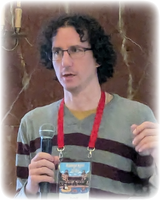
Tomáš Šedovič is a program manager at the Rust Foundation. He co-leads the goals team, which helps organize the Rust project's overall goals, including making sure that the people who have agreed to work on one have the support they need. At Kangrejos 2026, he provided an overview of the Rust project's goal processes aimed at ensuring that the Rust for Linux developers were aware of how the project organizes, tracks, and amends goals. The Rust for Linux project has inspired several current project goals, so he thought that getting an inside view of the process might be helpful.
The Rust project's goals are one of several entry points to making changes in Rust, Šedovič said. If someone wants to make a change and knows how, they can just talk to the relevant team and do it. If someone wants to make a change, but they don't know where to start or who to talk to, that's where the goals team comes in. They will take a proposal, work on it in collaboration with the submitter, bring it to the right people to make the change, and follow up to make sure everything stays on track.
The initial proposal can be anything: a feature, refactoring in the compiler, test coverage, performance work, etc. Most goals are for specific features, but they don't have to be. Once the proposal is written up, someone needs to commit to doing the actual implementation work. Often, that is the proposal author, but sometimes it's another contributor to the project. Occasionally, getting someone to agree to do the implementation requires being able to fund their time. The goals team has recently started connecting people with proposals that need funding to donors who are interested in seeing that work done.
Proposals, funding, and in-progress goals are all tracked on the Rust goals web site. Some of the goals are also bundled together into "roadmaps", which are collections of related goals. Goals are supposed to be self-contained and take no more than about a year. Roadmaps are longer-term plans, such as enabling the Linux kernel to build with only stable language features. In 2024, the Rust for Linux project introduced a single Rust project goal. Since then, the ambition has expanded, and there are now thirteen listed goals as part of the Rust for Linux roadmap.
Šedovič briefly demonstrated the layout of the goals website, showing the list of goals in search of contributors, the list of goals looking for funding, and the complete list of all goals. Miguel Ojeda compared this last list to the C++ committee's list of papers, for anyone more familiar with the C/C++ development model.
Goal!
Šedovič then shared a brief progress update on all of the current Rust for Linux goals. He started with the field projections goal, which he called a good example of a well-written goal. Each goal is supposed to be assigned to a specific point of contact, in this case Benno Lossin, who is responsible for ongoing updates. Goals can also have a dedicated Zulip channel for discussion, and one assigned "champion" on each of the involved teams. The field projections goal needs changes to the language's definition, the type checker, the compiler itself, the libraries, and the operational semantics of the language; therefore it has an assigned champion from each of those teams.
The actual work on the goal itself has largely been mapping out the possible design space. Lossin promised to discuss it in his later talk, so Šedovič skipped most of the technical details. Tyler Mandry had also described some of the finalized design at RustConf the previous week.
The next goal discussed, arbitrary self types, was a bit less far-reaching. Currently, methods on Rust types can receive a reference to the value that they are called on as a built-in reference or a built-in smart pointer type such as Box or Rc. The arbitrary self types effort, which is being led by Ding Xiang Fei, seeks to extend that capability to arbitrary user-defined smart pointers. In the kernel, that could make it easier to define convenient APIs that access resources while taking a lock or using read-copy-update (RCU) protection.
Another small change is better in-place initialization. Currently, all structures in Rust are allocated on the stack, even if they are then immediately moved into the heap. That is suboptimal, since it can result in stack overflows when allocating large structures, especially in the kernel, which uses a smaller stack. While it is possible to work around in most cases by filling a slice of memory with zeros and type-casting a pointer to it, it would be nice to have built-in language support, as C++ does. Alice Ryhl is working on that goal.
The concept of an immovable type might also be something that Rust can steal from C++. All Rust types can be moved by directly moving their bytes, except for types wrapped in Pin. That wrapping has always been something of a hack, and makes many interfaces dealing with pinned structures more complicated than they have to be. The immovable types and guaranteed destructors goal encompasses the work necessary to implement a new Move auto-trait that can be opted out of to mark a type as not movable.
The const traits, full const generics, and supertrait auto-implementation goals are all intended to improve the flexibility of Rust's type system. They would, respectively, allow for using trait implementations at compile time, a limited form of dependent typing, and easier backward-compatible changes to trait hierarchies. Ojeda said that the kernel would make good use of all of them, since the ability to safely generate specialized code at compile time is generally useful in a kernel context.
The final goal that Šedovič brought up was the one that started the whole set of Rust for Linux goals: stabilizing the unstable compiler features that the kernel's build relies on. Ojeda then directed people to the tracking document where he keeps abreast of these shared goals on the kernel side, and asked Šedovič if he had any idea how long it might take to work through the existing Rust for Linux goals.
Šedovič did not think that it was possible to say for certain, but said that
he's "seen a massive amount of progress
" since he started working on the
goals team. "Field projections, in-place initialization — those are really
hard problems, but people have really been getting into it.
"
But it's promising, he said, that many of these language changes that were
originally requested by the Rust for Linux project are now also being requested
by the Python contributors who are attempting to bring Rust to CPython. It has been
pleasant to be able to say "oh, we're already working on all of these
things,
" Šedovič said. The fact that two big C projects are requesting the same
features, and pooling resources to work on them, suggests that Rust will be
well adapted to integrating into existing C projects once the current goals are
realized, he concluded.
[ Thanks to the Linux Foundation, LWN's travel sponsor, for assistance with traveling to Kangrejos. ]
| Index entries for this article | |
|---|---|
| Conference | Kangrejos/2026 |