

The year in Plasma and what's ahead
A lot has happened in the KDE Plasma desktop environment in the last year. Marco Martin, a KDE contributor who spends most of his time working on Plasma, took the stage at Akademy 2026 in Graz, Austria to give an update on Plasma's major new features, some of the minor-but-interesting ones, and a preview of what's coming soon. The biggest upcoming change, dropping X11 support from Plasma, has been well-advertised; but there are also plans afoot to further improve remote-desktop support and more.
Numbers
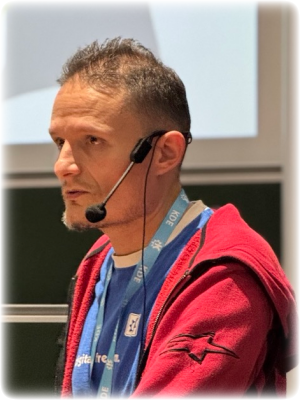
Martin was introduced as being one of the contributors who has been active in Plasma development for the longest time. He began contributing, according to this interview, in 2007. But he was not at Akademy to talk about his work from days gone by on projects like Plasma Netbook; he wanted to focus on the last year of Plasma development, and how much had changed since the Akademy 2025 conference.
In that time, he said, there had been "roughly four point releases
"
that he was going to talk about: Plasma 6.4, which
was released in June 2025, through Plasma 6.8. That release is due in mid-October to
coincide with KDE's 30th
anniversary. The first beta for 6.8 was announced on
September 10.
He started with "some boring numbers
" to provide a quantitative
overview of how much work had happened since last year. Martin led with the
number of bugs that were addressed: a total of 5,286 bugs reports were closed as
"RESOLVED", but that includes duplicates, invalid bugs, and so forth. In total,
there were 1,681 bugs that were closed with the "FIXED" status. Those, of
course, were the bug reports where contributors agreed there was a problem and
were able to solve it.
Martin said he had used the GitLab API to gather the number of merge requests
that had been created over the past year in five project repositories under
the Plasma group: KWin, Plasma
Workspace, Plasma
Desktop, Discover, and Union. There are many other
repositories under the Plasma group, but those were the ones Martin felt were
most representative of Plasma development overall. In total, there were 7,903
merge requests. The KWin window manager for the Plasma desktop received the most attention,
1,847 merge requests, "because it's a very central part [...] if it doesn't work, your
screen is not displaying anything
".
The Union style engine for KDE applications was at the bottom of the list, with 261 merge requests—but that number may be deceptive. Union is a relatively new addition to KDE; Arjen Hiemstra introduced it in early 2025, and the styling engine first shipped with KDE 6.7. Martin said that Union was important in solving the problem of providing a coherent visual interface for all Qt and QML applications. He noted that it had received a lot of attention over the past year, with many user-interface and usability improvements, as well as work to improve its performance. Hiemstra's May update gives a good overview of the work that had gone into Union just prior to its inclusion in Plasma 6.7.
Out of the 7,903 merge requests that were opened, a total of 6,556 were accepted, or
about 82%. However, Martin warned that he was starting to see "an increase of
purely LLM-generated merge requests
" where it was clear that the description
and code were entirely LLM-generated "and the person that is submitting it
doesn't really know what the patch does
". He said that it's "not that
many
" yet, but he felt that there was a need for an explicit AI policy so
that maintainers had guidelines they could rely on and point potential
contributors to. Nate Graham had started work on such a policy, but it appears
that has been abandoned after
the policy became a lightning rod for online criticism. Whether he, or
another KDE contributor, will pick that up again is unclear.
What changed?
"Those were just numbers
", Martin said; he wanted to look at some of
the new features that had been introduced in Plasma and KWin and had chosen
"a completely arbitrary
" set of changes, starting from Plasma 6.5, to
talk about. Plasma has long had light and dark themes; the 6.5 release
introduced the ability to have the theme change automatically so that the light
theme would be used during the day and the dark theme used at night. Users can
configure the transition to happen automatically at sunrise and sunset based on
the device's location, or choose the time of day to switch from dark to light
and back again.
Another improvement that made its way into 6.5 is clipboard sharing between
the local and remote desktops when using the remote-desktop protocol (RDP). So,
for example, a user can copy text on their local desktop session and paste it
into an application in the remote session. Martin mentioned that there were
"many little paper-cut fixes
" as well, such as visual improvements for
the Sticky Notes widget, several updates to the Folder
View widget, and more.
The KDE clipboard added a feature that allows users to create a QR code for sharing text to a mobile device; after copying text to the clipboard, a user can select "Show QR Code" and then scan the code with their phone or other mobile device to copy the text to the mobile device's clipboard.
New keyboard
The first change that Martin discussed in Plasma 6.6 was the
official release of Plasma
Keyboard, a virtual keyboard for touchscreens. It replaced the "aging
and not well maintained
" Maliit Keyboard
that KDE had been using. "So now we have an in-house virtual keyboard that we
can improve as much as we want.
"
Plasma has a number of clock widgets for users to
choose from. In the past each clock widget had implemented similar features
independently, but 6.6 introduced
a new libclock library that helped to reduce the amount of code duplication,
which Martin was happy about. "I really love when merge requests have more
red lines than green lines. That's the best merge request.
" Users will also
be likely to appreciate another removal: Plasma's system settings will no longer
display a KDE
Configuration Module (KCM) page for hardware that is not present. Previous
releases of Plasma would display, for example, a Thunderbolt settings page even
if a system did not have the accompanying hardware—which could be
confusing for users.
The addition of the Union styling engine in 6.7 will make it much easier for
developers to work with styles without having to use Qt's QStyle to implement
themes. "It's just a horrible experience to code. It's thousands of lines of
C++, no thanks.
" Instead, developers can style Plasma applications and so
forth using CSS. Martin gave a shout out to Akseli Lahtinen who
"suffered through the pain of doing a QStyle that understands Union themes so
nobody else will have to touch QStyle anymore
".
Martin also touted, once again, many paper-cut fixes in 6.7 such as better auto-hiding for panels when using multiple screens. The new virtual keyboard gained more granular controls, he said, so that users can configure it to only appear if a device is in tablet mode, or to appear when using a touch screen or a mouse.
6.8 is coming
There has been a lot of work for 6.8, he said, the first highlight of the
upcoming release was "not a thing we added, but a thing that we removed: X11
support is going away
". The audience applauded at some length after Martin
said that. This should not come as a surprise, as it was announced
by the Plasma team in November 2025. Martin said that the removal of
X11-specific code will simplify maintaining Plasma's panel, taskbar, and other
features, "which will also hopefully mean [they will be] much less buggy, a
bit faster, and all of that
".
"We also saved some microseconds in loading wallpapers
", he said,
"which actually matters because you could have three screens with three 4K
wallpapers
". Faster loading of wallpapers means that Plasma will start more
quickly. The rollout of the Union styling engine continues in 6.8 with support
for Qt widgets. "It's still not perfect
", Martin said, but it's getting
there. He thought that Plasma's default theme, Breeze, could be entirely
Union-based within one or two releases.
Something that will not be visible in the 6.8 release, but will pay off
later, is work to port many of Plasma's KCMs to the Kirigami user-interface
library, or Framework
in KDE parlance. When all of the KCMs have been ported to Kirigami components,
he said, it will be possible to do a "big restyle all at once
" to offer a
more modern look for configuration modules used in KDE's System Settings
application and elsewhere.
Martin also sped through a few new features that had appeared in KWin over
the past year or so. He noted there had been "much improvement
" in its
screen-mirroring features, though he did not go into detail. In the 6.6 release,
KWin gained the ability to allow virtual screens that are only shared on remote
desktops, which allows for different color depths, refresh rates, and so forth
for virtual screens that only appear via an RDP session.
A big thing that has been missing in Plasma on Wayland, he said, is the
session-restore protocol; this is something that many X11 users were
particularly attached to, and finally appeared in the 6.7 release. "Now, when
you log out from Plasma, you can say 'save all my windows'. In Wayland we
couldn't do that, now we can.
"
KWin 6.7 also added the ability to switch virtual desktops independently
from one screen to another; prior to that release, switching of virtual desktops
was always synchronized across all monitors. "It has been the one feature
that I've the seen most people happy about.
" He said that the "various
Linux YouTubers
" were all talking about it, "so that's good, since it
makes many users happy, apparently
". He added that KWin had also seen
"some improvement
" in support for multiple GPUs, which would be useful
for laptops that have both Intel and NVIDIA GPUs.
Questions
Martin left a good amount of time for questions. One attendee asked him what
he thought the top pain points were for users of Plasma. Martin said that one
would be "still a bit of a look of complexity
" in some areas. He said
that the defaults for Plasma and major applications like Dolphin were good, but if a user went
into their settings to change defaults "all the complexity is all of a sudden
thrown at you at once, still
". He wanted to make it easier for users when
they are "slightly outside the default
". He added that multi-screen
setups were still not "perfect, perfect, perfect
".
Another audience member wanted a concrete example of how removing X11 had
made Martin's life easier. Martin said that there was a great deal of
complexity, for example, in the Plasma panels. "We had two
completely different code paths for managing the positioning, the auto-hide, and
whatnot on X11 and Wayland
" that amounted to two completely different
implementations of the same features which meant the code was "very not
elegant
". He also raised multi-monitor setups and managing screen
configuration changes as complex with different code paths. "Only on the
Wayland one could we do a nice, very reproducible autotest. The X11 one was a
bit YOLO. So all that code is dead now and I'm very happy.
"
The video of the talk is available on media.ccc.de. The slides have not yet been published.
[I would like to thank the Linux Foundation, LWN's travel sponsor, for its assistance with my trip to Graz, Austria for Akademy 2026.]
| Index entries for this article | |
|---|---|
| Conference | Akademy/2026 |
The LWN site is currently under high scraper load, so comment display has been suppressed for anonymous users. If you are a human, you may read the comments by clicking the button below:
Note: you can avoid this step in the future by logging into your LWN account.