

LWN.net Weekly Edition for September 24, 2026
Welcome to the LWN.net Weekly Edition for September 24, 2026
This edition contains the following feature content:
- Looking forward to Git 2.56 — and 3.0: new features in the latest Git release, and the roadmap beyond.
- Compiling the kernel with gccrs: the status of the gccrs project and a look at the work still needed to compile the kernel.
- Testing compat_linux on NetBSD with the Linux Test Project: using Linux's own test project to test NetBSD's ability to run Linux binaries.
- Thread-identity switcheroo for io_uring: a somewhat radical, maybe even scary, solution to a maintaining io_uring's "never blocks" guarantee.
- Ideas on modernizing the open-source desktop: Scott Jenson wants open source to take the lead on updating the desktop experience.
This week's edition also includes these inner pages:
- Brief items: Brief news items from throughout the community.
- Announcements: Newsletters, conferences, security updates, patches, and more.
Please enjoy this week's edition, and, as always, thank you for supporting LWN.net.
Looking forward to Git 2.56 — and 3.0
The Git source-code management system is at the core of development processes worldwide, so changes, especially incompatible changes, are of great interest to the developers involved. The Git 2.56 release, which can be expected around the end of September, is currently available in release-candidate form. It is not the most earth-shaking of releases, but the one that follows, which might be the long-awaited Git 3.0, may well be.
What's in Git 2.56
The Git 2.56 release contains something over 700 non-merge commits; it brings a number of nice improvements, but will not fundamentally change the Git experience for most users. One feature that offers some potential in that regard is the addition of the drop subcommand to the (still experimental) git history toolbox:
$ git history drop commit-id
This command will cause the identified commit to be removed from the history of the current branch, replaying all commits that were added after it. It offers an easier way of removing an offending commit. Unfortunately, it still refuses to work if the history contains merge commits, making it unusable for many (or most) repositories.
The git status command will now suggest a git pull command to update a branch that is behind the branch it tracks. It still, though, will say that a branch is "up to date" even if it lags behind an (unfetched) remote tracking branch.
The git refs command exists to manipulate references at a low level; in 2.56, it has gained a number of new subcommands. Those commands, create, delete, update, and rename, perhaps surprisingly for Git, do exactly what their names suggest they would.
There are a number of minor usability tweaks. The new --delete-merged option to git branch will remove local branches that have been merged into their remote tracking branches. An attempt to delete a branch with git branch -d will fail, with a useful message, if that branch is being used for bisection. Attempts to lock the configuration file will be retried on failures, avoiding annoyance when multiple commands try to modify the file at once. git add has a new --resolved option that only adds files with merge conflicts that have been resolved.
Beyond that, there is the usual long list of bug fixes, refactorings, and performance improvements. All told, 2.56 looks like a solid release, but it also shows the signs of a project that is holding back much of its more significant work for the future. That leads to the question of what comes next.
After 2.56?
In early September, Git maintainer Junio Hamano asked the community what the next release should be. Would it be best to put out the 3.0 release that the community has been working toward for some time, finishing the year on a high note? Or, instead, is there a need for one or more 2.x releases still before the 3.0 release can happen?
This is an important question, because 3.0 will contain a number of compatibility breaks that may make some users pause before upgrading. Of those, perhaps the most significant is the switch to using the SHA-256 hash function by default, rather than the SHA-1 hash that Git has used since the beginning. SHA-1 has long been deemed to be weak, which is worrisome for applications like Git. Hashes are used to identify every object (files, directory trees, commits) in the Git repository, and are used to verify the chain of commits leading to any given point. If SHA-1 can be broken, it can conceivably be used to modify the history of a repository in ways that are difficult or impossible to detect.
Git has long included defenses against the known SHA-1 attacks, and few people appear to be seriously worried about the potential for compromised repositories now. Still, it makes a lot of sense to move to a more secure hash function.
Non-experimental support for SHA-256 has existed in Git since the 2.42 release in 2023, though some of the glue for interoperating with older repositories has taken longer. The biggest concern that has kept the Git developers from moving to SHA-256 by default for some time now has been support (or the lack thereof) at the major forge sites. GitLab has had support since 2024, and Forgejo has support as well. The elephant that is still missing from this room, though, is GitHub; releasing a version of Git that creates GitHub-incompatible repositories is a worrisome prospect. It still is not clear when GitHub might add that support, but it is notable that brian m. carlson, a GitHub employee and a key developer behind the SHA-256 transition, responded to Hamano's question by saying that news on that topic was coming, and that having the next release be 3.0 might be the best choice.
That said, carlson has posted one other change that they would like to see added before 3.0 comes out. While Git has always managed hexadecimal numbers (specifically, object IDs) as lower-case strings, it has also accepted upper-case IDs. That leads to situations where two seemingly different IDs (f00f00 and F00F00, say) are actually the same. Seemingly, bugs and security vulnerabilities have arisen from this ambiguity. So carlson wants to change Git's behavior to only accept IDs in lower case. That is a change that, seemingly, should not cause problems for too many users, but there is almost certainly somebody somewhere who relies on that behavior.
Another significant change that has been waiting for the 3.0 release is the switch to the "reftable" mechanism. A reference (more commonly "ref") in Git is an association between a name and an object in the repository; branches, tags, and remotes are all refs, for example. Git currently (by default) stores each ref as a file under .git/refs/ in the repository. If a repository contains a branch called foo, there will be a file, .git/refs/heads/foo, containing the ID of the commit at the head of that branch. There is also a mechanism to pull all of these refs together into a packed-refs file, which increases performance — to a point.
This mechanism works, but becomes increasingly inefficient as the number of refs grows. In some projects, the number of refs does indeed grow. According to the project's reftable documentation, the Android repository contains over 800,000 refs. At that scale, looking up refs, or determining whether any refs pointing to a specific commit exist, can be an expensive operation. Slowing down development can be a yellow-card-level annoyance, leading to a desire to do something about the refs.
The Git 2.45 release added reftables as a more efficient way of storing refs. It is a binary file optimized for both space efficiency and quick access. Since then, it has been possible to create a repository that uses a reftable rather than the old file-based mechanism, but that has never been the default. Switching to reftable should have no visible consequences (other than better performance) for users of Git itself, but it can be a problem for users of other software packages that access Git repositories. In his email, carlson mentioned libgit2 as a potential concern.
As it turns out, libgit2 will not be a blocker here; Patrick Steinhardt let it be known that he has added reftable support to libgit2, and that SHA-256 support had been enabled by default in August. So libgit2 should be ready for the Git 3.0 transition.
Finally, as mentioned by carlson, there is the Rust question. The project has added some trial support for code written in Rust, but has hesitated to make Rust mandatory for the building of Git. That, too, is expected to change in the 3.0 release; after that, any platform that does not have a working Rust compiler will be unable to upgrade.
After listing these concerns, carlson suggested that they probably should not hold up the 3.0 release:
I think anyone else who is not already extremely far along on SHA-256 (and reftable, for software working with local repositories) is likely not worth considering. JGit and Gitoxide were both informed that SHA-256 was coming in Git 3.0 at least a year ago, for instance. (I know because I did the informing.)Similarly, I am not aware of anyone who is seriously undertaking Rust support for platforms that do not already support it, so I don't think that should be a blocker, either.
That led to their conclusion that, most likely, designating the next release as 3.0 would be the best choice.
What will actually happen has not, yet, been announced publicly; that is
waiting for Hamano to make a decision. As he put it: "this is not a
popularity contest, nor is it even a democracy
". In the nearly two
weeks since his query was posted, though, there has been no strong
opposition to moving into the 3.x era and leaving some of Git's early
design decisions behind (though, naturally, repositories using SHA-1 and
lacking reftables will continue to be fully supported). If the 3.0 release
does not happen in 2026, it seems certain to show up shortly thereafter.
Update: at Kernel Recipes, Steinhardt described the plan that had been agreed to regarding releases. The December 2026 release will be called 2.98, as a signal that the 3.0 transition is coming. The 2.99 release will follow in April 2027; that will be a long-term-support release. Git 3.0 will also be released at the same time, and will be the base for all subsequent releases.
Compiling the kernel with gccrs
Pierre-Emmanuel Patry and Arthur Cohen gave a talk at RustConf 2026 on the status of the Rust frontend for GCC (gccrs), with a particular eye toward the goal of compiling the Linux kernel. Patry gave a follow-up talk for a more kernel-focused audience at Kangrejos the next week, which Cohen could not attend. The gccrs project is making good progress overall, but it will still be some time until the compiler is usable.
Cohen began the RustConf talk by stating that the title of the presentation,
"Compiling the Linux kernel with gccrs", was a lie. Gccrs cannot currently
compile the Linux kernel, for multiple reasons. One such reason, Cohen said, is
that he and Patry were laid off and couldn't dedicate all of their time to
gccrs — although
Open Source Security has since picked up their contracts.
Another reason, which Patry brought up at Kangrejos, was that their
current goal was really to
"miscompile the Linux kernel
". The project needs to get to the point of
emitting a binary that can be tested and validated to be said to be
"compiling" anything; almost certainly, there will be a delay between the point
where gccrs accepts the kernel's Rust code without complaint, and where the
output it produces is actually a usable kernel.
Nevertheless, the two of them have made substantial progress.

GCC is a nearly 40-year-old project, Cohen explained, that brings together compilers for a number of different languages, such as C, C++, Fortran, Go, and Algol. The gccrs project wants to add a full implementation of a Rust compiler to that list, separate from the Rust project's rustc compiler. That is important for many reasons. For example, GCC supports more backend architectures than rustc does. GCC also supports custom compiler plugins that many existing projects rely on. With Rust code now included in the Linux kernel, it would be nice to be able to compile the kernel with just GCC.
Therefore, the main goal of gccrs has been to compile the Rust code present in
the Linux kernel. That code is split into several different crates that depend
on each other, Patry explained to both the RustConf and Kangrejos audiences.
The most fundamental is
core,
which provides the "bare minimum to make Rust language features work
".
For example, for loops in Rust use the
Iterator trait, which is
defined in core. Without core, the compiler can't support for
loops.
Other crates within the kernel include stdarch, which provides architecture-specific operations, alloc, which handles memory allocation, pin_init, which handles creating immovable structures, and others. When gccrs started, Patry said, he and Cohen began by trying to compile small snippets of Rust code in isolation. That approach has reached its limits, so the plan now is to focus on making core work, and then move up the dependency graph to alloc and so on, until the whole kernel compiles.
That approach has been working well, but has caused some problems with trying to parallelize the work, Cohen said. Currently, each problem that comes up with compiling core is hidden behind the previous problem, making it hard to split work across multiple contributors. To address that, Patry and Cohen made a mock version of the core library with only the parts needed by alloc, so that getting that crate to compile could proceed in parallel.
The core library is "really complicated
", Cohen added. In many
ways, it is the strangest Rust library, since it needs to do so many low-level
operations that other code doesn't need to address. The hope is that once gccrs can
compile core, it will be able to handle most Rust code, and any
remaining libraries will be easy to support. "Maybe I just tell myself
that,
" Cohen added, to general chuckles. The alloc crate also
uses some complicated features, such as
arbitrary self types, but the version
used in the kernel is simpler than the one used in the standard library, so
Cohen is not too worried.

The project will eventually need to get the standard-library version working, however. There are two kernel crates that use procedural macros, Patry said, which are Rust code that is called during the compilation process, and can link against the standard library. So, even though the kernel itself does not link the standard library, gccrs will still need to be able to build it in order to compile the kernel.
At Kangrejos, Miguel Ojeda asked whether it would be possible to use procedural macros compiled by rustc, as a temporary workaround until the standard library is usable. Patry wasn't sure, but thought that it was theoretically possible. He was leery of disrupting the ecosystem by introducing strange incompatibilities between procedural macros and the code they generate, however. Ojeda opined that a workaround that gave the kernel access to gccrs a bit earlier would be useful for testing gccrs and finding problems. He then went to check on the use of the standard library in procedural macros in the kernel, and reported a few minutes later that the only uses are via the syn crate, and a single use of a BTreeSet that could probably be replaced.
Gary Guo thought that Ojeda was overlooking the complexity needed to support
allocation, however, which is used implicitly by procedural macros. Once
allocation is working, "you probably also get B-Trees for free
," he
remarked. Patry said that he hadn't spent much time looking into getting
procedural macros working, since he and Cohen had been focused on the core
crate. Maybe some additional thought will find a way to make it work, he suggested.
Compiling core
Cohen went into more detail on what has been involved in getting
core to compile. For the past three years, he and Patry have mostly been
working on fixing name resolution, the process of linking uses of names to their
definitions. The initial implementation was simple,
"like how a textbook compiler does name resolution
". That implementation
proved to be fundamentally flawed, however, because Rust's name resolution is
quite complex. There are multiple separate namespaces (for functions
and constants, types, labels, and lifetimes), and name
resolution sometimes has to cross between them. Additionally, names can be used
before they are defined.
Names can also be defined by macros, which themselves rely on being able to
resolve names. Therefore, name resolution and macro expansion have to
run interleaved with each other, in a
fix-point fashion that repeats the process
until all names have been discovered. Cohen originally told his boss that this
work would take three weeks. Patry and Cohen finished it just before RustConf, nearly
three years later. Despite the delays, name resolution is now working correctly,
as is declarative macro expansion.
It is not particularly fast, but "that is a problem for future Arthur
".
At Kangrejos, Patry went into more detail on the performance problem. The
core crate is roughly 85,000 lines of code, and gccrs used to take about 42
minutes to compile it. The crate does rely heavily on macros, but most of the
time is spent in name resolution. Because name resolution runs until it
reaches a fix-point, the compiler makes many of the same calls. Adding a cache
for those calls brought the time required to compile core down to three
minutes (compared to rustc's 30 seconds),
which is "not as fast as rustc, but fast enough to work with
".
The other tricky parts, such as inline assembly support, and the lang items system, are mostly working. At this point, each individual bug that the gccrs developers work on could be the last one standing between gccrs and compiling core.
There is still a known problem with passing crate metadata between compilation units, Patry added. Right now, the serialization format for crate metadata is a dump of the crate's abstract syntax tree. That's a temporary hack, he explained, which is working for the moment but that will need to be cleaned up to do cross-crate linking correctly.
Next steps
Cohen then explained some of the next steps for the project. Another known problem is the handling of the Drop trait, which is used to automatically clean up allocations at the end of their scope. Janet Chien, a Google Summer of Code (GSoC) participant working with the gccrs project, has been focused on improving that part of the implementation. When she started work, gccrs did not implement drops at all. Now, it has support for common cases, but can still be tripped up by nonlinear control flow, partial moves, generics, and temporary values. Enes Çevik, another GSoC participant, has been adding infrastructure for compiling and testing the alloc crate.
Once gccrs can compile all of the crates used by the kernel, the next step will be to catch up to stable Rust. For the last several years, gccrs has been targeting parity with rustc version 1.49 and a matching old version of the kernel. The project chose to do that to avoid chasing an endlessly moving target while trying to get basic functionality working at all; eventually, however, it will be time to chase that target. Patry is not too worried about the process of catching up. Most changes to the language come in the form of new library functions and types, and stabilization of existing unstable features, which Cohen expects should be trivial to support.
There are three features in particular that do represent actual changes to the language itself that will have to be dealt with, which Patry called out for the RustConf audience: trait upcasting, the new use<...> syntax, and return-position impl Trait in traits. There is also one additional experimental feature, cfi_encoding, which the kernel uses when generating bindings between C and Rust code. That will be slightly tricky, Patry explained, because it requires changes to GCC's control-flow integrity (CFI) code. There is an existing patch series addressing that, but it has remained unmerged since its introduction in 2025. The gccrs developers may need to work with the rest of the GCC maintainers to figure out whether that series is acceptable and how to get it merged.
After that, the project will have to test kernels compiled with gccrs to ensure that the behavior exactly matches that of binaries compiled with rustc. Since the kernel is not even compiling yet, Patry and Cohen haven't begun major work in that direction, but they have taken a few preliminary steps.
One audience member at RustConf asked whether gccrs implemented any of the intermediate representations that rustc uses. Patry said that it did not — although since the project hopes to reuse the implementation of the next-generation trait solver, the code may eventually have to produce an intermediate representation suitable for that.
Another person asked how well documented the Rust language specification is, and how that affected the validation of gccrs. The specification is not enough to fully implement a compiler, Cohen said, but that isn't the fault of the people working on the specification. The upstream rustc developers are productive, with new features coming with each version of the compiler. Patry and Cohen have tried to improve the specification where it is lacking, which is another benefit of having an independent reimplementation of the language.
[ Thanks to the Linux Foundation, LWN's travel sponsor, for assistance with attending both RustConf and Kangrejos. ]
Testing compat_linux on NetBSD with the Linux Test Project
NetBSD has long had support for running Linux binaries via its kernel-level compat_linux feature, but test coverage for it was less complete than some might hope. In order to provide better testing for compat_linux, Google Summer of Code (GSoC) participant Henrique Brito opted to work on enabling the Linux Test Project (LTP) test suite to compile and run on NetBSD. At EuroBSDCon 2026, Brito's mentor, Stephen Borrill, provided a report on the project, and the status of LTP on NetBSD. The work has already resulted in some minor fixes, and a good list of additional problems to solve.
I did not attend EuroBSDCon 2026 in person, but had the opportunity to watch Borrill's presentation shortly after it was live-streamed. The video is available along with the other EuroBSDCon 2026 videos on a PeerTube instance, and the slides are linked from his web site.
Borrill, who has been a NetBSD developer since 2007, said that he runs a company that develops thin clients and servers based on NetBSD. Many thin clients need to access virtual desktops using a proprietary Independent Computing Architecture (ICA) application from Citrix. There is no NetBSD-native version of this client, but there is a Linux version that will run under compat_linux, and Borrill maintains its package for the NetBSD Packages Collection (pkgsrc), which is a repository of third-party software.
He ran into a new version of the ICA client that would not run under compat_linux. Instead, it would fail with an ENOSYS error, indicating a system call that was not implemented. That led him to take an interest in compat_linux, and he added an entry to NetBSD's list of suggested projects for GSoC to emulate missing Linux system calls.
compat_linux
The first GSoC project did not solve Borrill's problem; that project led to a native implementation of the splice() system call that can be called by compat_linux. The ENOSYS error he had been running into was fixed separately when the timer_create() call was added; after that, Borrill said, he didn't care much about emulating missing system calls. He was, however, interested in testing linux_compat.
The original title of Borrill's talk included the phrase "Linux emulation" to
describe compat_linux,
which he said is not quite right; NetBSD runs Linux code natively, with
"virtually no performance impact
", when compat_linux is
enabled. "All we're doing is having a small shim that's making it look like
it's Linux in terms of things like system calls and how we access files.
"
The mapping of Linux system calls to NetBSD calls is defined for each
architecture in /sys/compat/linux/arch/<ARCH>/syscalls.master,
where ARCH would be amd64, i386, etc. The NetBSD
Internals documentation, though slightly dated, explains how the operating
system examines
an executable binary and determines which
kernel ABI to use.
The compat_linux feature is not enabled by default in NetBSD's GENERIC kernel,
but it is available as a module. Borrill said that "everything's been moved
to modules
" for security reasons. compat_linux
translates Linux system calls into NetBSD system calls and looks for any shared
libraries that the application depends on in a "shadow root" directory under
/emul/linux (or /emul/linux32 for 32-bit applications). For
example, if a Linux binary tries to open /usr/bin/ldd, then NetBSD will first
look to /emul/linux/usr/bin/ldd before falling back to
/usr/bin/ldd.
As one might expect from NetBSD, compat_linux has support
for quite a few architectures, including 32-bit and 64-bit
applications for both x86 and Arm. Borrill noted that NetBSD also
includes support for running FreeBSD, SunOS, and Ultrix binaries and
"used to support a lot more, you know, a really crazy
amount
". However, the need to run many of the other operating
system's binaries has slowly died away—as well the hardware
needed to run those binaries in numerous instances.
Testing compat_linux
NetBSD has a native testing framework called Kyua, but it does not have extensive
coverage for compat_linux. Rather than trying to add that support into
NetBSD's regular test suite, Borrill thought the project might be able to build
LTP for NetBSD and use it instead. He noted that LTP has tests for "all sort
of things; but for the moment we're only looking at the syscall side of
it
". He said that consists of about 376 collections of tests with about
1,300 tests in total.
The first decision was how to build LTP; rather than trying to cross-compile it, Brito and Borrill opted to build it with a Linux version of GCC under compat_linux instead. They chose to use the SUSE 15.5 compatibility package from pkgsrc, created a Linux compatibility package for GCC 12 and uploaded that to pkgsrc. Once the test suite was running, he said, they noticed that most of the tests that were run passed, but many were being skipped.
Brito thought that it would turn out to be a boring project if everything passed; Borrill looked into it and noticed that Brito had started with NetBSD 10.1. That release has a compat_linux that presents itself as Linux 3.11, which was released in 2013. Obviously, quite a bit had changed since that kernel was released; the SUSE 15.5 packages for NetBSD, for instance, expect Linux 5.14.21. Testing system calls that were added since 3.11.6 would certainly increase the odds of finding problems as well as help to ensure that more Linux applications would work.
Borrill said that they could just change the configuration to declare a different version of the kernel for compat_linux, but it was decided that a better fix would be to use NetBSD 11, which has a compat_linux that declares 6.3.10 as the Linux kernel version, even though NetBSD 11 had not been released yet. However, the fourth release candidate of NetBSD 11 was available, and the final release was announced on July 30, about two months after the start of coding for this year's GSoC.
Not surprisingly, they also had to skip some of the tests because of features that were not available on NetBSD. For example, Borrill said that LTP attempts to test filesystems that NetBSD does not support, such as Btrfs and XFS, so they restricted the tests to ext2, ext3, ext4, and tmpfs. Ultimately, Brito created a manager script (compat_linux_test_project) to handle running LTP against compat_linux. It accounts for the differences between NetBSD and Linux to compile LTP properly, run tests, and skip tests known to (for example) hang or panic the kernel. They also decided to package the work for others to use with an eye to publishing it via pkgsrc. It is not yet merged into the official pkgsrc tree, but it is currently available in the emulators/compat_linux_test_project directory of Brito's pkgsrc fork on GitHub.
Borrill suggested that they try compiling everything statically, rather than
dynamically, so that there would be no additional requirements "like all the
Linux libraries and things like that
". The package came out to about 80MB in
size when compiled dynamically, but when built statically it turned out to be
about 5.1GB. "I built this while I was down at the pub and I had time to
order and drink a whole pint while it was just trying to build the package into
a tarball at the end.
" That is probably a no-go, he said, but the option to
compile everything statically is still available for anyone who wants it.
It takes about 25 minutes to run all of the tests, but the script allows users to specify which system calls they would like the test to avoid having to re-run the entire batch. For example, this command would test the readv(), writev(), open(), and close() system calls.
$ compat_linux_test_project -s readv, writev, open, close
The script also has options for users to re-run tests and compare them
against previous. "We've also included a sort of default
baseline of what we believe the current state of affairs is, so you can just
compare the run on your machine with the defined baseline we already have.
"
Failure types
linux_compat has implemented most of the Linux system calls "in
that you can generally have a first stab at taking a Linux binary and expect it
to work
", Borrill said. The ways that it doesn't work, though, are
interesting and varied; there are many types of failure that might present
themselves.
The easiest ones to deal with are features where it's known that "it's not
supported and we don't care about that
". Likewise, some system calls will be
missing entirely; for example, NetBSD does not support any of the system calls
related to Linux namespaces. Later in the talk, he mused that the missing
namespace system calls would be nice to have for NetBSD but, "definitely
outside the scope of a GSoC project
".
In some cases, a test may exercise a system call supported by
compat_linux that "might look right on the face of it
" but fail
because of a Linux-specific flag that is not supported on NetBSD. In other cases
failures may turn up something that NetBSD just hasn't implemented yet, or it
could be "something that only makes sense within the Linux world
".
There are also environmental variables and configurations to
consider when running LTP on NetBSD; Borrill noted that
LTP looks for the .config file for the Linux kernel to see what to run, but since
compat_linux does not supply a kernel, it also lacks a
configuration file. Brito's script takes care of supplying the appropriate
.config so that LTP skips unsupported subsystems and operations. The
last type of failures he mentioned were the exciting ones "where everything
crashes, machines die, all those sorts of things
".
Examples
He then cited some specific examples, such as lseek() which has two flags that are not implemented: SEEK_DATA and SEEK_HOLE. That caused the test to stop early, so it did not flag later tests as failed.
Many of the file-open tests failed because compat_linux did not support the open() system call's O_TMPFILE and O_PATH flags. A fix for that, he said, might be to actually implement those in the NetBSD kernel so that compat_linux inherits them natively. Another option, for things that would not be useful for NetBSD, would be to implement it only within the compat_linux layer. An example of that is the rt_sigqueueinfo() system call used to send a signal and data to a process; that is only available via compat_linux.
One of the interesting failures, he said, was that the behavior of Linux
diverges from BSDs when iovcnt = 0 is passed to writev(). The
BSDs, he said, return EINVAL as specified by POSIX—Linux returns
"0" instead, indicating that, as requested, no data was transferred. "The tests were failing, but by all the specs, we were
doing the right thing. And that's because zero is an invalid value, and so we
were returning EINVAL.
" That would not be implemented natively, but could be
implemented in compat_linux in two or three lines to "sort of be
bug-compatible
" with Linux.
But does compat_linux always need to be bug-compatible? He
pointed out that LTP's tests for setsockopt()
and shmat()
look for known Linux bugs that are not present in NetBSD. "So what
do we do with those? Do we just ignore them? Or do we need to be
bug-compatible like we were with the
writev() one?
"
One test failure that was discovered had "a certain sense of
irony
", he said, because it was related to a system call added in
a previous GSoC. The call copy_file_range()
causes a kernel panic on NetBSD when off_in or
off_out, which give the target ranges to copy from a file and
to a file (respectively), are not NULL; the call should
support non-null values for the file offset. It was simple, and the
fix has already been committed to NetBSD.
What's next?
The GSoC project focused on testing x86 and x86-64. Borrill said that one of
the obvious next steps would be to work toward testing on multiple
architectures, in particular Arm. "Some of the more esoteric architectures
we're probably not going to bother with
". Supporting Arm, however, will
require updating the SUSE compatibility packages available on pkgsrc to support
additional architectures. He said that he had not yet had time to do that, but
he thought it would be really useful and planned to "get a Raspberry Pi up
and actually give it a go
" once he was home from the conference.
As part of the project, Brito has put together a
spreadsheet of the test results of system calls considered fundamental; that
is, those that are used more often by Linux applications. Borrill said
that, because Brito had done the legwork to identify not only which system calls
were failing but why, there is now "a shopping list of tasks we can pick
up
", which may be useful not only for compat_linux, but NetBSD
itself.
Borrill wrapped up his talk by thanking Google for supporting NetBSD through
GSoC, Brito for his work on the project, and Leonardo Taccari who became
involved in NetBSD as a GSoC participant, later became a mentor, and now helps
to organize the project's involvement in the program. "He's really gone up
the management tree there. His pay grade hasn't gone up, but he's been fantastic
at organizing everyone
".
Questions
The first person to be called on said: "In the past, I remember that futex()
support was a big issue, and that it wasn't well supported in the Linux
emulation. Is it better now?
" Borrill replied that it was not; it was just
one of the things he had not specifically covered during the talk. He noted that
it was documented in Brito's spreadsheet.
Another audience member wanted to know whether compat_linux had
support for versioning when there were "different versions of the same thing,
like earlier version and later version
". For example, what if the
behavior of a system call was different between Linux 3.11 and 5.15?
Did the compatibility layer support
both versions, or just emulate the most recent version. Borrill said that the short answer
was that he didn't know; NetBSD does have system-call versioning, but "we
don't do any of that in the Linux compatibility
". It does, he added, support
two versions of SUSE binaries, with the latest being 15.5. He referred the
questioner to the spreadsheet for more information.
Thread-identity switcheroo for io_uring
The io_uring subsystem is all about asynchronous execution; applications count on it to not block — unless explicitly requested to. Within io_uring, maintaining the "never blocks" guarantee has sometimes been a challenge, given that many paths in the kernel were never designed for asynchronous execution. This problem has been worked around, but at a significant cost to performance. Now, io_uring maintainer Jens Axboe has posted an RFC patch set with a somewhat radical (and potentially scary) solution to the problem.A process in user space can submit one or more operations to io_uring by describing them in submission-queue entries (SQEs) in the submission ring, then calling io_uring_enter(). The kernel will initiate processing on all of the entries that were placed into the ring. If possible, the kernel will execute them immediately within the io_uring_enter() call. For example, if a read request can be satisfied with data that is already in the page cache and the user-space buffer is entirely resident within RAM, then the requested data can be copied immediately without blocking.
In cases where blocking is required, though, things become more complicated. Many of the I/O paths within the kernel have asynchronous support built into them; they will carry a new request as far as it can go, and finish the job elsewhere within the kernel once the blocking operation has completed. There are other operations, though, that lack this support; these include the io_uring equivalent of system calls like fdatasync(), statx(), some openat() paths (the O_NONBLOCK flag notwithstanding), and others. The io_uring code must take extra care when implementing these operations, lest io_uring_enter() block partway through processing a set of submitted operations.
In current kernels, any operation that might cause io_uring_enter() to block is handed off to a separate worker thread for execution. That allows the submitting thread to continue; the separate worker can block, if need be, without holding up anything else. This handoff is not free, though; the kernel must wake a waiting worker thread and perform a context switch, among other costs. If the operation does indeed block, those costs may not be significant in the end. In many cases, though, the operation can be completed without blocking. In such cases, the extra overhead becomes a significant part of the overall cost of executing the request. Since developers who turn to io_uring are usually doing so in search of improved application performance, the cost of avoiding blocking that might not happen anyway hurts.
One solution to the problem would be to rework all of the system-call paths in the kernel to be non-blocking. That has been done, in some cases, over the years, but it is not an easy or quick task. An alternative — the one that Axboe has chosen — is to proceed with a potentially blocking operation then handle cases that actually block without blocking the submitting thread.
Detecting operations that do indeed block requires a change to the scheduler. A new flag (PF_IO_HANDOFF) is added to the flags field of the task_struct structure that represents a thread. If a thread is about to block for any reason and it has that flag set, the scheduler will make a call to a new function called io_uring_task_sleeping(). Hooking into the scheduler in this way allows io_uring to be informed about blocking that happens anywhere in the kernel, without having to modify the actual code paths involved.
Once io_uring knows that an operation is going to block, it must do something about the situation. One option, in theory, would be to unwind whatever work had been done up to the blocking point, then to restart the operation in a worker thread. But, since this blocking can happen almost anywhere in the kernel, that is not really an option. As a general rule, once io_uring has started a requested operation involving kernel code paths that are not designed to avoid blocking, it must see that operation through to the finish.
Axboe's solution is "thread identity handoff". When the scheduler informs io_uring about a thread that is about to block, io_uring responds by selecting a worker thread from its thread pool. Rather than hand the ongoing work over to that thread (which is not possible at this point), the code exchanges the identities of the two threads. The worker thread is made to look like the original submitting thread in every way, including its thread ID, signal-handling setup, and more; that thread then continues processing the submission ring before, eventually, returning to user space. The thread that returns from io_uring_enter() has a different task_struct than the one that made the call, but everything else (hopefully) looks the same.
Meanwhile, the original thread, which was about to block executing an operation, takes on the worker thread's identity, then proceeds to block as usual. When it wakes, it will continue the operation through completion, then take its place in the worker-thread pool. The end result is that potentially blocking operations can be executed by the submitting thread and, if they can run without actually blocking, be handled entirely there. The cost of bringing in a worker thread is only paid if the operation really does block.
It sounds simple enough, but this kind of identity exchange is fraught with potential land mines. Before the two threads involved can exchange their task_struct structures, the kernel must make absolutely sure that nothing else in the kernel holds references to those structures. Otherwise, something will eventually be done with a reference to the wrong task_struct, an outcome that will do nothing to reduce the strain on all of the people trying to keep up with the stream of kernel CVEs. That is a result that is deemed to be worth avoiding.
Preventing it means being sure, before starting an operation that might block, that the submitting thread will be able to hand off its identity if the need arises. There is a long list (found in the definitions of thread_handoff_allowed() and thread_handoff_compatible() in this patch) of conditions that would prevent a handoff and require the operation to be executed in the old way. For example, if the thread is being traced with ptrace(), then the tracer holds a reference to its task_struct. By the same logic, if the thread in question is tracing any other tasks, those tasks hold references, so the thread cannot perform a handoff. Other conditions that will prevent a handoff include using perf events, having futex ownership tracked in the kernel, running under a realtime scheduler, holding a core scheduling cookie, performing a vfork(), and several others. This determination seems like the scariest, most fragile part of this series. The task_struct is widely available, so it is hard to know that all of the possibilities for possible references in the kernel have been covered — before one even begins to worry about the addition of new references in the future by developers who are not thinking about io_uring at all.
The potential payoff is large, though. The cover letter includes a number of benchmark results. For some quick, non-blocking operations, the improvements can be huge; an fsync() benchmark run on a tmpfs filesystem showed a nearly 700% improvement. Other improvements are more modest, and some of the tests that always block show regressions. The worst regressions tended to be with a higher queue depth — when there is a longer list of operations all being submitted at once. Immediately pushing each of those operations into a worker thread allows them to be worked on in parallel, while processing them up to the blocking point in the submitting thread serializes that work, slowing it down. Axboe said that he has ideas for addressing that problem, but he is unsure whether they are worth pursuing because, he said, applications that perform these operations tend not to have high queue depths to begin with.
Axboe clearly does not expect to merge this series in the near future; he
is more concerned with determining whether the overall approach has any
chance of being viable. Comments have been limited so far. Peter Zijlstra
pointed
out that one of the other conditions blocking identity handoff — if the
thread involved is running with a shadow stack — will prevent the use of
the feature on most deployed systems; Axboe thinks
that the shadow stack can be moved with the rest of the thread's identity.
Beyond that, it seems that developers are still mostly digesting this
series that, as Gabriel Krisman Bertazi said, is "really
cool and seems like very dangerous thing
". If this series can convince
developers that the "dangerous" part has been dealt with, it may eventually
lead to significantly better io_uring performance for a number of workloads.
Ideas on modernizing the open-source desktop
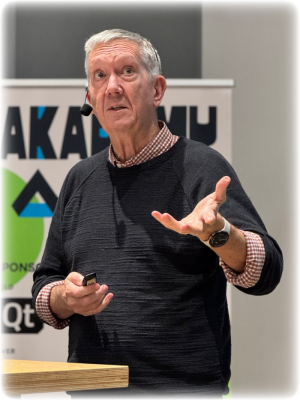
Scott Jenson has been working on user interfaces (UIs) and user experience (UX) for many years at Apple, Google, and other companies. Now, he's trying to convince open-source projects to experiment more and drive the desktop beyond the age-old "windows, icons, menus, pointer" (WIMP) model. At Akademy 2026, KDE's annual developer conference, he shared his complaints and ideas in a talk aimed at convincing those in attendance to take the lead on desktop design.
He introduced himself as someone who has been doing UX for a long time, much
of that time at Google. He said that over that time he had noticed a cultural shift,
"because back in 2005 when I joined, we weren't evil; we were really trying to do the
right thing
". He had worked on the Chrome team for a while, which he said was
"filled with people who wanted nothing but open-source, open-web
"
projects. Things had changed radically, which led him to leave Google, "but I'm
trying to atone for my sins working for these companies
".
He now does work for Mastodon and Home Assistant, "just kind of trying to
squeeze a little bit more good UX design into open source
". Jenson said he did
not want to be confrontational, but he thought that open source needs a lot of help
in the area of UX design. That is challenging, because open-source projects are
understaffed.
Innovation
He was at Akademy to discuss his ideas because he had given a talk
similar to this at Ubuntu's conference last year, which proved to be popular. "It
got more than half a million views on YouTube—which by YouTube standards is
trivial, but by Scott standards is enormous.
" That told him that the topic of
desktop UX was something that people wanted to talk about. This time around, he also
wanted to show a few examples of prototypes he had to demonstrate his ideas.
He thinks that desktop UX is very different from other kinds of UX. Jenson related
a story about working on the Macintosh's Finder application, which is a file
manager. The team "wanted to do ellipses
" in file names when showing a file in
the Finder that had a name too long to display in its entirety. The developers wanted
to put the ellipsis at the end of the file name, but he thought that would lose
too much information, and suggested that the ellipses should be in the middle of the
file names. "It's now considered to be one of those things that's an exciting
little attention-to-detail issue the Macintosh does.
"
Another UX detail that he worked on is the way that clicking and dragging files from one window to another works on the Mac. A mouse click action has two parts: when the user depresses the button (mouse down) and when the user releases the button (mouse up). On the Mac, item selection happens on mouse down, but the window only raises on the mouse up action. In other words, if a user drags an icon from a Finder window into another window, the first window is not raised.
On most Linux systems, though, if a user is trying to click and drag a file from a window in the background it will cause the window to raise as soon as the user does the "mouse down" action. That complicates trying to click and drag a file from one window to another. That is a fundamental action that means that users can't move data into applications quite as easily on Linux as they can on the Mac.
He said that he had talked about that issue two years ago on Mastodon, which raised a response from a KDE developer who thought it was a good idea to separate the mouse down and mouse up actions when dragging data between windows. Then they implemented it a few hours later.
"I forgot who that was. So if anybody here did that
", he said, but before
he could finish the sentence a voice from somewhere in the room responded, "you're
welcome
". Jenson yelled "thank you! I've been wanting to meet you for two
years!
" That was an example, he said, of how open source can be awesome:
someone can just say "that's a good idea, I'll just do it
" and then rapidly
implement and push the feature to the project.
Stabilized
The point he was really trying to make, though, is that the desktop UX
had not really changed in 20 years. There were plenty of new ideas and improvements in
the 1980s and 1990s, "and then it just stabilized, and not much has really
changed
". But people are doing much more with their computers today, and he
thinks that there are ways for desktop UX to grow.
Much of the UX for Linux systems was originally copied from Windows and the Mac,
"KDE even says it's for Windows users, that it wants to be similar to Windows for
users
". There's nothing wrong with that, but he felt that the Linux community
"in general
" had been leaning on Microsoft and Apple to do all of the UX research
and testing, "and frankly, [make] the mistakes
".
Some might point out that GNOME has conducted user research for some of its design changes, and KDE's human-interface guidelines (HIG) were also developed based on research by its contributors. However, it would be fair to say that these are exceptions rather than the norm; certainly, no one is funding or conducting regular UX design research and development for the Linux desktop overall.
He said that it is smart to let Apple and Microsoft do these things first "so
we can draft behind them
", but the problem is that "they've just kind of given
up to an extent
". Apple has been letting its desktop UX, and desktop hardware,
"languish for years and years and years
" because it had shifted its focus to
the iPhone and iPad devices. "I mean, like, Apple wanted the Mac to die. They
wanted the world to move over to the iPad. Guess what? It
didn't.
"
Apple has since turned its attention back to the Mac, but the things they've done
since—such as the Liquid
Glass design language—have not been really popular with users. The features
that Apple tends to add, he said, are "basically about tying it closer to the
iPhone, tying you closer into their ecosystem
". That isn't about improving the
desktop, it's about increasing their moat.
Microsoft "is just making one mistake after another
". He cited the
company's attempts to force users to store files using its OneDrive cloud-storage service, the
privacy-invasive Windows
Recall feature that drew widespread criticism, and "ads everywhere
" on the
Windows desktop. His point was not to bash Apple or Microsoft, though the audience
didn't seem to object to this, it was to point out that the Linux desktop could not
follow their example any longer. "The whole Linux community has been just waiting
for Apple and Microsoft, more or less, to take all the risks, and they're not taking
any more risks.
"
Three pushbacks
Jenson emphasized that he didn't want to change everything, but he wanted to see
experiments and additional development aimed at improving the desktop
experience. However, he said that he gets pushback when he tells people that desktop
innovation has stopped, and that the Linux desktop "can't just patch and bug fix
our way into the future, we have to start taking leadership ourselves
".
He grouped the pushback into three categories. The first objection he receives is
"mobile won; the desktop is old, just do what mobile does
". He dismissed that
by saying that mobile has indeed won the consumer market, social media, and other
areas, but "it didn't win productivity
". People still do their work on
computers, because "desktops are silently awesome; they have keyboards and big
screens, and they can do amazing things
". However, people have lost sight of that
and don't really appreciate how good desktops are. "I think we should understand
why they're good, and then what we can do to make them better.
"
The second objection he hears is that there are only so many ways that the WIMP
model can work. "Just stop trying to fix it; it's done.
" He disagreed with
that as well, and thought that there was more to be done. The final, particularly
strong, objection from the tech community is "don't touch my stuff
". People
get angry when they have worked hard to get their desktop environment just as they
like it and something changes to disrupt that. "And I get that. As I said before,
I don't want to change everything.
" But the world is changing, "and we need to
grow our way gently into some new things.
"
What is UX?
Thinking about where to go next with desktop design gets to the question "what is
UX?" He said that term was misunderstood and that people, especially manager types,
"they think it's just pixels, but UX is so much more than pixels
". It helps to
think of UX as having layers, he said. There is style, which consists of white
space, iconography, color schemes, and yes, pixels. But there is also structure, he
said, which is how the user moves through the application, the navigation
model.
Strategy is another part of UX; understanding who the target user is, and
determining what they want. Deciding what is important, and what is not; what will
the development team prioritize and what will it ignore? "The fastest way a UX
designer can save your team time is to help you say no.
"
There is also a layer he called "stuff
": the lower-level limitations of the
underlying technology that a platform has which influence UX. For example, he said, if
an application is being created for DOS, "you're not going to write a nice
Macintosh application. The technology dictates what you can do
". The desktop has
been evolving for 40 years and has "historical cruft
" that carries expected
standards.
We just have a bunch of stuff that we just accepted. And I think if we're going to fix the desktop, we have to understand this lower-level limitation, and how do we want to fix that? We just accept that mobile and desktop has stuff today, and we just don't think about fixing it.
People forget, he said, that the original Macintosh screen was "a whopping 342
pixels high
". Naturally, windows overlapped a lot. Since then, "we just
assumed that Windows have to overlap
". But many people have "giant, giant
screens
", and the existing window-manager model does not work so well for those
devices. "I can understand why people use tiled window systems and so forth,
because this existing model just does not work very well.
"
Understanding the future
Early in the talk, he had referenced a saying by Alan Kay, who had led design of the
first WIMP interface at Xerox PARC: "Perspective is worth 80 IQ points.
"
Jenson now circled back to Kay: "Who, as you can tell, I really like a lot. [...] He
talks about three steps to understand stuff
". The first step, he said, was to
think about the present, "what is happening right now?
" The second is
"don't forget the past, know what work has happened before
", and the final
step is to ensure that "your questions are really clear
". Too many people rush to
a solution, he said, but they should be rushing to questions. If the questions are
clear, then the answers will be better.
He did not want to make the talk about AI, he said, but he had to address
it. "I have to talk about AI, and it pisses me off because there's so many cool
things we could be talking about, and AI just sucks up all the oxygen, and it's all
you can talk about
". But, he conceded, there are many things happening with AI on
the desktop, albeit in a weird way.
He explained some of the current efforts to integrate AI with the desktop as
"trying to sneak AI in
" while keeping the UI exactly the same. Other efforts
try to use AI to understand what is on the screen and use chatbots to interact with
the interface, "which I think is kind of missing the point here
". That is,
until last summer when Anthropic introduced Claude Code. "It completely changed
things, because was looking down into your filesystem
" and drew context from the
content of a user's files. That allowed it to do more interesting things and interact
with the system.
After mentioning Claude, he paused to say he was only speaking about frontier
models because everyone else is discussing them. "I have a lot of personal
problems with the frontier models. They are ethical and environmental disasters. I am
not very excited by them
". He said he was excited by Apertus, which is billed as a fully open,
responsible model for sovereign AI created by the Swiss AI Initiative. "I do think it's
possible to talk about ethically trained small language models running locally, and
you don't have to sell your soul to the devil.
"
The curse of direct manipulation
The key point he wanted to make was not about generative AI uses, but about how giving it access to the filesystem improved its usability. It now had context and could work with the user's data, but it was working at the filesystem level and not using the desktop UX.
He talked about the desktop building blocks, basically the familiar WIMP model
plus the desktop clipboard, as the way that users move data around. Expert users
can move data around quickly, he said, but there's a problem: the desktop is
stateless. He called this the curse of direct manipulation; there is no working
memory to the desktop. "If you copy a few too many things to the clipboard, oh
sorry, it's gone
".
Jenson theorized that the reason there are so many desktop environments, window
managers, and Wayland compositors for Linux—as well as alternative clipboard
managers—is because the desktop isn't quite working right for users. He thought
it was really about working memory: "How do I manage my data in such a way that I
can remember it across all of these things and actually use it.
" His perspective
shifted to asking "what would we do to working memory to improve the desktop
UX?
"
AI may have given him the idea, but he added that he wanted to solve the desktop
UX for people first. "If the AI can use it, great. I don't care. That comes
later.
"
Remember your past
There is prior art in trying to create systems that help provide users with more
context and working memory related to their data. He referenced a paper called
"Lifestreams: a storage model for personal data". That paper made the case that
desktop systems are "are ill-equipped to manage the electronic information and
events of the typical computer user
", and introduced the Lifestreams idea as a
metaphor for dynamically organizing a user's computer workspace.
That paper influenced the ill-fated WinFS project from Microsoft, which was an attempt to merge data storage and management based on relational database systems. It was demonstrated in 2003 and scheduled to ship sometime later, but ultimately the project was shelved in 2006. On the free-software side of the house, there was the semantic desktop project NEPOMUK, which was a research project funded by the European Union.
A version of NEPOMUK was included
in KDE 4, with the idea was that it would allow applications "to use
information from all over the desktop, the web, other devices, and combine it into
one coherent interface
". It was later removed and replaced with the Baloo file-indexing and search framework
for the Plasma desktop, which has some overlap with NEPOMUK's functionality but with
a reduced scope of features.
Jenson said that he is concerned that people see the failure of those projects as
proof that the ideas were wrong. He argued that is not the case, "I would say that
it is the hardware and systems at the time let the vision down. I think it's time to
rethink these projects
" in light of newer hardware and better systems.
Prototypes
Having visited the present and the past, as Kay recommended, he had come up
with a few questions that he thought worth exploring related to desktop UX. The first
was "what would happen if we only designed for large monitors?
" What would it
unlock if there were desktop designs that ignored laptops and only focused on
widescreen monitors? Another question he had was how could the desktop capture a
user's intent over time?
Those questions led to the prototypes that he said he was a little nervous to show
the audience "because technical people love to find mistakes
". The demos are
about 29 minutes into the video
of Jenson's talk. His slides have not yet been published but he told me at the
event that they would be at some point.
The first demo was to show how a desktop might make better use of a widescreen
display. He noted that the center of a widescreen monitor is good for working
with an application, but it becomes more difficult to work on the sides of the
monitor. "It's good for peripheral vision, but not good for working
".
He demonstrated a desktop layout, a screenshot of which is below, that would put the
focus on the window or windows in the middle of the monitor. He had included a grid
in the background that tapers off from the middle of the screen to simulate a
widescreen monitor. The idea was that a widescreen-first desktop would emphasize
information in the middle of the screen, and then use an Exposé-like tiling model to arrange the
rest of the desktop's windows. This would make the windows that were not in use
easier to interact with, he thought, and be a better model than virtual desktops for
managing lots of windows. "I'm not against virtual desktops. Virtual desktops are
used by very organized and intelligent people. I know my audience.
" However, he
said, most people can't deal with virtual desktops.
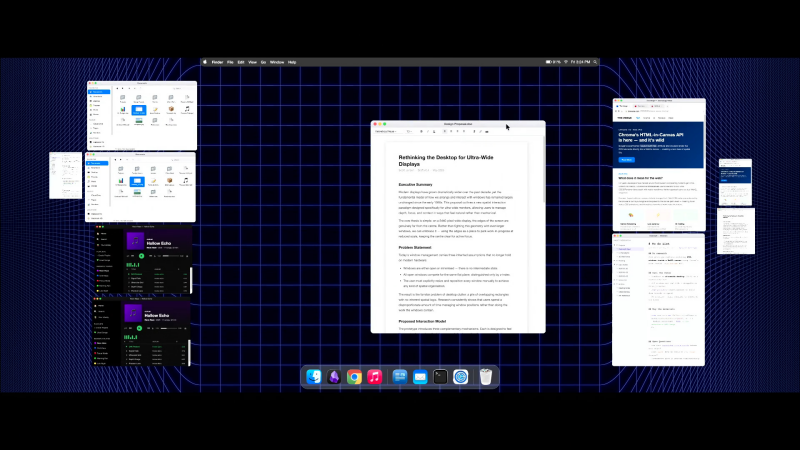
He also demonstrated dragging a music-player window all the way to one side of the
screen, which he called "the stash area
". As it moved to the edge, it
transformed into a widget with just a play button instead of showing the full
window. He thought that it would be possible to do the things he was demonstrating
with Wayland as it is today.
Jenson put up another demonstration of an improved clipboard model that copied
ideas from the Obsidian editor's Canvas feature. Canvas allows users to drag and
drop images, text, and files to create a visual layout of information. A user could
create a document and drag information from a web browser into the document, drop a
file in from another source, "the idea here is that this is now effectively a
collection of stuff that I have gathered for this document. And if I close it and
then come back tomorrow, it's all still there
". He added that a local AI would be
able to come in and organize the information a user had gathered, "oh, look,
you've got a bunch of hotels, let me organize them for you
".
The final idea he discussed was a way of gathering "privacy-preserving
data
" to help give users a better visualization of things like web-browsing
history. A web browser will only give the user a view of their browsing history that
"is not very useful
" he said, so he tried to gather data "not using AI,
just using simple math
" that would use attention signals—such as how long
the user was on a web page—to tell a story of where they spent their time on
the desktop. "I basically came up with this spatial associative episodic memory
prompt
" to organize data in a helpful, interesting way. He thought that working
memory was a good way to explore new ideas for desktop UX.
So the goal with this talk is to say, let's start to take this apart. And I really hope that my prototypes cause you guys to come to me and say, We forgot about this, and let's talk about that. [...] So I just want us to try, because no one else is going to try, and I think someone's got to start.
There was time for a single question. An audience member asked how Jenson's model
would protect against all of the privacy concerns that Microsoft faced with Windows
Recall. "How are we going to make sure that this history remains only accessible
by the user and cannot be hacked in like it could happen with Windows
Recall?
"
Jenson answered that his idea was to gather telemetry data, "not interesting
information
", which would significantly reduce the attractiveness of the data to
would-be attackers. He said he did not want to underplay the issue, though, and
wanted to build prototypes to see if the idea was good first, and then explore ways
to encrypt or protect the data. He agreed that even this data could be valuable
information. He added that the biggest problem with Windows Recall was "how
stupidly they protected it
" and he was sure others could do a lot better job.
[I would like to thank the Linux Foundation, LWN's travel sponsor, for its assistance with my trip to Graz, Austria for Akademy 2026.]
Brief items
Security
Critical WordPress RCE vulnerability announced
A critical vulnerability has been discovered in WordPress's get_page_template() function for page-template resolution that could allow remote-code execution (RCE) by an unauthenticated attacker, in some limited circumstances. The project has provided an update for the most recent branch of WordPress, as well as backports of the fix for branches back to 4.7. See the vulnerability report for the conditions required for an RCE attack to be successful.
The vulnerability also affects the ClassicPress fork of WordPress, though a security update has not been provided for that project yet. LWN covered ClassicPress in 2024. Users of either content-management system should update soon.
Critical security vulnerabilities in the Radicle network protocol
The Radicle peer-to-peer
code-collaboration project has disclosed
two critical vulnerabilities in the network protocol used by Radicle
nodes. The first flaw is that the network protocol used by Radicle "does not
give the confidentiality it was expected to give
", which allows anyone who
can observe the network between two nodes to read the data exchanged. The second
is that peer authentication is broken and allows impersonation, so an attacker
can spoof their Node ID and read private repositories they should not be able to
read.
In practice, the two flaws are most useful when they can be exploited together: an attacker on the path sees the Node IDs at both ends of a connection, and both are normally on the allow-list. That attacker can read whatever is exchanged while they watch, and can then use a Node ID they saw to fetch the whole repository on demand. The realistic threat is anyone on the path between your node and node it syncs with, and no setting or allow-list protects against them.
We are publishing this before the security update is available. You can act on it today, and no fix we release later can undo an exposure that has already happened.
See the post for workarounds that can be used today; a major update that will be backward-incompatible is underway.
Kernel development
Kernel release status
The current development kernel is 7.3-rc4, released on September 20. It is, unsurprisingly at this point, large; Linus said: "We all know the drill by now: 'it's big, yadda yadda'".
This release has seen 17,056 non-merge changesets from 2,720 developers, 649 of whom were first-time kernel contributors. The release history looks like:
RC Date Commits v7.3-rc1 2026-08-30 16267 16267 v7.3-rc2 2026-09-06 681 681 v7.3-rc3 2026-09-13 733 733 v7.3-rc4 2026-09-20 598 598
See the LWN KSDB v7.3 page for a lot more details.
Stable updates: the large 7.2.7, 6.18.53, and 6.12.111 updates were released on September 21.
Systemtap 5.6 released
Version 5.6 of the Systemtap tracing tool has been released.
BPF LSM hooks and XDP packet-processing probes for the --bpf runtime, BTF-based kernel.tracepoint probes, statement execution tracing, a new @enumname() operator, richer runtime error context, dyninst hardware watchpoints, modern systemd service templates, and broad Linux 7.2 runtime/tapset compatibility work. Multithreaded speedups throughout.
Development
GNOME 51 released
Version 51 of the GNOME desktop environment has been released. The list of changes includes a number of performance improvements, offline data and better transit information in the Maps application, a new interface for the file previewer, and more.Igalia celebrates "Twenty-Five Years Upstream"
The open-source consulting firm Igalia has put out an announcement celebrating 25 years of working on upstream FOSS projects for its clients. The list of projects the company has worked on is rather eye-opening: WebKit, mobile-browser rendering (on Maemo, Moblin, MeeGo, and Tizen), the Linux kernel (CPU and GPU scheduling), 3D graphics drivers, the Orca screen reader, GStreamer, and lots more. Beyond that, the company, which is a worker-owned cooperative, does its work in ways that benefit the community as well as its clients:None of this is charity. Igalia is a consultancy, and most of the work above was paid for by someone with a product to ship: a device maker who needs the web to run well on their hardware, a platform that needs a feature its users keep asking for, a company whose roadmap depends on something deep in the stack working better than it does today. What they get from us is not a patch to carry forever. We do the work upstream, in the project itself, so it arrives in the next release and keeps working long after the contract ends. Our customers ship products built on code that nobody has to maintain alone, and everyone else gets the same code. That has been the arrangement from the start.
Systemd v262 released
Systemd v262 has been released. Some of the notable new features include the ability to build systemd as a single statically linked binary for small containers, support for the kernel coredump socket protocol introduced with Linux 6.17, addition of OpenSSL 4 support, and many other changes. See the release notes for a full list of changes.
Development quotes of the week
In a software context, I think part of the Star Trek utopia we should be striving for (and a sign we've achieved it) is putting a wooden stake through the heart of the word "consumer."— Matilda Horger
— Tomas VondraLet's say you're working on a patch, and you want to post it to the list already. There's one more change needed, to fix a design issue. It'd take ~10 minutes of your time, but it's mostly mechanical, anyone can do it. So you post the patch without it, to get the feedback earlier.
This unfortunately has two likely consequences. Some reviewers will point out that one change - which you already planned to do, so it's not very useful feedback. And other reviewers will end up doing the change themselves, and now you've wasted 10 minutes of each reviewer's time.
If you can save time for other people, do it. It may be just 10 minutes of your time, but with multiple people it quickly adds up and it can be 1 hour of "community time."
Page editor: Daroc Alden
Announcements
Newsletters
Distributions and system administration
Development
Meeting minutes
Calls for Presentations
CFP Deadlines: September 24, 2026 to November 23, 2026
The following listing of CFP deadlines is taken from the LWN.net CFP Calendar.
| Deadline | Event Dates | Event | Location |
|---|---|---|---|
| September 28 | November 3 November 4 |
Open vSwitch and OVN 2026 Fall Conference | Heilbronn, Germany |
| October 1 | November 7 November 8 |
OpenFest 2026 | Sofia, Bulgaria |
| October 1 | November 12 November 13 |
Ubuntu Summit 26.10 | Online |
| October 4 | November 7 November 8 |
OpenALT | Brno, Czechia |
| October 9 | November 20 November 21 |
OLF Conference | Columbus, Ohio, US |
| November 1 | April 1 April 4 |
Southern California Linux Expo | Pasadena, CA, US |
If the CFP deadline for your event does not appear here, please tell us about it.
Upcoming Events
Events: September 24, 2026 to November 23, 2026
The following event listing is taken from the LWN.net Calendar.
| Date(s) | Event | Location |
|---|---|---|
| September 19 September 24 |
Akademy 2026 | Graz, Austria |
| September 22 September 24 |
Reproducible Builds Summit | Gothenburg, Sweden |
| September 25 September 27 |
PostmarketOS and Alpine Linux Conference | Aachen, Germany |
| September 28 September 30 |
X.Org Developers Conference | Toronto, Canada |
| September 28 October 1 |
Alpine Linux Persistence and Storage Summit | Lizumerhütte, Tyrol, Austria |
| September 30 October 1 |
All Systems Go! 2026 | Berlin, Germany |
| October 1 October 2 |
embedded Linux for Safe and Secure Applications | Göttingen, Germany |
| October 1 | Open Tech Day | Software-defined Storage | Nuremberg, Germany |
| October 2 October 4 |
GNU Tools Cauldron | Prague, Czechia |
| October 3 October 4 |
openSUSE.Asia Summit 2026 | Yogyakarta, Indonesia |
| October 3 October 4 |
Linux Days 2026 | Prague, Czechia |
| October 5 October 7 |
Linux Plumbers Conference 2026 | Prague, Czechia |
| October 6 | Yocto Project Developer Day 2026 | Prague, Czechia |
| October 6 | Real-time Linux User Forum | Prague, Czechia |
| October 7 October 9 |
Embedded Linux Conference Europe | Prague, Czech Republic |
| October 7 October 9 |
Open Source Summit Europe | Prague, Czech Republic |
| October 8 | Linux Security Summit Europe | Prague, Czechia |
| October 10 October 11 |
GStreamer Conference 2026 | Prague, Czech Republic |
| October 13 October 15 |
OpenSSL Conference | Prague, Czech Republic |
| October 14 October 17 |
PyCon South Africa | Cape Town, South Africa |
| October 16 October 18 |
VideoLAN Developers' Days | Rome, Italy |
| October 18 October 20 |
All Things Open | Raleigh, NC, US |
| October 20 October 23 |
The Matrix Conference | Malmö, Sweden |
| October 20 October 23 |
PostgreSQL Conference Europe | Valencia, Spain |
| October 30 November 1 |
Qubes OS Summit | Berlin, Germany |
| November 3 November 4 |
Open vSwitch and OVN 2026 Fall Conference | Heilbronn, Germany |
| November 6 November 7 |
Texas Linux Festival | Austin, TX, US |
| November 7 November 8 |
OpenFest 2026 | Sofia, Bulgaria |
| November 7 November 8 |
OpenALT | Brno, Czechia |
| November 12 November 13 |
Ubuntu Summit 26.10 | Online |
| November 14 November 15 |
Capitole du Libre 2026 | Toulouse, France |
| November 17 November 19 |
Open Source Monitoring Conference | Nuremberg, Germany |
| November 20 November 21 |
OLF Conference | Columbus, Ohio, US |
If your event does not appear here, please tell us about it.
Security updates
Alert summary September 17, 2026 to September 23, 2026
| Dist. | ID | Release | Package | Date |
|---|---|---|---|---|
| AlmaLinux | ALSA-2026:67530 | 10 | .NET 10.0 | 2026-09-18 |
| AlmaLinux | ALSA-2026:68676 | 8 | .NET 10.0 | 2026-09-18 |
| AlmaLinux | ALSA-2026:67613 | 9 | .NET 10.0 | 2026-09-16 |
| AlmaLinux | ALSA-2026:67525 | 10 | .NET 8.0 | 2026-09-16 |
| AlmaLinux | ALSA-2026:68316 | 8 | .NET 8.0 | 2026-09-17 |
| AlmaLinux | ALSA-2026:67524 | 9 | .NET 8.0 | 2026-09-16 |
| AlmaLinux | ALSA-2026:67528 | 10 | .NET 9.0 | 2026-09-16 |
| AlmaLinux | ALSA-2026:68233 | 8 | .NET 9.0 | 2026-09-17 |
| AlmaLinux | ALSA-2026:67614 | 9 | .NET 9.0 | 2026-09-16 |
| AlmaLinux | ALSA-2026:69113 | 8 | apr-util | 2026-09-21 |
| AlmaLinux | ALSA-2026:67886 | 10 | coreutils | 2026-09-17 |
| AlmaLinux | ALSA-2026:69964 | 8 | coreutils | 2026-09-22 |
| AlmaLinux | ALSA-2026:69277 | 8 | corosync | 2026-09-22 |
| AlmaLinux | ALSA-2026:67873 | 9 | corosync | 2026-09-17 |
| AlmaLinux | ALSA-2026:69125 | 10 | curl | 2026-09-22 |
| AlmaLinux | ALSA-2026:69126 | 9 | curl | 2026-09-22 |
| AlmaLinux | ALSA-2026:67585 | 9 | firewalld | 2026-09-16 |
| AlmaLinux | ALSA-2026:69387 | 8 | freerdp | 2026-09-22 |
| AlmaLinux | ALSA-2026:69100 | 9 | gstreamer1-plugins-base | 2026-09-22 |
| AlmaLinux | ALSA-2026:66355 | 10 | kernel | 2026-09-17 |
| AlmaLinux | ALSA-2026:67471 | 10 | kernel | 2026-09-17 |
| AlmaLinux | ALSA-2026:68507 | 10 | kernel | 2026-09-19 |
| AlmaLinux | ALSA-2026:68531 | 8 | kernel | 2026-09-18 |
| AlmaLinux | ALSA-2026:67150 | 9 | kernel | 2026-09-17 |
| AlmaLinux | ALSA-2026:67470 | 9 | kernel | 2026-09-17 |
| AlmaLinux | ALSA-2026:68532 | 8 | kernel-rt | 2026-09-17 |
| AlmaLinux | ALSA-2026:69553 | 10 | libarchive | 2026-09-22 |
| AlmaLinux | ALSA-2026:67909 | 10 | libevent | 2026-09-17 |
| AlmaLinux | ALSA-2026:67908 | 8 | libevent | 2026-09-17 |
| AlmaLinux | ALSA-2026:67910 | 9 | libevent | 2026-09-17 |
| AlmaLinux | ALSA-2026:68266 | 8 | libsoup | 2026-09-17 |
| AlmaLinux | ALSA-2026:68234 | 9 | libsoup | 2026-09-17 |
| AlmaLinux | ALSA-2026:68235 | 10 | libsoup3 | 2026-09-17 |
| AlmaLinux | ALSA-2026:69095 | 8 | libtiff | 2026-09-21 |
| AlmaLinux | ALSA-2026:69655 | 8 | libxml2 | 2026-09-22 |
| AlmaLinux | ALSA-2026:67979 | 10 | microcode_ctl | 2026-09-17 |
| AlmaLinux | ALSA-2026:68011 | 9 | microcode_ctl | 2026-09-17 |
| AlmaLinux | ALSA-2026:67283 | 9 | nginx:1.26 | 2026-09-16 |
| AlmaLinux | ALSA-2026:69609 | 10 | openexr | 2026-09-22 |
| AlmaLinux | ALSA-2026:69129 | 10 | openssh | 2026-09-22 |
| AlmaLinux | ALSA-2026:69266 | 8 | openssh | 2026-09-21 |
| AlmaLinux | ALSA-2026:69130 | 9 | openssh | 2026-09-22 |
| AlmaLinux | ALSA-2026:68787 | 8 | perl-Net-DNS | 2026-09-18 |
| AlmaLinux | ALSA-2026:68786 | 9 | perl-Net-DNS | 2026-09-19 |
| AlmaLinux | ALSA-2026:67280 | 10 | postgresql18 | 2026-09-17 |
| AlmaLinux | ALSA-2026:67166 | 10 | postgresql18-postgis | 2026-09-22 |
| AlmaLinux | ALSA-2026:69876 | 8 | postgresql:16 | 2026-09-22 |
| AlmaLinux | ALSA-2026:67491 | 9 | postgresql:16 | 2026-09-17 |
| AlmaLinux | ALSA-2026:67848 | 9 | postgresql:18 | 2026-09-17 |
| AlmaLinux | ALSA-2026:67943 | 8 | python-lxml | 2026-09-17 |
| AlmaLinux | ALSA-2026:67584 | 10 | rsyslog | 2026-09-16 |
| AlmaLinux | ALSA-2026:69541 | 10 | rsyslog | 2026-09-22 |
| AlmaLinux | ALSA-2026:67583 | 9 | rsyslog | 2026-09-16 |
| AlmaLinux | ALSA-2026:69540 | 9 | rsyslog | 2026-09-22 |
| AlmaLinux | ALSA-2026:68692 | 10 | sudo | 2026-09-19 |
| AlmaLinux | ALSA-2026:69123 | 9 | sudo | 2026-09-22 |
| AlmaLinux | ALSA-2026:67832 | 8 | tesseract | 2026-09-16 |
| AlmaLinux | ALSA-2026:67831 | 9 | tesseract | 2026-09-17 |
| AlmaLinux | ALSA-2026:69259 | 10 | tomcat | 2026-09-22 |
| AlmaLinux | ALSA-2026:68677 | 8 | tomcat | 2026-09-18 |
| AlmaLinux | ALSA-2026:68660 | 9 | tomcat | 2026-09-19 |
| AlmaLinux | ALSA-2026:68651 | 10 | tomcat9 | 2026-09-19 |
| AlmaLinux | ALSA-2026:68291 | 10 | unbound | 2026-09-17 |
| AlmaLinux | ALSA-2026:69120 | 8 | unbound | 2026-09-21 |
| AlmaLinux | ALSA-2026:68292 | 9 | unbound | 2026-09-17 |
| AlmaLinux | ALSA-2026:69098 | 9 | webkit2gtk3 | 2026-09-22 |
| AlmaLinux | ALSA-2026:69308 | 10 | yggdrasil | 2026-09-22 |
| AlmaLinux | ALSA-2026:69099 | 10 | yggdrasil-worker-package-manager | 2026-09-22 |
| Debian | DSA-6505-1 | stable | bind9 | 2026-09-17 |
| Debian | DLA-4790-1 | LTS | chromium | 2026-09-21 |
| Debian | DSA-6506-1 | stable | chromium | 2026-09-17 |
| Debian | DSA-6508-1 | stable | chromium | 2026-09-19 |
| Debian | DLA-4781-1 | LTS | firefox-esr | 2026-09-17 |
| Debian | DSA-6501-1 | stable | firefox-esr | 2026-09-16 |
| Debian | DSA-6509-1 | stable | gimp | 2026-09-20 |
| Debian | DSA-6504-1 | stable | libapache2-mod-auth-openidc | 2026-09-17 |
| Debian | DLA-4789-1 | LTS | libde265 | 2026-09-20 |
| Debian | DLA-4786-1 | LTS | libevent | 2026-09-18 |
| Debian | DLA-4788-1 | LTS | linux-6.12 | 2026-09-19 |
| Debian | DLA-4791-1 | LTS | memcached | 2026-09-23 |
| Debian | DSA-6502-1 | stable | mkvtoolnix | 2026-09-16 |
| Debian | DLA-4784-1 | LTS | nginx | 2026-09-17 |
| Debian | DLA-4787-1 | LTS | ruby-jwt | 2026-09-19 |
| Debian | DLA-4782-1 | LTS | thunderbird | 2026-09-17 |
| Debian | DSA-6503-1 | stable | thunderbird | 2026-09-16 |
| Debian | DSA-6500-1 | stable | tor | 2026-09-16 |
| Debian | DSA-6507-1 | stable | unbound | 2026-09-19 |
| Debian | DLA-4783-1 | LTS | xz-utils | 2026-09-17 |
| Debian | DLA-4785-1 | LTS | zip | 2026-09-18 |
| Fedora | FEDORA-2026-c74ff43396 | F43 | GitPython | 2026-09-18 |
| Fedora | FEDORA-2026-040732b5dc | F45 | OpenBoard | 2026-09-22 |
| Fedora | FEDORA-2026-040732b5dc | F45 | Pencil2D | 2026-09-22 |
| Fedora | FEDORA-2026-040732b5dc | F45 | alsa-plugins | 2026-09-22 |
| Fedora | FEDORA-2026-040732b5dc | F45 | amarok | 2026-09-22 |
| Fedora | FEDORA-2026-040732b5dc | F45 | aqualung | 2026-09-22 |
| Fedora | FEDORA-2026-9949becb18 | F45 | asterisk | 2026-09-21 |
| Fedora | FEDORA-2026-040732b5dc | F45 | atomes | 2026-09-22 |
| Fedora | FEDORA-2026-040732b5dc | F45 | attract-mode | 2026-09-22 |
| Fedora | FEDORA-2026-040732b5dc | F45 | audacious-plugins | 2026-09-22 |
| Fedora | FEDORA-2026-040732b5dc | F45 | audacity | 2026-09-22 |
| Fedora | FEDORA-2026-040732b5dc | F45 | baresip | 2026-09-22 |
| Fedora | FEDORA-2026-040732b5dc | F45 | blender | 2026-09-22 |
| Fedora | FEDORA-2026-040732b5dc | F45 | calibre | 2026-09-22 |
| Fedora | FEDORA-2026-040732b5dc | F45 | cantata | 2026-09-22 |
| Fedora | FEDORA-2026-040732b5dc | F45 | cef | 2026-09-22 |
| Fedora | FEDORA-2026-040732b5dc | F45 | chromaprint | 2026-09-22 |
| Fedora | FEDORA-2026-a1a12d9b4f | F43 | chromium | 2026-09-19 |
| Fedora | FEDORA-2026-441ccd8509 | F44 | chromium | 2026-09-18 |
| Fedora | FEDORA-2026-f910229c11 | F44 | chromium | 2026-09-23 |
| Fedora | FEDORA-2026-6932094a69 | F45 | chromium | 2026-09-19 |
| Fedora | FEDORA-2026-040732b5dc | F45 | chromium | 2026-09-22 |
| Fedora | FEDORA-2026-97a7ec5786 | F43 | cyrus-imapd | 2026-09-23 |
| Fedora | FEDORA-2026-740bc1c6fa | F44 | cyrus-imapd | 2026-09-23 |
| Fedora | FEDORA-2026-3bf3e31ef4 | F45 | cyrus-imapd | 2026-09-23 |
| Fedora | FEDORA-2026-040732b5dc | F45 | digikam | 2026-09-22 |
| Fedora | FEDORA-2026-ad8394dc92 | F44 | doctl | 2026-09-20 |
| Fedora | FEDORA-2026-a205d8bdfd | F45 | doctl | 2026-09-22 |
| Fedora | FEDORA-2026-04a0116777 | F43 | dotnet10.0 | 2026-09-23 |
| Fedora | FEDORA-2026-a5c27e8727 | F44 | dotnet10.0 | 2026-09-23 |
| Fedora | FEDORA-2026-fa6de37202 | F45 | dotnet10.0 | 2026-09-23 |
| Fedora | FEDORA-2026-d757a4044b | F43 | dotnet8.0 | 2026-09-23 |
| Fedora | FEDORA-2026-0fa8c76e88 | F44 | dotnet8.0 | 2026-09-23 |
| Fedora | FEDORA-2026-182712d480 | F43 | dotnet9.0 | 2026-09-23 |
| Fedora | FEDORA-2026-9d80c37c0a | F44 | dotnet9.0 | 2026-09-23 |
| Fedora | FEDORA-2026-e8a6485109 | F43 | dovecot | 2026-09-19 |
| Fedora | FEDORA-2026-2e6b786570 | F44 | dovecot | 2026-09-19 |
| Fedora | FEDORA-2026-8b8efbd2b8 | F45 | dovecot | 2026-09-19 |
| Fedora | FEDORA-2026-040732b5dc | F45 | dragon | 2026-09-22 |
| Fedora | FEDORA-2026-1ea9bbcb29 | F43 | evolution | 2026-09-19 |
| Fedora | FEDORA-2026-99a4ff5552 | F44 | evolution | 2026-09-19 |
| Fedora | FEDORA-2026-040732b5dc | F45 | ffmpeg | 2026-09-22 |
| Fedora | FEDORA-2026-040732b5dc | F45 | ffmpegthumbnailer | 2026-09-22 |
| Fedora | FEDORA-2026-040732b5dc | F45 | ffmpegthumbs | 2026-09-22 |
| Fedora | FEDORA-2026-040732b5dc | F45 | ffms2 | 2026-09-22 |
| Fedora | FEDORA-2026-d7ba4af112 | F43 | firefox | 2026-09-19 |
| Fedora | FEDORA-2026-040732b5dc | F45 | fooyin | 2026-09-22 |
| Fedora | FEDORA-2026-e9a6f74bd2 | F45 | forgejo | 2026-09-19 |
| Fedora | FEDORA-2026-75bde5d061 | F43 | freeciv | 2026-09-19 |
| Fedora | FEDORA-2026-3b9c14cd66 | F44 | freeciv | 2026-09-19 |
| Fedora | FEDORA-2026-6fe2310246 | F45 | freeciv | 2026-09-19 |
| Fedora | FEDORA-2026-1c8697a163 | F44 | freeipa | 2026-09-21 |
| Fedora | FEDORA-2026-b314830fc3 | F45 | freeipa | 2026-09-21 |
| Fedora | FEDORA-2026-febfd10293 | F44 | freeipmi | 2026-09-23 |
| Fedora | FEDORA-2026-abe39f1809 | F45 | freeipmi | 2026-09-18 |
| Fedora | FEDORA-2026-572a0f4178 | F43 | gegl04 | 2026-09-20 |
| Fedora | FEDORA-2026-572a0f4178 | F43 | gimp | 2026-09-20 |
| Fedora | FEDORA-2026-040732b5dc | F45 | glaxnimate | 2026-09-22 |
| Fedora | FEDORA-2026-d5c7f91202 | F43 | gnatcoll | 2026-09-18 |
| Fedora | FEDORA-2026-11f44e3c2c | F44 | gnatcoll | 2026-09-18 |
| Fedora | FEDORA-2026-c8b1bb0c97 | F45 | gnatcoll | 2026-09-18 |
| Fedora | FEDORA-2026-040732b5dc | F45 | goldendict-ng | 2026-09-22 |
| Fedora | FEDORA-2026-040732b5dc | F45 | gpac | 2026-09-22 |
| Fedora | FEDORA-2026-040732b5dc | F45 | gstreamer1-plugin-libav | 2026-09-22 |
| Fedora | FEDORA-2026-040732b5dc | F45 | guacamole-server | 2026-09-22 |
| Fedora | FEDORA-2026-040732b5dc | F45 | guvcview | 2026-09-22 |
| Fedora | FEDORA-2026-040732b5dc | F45 | haruna | 2026-09-22 |
| Fedora | FEDORA-2026-040732b5dc | F45 | hedgewars | 2026-09-22 |
| Fedora | FEDORA-2026-040732b5dc | F45 | icecat | 2026-09-22 |
| Fedora | FEDORA-2026-040732b5dc | F45 | janus | 2026-09-22 |
| Fedora | FEDORA-2026-040732b5dc | F45 | k3b | 2026-09-22 |
| Fedora | FEDORA-2026-040732b5dc | F45 | kdenlive | 2026-09-22 |
| Fedora | FEDORA-2026-ca91e91bf0 | F44 | kernel | 2026-09-23 |
| Fedora | FEDORA-2026-4c098c462e | F45 | kernel | 2026-09-23 |
| Fedora | FEDORA-2026-040732b5dc | F45 | kf5-kfilemetadata | 2026-09-22 |
| Fedora | FEDORA-2026-040732b5dc | F45 | kf6-kfilemetadata | 2026-09-22 |
| Fedora | FEDORA-2026-040732b5dc | F45 | kpipewire | 2026-09-22 |
| Fedora | FEDORA-2026-040732b5dc | F45 | lazygal | 2026-09-22 |
| Fedora | FEDORA-2026-578a96e5f5 | F44 | lego | 2026-09-22 |
| Fedora | FEDORA-2026-9eaee019b6 | F45 | lego | 2026-09-22 |
| Fedora | FEDORA-2026-040732b5dc | F45 | libcamera-apps | 2026-09-22 |
| Fedora | FEDORA-2026-ba6dbf405c | F44 | libheif | 2026-09-20 |
| Fedora | FEDORA-2026-73d31ad4c6 | F45 | libheif | 2026-09-19 |
| Fedora | FEDORA-2026-040732b5dc | F45 | libheif | 2026-09-22 |
| Fedora | FEDORA-2026-040732b5dc | F45 | libopenshot | 2026-09-22 |
| Fedora | FEDORA-2026-040732b5dc | F45 | libopenshot-audio | 2026-09-22 |
| Fedora | FEDORA-2026-040732b5dc | F45 | libvncserver | 2026-09-22 |
| Fedora | FEDORA-2026-743387fdbe | F45 | libxmp | 2026-09-23 |
| Fedora | FEDORA-2026-040732b5dc | F45 | localsearch | 2026-09-22 |
| Fedora | FEDORA-2026-040732b5dc | F45 | mat2 | 2026-09-22 |
| Fedora | FEDORA-2026-040732b5dc | F45 | minidlna | 2026-09-22 |
| Fedora | FEDORA-2026-040732b5dc | F45 | mivisionx | 2026-09-22 |
| Fedora | FEDORA-2026-040732b5dc | F45 | mixxx | 2026-09-22 |
| Fedora | FEDORA-2026-040732b5dc | F45 | mlt | 2026-09-22 |
| Fedora | FEDORA-2026-040732b5dc | F45 | monado | 2026-09-22 |
| Fedora | FEDORA-2026-040732b5dc | F45 | mpd | 2026-09-22 |
| Fedora | FEDORA-2026-040732b5dc | F45 | mpv | 2026-09-22 |
| Fedora | FEDORA-2026-040732b5dc | F45 | mpv-mpris | 2026-09-22 |
| Fedora | FEDORA-2026-040732b5dc | F45 | neatvnc | 2026-09-22 |
| Fedora | FEDORA-2026-67f78e732b | F43 | nodejs-undici | 2026-09-18 |
| Fedora | FEDORA-2026-90bb0fcd50 | F44 | nodejs-undici | 2026-09-18 |
| Fedora | FEDORA-2026-25a6102ac6 | F45 | nodejs-undici | 2026-09-18 |
| Fedora | FEDORA-2026-040732b5dc | F45 | notcurses | 2026-09-22 |
| Fedora | FEDORA-2026-d7ba4af112 | F43 | nss | 2026-09-19 |
| Fedora | FEDORA-2026-9b9d903069 | F45 | nss | 2026-09-21 |
| Fedora | FEDORA-2026-040732b5dc | F45 | nv-codec-headers13.0 | 2026-09-22 |
| Fedora | FEDORA-2026-040732b5dc | F45 | obs-studio | 2026-09-22 |
| Fedora | FEDORA-2026-040732b5dc | F45 | obs-studio-plugin-droidcam | 2026-09-22 |
| Fedora | FEDORA-2026-040732b5dc | F45 | obs-studio-plugin-pwvideo | 2026-09-22 |
| Fedora | FEDORA-2026-040732b5dc | F45 | obs-studio-plugin-vaapi | 2026-09-22 |
| Fedora | FEDORA-2026-040732b5dc | F45 | obs-studio-plugin-vkcapture | 2026-09-22 |
| Fedora | FEDORA-2026-040732b5dc | F45 | obs-studio-plugin-webkitgtk | 2026-09-22 |
| Fedora | FEDORA-2026-040732b5dc | F45 | olive | 2026-09-22 |
| Fedora | FEDORA-2026-8cbd9e2c8b | F43 | open62541 | 2026-09-17 |
| Fedora | FEDORA-2026-6d919ea521 | F44 | open62541 | 2026-09-17 |
| Fedora | FEDORA-2026-3fd073ad5b | F45 | open62541 | 2026-09-17 |
| Fedora | FEDORA-2026-040732b5dc | F45 | openal-soft | 2026-09-22 |
| Fedora | FEDORA-2026-040732b5dc | F45 | opencv | 2026-09-22 |
| Fedora | FEDORA-2026-040732b5dc | F45 | openmw | 2026-09-22 |
| Fedora | FEDORA-2026-38b019a0f0 | F43 | opkssh | 2026-09-21 |
| Fedora | FEDORA-2026-f7b73f165d | F44 | opkssh | 2026-09-21 |
| Fedora | FEDORA-2026-559bbb39f5 | F45 | opkssh | 2026-09-21 |
| Fedora | FEDORA-2026-040732b5dc | F45 | opustags | 2026-09-22 |
| Fedora | FEDORA-2026-040732b5dc | F45 | os-autoinst | 2026-09-22 |
| Fedora | FEDORA-2026-6ac486039c | F44 | parted | 2026-09-18 |
| Fedora | FEDORA-2026-6bfd19245e | F45 | parted | 2026-09-21 |
| Fedora | FEDORA-2026-23dc582dae | F44 | patool | 2026-09-22 |
| Fedora | FEDORA-2026-3a35235bd6 | F45 | patool | 2026-09-22 |
| Fedora | FEDORA-2026-167a356523 | F43 | perl-HTML-FormHandler | 2026-09-22 |
| Fedora | FEDORA-2026-21850d7df0 | F44 | perl-HTML-FormHandler | 2026-09-22 |
| Fedora | FEDORA-2026-406a152d49 | F45 | perl-HTML-FormHandler | 2026-09-22 |
| Fedora | FEDORA-2026-48a4531e02 | F43 | perl-Net-DNS | 2026-09-23 |
| Fedora | FEDORA-2026-57f107ed83 | F44 | perl-Net-DNS | 2026-09-23 |
| Fedora | FEDORA-2026-caf49a7828 | F43 | php-pecl-mongodb2 | 2026-09-17 |
| Fedora | FEDORA-2026-358d3ccdfe | F44 | php-pecl-mongodb2 | 2026-09-17 |
| Fedora | FEDORA-2026-040732b5dc | F45 | pianobar | 2026-09-22 |
| Fedora | FEDORA-2026-58a319c686 | F44 | postgresql16-anonymizer | 2026-09-23 |
| Fedora | FEDORA-2026-bc7408de42 | F45 | postgresql16-anonymizer | 2026-09-23 |
| Fedora | FEDORA-2026-8590121cf7 | F45 | prometheus-podman-exporter | 2026-09-22 |
| Fedora | FEDORA-2026-040732b5dc | F45 | python-audioread | 2026-09-22 |
| Fedora | FEDORA-2026-6b28b4e483 | F43 | python-django5 | 2026-09-18 |
| Fedora | FEDORA-2026-301e6e2983 | F44 | python-django5 | 2026-09-18 |
| Fedora | FEDORA-2026-950089270f | F45 | python-django5 | 2026-09-18 |
| Fedora | FEDORA-2026-6613125727 | F44 | python-django6 | 2026-09-17 |
| Fedora | FEDORA-2026-522a9411e7 | F45 | python-django6 | 2026-09-17 |
| Fedora | FEDORA-2026-8caad572b0 | F44 | python-jwcrypto | 2026-09-17 |
| Fedora | FEDORA-2026-6d094c5360 | F45 | python-jwcrypto | 2026-09-17 |
| Fedora | FEDORA-2026-040732b5dc | F45 | python-torchaudio | 2026-09-22 |
| Fedora | FEDORA-2026-040732b5dc | F45 | python-torchvision | 2026-09-22 |
| Fedora | FEDORA-2026-040732b5dc | F45 | qmmp | 2026-09-22 |
| Fedora | FEDORA-2026-040732b5dc | F45 | qmmp-plugin-pack | 2026-09-22 |
| Fedora | FEDORA-2026-040732b5dc | F45 | qmplay2 | 2026-09-22 |
| Fedora | FEDORA-2026-040732b5dc | F45 | qt5-qtwebengine | 2026-09-22 |
| Fedora | FEDORA-2026-040732b5dc | F45 | qt6-qtmultimedia | 2026-09-22 |
| Fedora | FEDORA-2026-040732b5dc | F45 | qt6-qtwebengine | 2026-09-22 |
| Fedora | FEDORA-2026-040732b5dc | F45 | qtox | 2026-09-22 |
| Fedora | FEDORA-2026-040732b5dc | F45 | retroarch | 2026-09-22 |
| Fedora | FEDORA-2026-040732b5dc | F45 | rocdecode | 2026-09-22 |
| Fedora | FEDORA-2026-040732b5dc | F45 | rocdecode7.2 | 2026-09-22 |
| Fedora | FEDORA-2026-821349f438 | F43 | roundcubemail | 2026-09-17 |
| Fedora | FEDORA-2026-38c637be37 | F44 | roundcubemail | 2026-09-17 |
| Fedora | FEDORA-2026-6ab831c1c5 | F45 | roundcubemail | 2026-09-17 |
| Fedora | FEDORA-2026-040732b5dc | F45 | rsgain | 2026-09-22 |
| Fedora | FEDORA-2026-b3bccd6a30 | F43 | ruby | 2026-09-19 |
| Fedora | FEDORA-2026-fe1549bec3 | F43 | sblim-cmpi-base | 2026-09-18 |
| Fedora | FEDORA-2026-7510dd645d | F44 | sblim-cmpi-base | 2026-09-18 |
| Fedora | FEDORA-2026-700fe12346 | F45 | sblim-cmpi-base | 2026-09-18 |
| Fedora | FEDORA-2026-040732b5dc | F45 | siril | 2026-09-22 |
| Fedora | FEDORA-2026-040732b5dc | F45 | squeezelite | 2026-09-22 |
| Fedora | FEDORA-2026-0cae436fa5 | F43 | stb | 2026-09-19 |
| Fedora | FEDORA-2026-2a592f622a | F44 | stb | 2026-09-19 |
| Fedora | FEDORA-2026-63e7be05c3 | F45 | stb | 2026-09-19 |
| Fedora | FEDORA-2026-040732b5dc | F45 | swayimg | 2026-09-22 |
| Fedora | FEDORA-2026-379e77483b | F44 | thunderbird | 2026-09-21 |
| Fedora | FEDORA-2026-aa0e0deed1 | F45 | thunderbird | 2026-09-20 |
| Fedora | FEDORA-2026-040732b5dc | F45 | tigervnc | 2026-09-22 |
| Fedora | FEDORA-2026-040732b5dc | F45 | timg | 2026-09-22 |
| Fedora | FEDORA-2026-3baacede89 | F45 | unbound | 2026-09-21 |
| Fedora | FEDORA-2026-040732b5dc | F45 | unpaper | 2026-09-22 |
| Fedora | FEDORA-2026-040732b5dc | F45 | vlc | 2026-09-22 |
| Fedora | FEDORA-2026-040732b5dc | F45 | vtk | 2026-09-22 |
| Fedora | FEDORA-2026-040732b5dc | F45 | waypipe | 2026-09-22 |
| Fedora | FEDORA-2026-21b582110b | F45 | webkitgtk | 2026-09-21 |
| Fedora | FEDORA-2026-040732b5dc | F45 | wf-recorder | 2026-09-22 |
| Fedora | FEDORA-2026-040732b5dc | F45 | wivrn | 2026-09-22 |
| Fedora | FEDORA-2026-040732b5dc | F45 | wxsvg | 2026-09-22 |
| Fedora | FEDORA-2026-040732b5dc | F45 | xine-lib | 2026-09-22 |
| Fedora | FEDORA-2026-040732b5dc | F45 | xmms2 | 2026-09-22 |
| Fedora | FEDORA-2026-040732b5dc | F45 | xpra | 2026-09-22 |
| Fedora | FEDORA-2026-040732b5dc | F45 | xscreensaver | 2026-09-22 |
| Fedora | FEDORA-2026-040732b5dc | F45 | yle-dl | 2026-09-22 |
| Fedora | FEDORA-2026-855d5949d1 | F44 | znc | 2026-09-22 |
| Fedora | FEDORA-2026-3135766c09 | F45 | znc | 2026-09-22 |
| Fedora | FEDORA-2026-855d5949d1 | F44 | znc-clientbuffer | 2026-09-22 |
| Fedora | FEDORA-2026-3135766c09 | F45 | znc-clientbuffer | 2026-09-22 |
| Mageia | MGASA-2026-0410 | 10, 9 | aom | 2026-09-16 |
| Mageia | MGASA-2026-0422 | 10 | bind | 2026-09-20 |
| Mageia | MGASA-2026-0408 | 10, 9 | cockpit | 2026-09-16 |
| Mageia | MGASA-2026-0435 | 10, 9 | cpio | 2026-09-23 |
| Mageia | MGASA-2026-0434 | 10, 9 | diffutils | 2026-09-23 |
| Mageia | MGASA-2026-0427 | 10, 9 | gawk | 2026-09-20 |
| Mageia | MGASA-2026-0417 | 10, 9 | gdk-pixbuf2.0 | 2026-09-18 |
| Mageia | MGASA-2026-0415 | 10, 9 | graphicsmagick | 2026-09-18 |
| Mageia | MGASA-2026-0418 | 10, 9 | gstreamer1.0-plugins-base | 2026-09-19 |
| Mageia | MGASA-2026-0414 | 10 | imagemagick | 2026-09-17 |
| Mageia | MGASA-2026-0420 | 10 | libde265 | 2026-09-20 |
| Mageia | MGASA-2026-0412 | 10, 9 | libgd | 2026-09-16 |
| Mageia | MGASA-2026-0416 | 10, 9 | libpcap | 2026-09-18 |
| Mageia | MGASA-2026-0425 | 10, 9 | libssh | 2026-09-20 |
| Mageia | MGASA-2026-0428 | 10 | mpg123 | 2026-09-20 |
| Mageia | MGASA-2026-0433 | 10, 9 | nmap | 2026-09-21 |
| Mageia | MGASA-2026-0424 | 10, 9 | ntfs-3g | 2026-09-20 |
| Mageia | MGASA-2026-0430 | 10, 9 | ntpsec | 2026-09-20 |
| Mageia | MGASA-2026-0411 | 10, 9 | packagekit | 2026-09-16 |
| Mageia | MGASA-2026-0423 | 10 | patch | 2026-09-20 |
| Mageia | MGASA-2026-0431 | 10, 9 | pcre2 | 2026-09-21 |
| Mageia | MGASA-2026-0437 | 10, 9 | perl-Dancer2 | 2026-09-23 |
| Mageia | MGASA-2026-0426 | 10, 9 | perl-YAML | 2026-09-20 |
| Mageia | MGASA-2026-0429 | 10, 9 | postfix | 2026-09-20 |
| Mageia | MGASA-2026-0421 | 10, 9 | python-configargparse | 2026-09-20 |
| Mageia | MGASA-2026-0409 | 10, 9 | python-h2 | 2026-09-16 |
| Mageia | MGASA-2026-0419 | 10, 9 | python-httplib2 | 2026-09-20 |
| Mageia | MGASA-2026-0413 | 10 | python-starlette | 2026-09-17 |
| Mageia | MGASA-2026-0436 | 10, 9 | rest | 2026-09-23 |
| Mageia | MGASA-2026-0432 | 10, 9 | vim | 2026-09-21 |
| Oracle | ELSA-2026-67530 | OL10 | .NET 10.0 | 2026-09-17 |
| Oracle | ELSA-2026-68676 | OL8 | .NET 10.0 | 2026-09-21 |
| Oracle | ELSA-2026-67613 | OL9 | .NET 10.0 | 2026-09-17 |
| Oracle | ELSA-2026-67525 | OL10 | .NET 8.0 | 2026-09-17 |
| Oracle | ELSA-2026-68316 | OL8 | .NET 8.0 | 2026-09-18 |
| Oracle | ELSA-2026-67524 | OL9 | .NET 8.0 | 2026-09-17 |
| Oracle | ELSA-2026-67528 | OL10 | .NET 9.0 | 2026-09-17 |
| Oracle | ELSA-2026-68233 | OL8 | .NET 9.0 | 2026-09-18 |
| Oracle | ELSA-2026-67614 | OL9 | .NET 9.0 | 2026-09-17 |
| Oracle | ELSA-2026-55758 | OL7 | 389-ds-base | 2026-09-22 |
| Oracle | ELSA-2026-67886 | OL10 | coreutils | 2026-09-17 |
| Oracle | ELSA-2026-67873 | OL9 | corosync | 2026-09-17 |
| Oracle | ELSA-2026-69126 | OL9 | curl | 2026-09-22 |
| Oracle | ELSA-2026-54248 | OL7 | firefox | 2026-09-22 |
| Oracle | ELSA-2026-68549 | OL8 | firefox | 2026-09-18 |
| Oracle | ELSA-2026-67585 | OL9 | firewalld | 2026-09-17 |
| Oracle | ELSA-2026-67139-0 | OL10 | image-builder | 2026-09-21 |
| Oracle | ELSA-2026-67138-0 | OL9 | image-builder | 2026-09-21 |
| Oracle | ELSA-2026-500328 | kernel | 2026-09-18 | |
| Oracle | ELSA-2026-65334-0 | OL10 | kernel | 2026-09-17 |
| Oracle | ELSA-2026-67471-0 | OL10 | kernel | 2026-09-17 |
| Oracle | ELSA-2026-68507 | OL10 | kernel | 2026-09-21 |
| Oracle | ELSA-2026-500330 | OL7 | kernel | 2026-09-18 |
| Oracle | ELSA-2026-67468-0 | OL8 | kernel | 2026-09-17 |
| Oracle | ELSA-2026-500329 | OL8 | kernel | 2026-09-18 |
| Oracle | ELSA-2026-500330 | OL8 | kernel | 2026-09-18 |
| Oracle | ELSA-2026-500330 | OL8 | kernel | 2026-09-18 |
| Oracle | ELSA-2026-68531 | OL8 | kernel | 2026-09-21 |
| Oracle | ELSA-2026-67470-0 | OL9 | kernel | 2026-09-17 |
| Oracle | ELSA-2026-500328 | OL9 | kernel | 2026-09-18 |
| Oracle | ELSA-2026-500329 | OL9 | kernel | 2026-09-18 |
| Oracle | ELSA-2026-500329 | OL9 | kernel | 2026-09-18 |
| Oracle | ELSA-2026-68570 | OL9 | kernel | 2026-09-21 |
| Oracle | ELSA-2026-67909 | OL10 | libevent | 2026-09-17 |
| Oracle | ELSA-2026-67908 | OL8 | libevent | 2026-09-21 |
| Oracle | ELSA-2026-67910 | OL9 | libevent | 2026-09-18 |
| Oracle | ELSA-2026-68266 | OL8 | libsoup | 2026-09-18 |
| Oracle | ELSA-2026-68234 | OL9 | libsoup | 2026-09-17 |
| Oracle | ELSA-2026-68235 | OL10 | libsoup3 | 2026-09-18 |
| Oracle | ELSA-2026-65147-0 | OL8 | microcode_ctl | 2026-09-17 |
| Oracle | ELSA-2026-67315-0 | OL8 | nginx:1.24 | 2026-09-17 |
| Oracle | ELSA-2026-67308-0 | OL9 | nginx:1.24 | 2026-09-17 |
| Oracle | ELSA-2026-27746 | OL10 | openssl-fips-provider | 2026-09-22 |
| Oracle | ELSA-2026-68787 | OL8 | perl-Net-DNS | 2026-09-21 |
| Oracle | ELSA-2026-68786 | OL9 | perl-Net-DNS | 2026-09-21 |
| Oracle | ELSA-2026-67162-0 | OL8 | perl | 2026-09-17 |
| Oracle | ELSA-2026-67278-0 | OL8 | perl:5.32 | 2026-09-17 |
| Oracle | ELSA-2026-67491 | OL9 | postgresql:16 | 2026-09-17 |
| Oracle | ELSA-2026-67848 | OL9 | postgresql:18 | 2026-09-17 |
| Oracle | ELSA-2026-67943 | OL8 | python-lxml | 2026-09-21 |
| Oracle | ELSA-2026-64824-0 | OL9 | redis | 2026-09-17 |
| Oracle | ELSA-2026-67463-0 | OL10 | rsync | 2026-09-17 |
| Oracle | ELSA-2026-67462-0 | OL9 | rsync | 2026-09-17 |
| Oracle | ELSA-2026-67584 | OL10 | rsyslog | 2026-09-17 |
| Oracle | ELSA-2026-67583 | OL9 | rsyslog | 2026-09-17 |
| Oracle | ELSA-2026-68692 | OL10 | sudo | 2026-09-21 |
| Oracle | ELSA-2026-69123 | OL9 | sudo | 2026-09-22 |
| Oracle | ELSA-2026-67830 | OL10 | tesseract | 2026-09-17 |
| Oracle | ELSA-2026-67832 | OL8 | tesseract | 2026-09-17 |
| Oracle | ELSA-2026-67831 | OL9 | tesseract | 2026-09-17 |
| Oracle | ELSA-2026-69259 | OL10 | tomcat | 2026-09-22 |
| Oracle | ELSA-2026-68677 | OL8 | tomcat | 2026-09-21 |
| Oracle | ELSA-2026-68660 | OL9 | tomcat | 2026-09-21 |
| Oracle | ELSA-2026-68651 | OL10 | tomcat9 | 2026-09-21 |
| Oracle | ELSA-2026-68291 | OL10 | unbound | 2026-09-18 |
| Oracle | ELSA-2026-68292 | OL9 | unbound | 2026-09-17 |
| Oracle | ELSA-2026-69098 | OL9 | webkit2gtk3 | 2026-09-22 |
| Oracle | ELSA-2026-69308 | OL10 | yggdrasil | 2026-09-22 |
| Oracle | ELSA-2026-69099 | OL10 | yggdrasil-worker-package-manager | 2026-09-22 |
| Red Hat | RHSA-2026:67872-01 | EL10 | corosync | 2026-09-17 |
| Red Hat | RHSA-2026:67881-01 | EL10.0 | corosync | 2026-09-17 |
| Red Hat | RHSA-2026:68574-01 | EL7 | corosync | 2026-09-17 |
| Red Hat | RHSA-2026:67873-01 | EL9 | corosync | 2026-09-17 |
| Red Hat | RHSA-2026:67878-01 | EL9.4 | corosync | 2026-09-17 |
| Red Hat | RHSA-2026:67879-01 | EL9.6 | corosync | 2026-09-17 |
| Red Hat | RHSA-2026:67128-01 | EL9.6 | delve | 2026-09-17 |
| Red Hat | RHSA-2026:67287-01 | EL9.6 | git-lfs | 2026-09-17 |
| Red Hat | RHSA-2026:67132-01 | EL9.6 | grafana-pcp | 2026-09-17 |
| Red Hat | RHSA-2026:68503-01 | EL8.8 | gstreamer1-plugins-base | 2026-09-17 |
| Red Hat | RHSA-2026:68510-01 | EL10.0 | libvirt | 2026-09-17 |
| Red Hat | RHSA-2026:68514-01 | EL9.2 | libvirt | 2026-09-17 |
| Red Hat | RHSA-2026:68509-01 | EL9.4 | libvirt | 2026-09-17 |
| Red Hat | RHSA-2026:68511-01 | EL9.6 | libvirt | 2026-09-17 |
| Red Hat | RHSA-2026:67974-01 | EL10.0 | opentelemetry-collector | 2026-09-23 |
| Red Hat | RHSA-2026:68527-01 | EL9.4 | opentelemetry-collector | 2026-09-17 |
| Red Hat | RHSA-2026:67975-01 | EL9.6 | opentelemetry-collector | 2026-09-23 |
| Red Hat | RHSA-2026:69293-01 | EL9 | osbuild-composer | 2026-09-23 |
| Red Hat | RHSA-2026:67464-01 | EL10 | rhc-worker-playbook | 2026-09-17 |
| Red Hat | RHSA-2026:68711-01 | EL7 | vim | 2026-09-18 |
| Slackware | SSA:2026-259-01 | mozilla-firefox | 2026-09-16 | |
| Slackware | SSA:2026-259-02 | mozilla-thunderbird | 2026-09-16 | |
| Slackware | SSA:2026-261-01 | stunnel | 2026-09-18 | |
| Slackware | SSA:2026-264-01 | util-linux | 2026-09-21 | |
| SUSE | SUSE-SU-2026:4265-1 | SLE12 | ImageMagick | 2026-09-18 |
| SUSE | openSUSE-SU-2026:11802-1 | TW | NetworkManager-applet-l2tp | 2026-09-20 |
| SUSE | SUSE-SU-2026:23726-1 | SLE16.0 | acl, attr | 2026-09-16 |
| SUSE | SUSE-SU-2026:23705-1 | SLE16.0 | acl, attr | 2026-09-16 |
| SUSE | SUSE-SU-2026:4210-1 | SLE15 | alloy | 2026-09-16 |
| SUSE | openSUSE-SU-2026:11803-1 | TW | alloy | 2026-09-20 |
| SUSE | openSUSE-SU-2026:11783-1 | TW | alsa | 2026-09-17 |
| SUSE | openSUSE-SU-2026:11828-1 | TW | amazon-cloudwatch-agent | 2026-09-22 |
| SUSE | SUSE-SU-2026:4286-1 | SLE12 | amazon-ssm-agent | 2026-09-22 |
| SUSE | SUSE-SU-2026:23724-1 | SLE16.0 | ansible-core | 2026-09-16 |
| SUSE | SUSE-SU-2026:23704-1 | SLE16.0 | ansible-core | 2026-09-16 |
| SUSE | openSUSE-SU-2026:11829-1 | TW | apko | 2026-09-22 |
| SUSE | openSUSE-SU-2026:11830-1 | TW | apptainer | 2026-09-22 |
| SUSE | openSUSE-SU-2026:11831-1 | TW | bazel-rules-python-source | 2026-09-22 |
| SUSE | SUSE-SU-2026:4285-1 | SLE15 | bind | 2026-09-22 |
| SUSE | openSUSE-SU-2026:0340-1 | osB15 | cadvisor | 2026-09-21 |
| SUSE | openSUSE-SU-2026:21866-1 | oS16.0 | chirp | 2026-09-17 |
| SUSE | openSUSE-SU-2026:21858-1 | oS16.0 | chromium | 2026-09-17 |
| SUSE | openSUSE-SU-2026:0342-1 | osB15 | chromium | 2026-09-21 |
| SUSE | SUSE-SU-2026:4237-1 | SLE12 | cjose | 2026-09-17 |
| SUSE | SUSE-SU-2026:4253-1 | SLE15 | cjose | 2026-09-17 |
| SUSE | SUSE-SU-2026:4251-1 | SLE15 oS15.6 | cjose | 2026-09-17 |
| SUSE | SUSE-SU-2026:4208-1 | SLE15 SLE5.5 SLE-m5.5 oS15.4 | clamav | 2026-09-16 |
| SUSE | SUSE-SU-2026:23727-1 | SLE16.0 | clamav | 2026-09-16 |
| SUSE | SUSE-SU-2026:23706-1 | SLE16.0 | clamav | 2026-09-16 |
| SUSE | SUSE-SU-2026:4209-1 | SLE15 | containerized-data-importer | 2026-09-16 |
| SUSE | openSUSE-SU-2026:0324-1 | osB15 | coredns | 2026-09-21 |
| SUSE | SUSE-SU-2026:4202-1 | MP4.3 SLE15 oS15.3 | corosync | 2026-09-16 |
| SUSE | SUSE-SU-2026:4216-1 | SLE12 | cups | 2026-09-17 |
| SUSE | SUSE-SU-2026:4281-1 | SLE15 SLE5.3 SLE5.4 SLE5.5 SLE-m5.3 SLE-m5.4 SLE-m5.5 | cups | 2026-09-22 |
| SUSE | openSUSE-SU-2026:11785-1 | TW | cups | 2026-09-17 |
| SUSE | openSUSE-SU-2026:11786-1 | TW | discount | 2026-09-17 |
| SUSE | SUSE-SU-2026:4212-1 | SLE15 oS15.4 | distribution | 2026-09-16 |
| SUSE | SUSE-SU-2026:4271-1 | SLE12 | dovecot22 | 2026-09-21 |
| SUSE | openSUSE-SU-2026:11819-1 | TW | fake-gcs-server | 2026-09-21 |
| SUSE | openSUSE-SU-2026:11794-1 | TW | ffmpeg-8 | 2026-09-18 |
| SUSE | SUSE-SU-2026:4247-1 | SLE12 | firefox | 2026-09-17 |
| SUSE | SUSE-SU-2026:4264-1 | SLE15 oS15.4 | firefox | 2026-09-18 |
| SUSE | SUSE-SU-2026:23784-1 | SLE16.0 | firefox | 2026-09-21 |
| SUSE | openSUSE-SU-2026:11826-1 | TW | firefox | 2026-09-22 |
| SUSE | openSUSE-SU-2026:11796-1 | TW | firefox-esr | 2026-09-18 |
| SUSE | openSUSE-SU-2026:21853-1 | oS16.0 | firefox | 2026-09-17 |
| SUSE | openSUSE-SU-2026:0339-1 | osB15 | freeciv | 2026-09-21 |
| SUSE | SUSE-SU-2026:23746-1 | SLE-m6.1 | freeipmi | 2026-09-21 |
| SUSE | SUSE-SU-2026:4277-1 | SLE15 oS15.4 | freeipmi | 2026-09-22 |
| SUSE | openSUSE-SU-2026:11797-1 | TW | freeipmi | 2026-09-18 |
| SUSE | SUSE-SU-2026:23849-1 | SLE-m6.2 | gdb | 2026-09-22 |
| SUSE | SUSE-SU-2026:4294-1 | SLE12 | gdb | 2026-09-23 |
| SUSE | openSUSE-SU-2026:21861-1 | oS16.0 | gh | 2026-09-17 |
| SUSE | openSUSE-SU-2026:0333-1 | osB15 | gh | 2026-09-21 |
| SUSE | SUSE-SU-2026:23830-1 | SLE-m6.0 | glibc | 2026-09-22 |
| SUSE | SUSE-SU-2026:23738-1 | SLE-m6.1 | glibc | 2026-09-21 |
| SUSE | SUSE-SU-2026:4204-1 | SLE12 | glibc | 2026-09-16 |
| SUSE | SUSE-SU-2026:4250-1 | SLE15 oS15.6 | glibc | 2026-09-17 |
| SUSE | openSUSE-SU-2026:11787-1 | TW | glibc | 2026-09-17 |
| SUSE | SUSE-SU-2026:4206-1 | MP4.3 SLE15 | google-cloud-sap-agent | 2026-09-16 |
| SUSE | SUSE-SU-2026:23729-1 | SLE16.0 | google-cloud-sap-agent | 2026-09-16 |
| SUSE | SUSE-SU-2026:23708-1 | SLE16.0 | google-cloud-sap-agent | 2026-09-16 |
| SUSE | SUSE-SU-2026:4270-1 | MP4.3 SLE15 SLE5.5 SLE-m5.5 | google-guest-agent | 2026-09-21 |
| SUSE | SUSE-SU-2026:23831-1 | SLE-m6 SLE-m6.0 | google-guest-agent | 2026-09-22 |
| SUSE | SUSE-SU-2026:23736-1 | SLE-m6 SLE-m6.1 | google-guest-agent | 2026-09-21 |
| SUSE | SUSE-SU-2026:23745-1 | SLE-m6.1 | google-guest-agent | 2026-09-21 |
| SUSE | SUSE-SU-2026:4272-1 | SLE12 | google-guest-agent | 2026-09-21 |
| SUSE | SUSE-SU-2026:4293-1 | MP4.3 SLE15 SLE5.5 SLE-m5.5 | google-osconfig-agent | 2026-09-23 |
| SUSE | SUSE-SU-2026:23841-1 | SLE-m6.0 | google-osconfig-agent | 2026-09-22 |
| SUSE | SUSE-SU-2026:23739-1 | SLE-m6.1 | google-osconfig-agent | 2026-09-21 |
| SUSE | SUSE-SU-2026:4292-1 | SLE12 | google-osconfig-agent | 2026-09-23 |
| SUSE | SUSE-SU-2026:23712-1 | SLE16.0 | govulncheck-vulndb | 2026-09-16 |
| SUSE | SUSE-SU-2026:23692-1 | SLE16.0 | govulncheck-vulndb | 2026-09-16 |
| SUSE | SUSE-SU-2026:4200-1 | SLE12 | gvfs | 2026-09-16 |
| SUSE | SUSE-SU-2026:4238-1 | SLE15 oS15.4 | gvfs | 2026-09-17 |
| SUSE | SUSE-SU-2026:4240-1 | SLE15 oS15.6 | gvfs | 2026-09-17 |
| SUSE | SUSE-SU-2026:23730-1 | SLE-m6.1 | helm | 2026-09-21 |
| SUSE | SUSE-SU-2026:23688-1 | SLE16.0 | helm | 2026-09-16 |
| SUSE | openSUSE-SU-2026:0337-1 | osB15 | hugo | 2026-09-21 |
| SUSE | SUSE-SU-2026:23735-1 | SLE-m6.1 | jq | 2026-09-21 |
| SUSE | SUSE-SU-2026:4275-1 | SLE15 SLE5.3 SLE5.4 SLE5.5 SLE-m5.3 SLE-m5.4 SLE-m5.5 | jq | 2026-09-21 |
| SUSE | SUSE-SU-2026:23728-1 | SLE16.0 | jq | 2026-09-16 |
| SUSE | SUSE-SU-2026:23707-1 | SLE16.0 | jq | 2026-09-16 |
| SUSE | openSUSE-SU-2026:11789-1 | TW | jq | 2026-09-17 |
| SUSE | SUSE-SU-2026:23844-1 | SLE-m6.0 | kbd | 2026-09-22 |
| SUSE | SUSE-SU-2026:23742-1 | SLE-m6.1 | kbd | 2026-09-21 |
| SUSE | SUSE-SU-2026:4211-1 | SLE15 | kbd | 2026-09-16 |
| SUSE | SUSE-SU-2026:4207-1 | SLE15 SLE5.3 SLE5.4 SLE5.5 SLE-m5.3 SLE-m5.4 SLE-m5.5 oS15.4 | kbd | 2026-09-16 |
| SUSE | openSUSE-SU-2026:11821-1 | TW | kbfs | 2026-09-21 |
| SUSE | SUSE-SU-2026:4284-1 | MP4.3 SLE15 SLE5.3 SLE5.4 SLE-m5.3 SLE-m5.4 | kernel | 2026-09-22 |
| SUSE | SUSE-SU-2026:4282-1 | SLE12 | kernel | 2026-09-22 |
| SUSE | SUSE-SU-2026:4254-1 | SLE15 | kernel | 2026-09-17 |
| SUSE | SUSE-SU-2026:4279-1 | SLE15 SLE5.3 SLE5.4 SLE-m5.3 SLE-m5.4 | kernel | 2026-09-22 |
| SUSE | openSUSE-SU-2026:11805-1 | TW | kernel-devel | 2026-09-20 |
| SUSE | openSUSE-SU-2026:0334-1 | osB15 | keybase-client | 2026-09-21 |
| SUSE | openSUSE-SU-2026:11774-1 | TW | kubernetes1.34-apiserver | 2026-09-16 |
| SUSE | openSUSE-SU-2026:11775-1 | TW | kubernetes1.35-apiserver | 2026-09-16 |
| SUSE | openSUSE-SU-2026:11822-1 | TW | kyverno | 2026-09-22 |
| SUSE | SUSE-SU-2026:4205-1 | SLE15 oS15.6 | lcms2 | 2026-09-16 |
| SUSE | openSUSE-SU-2026:11784-1 | TW | libcjose-devel | 2026-09-17 |
| SUSE | SUSE-SU-2026:23715-1 | SLE16.0 | libcupsfilters | 2026-09-16 |
| SUSE | SUSE-SU-2026:23695-1 | SLE16.0 | libcupsfilters | 2026-09-16 |
| SUSE | SUSE-SU-2026:4276-1 | SLE15 | libheif | 2026-09-21 |
| SUSE | openSUSE-SU-2026:11825-1 | TW | libipa_hbac-devel | 2026-09-22 |
| SUSE | openSUSE-SU-2026:11777-1 | TW | liblzmasdk26 | 2026-09-16 |
| SUSE | openSUSE-SU-2026:11790-1 | TW | libmbedcrypto7 | 2026-09-17 |
| SUSE | SUSE-SU-2026:23829-1 | SLE-m6.0 | libpcap | 2026-09-22 |
| SUSE | SUSE-SU-2026:23737-1 | SLE-m6.1 | libpcap | 2026-09-21 |
| SUSE | SUSE-SU-2026:4239-1 | SLE12 | libpcap | 2026-09-17 |
| SUSE | openSUSE-SU-2026:11823-1 | TW | libsoup-3_0-0 | 2026-09-22 |
| SUSE | SUSE-SU-2026:23800-1 | SLE-m6.2 | libsoup | 2026-09-21 |
| SUSE | SUSE-SU-2026:23848-1 | SLE-m6.2 | libsoup | 2026-09-22 |
| SUSE | SUSE-SU-2026:4274-1 | SLE15 oS15.4 | libsoup | 2026-09-21 |
| SUSE | SUSE-SU-2026:4273-1 | SLE15 oS15.6 | libsoup | 2026-09-21 |
| SUSE | SUSE-SU-2026:4278-1 | SLE5.3 SLE5.4 SLE5.5 SLE-m5.3 SLE-m5.4 SLE-m5.5 oS15.3 | libtpms | 2026-09-22 |
| SUSE | SUSE-SU-2026:23731-1 | SLE-m6.1 | libzypp, zypper | 2026-09-21 |
| SUSE | SUSE-SU-2026:23709-1 | SLE16.0 | libzypp, zypper | 2026-09-16 |
| SUSE | SUSE-SU-2026:23689-1 | SLE16.0 | libzypp, zypper | 2026-09-16 |
| SUSE | openSUSE-SU-2026:21864-1 | oS16.0 | mbedtls-2 | 2026-09-17 |
| SUSE | openSUSE-SU-2026:0341-1 | osB15 | mbedtls | 2026-09-21 |
| SUSE | openSUSE-SU-2026:11778-1 | TW | mistral-vibe | 2026-09-16 |
| SUSE | SUSE-SU-2026:4249-1 | SLE15 oS15.6 | netcdf | 2026-09-17 |
| SUSE | openSUSE-SU-2026:11807-1 | TW | nginx | 2026-09-20 |
| SUSE | SUSE-SU-2026:4248-1 | SLE12 | nodejs18 | 2026-09-17 |
| SUSE | SUSE-SU-2026:4261-1 | SLE15 oS15.4 | nodejs18 | 2026-09-18 |
| SUSE | SUSE-SU-2026:2685-2 | SLE12 | openCryptoki | 2026-09-21 |
| SUSE | openSUSE-SU-2026:21870-1 | oS16.0 | openai-codex | 2026-09-17 |
| SUSE | SUSE-SU-2026:23717-1 | SLE16.0 | opensc | 2026-09-16 |
| SUSE | SUSE-SU-2026:23697-1 | SLE16.0 | opensc | 2026-09-16 |
| SUSE | SUSE-SU-2026:4287-1 | SLE11 | openssl-certs | 2026-09-22 |
| SUSE | SUSE-SU-2026:4242-1 | SLE12 | openvpn | 2026-09-17 |
| SUSE | SUSE-SU-2026:4217-1 | SLE15 oS15.4 | openvpn | 2026-09-17 |
| SUSE | SUSE-SU-2026:4213-1 | SLE15 oS15.6 | openvpn | 2026-09-16 |
| SUSE | SUSE-SU-2026:23840-1 | SLE-m6.0 | pcre2 | 2026-09-22 |
| SUSE | SUSE-SU-2026:23740-1 | SLE-m6.1 | pcre2 | 2026-09-21 |
| SUSE | SUSE-SU-2026:4201-1 | SLE12 | pcre2 | 2026-09-16 |
| SUSE | SUSE-SU-2026:4241-1 | SLE15 oS15.6 | pcre2 | 2026-09-17 |
| SUSE | SUSE-SU-2026:4280-1 | SLE12 | perl-Authen-SASL | 2026-09-22 |
| SUSE | openSUSE-SU-2026:21859-1 | oS16.0 | perl-net-dns | 2026-09-17 |
| SUSE | SUSE-SU-2026:4283-1 | SLE15 oS15.4 | php-composer2 | 2026-09-22 |
| SUSE | SUSE-SU-2026:4288-1 | SLE15 oS15.6 | php-composer2 | 2026-09-22 |
| SUSE | openSUSE-SU-2026:0329-1 | osB15 | python-asteval | 2026-09-21 |
| SUSE | SUSE-SU-2026:23722-1 | SLE16.0 | python-jwcrypto | 2026-09-16 |
| SUSE | SUSE-SU-2026:23702-1 | SLE16.0 | python-jwcrypto | 2026-09-16 |
| SUSE | openSUSE-SU-2026:0328-1 | osB15 | python-jwcrypto | 2026-09-21 |
| SUSE | SUSE-SU-2026:23845-1 | SLE-m6.0 | python311 | 2026-09-22 |
| SUSE | SUSE-SU-2026:23743-1 | SLE-m6.1 | python311 | 2026-09-21 |
| SUSE | openSUSE-SU-2026:11824-1 | TW | python313-PyMuPDF | 2026-09-22 |
| SUSE | openSUSE-SU-2026:11799-1 | TW | python313-aiosmtplib | 2026-09-18 |
| SUSE | openSUSE-SU-2026:11815-1 | TW | python313-ansi2html | 2026-09-21 |
| SUSE | openSUSE-SU-2026:11800-1 | TW | python313-litellm | 2026-09-18 |
| SUSE | SUSE-SU-2026:23796-1 | SLE-m6.2 | rpm | 2026-09-21 |
| SUSE | SUSE-SU-2026:23787-1 | SLE16.0 | rpm | 2026-09-21 |
| SUSE | SUSE-SU-2026:23782-1 | SLE16.0 SLE-m6.2 | rpm | 2026-09-21 |
| SUSE | openSUSE-SU-2026:11818-1 | TW | shadowsocks-rust | 2026-09-21 |
| SUSE | openSUSE-SU-2026:11791-1 | TW | sngrep | 2026-09-17 |
| SUSE | openSUSE-SU-2026:0330-1 | osB15 | sofia-sip | 2026-09-21 |
| SUSE | SUSE-SU-2026:4268-1 | SLE15 oS15.4 | thunderbird | 2026-09-18 |
| SUSE | openSUSE-SU-2026:11827-1 | TW | thunderbird | 2026-09-22 |
| SUSE | SUSE-SU-2026:4252-1 | SLE12 | tiff | 2026-09-17 |
| SUSE | SUSE-SU-2026:4203-1 | SLE15 | tomcat | 2026-09-16 |
| SUSE | SUSE-SU-2026:23720-1 | SLE16.0 | tomcat | 2026-09-16 |
| SUSE | SUSE-SU-2026:23700-1 | SLE16.0 | tomcat | 2026-09-16 |
| SUSE | SUSE-SU-2026:23711-1 | SLE16.0 | tomcat10 | 2026-09-16 |
| SUSE | SUSE-SU-2026:23690-1 | SLE16.0 | tomcat10 | 2026-09-16 |
| SUSE | SUSE-SU-2026:23710-1 | SLE16.0 | tomcat11 | 2026-09-16 |
| SUSE | SUSE-SU-2026:23691-1 | SLE16.0 | tomcat11 | 2026-09-16 |
| SUSE | openSUSE-SU-2026:0335-1 | osB15 | trivy | 2026-09-21 |
| SUSE | SUSE-SU-2026:4296-1 | SLE12 | util-linux | 2026-09-23 |
| SUSE | openSUSE-SU-2026:11782-1 | TW | znc | 2026-09-17 |
| Ubuntu | USN-8777-1 | 22.04 24.04 26.04 | bison | 2026-09-17 |
| Ubuntu | USN-8779-1 | 18.04 20.04 22.04 24.04 26.04 | bubblewrap | 2026-09-17 |
| Ubuntu | USN-8779-2 | 18.04 20.04 22.04 24.04 26.04 | bubblewrap | 2026-09-17 |
| Ubuntu | USN-8788-1 | 22.04 24.04 26.04 | clamav | 2026-09-21 |
| Ubuntu | USN-8790-1 | 14.04 16.04 18.04 20.04 22.04 24.04 26.04 | expat | 2026-09-21 |
| Ubuntu | USN-8791-1 | 22.04 24.04 26.04 | ghostscript | 2026-09-21 |
| Ubuntu | USN-8794-1 | 14.04 16.04 18.04 20.04 22.04 24.04 26.04 | glib2.0 | 2026-09-21 |
| Ubuntu | USN-8797-1 | 16.04 18.04 20.04 22.04 24.04 26.04 | gst-plugins-base1.0 | 2026-09-21 |
| Ubuntu | USN-8778-1 | 16.04 18.04 20.04 22.04 24.04 26.04 | gst-plugins-good1.0 | 2026-09-17 |
| Ubuntu | USN-8798-1 | 16.04 18.04 20.04 22.04 24.04 26.04 | gst-plugins-good1.0 | 2026-09-21 |
| Ubuntu | USN-8773-1 | 22.04 24.04 | guix | 2026-09-16 |
| Ubuntu | USN-8733-2 | 14.04 18.04 20.04 | gzip | 2026-09-23 |
| Ubuntu | USN-8774-1 | 26.04 | libheif | 2026-09-16 |
| Ubuntu | USN-8780-1 | 16.04 18.04 20.04 22.04 24.04 26.04 | libsoup2.4, libsoup3 | 2026-09-21 |
| Ubuntu | USN-8799-1 | 14.04 16.04 18.04 20.04 22.04 | libssh2 | 2026-09-22 |
| Ubuntu | USN-8787-1 | 14.04 16.04 18.04 20.04 22.04 24.04 26.04 | libxml2 | 2026-09-21 |
| Ubuntu | USN-8730-5 | 20.04 22.04 | linux-aws, linux-aws-5.15, linux-aws-fips, linux-nvidia-tegra-igx | 2026-09-22 |
| Ubuntu | USN-8725-2 | 16.04 | linux-aws | 2026-09-18 |
| Ubuntu | USN-8715-2 | 20.04 | linux-aws-fips | 2026-09-18 |
| Ubuntu | USN-8726-4 | 26.04 | linux-azure, linux-oracle | 2026-09-22 |
| Ubuntu | USN-8730-3 | 20.04 22.04 | linux-azure-5.15, linux-azure-fde-5.15, linux-azure-fips | 2026-09-18 |
| Ubuntu | USN-8714-3 | 18.04 20.04 | linux-azure-5.4, linux-gcp-fips | 2026-09-18 |
| Ubuntu | USN-8761-3 | 22.04 | linux-azure-6.8 | 2026-09-21 |
| Ubuntu | USN-8728-2 | 24.04 | linux-azure-7.0 | 2026-09-22 |
| Ubuntu | USN-8801-1 | 24.04 26.04 | linux-azure-fde, linux-azure-fde-7.0 | 2026-09-22 |
| Ubuntu | USN-8730-4 | 22.04 | linux-azure-fde, linux-intel-iotg, linux-kvm, linux-oracle, linux-xilinx-zynqmp | 2026-09-21 |
| Ubuntu | USN-8793-1 | 24.04 | linux-azure-fde | 2026-09-21 |
| Ubuntu | USN-8793-2 | 22.04 | linux-azure-fde-6.8 | 2026-09-22 |
| Ubuntu | USN-8761-2 | 24.04 | linux-azure-fips | 2026-09-18 |
| Ubuntu | USN-8729-3 | 22.04 24.04 | linux-gcp-6.8, linux-ibm, linux-xilinx | 2026-09-21 |
| Ubuntu | USN-8726-3 | 26.04 | linux-ibm | 2026-09-21 |
| Ubuntu | USN-8729-4 | 22.04 24.04 | linux-lowlatency, linux-lowlatency-hwe-6.8 | 2026-09-22 |
| Ubuntu | USN-8760-2 | 26.04 | linux-nvidia | 2026-09-22 |
| Ubuntu | USN-8800-1 | 26.04 | linux-nvidia-bos | 2026-09-22 |
| Ubuntu | USN-8781-1 | 24.04 | linux-nvidia-tegra | 2026-09-18 |
| Ubuntu | USN-8802-1 | 22.04 24.04 | linux-oracle, linux-oracle-6.8 | 2026-09-22 |
| Ubuntu | USN-8668-2 | 22.04 | linux-raspi | 2026-09-21 |
| Ubuntu | USN-8661-5 | 22.04 | linux-raspi | 2026-09-22 |
| Ubuntu | USN-8726-2 | 26.04 | linux-raspi | 2026-09-18 |
| Ubuntu | USN-8729-2 | 24.04 | linux-raspi-realtime | 2026-09-18 |
| Ubuntu | USN-8792-1 | 22.04 24.04 26.04 | memcached | 2026-09-21 |
| Ubuntu | USN-8795-1 | 18.04 20.04 22.04 24.04 26.04 | openjdk-17 | 2026-09-22 |
| Ubuntu | USN-8796-1 | 20.04 22.04 24.04 26.04 | openjdk-21 | 2026-09-22 |
| Ubuntu | USN-8783-1 | 22.04 24.04 26.04 | openjdk-25 | 2026-09-21 |
| Ubuntu | USN-8784-1 | 16.04 18.04 20.04 22.04 24.04 26.04 | openjdk-8 | 2026-09-21 |
| Ubuntu | USN-8785-1 | 18.04 20.04 22.04 24.04 26.04 | openjdk-lts | 2026-09-21 |
| Ubuntu | USN-8804-1 | 14.04 16.04 18.04 20.04 | openssh | 2026-09-22 |
| Ubuntu | USN-8736-2 | 24.04 | perl | 2026-09-16 |
| Ubuntu | USN-8776-1 | 18.04 26.04 | python-cryptography | 2026-09-16 |
| Ubuntu | USN-8782-1 | 22.04 24.04 26.04 | rclone | 2026-09-18 |
| Ubuntu | USN-8786-1 | 16.04 18.04 20.04 22.04 24.04 26.04 | rsyslog | 2026-09-21 |
| Ubuntu | USN-8775-1 | 18.04 20.04 22.04 24.04 26.04 | sqlite3 | 2026-09-17 |
| Ubuntu | USN-8789-1 | 22.04 24.04 26.04 | strongswan | 2026-09-21 |
| Ubuntu | USN-8803-1 | 24.04 26.04 | sudo | 2026-09-22 |
| Ubuntu | USN-8771-1 | 24.04 26.04 | valkey | 2026-09-17 |
Kernel patches of interest
Kernel releases
Architecture-specific
BPF-related
Build system
Core kernel
Development tools
Device drivers
Device-driver infrastructure
Documentation
Filesystems and block layer
Memory management
Networking
Security-related
Virtualization and containers
Miscellaneous
Page editor: Joe Brockmeier