

Indico: event management using Python
The Indico event-management tool has been in development at CERN for two decades at this point. The MIT-licensed web application helps organize conferences, meetings, workshops, and so on; it runs on Python and uses the Flask web framework. Two software engineers on the project, Dominic Hollis and Tomas Roun, came to EuroPython 2025 in Prague to talk about Indico, its history, and some metrics about its community. There is a bit of a connection between Indico and the conference: in 2006 and 2007, the tool was used to manage EuroPython.
CERN
Since they work in a rather interesting place, Roun started with an overview of CERN. He said that attendees may be familiar with CERN from pop culture; for example, it appears in the opening scenes of the movie Angels & Demons, where the bad guy tries to steal antimatter from the organization. That is not completely unrealistic, he said, showing a picture of the antimatter factory at CERN; he and Hollis do not work all that far from the factory on the campus.
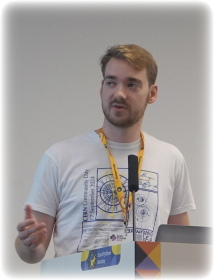
CERN is "the largest particle physics lab in the world
".
There are thousands of people working on site, keeping the facilities
running, including both of them. Thousands of scientists also come to CERN
each year to
run their experiments.
One of the main things that happens at CERN is experiments with particle
collisions. "We take particles, for example protons, we make them go
very very fast and then we smash them together and see what happens.
"
The Large
Hadron Collider (LHC) is used for those collisions, which is the largest
particle accelerator and collider in the world; it is also the largest
machine ever built. The LHC has four hangar-sized detectors that are
effectively large, high-speed cameras to record the collisions so that they can
be reconstructed by the scientists.
Probably the most famous discovery made using the LHC was of the Higgs boson in 2012. It was a missing particle in the standard model of particle physics, which had been theorized to exist since the 1960s. Beyond physics, the World Wide Web was invented at CERN by Tim Berners-Lee in 1989.
"CERN also supports open source and open science, in general.
" All
of the research done there is "open and available to anybody
". In
addition, the organization releases a lot of the tools it develops
internally, such as Indico, as open source; he mentioned the ROOT data-analysis framework and Zenodo data repository as examples. CERN also contributes to various
open-source projects, such as OpenStack and Python. At CERN,
Python is used for everything, Roun said: "web applications, like
Indico, but also desktop applications, machine learning, data analysis, and
just random scripts that bolt everything together
". More information
can be found on CERN's open-source
program office page and the list of
projects in the organization's GitHub
repository.
Indico
With that, he turned over the podium to Hollis, who described Indico as a Swiss Army knife for managing meetings, conferences, and more. Its core is developed at CERN, but there are also lots of contributions from organizations like the United Nations (UN), Max-Planck Institute for Physics, and others.
"It is one of the more popular event-management systems that you probably
never heard about.
" There are more than 300 instances installed
worldwide that the project knows about. Those servers are handling around
350,000 users. The initial adopters were research-oriented, but more
recently there has been adoption by diplomatic users (indico.un.org) and in the tech industry,
such as by Canonical, GNOME, and the Linux Plumbers Conference (LPC). LWN looked at Indico back in 2018 in conjunction
with its adoption by LPC.

Beyond Python and Flask, Indico uses SQLAlchemy for access to its PostgreSQL database. It uses React in its web interface. There is more to the stack, Hollis said, which people can investigate in the project's GitHub repository.
The project has been under development for more than 20 years at this
point. It started as a PHP application called CDSAgenda back in
1999, which used MySQL as its database; it was a "typical LAMP
stack
", which was common in those days. It was developed and
maintained by a small team at CERN for use by the organization.
In the early 2000s, the EU funded development of a "catch-all"
event-management system, which CERN built as Integrated Digital Conference
or InDiCo. It was written in Python, using mod_python and mod_wsgi for the
Apache web server, and the Zope Object
Database (ZODB) for storage. It also "featured a very limited,
home-brewed templating engine
". After a few years of development work,
the first event was hosted, the Computing in High Energy Physics (CHEP)
conference, which became known by project members as "event zero".
EuroPython 2006 was hosted by CERN and was run on InDiCo, as was EuroPython 2007 in
Lithuania.
The name was changed to "Indico" in 2010 or so and the project changed in
other ways. Over the next the few years, it adopted Flask and then started
using Redis for Flask sessions to reduce
the pressure on ZODB. SQLAlchemy and PostgreSQL replaced ZODB in 2014 or
so, though, for a while, they ran in parallel. Users were being stored in
PostgreSQL and events in ZODB, which was "a bit of a mess
". The
home-grown templating engine was replaced with Jinja. Between 2014
and 2017, nearly all of the Python code base, some 200,000 lines, was
rewritten or refactored to remove CamelCase, make it conform to PEP 8 ("Style Guide for Python
Code"), and perform other cleanups. That journey was described on a poster
that Hollis showed.
He quickly went through some of the highlights since 2017, including adding React and a new room-booking interface in 2019. Around 2020, the transition from Python 2 to Python 3 was made. Modernizing OAuth handling and adding support for API access via personal-access tokens, along with some cleanup, was done in 2021. The advent of the GDPR initiated some additional privacy features in 2022, and better document generation using WeasyPrint for things like receipts, statements of attendance, and so on.
There have been some projects that were spinoffs from the Indico work, starting with Flask-Multipass. It allows simultaneously using multiple authentication mechanisms with Flask. It is used in Indico, but is packaged separately so it can be used by any Flask application. It supports many different authentication mechanisms, like OAuth, LDAP, and SAML, as well as lesser-used ones like Shibboleth.
Making it easier to use Flask routes from JavaScript is the focus of the js-flask-urls library. It helps glue together a JavaScript-based frontend to a Flask backend without having to hard-code the Flask URLs. He also noted that the Indico command-line interface can be used to manage various aspects of the instance. "indico shell" is helpful for administrators, but it can also be used when developing Indico features or plugins.
Metrics
Roun returned to the microphone to report on some of the metrics that have
been gathered from the project's Git repository. There is a Linux
Foundation project called CHAOSS,
"which gives you all sorts of different metrics you can actually run on
your open-source project to figure out how you are doing
". The Indico
project is interested in a number of different measures, including the code
evolution in terms of size and languages, amount of legacy code, number of
contributors, its bus factor, and the work-life balance for its
contributors.
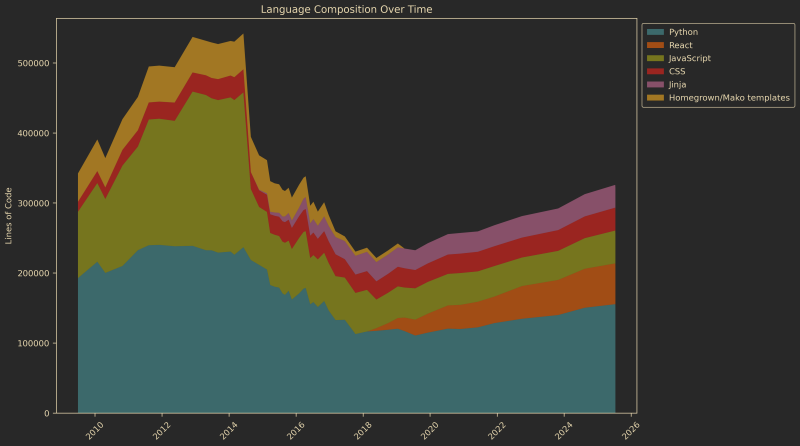
His first graph (seen above from the talk
slides) showed the code base size and languages used over the years since
2009, which is when the project started using Git. One interesting thing
is that the size of the project is about the same now as it was in 2009,
325,000 lines of code or so,
though "we've shipped probably hundreds of features in Indico
" over
that time, he said. That means the project is much more efficient in what
it is able to achieve per line of code, "which I think is quite
cool
". Currently, the project is roughly half Python, with
React, JavaScript, CSS, and Jinja templates making up the rest of it.
Since Indico is over 20 years old, it is going to have some legacy code, Roun said; the project would like to be able to measure the amount of that code. Another useful measure is which modules are not being touched much or at all, which may indicate a lack of knowledge about how they work and concern about breaking things when changes are made. He showed a histogram of the age of all of the lines of code in Indico, which measures how long a line of code stays unmodified in the code.
The average lifetime is
around six years. That's a reasonable number, he said,
"it means we aren't actually rewriting stuff all the time, so we do have
some stable and well-tested code
", but without "too much legacy
code, it's still manageable
". He noted that there is a chunk of code
that has not been touched in 16 years, but it is something that he is
currently rewriting, so that piece of legacy code will largely be gone soon.
His next graphs were of contributors, the first showing steady growth in
the total number of contributors to somewhere close to 200. It shows that,
even with large and somewhat complicated code base, "people are able to
get familiar with it and contribute
". The other graph was a breakdown
by year of existing and new contributors, which showed low-mid teens for
new contributors and 40-50 total contributors over the last five years or
so. The team at CERN is five or six people, so there are quite a few
others who are also working on the tool, both individuals and from
organizations using Indico. He noted that the UN has made quite a few
contributions recently.
There are lots of ways beyond code to contribute to a project, he said,
including documentation, design, artwork, community building, or spreading
the word. Another, that Indico has "been doing quite well
" with, is translations. The
tool is available in more than 15 languages and there are a few more that
are being worked on. Except for French, all of the translations are being
done by volunteers. It is a large job, as there are more than 6,000 phrases
that need to be translated for the project.
He showed a few other graphs, then wrapped up the presentation. Indico has
been through a lot of changes over the last 20 years, Roun said. "We've
changed technologies, frameworks, databases, even programming languages,
and, so, who knows where we're going to be in five, ten, 15 years, but for
sure Indico is going to be around and kicking.
"
Q&A
There was a good bit of time left for questions, starting with one about
why Transifex was chosen for
managing translations over other options. Roun said that the choice was
made long ago, before Weblate "was
as good as it is now
". There have been thoughts about switching to
Weblate, but there are many translation volunteers who are used to
Transifex, so switching would "probably hurt more people than it would
help
"; in addition, the project is happy overall with Transifex.
Another question regarded any regrets that they had about technology
choices that were made along the way. Hollis quickly stepped up to answer:
"This is a personal opinion, but React and the JavaScript
ecosystem
", though it was not clear that he was being entirely serious.
He continued that "there are always mini-regrets when you change
tech
", because there is always something new that others are jumping
onto. The project tries to follow standards of various sorts, but those
standards change over time.
From the audience, Indico lead developer and project manager Adrian Mönnich
said that the choice of ZODB in the early days might be a candidate for
something that was regretted. That choice was made well before his time.
ZODB made it more difficult to change the underlying objects being used
in Indico, since they were stored in what some called a "glorified pickle store
".
The idea was that ZODB made it easy to prototype Indico in the early going
and, on balance, its use allowed the project to make a lot of progress
quickly, so maybe it is not truly a regret, he said.
Another question was about how the installations were tracked and how
communication within the community was done. Hollis said that the forum at talk.getindico.io was a
general-purpose discussion site "for all things Indico
". There is
also a Matrix
channel. Indico instance administrators can choose to enable
telemetry, which is just some simple information that allows the project to
count the number of servers and the Indico version they are running.
The priority given to proposed features was up next; is it based on CERN's
needs or other criteria? Roun said that originally it was all based on
what CERN needed, but that now "the core of Indico is for everybody,
there is no CERN-specific stuff in it
". CERN has some plugins for
functionality it needs, but the rest of the code is meant to take into
account the needs of all Indico users.
[I would like to thank the Linux Foundation, LWN's travel sponsor, for travel assistance to Prague for EuroPython.]
| Index entries for this article | |
|---|---|
| Conference | EuroPython/2025 |
| Python | Applications |
The LWN site is currently under high scraper load, so comment display has been suppressed for anonymous users. If you are a human, you may read the comments by clicking the button below:
Note: you can avoid this step in the future by logging into your LWN account.