

Device-initiated I/O
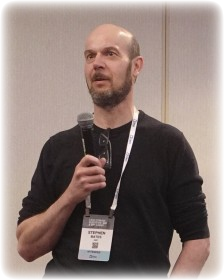
Peer-to-peer DMA (P2PDMA) has been part of the kernel since the 4.20 release in 2018; it provides a framework that allows devices to transfer data between themselves directly, without using system RAM for the transfer. At the 2025 Linux Storage, Filesystem, Memory Management, and BPF Summit (LSFMM+BPF), Stephen Bates led a combined storage, filesystems, and memory-management session on device-initiated I/O, which is perhaps what P2PDMA is evolving toward. Two years ago, he led a session on P2PDMA at the summit; this year's session was a brief update on P2PDMA with a look at where it may be heading.
He began by looking at where P2PDMA is today. It started as an in-kernel API that enabled DMA requests between PCIe devices; one of the first users of the API was the NVMe-over-fabrics target, which allowed data to flow directly into an NVMe drive via remote DMA (RDMA). Access to the feature from user space was added, so that mmap() could be used to map device memory. That capability is being used by some companies, sometimes in conjunction with out-of-tree patches expanding the functionality.
Bates admitted to having stepped away from P2PDMA for a bit due to a job change and other distractions, so he was not entirely sure about the status of the feature in some respects. He wondered about Arm 64-bit support; Christoph Hellwig said that it is supported, which means that architecture support is in pretty good shape, Bates said.
Trying to do P2PDMA in the presence of an I/O memory-management unit (IOMMU) had been difficult, he said, so initially users turned off IOMMUs; that is not required any longer. There are a handful of PCIe features that have gained support, including page request interface (PRI) and address translation services (ATS); those features are meant to improve things but also end up making everything more confusing, he said.
Device initiation
His goal for the session was to talk about "what the next natural
step for peer-to-peer is, and that is device-initiated I/O
". The first
two days of the summit have
been interesting, Bates said; he has been talking with other attendees
about the speed of progress on PCIe devices, as well as the increases in
I/O operations per second (IOPS) on newer
NVMe SSDs. The block layer is also able to do more IOPS, with people
reporting that a "hacked" io_uring can do up to 60-million IOPS per core,
though Bates noted that the exact number should be taken with a grain of
salt, but IOPS are increasing overall.
People are reporting that the NVMe driver can support eight-million IOPS per core, he said, in IOMMU pass-through mode, but Jens Axboe said that his testing shows around 10-12 million IOPS on a particular Threadripper-based system. The numbers vary widely and depend on other factors such as the temperature of the system (thus whether the CPUs are thermally limited), Bates said. The NVMe driver can only sustain around two-million IOPS when establishing a DMA mapping and programming windows into the IOMMU is required. He noted that there were some sessions at LSFMM+BPF about improving the DMA-mapping code, which may help reduce some of that overhead.
But handling eight-million IOPS is consuming an entire CPU core to do the I/O and there are SSDs
coming that can do up to ten-million IOPS. It seems a shame that people are
buying fast, expensive processors that are spending all of their cycles
doing I/O. There are two ways to improve that situation, he said; either
reduce the number of CPU instructions needed per I/O operation or have the
devices themselves issue the I/O. There is an Intel CPU instruction, which
Matthew Wilcox called the "NVMe-queue-submission instruction
", that
might help, though Hellwig pointed out that "number of instructions" is not
necessarily the same as time spent since instructions take a variable
number of cycles.
Since you can already do things like DMA from PCIe devices, Bates said, "an
accelerator or some other kind of I/O device that has enough
intelligence to have code on it that generates NVMe-submission-queue
entries and rings doorbells
" could handle its own I/O—or I/O for other
devices. The smart device would run enough of the NVMe driver to do I/O
requests. He noted a paper
that reported on what NVIDIA and the University of Illinois had done using
GPUs for NVMe I/O, though it was only a proof of concept. Hellwig pointed
out that Mellanox (which is now part of
NVIDIA) had been doing similar things for RDMA well before that paper was
written. Bates said there had been patches for that at one point, but he
did not think they
were merged; Jason Gunthorpe said that the feature was part of a
shipping product at this point.
Bates would like to see an open, vendor-neutral framework for
device-initiated I/O "where anyone who wants to can play in this
space
". He thinks there would need to be a way to request and reserve
NVMe hardware queues as part of that, though Hellwig does not think that is
workable. Bates said that he does not want to take control of the device
completely away from the kernel (as with SR-IOV
or VFIO),
for error-handling reasons and because there may be a need to tie it into
filesystems. The administrative side would also remain in the kernel, he
thought.
If the feature was added, obviously some kind of protection is needed so
that devices cannot simply read and write wherever they want. There
was talk of "protection domains" for NVMe at one point, but he did not
think they were added to the specification. It would be useful for NVMe to
have the ability to restrict the kinds of operations that specific queues
are allowed to do. For example, they might be restricted to using a particular
namespace or a logical-block-address (LBA) range for a namespace. That
way, the controller would "act like a guard if the device got a little
crazy
".
Hellwig said that doing any of that requires a separate NVMe controller that can
be used to shut down misbehaving devices. That is an expensive option,
which is why people are looking for other solutions. Bates said that he is
"not 100% convinced
" that is the only way forward, however.
Another thing that a "naughty device
" might do would be to provide
an invalid destination address for a DMA operation, either maliciously or
mistakenly. Gunthorpe said that IOMMUs already handle that kind of problem
and that code to use them is available in the kernel.
Hellwig went into some detail of what was done for Parallel
NFS (pNFS) that would be applicable for this use case. It requires the
use of layout
leases, which reserve the block layout of the file on the storage medium,
but the lease is revocable by the kernel any time the layout changes. He
said that he and some colleagues are considering writing a paper on using
that technique for GPUs; "you should give us some good hardware and
you'll get a mention
", he said with a laugh.
Bates said that sounded promising as a way forward for device-initiated I/O
and that he had another topic that was slightly different, which he wanted
to discuss in the last few minutes of his slot. There is a large
accelerator company that is claiming that "AI workloads need a lot of
IOPS
", around 200-million IOPS per GPU, which is huge. The I/O
operations are small, less than 512 bytes—less than a block in size—and
the workload is read-only. "Trying to do that via standard NVMe
commands seems very foolish.
"
There is an NVMe base address register (BAR) for a controller memory buffer (CMB) that might be used to allow the AI accelerator to do load and store operations as with persistent memory. CXL has something similar, Bates said. The NVMe buffer could be mapped to a particular namespace or range in a namespace and allow the accelerator to do CXL-like memory accesses to the data. Hellwig said that using the CMB was not the right approach because it would be slow, with too much command overhead; instead the BAR should be used to create a direct mapping from the namespace that is read-only. He used an NVMe device ten years ago that could do that, so a proof of concept is probably easy to put together, but getting it added to NVMe will take longer.
At that point, the conversation split up into several as time expired.
| Index entries for this article | |
|---|---|
| Kernel | NVMe |
| Conference | Storage, Filesystem, Memory-Management and BPF Summit/2025 |
The LWN site is currently under high scraper load, so comment display has been suppressed for anonymous users. If you are a human, you may read the comments by clicking the button below:
Note: you can avoid this step in the future by logging into your LWN account.